

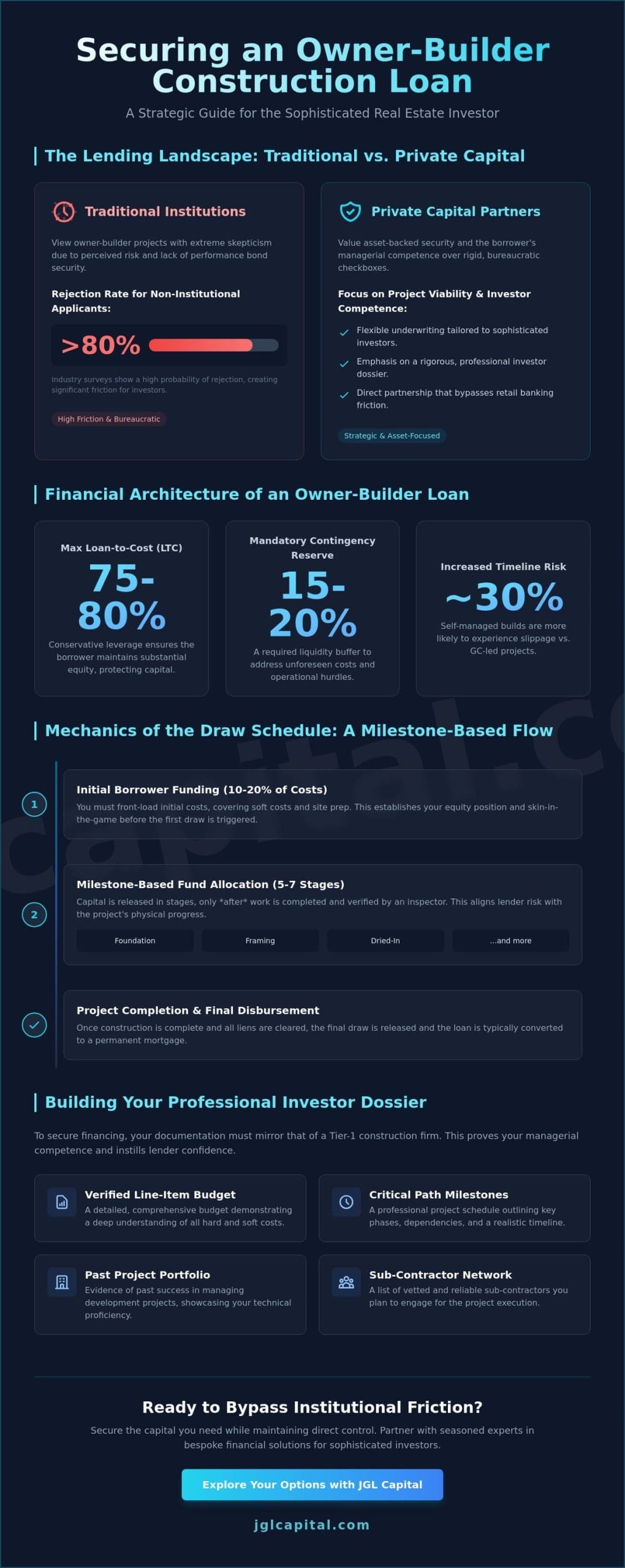
For the sophisticated real estate investor, the traditional requirement of a third-party general contractor often represents an unnecessary layer of capital inefficiency rather than a true risk mitigation strategy. You likely recognize that traditional lending institutions frequently view owner-builder projects through a lens of extreme skepticism, leading to rejection rates that can exceed 80% for non-institutional applicants according to industry surveys. This institutional rigidity often ignores the strategic oversight and technical proficiency that seasoned investors bring to their own developments. Understanding how to get a construction loan without a builder requires more than just a strong balance sheet; it demands a rigorous presentation of your project’s viability to private capital partners who value asset-backed security over bureaucratic checkboxes.
It’s our objective to provide you with the sophisticated financial frameworks and private capital strategies necessary to secure financing while maintaining direct control over your project’s execution. This guide examines the essential documentation required to satisfy institutional-grade lenders and the methods for optimizing your risk-adjusted returns by eliminating traditional overhead. By aligning your project’s structure with the expectations of private capital, you can bypass the friction of retail banking and focus on the disciplined creation of long-term value.
Key Takeaways
- Analyze the specialized financial frameworks of owner-builder instruments and the subsequent redistribution of risk inherent in self-managed construction.
- Gain insight into the cumulative nature of draw schedules and the tactical importance of maintaining initial liquidity for early-phase project funding.
- Evaluate the flexibility of private, asset-based capital as a superior alternative to rigid institutional lending when determining how to get a construction loan without a builder.
- Learn the methodology for developing a rigorous investor dossier, featuring verified line-item budgets and critical path milestones to secure project approval.
- Understand the necessity of a disciplined approach to capital allocation through strategic partnership with seasoned experts in bespoke financial solutions.
The Architecture of Owner-Builder Financing
The owner-builder construction loan functions as a specialized financial instrument designed for investors who possess the technical acumen to oversee their own development projects. Unlike conventional financing, this structure transfers the entirety of operational and completion risk from a third-party general contractor to the borrower. This shift necessitates a rigorous evaluation of the investor’s capability to manage complex capital draws and sub-contractor relationships. Understanding how to get a construction loan without a builder involves recognizing that the lender isn’t just financing a physical asset; they’re underwriting the borrower’s managerial competence.
Traditional institutions often exhibit a calculated hesitation toward these projects because they lack the performance bond security typically provided by established firms. While a standard mortgage loan relies on the appraised value of a finished structure, a construction loan is a dynamic credit facility. Because an estimated 82% of major financial institutions require a third-party contractor to mitigate liability, the self-managed route demands a professional-grade project management plan. This document must mirror the documentation of a Tier-1 construction firm to instill confidence in the credit committee.
Defining the Self-Managed Build
The legal distinction between a licensed contractor and an owner-builder is significant. An owner-builder assumes all fiduciary responsibilities; they’re personally liable for lien releases, site safety, and municipal code compliance. In the current fiscal environment, lenders typically offer a maximum loan-to-cost (LTC) ratio of 75% to 80% for these projects. This conservative leverage ensures that the borrower maintains substantial equity, protecting the institution’s capital allocation against market volatility or cost overruns. High-net-worth investors often prefer this route to maintain absolute strategic oversight of the build quality and material procurement.
The Institutional Perspective on Risk
Lenders prioritize the mitigation of completion risk. This is the statistical probability that a project remains unfinished due to mismanagement or capital exhaustion. Industry data from 2023 indicates that self-managed builds are 30% more likely to experience timeline slippage compared to those led by professional general contractors. To offset this, institutions mandate a 15% to 20% contingency reserve. This liquidity buffer is essential for addressing the unforeseen operational hurdles that arise during the vertical construction phase. A borrower’s technical proficiency is vetted through a review of past project portfolios and a deep dive into their proposed sub-contractor network. Success in learning how to get a construction loan without a builder depends on proving that the project’s execution is not a matter of chance, but a result of disciplined planning.
Mechanics of the Construction Loan Draw Schedule
The execution of a self-managed project requires a profound understanding of how capital flows from the lender to the site. Unlike traditional mortgages where funds are disbursed in a single lump sum, construction financing operates on a cumulative, milestone-based schedule. This structure ensures that the lender’s risk remains aligned with the physical appreciation of the asset. When investors seek to understand How Construction Loans Work, they must prioritize the mastery of the draw cycle. Successfully mastering how to get a construction loan without a builder hinges on your ability to maintain sufficient liquidity to front-load the initial stages of development. Most lenders require the borrower to fund the first 10% to 20% of construction costs before the first draw is triggered. This initial capital injection covers soft costs and early site preparation, establishing the equity position necessary to secure subsequent institutional disbursements.
Milestone-Based Fund Allocation
Lenders typically categorize disbursements into five to seven distinct stages. Common milestones include the completion of the foundation, the structural framing, and the dried-in status where the building is protected from the elements. The reimbursement model dictates that capital is only released after the specific phase is finished and verified. You’ll need to coordinate with subcontractors to ensure their payment schedules align with these lender-defined windows. Misalignment can lead to a 15% to 20% reduction in project IRR if labor stops due to cash flow constraints. The complexity of how to get a construction loan without a builder becomes evident during the reconciliation of these draw requests against actual vendor invoices.
The Inspection and Verification Process
The release of funds is contingent upon a rigorous third-party inspection process. A professional site evaluator, often a licensed engineer or architect, visits the property to confirm that the work matches the submitted draw request. To ensure a seamless cycle, you should maintain a digital repository of all invoices, lien waivers, and permits. Failed inspections often stem from incomplete work or deviations from approved plans, which can delay capital availability by 10 to 14 business days. These delays compound, potentially eroding the projected risk-adjusted returns of the investment. Effective capital management strategies remain essential for maintaining momentum when these administrative hurdles arise. By treating the draw schedule as a primary financial instrument, you protect the project’s solvency and ensure the long-term preservation of your investment capital.
Strategic Advantages of Private Capital for Self-Builds
Institutional lending frameworks often lack the elasticity required for non-traditional project structures. When sophisticated investors analyze how to get a construction loan without a builder, they recognize that private capital provides a streamlined path toward execution. Traditional banks rely on standardized underwriting that prioritizes historical personal income, whereas private lenders focus on the intrinsic value of the real estate asset. This shift allows for rapid capital deployment, which is essential in a market where prime opportunities disappear within 48 hours. By emphasizing project viability, private funding sources act as catalysts for value creation rather than bureaucratic hurdles. This speed of execution is a critical competitive advantage when competing against cash buyers in volatile markets.
Asset-Based Underwriting vs. Traditional Credit
Private capital providers utilize the After Repair Value (ARV) as the primary determinant for loan sizing and risk assessment. This approach contrasts sharply with conventional methods that require exhaustive documentation of personal liquidity and historical earnings. By focusing on the terminal value of the project, lenders eliminate the administrative friction that typically delays construction starts by 45 to 60 days. Most private construction facilities are structured with the following characteristics:
- Terms ranging from 12 to 24 months to accommodate various build cycles.
- Interest-only payment structures to preserve monthly cash flow during the construction phase.
- Loan-to-Value (LTV) ratios based on the future stabilized value of the property rather than current purchase price.
Investors seeking to deploy capital in high-growth regions should review the strategic insights found in this guide to hard money lenders Florida to understand how localized asset valuation drives lending decisions. This localized expertise ensures that the capital allocation remains aligned with regional market trends and exit strategies.
Flexibility in Project Oversight
The collaborative nature of private lending transforms the financier into a strategic partner invested in the project’s success. Traditional institutions often impose rigid draw schedules and permit no deviation from the initial plan without significant penalties or delays. In contrast, private capital offers the agility to modify project scopes as market conditions or physical site requirements evolve. This bespoke financing model accounts for the realities of self-managed builds, where the investor maintains direct control over subcontractors and timelines. It’s a method that prioritizes the delivery of the final asset over adherence to antiquated banking silos. Mastering how to get a construction loan without a builder involves leveraging this flexibility, which often includes a 72-hour turnaround for draw requests, ensuring that capital remains a tool for progress rather than a source of restriction. This disciplined stewardship of capital allows for the alignment of interests between the lender and the borrower, fostering a relationship built on transparency and shared objectives.
How to Qualify: Building the Professional Investor Dossier
Securing capital for self-managed projects requires the assembly of a comprehensive investor dossier that satisfies the analytical rigors of institutional underwriting. When investors seek to understand how to get a construction loan without a builder, they must recognize that the lender is essentially underwriting the investor’s operational capacity as much as the asset’s collateral value. This process begins with the transformation of preliminary estimates into a definitive schedule of values. It’s a shift from speculation to precision. Lenders don’t fund visions; they fund meticulously documented execution strategies.
The Importance of a Detailed Cost Breakdown
Institutional lenders differentiate between soft estimates and hard bids. A viable application requires signed quotes from every major subcontractor, covering mechanical, electrical, and structural systems. This granularity ensures that the loan-to-cost (LTC) ratios remain within the 70% to 80% threshold preferred by private capital sources. Every line item should be verified through current market data. The budget must incorporate a 10% to 15% contingency reserve to absorb price volatility in raw commodities. Documentation for soft costs, such as architectural fees, municipal impact fees, and legal oversight, ensures the total capital stack remains transparent and fully funded from the outset.
Establishing Professional Competence
A track record of successful capital deployment is the most effective tool for mitigating lender anxiety. Investors should provide a portfolio detailing the internal rate of return (IRR) and equity multiples achieved on previous builds or significant renovations. If the investor’s direct experience is limited, engaging a consulting builder or a third-party project manager provides the necessary strategic oversight. This approach is particularly relevant for those pursuing new construction loans for multi-unit or high-specification developments. It demonstrates a commitment to disciplined project management and professional stewardship of the lender’s capital.
- Verified Liquidity: Maintain cash reserves capable of covering at least six months of interest carry and potential cost overruns without compromising the project’s solvency.
- Permit Readiness: Secure all necessary municipal permits and zoning approvals prior to the loan application to eliminate regulatory delays.
- Critical Path Milestones: Develop a project timeline that identifies dependencies. This schedule should show exactly when each phase begins, from site preparation to final certificate of occupancy.
Lenders prioritize stability and analytical depth. They want to see that you’ve anticipated every variable in the development lifecycle. A professional dossier proves that the project is a structured investment rather than a speculative venture. For investors ready to move from planning to execution, JGL Capital offers the strategic capital solutions required for complex, self-managed developments.
Navigating the Path to Closing with JGL Capital
Securing capital for a project where the borrower assumes the role of the general contractor requires a rigorous, disciplined framework. Traditional institutions often hesitate when the standard builder-borrower separation is absent, yet successful execution depends on a lender who understands the nuances of self-managed developments. JGL Capital serves as a sophisticated ally for investors who possess the requisite expertise to oversee their own builds. We provide the institutional-grade support necessary to understand how to get a construction loan without a builder while maintaining the highest standards of financial oversight and risk management.
Tailored Financing for Complex Projects
Our underwriting process is designed specifically for high-stakes investment builds that demand more than a generic lending product. We prioritize the alignment of interests between the lender and the strategic developer, ensuring that every phase of the capital draw schedule reflects the actual progress on the ground. This approach integrates real estate investing as a core component of long-term wealth preservation. By focusing on asset-backed structures, we allow investors to bypass the rigid constraints of retail banking, facilitating projects that others might deem too complex or unconventional for standard portfolios.
The JGL Capital Advantage
With a 30-year track record in capital allocation, our firm offers a level of stability and insight that is rare in the private lending space. We cater specifically to high-net-worth individuals who value discretion and professional excellence. Bespoke capital allocation in the context of construction is the strategic and individualized distribution of financial resources designed to meet the specific risk parameters and liquidity needs of a unique real estate development. This commitment to precision ensures that your capital remains productive throughout the entire lifecycle of the development, from the initial site preparation to the final certificate of occupancy.
The path from planning to completion is defined by meticulous attention to detail. Our streamlined application process focuses on the intrinsic value of the asset and the viability of the project’s exit strategy. This efficiency allows you to focus on the technical aspects of the build while we manage the complexities of the funding mechanism. If you’re exploring how to get a construction loan without a builder, you need a partner who values analytical rigor over marketing hype. To initiate a confidential consultation regarding your upcoming project, please contact our team to discuss your strategic objectives and capital requirements.
- Direct access to decision-makers for rapid underwriting.
- Customized draw schedules aligned with project milestones.
- Expertise in diverse asset classes and complex ownership structures.
- A commitment to long-term stewardship of investor capital.
Architecting Your Path to Independent Project Execution
Mastering the intricacies of how to get a construction loan without a builder requires a sophisticated understanding of capital allocation and the mechanics of the construction draw schedule. Success depends on your ability to present a professional investor dossier that withstands the scrutiny of analytical rigor. By focusing on asset-based underwriting that emphasizes property value and project internal rate of return (IRR), you can navigate the path to closing with confidence. It’s about shifting from a transactional mindset to a strategic partnership that values long-term growth and integrity.
JGL Capital offers over 30 years of strategic expertise in private capital markets, providing the stability and stewardship necessary for institutional-grade investment projects. Our national reach ensures that your project benefits from a disciplined approach to wealth creation, regardless of its location. We’ve built a reputation as a quiet expert, relying on a proven track record rather than speculative trends. Secure your next project with a bespoke construction loan from JGL Capital. Your vision for independent development is achievable with the right strategic ally by your side.
Frequently Asked Questions
Is it possible to get a construction loan if I am acting as my own general contractor?
It’s entirely possible to secure financing as an owner-builder, though it requires a rigorous demonstration of technical competence and project management expertise. Most institutional lenders mandate that owner-builders provide a comprehensive resume detailing at least 5 years of relevant construction experience to mitigate the inherent operational risks. This high level of strategic oversight ensures that the capital allocation remains protected throughout the multi-stage development process.
What are the minimum down payment requirements for an owner-builder loan?
Lenders typically require a minimum down payment of 20% to 30% for projects where the borrower manages the construction. This higher threshold serves as a critical risk-mitigation tool, as the absence of a professional builder increases the project’s complexity. By maintaining a 75% loan-to-cost ratio, the firm ensures that the investor has significant skin in the game, which aligns the interests of the borrower with the long-term viability of the asset.
How do lenders verify progress before releasing funds in a draw schedule?
Progress verification is conducted through a series of 5 to 10 scheduled site inspections performed by a certified third-party professional. These inspectors verify that specific milestones, such as the completion of the building envelope or mechanical rough-ins, have been met according to the approved plans. Only after the inspector submits a formal report does the lender release the next tranche of capital, ensuring that the disbursement of funds corresponds exactly with the physical value added to the site.
Can I use the equity in my land as a down payment for the construction loan?
Utilizing land equity as a primary source of collateral is a standard practice in the industry. If the property has been held for more than 12 months, lenders generally recognize the full appraised value of the land toward the equity requirement. For investors exploring how to get a construction loan without a builder, this strategy allows for the optimization of existing assets to secure the necessary liquidity for the vertical phase of construction.
Do private money lenders require a licensed builder for new construction projects?
Private money lenders offer greater flexibility than traditional banks, though they still prioritize the preservation of capital through strict due diligence. While they don’t always mandate a licensed builder, they often require a 15% to 20% contingency fund to account for potential mismanagement or delays. This institutional approach focuses on the overall risk-adjusted return of the project rather than adhering to the rigid bureaucratic requirements found in conventional retail lending environments.
What happens if the construction costs exceed the original loan amount?
Cost overruns are typically addressed through a pre-funded contingency reserve that accounts for 10% of the total construction budget. If expenditures exceed this reserve, the borrower is responsible for covering the shortfall with personal capital before any further draws are authorized. This disciplined approach to portfolio optimization ensures that the project remains fully funded and prevents the stagnation that can occur when capital allocation is insufficient to meet rising material or labor costs.
How does the interest rate on a self-build loan compare to a traditional mortgage?
Interest rates for self-build loans are generally 1% to 2% higher than those of traditional 30-year fixed-rate mortgages. According to data from the Federal Reserve, they’re considered higher risk, which necessitates a premium to ensure adequate risk-adjusted returns for the lender. Understanding how to get a construction loan without a builder involves acknowledging these higher carrying costs, which are usually structured as interest-only payments during the active construction phase to maintain cash flow.
Can I convert a construction loan into a permanent mortgage after completion?
The conversion of a construction loan into a permanent mortgage is most efficiently executed through a single-close construction-to-permanent loan. This structure allows the loan to automatically transition into a traditional mortgage once the local municipality issues a Certificate of Occupancy. By utilizing this method, investors avoid paying a second set of closing costs, which can range from 3% to 5% of the total loan amount, thereby enhancing the overall financial efficiency of the investment.