

The true cost of capital in a large-scale development project is not a static figure determined at closing, but a dynamic variable that requires constant analytical oversight. For the disciplined developer, the uncertainty of fluctuating draw schedules and the nuances of private capital spreads often present a significant challenge to accurate financial forecasting. A primary concern for any professional investor is how are construction loan interest rates calculated within a shifting economic environment; this knowledge is essential for maintaining the integrity of a project’s pro forma and ensuring long-term value preservation.
It’s a common frustration that traditional financing models often fail to account for the complexities of institutional-grade construction, leaving you to manage unpredictable interest expenses. This article provides a comprehensive exploration of the mechanics behind construction financing, focusing on the benchmark plus spread model and the specifics of interest accrual on drawn funds. We’ll detail the methodology for calculating interest based on projected draw schedules, empowering you to select a strategic ally whose rate structures align with your institutional objectives.
Key Takeaways
- Recognize that interest accrues solely on disbursed capital rather than the total commitment, allowing for a more efficient allocation of resources throughout the development cycle.
- Master the mechanics of how are construction loan interest rates calculated so it’s possible to apply a daily interest factor to the outstanding principal balance with total precision.
- Evaluate your disbursement schedule carefully. The timing of major construction milestones directly dictates your cumulative interest expense.
- Establish robust interest reserves that provide a necessary buffer against unforeseen project delays or fluctuations in benchmark interest rates.
- Leverage the advantages of institutional-grade private capital by partnering with a seasoned ally that prioritizes asset value and professional execution.
Understanding the Fundamental Mechanics of Construction Interest
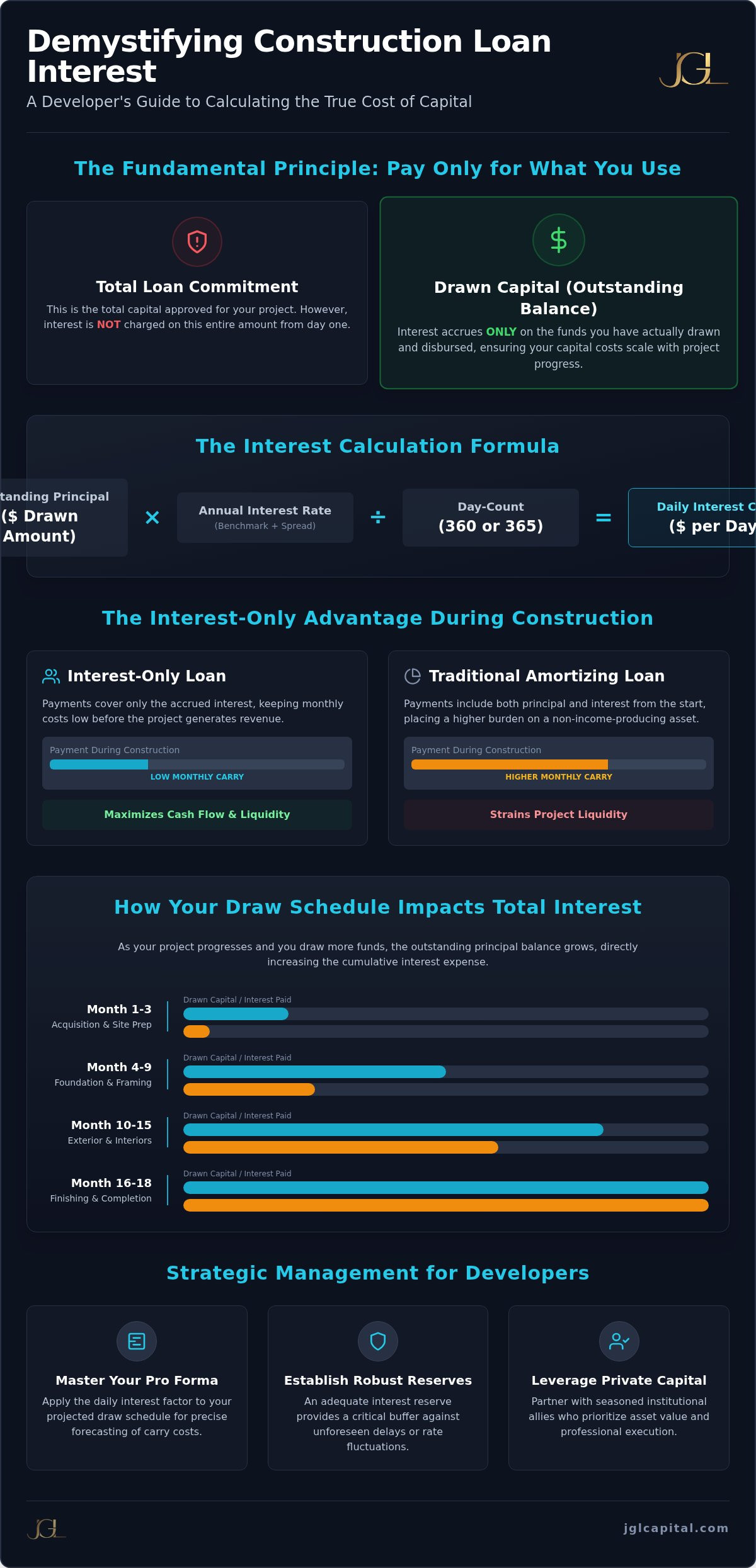
Construction interest operates on a fundamentally different premise than standard commercial term loans or residential mortgages. Rather than amortizing the principal from the outset, these instruments are structured as interest-only obligations that apply strictly to the capital currently deployed. This distinction is vital for sophisticated developers who must maintain high levels of liquidity during the volatile phases of site preparation and vertical construction. When assessing how are construction loan interest rates calculated, one must first recognize that the lender doesn’t charge interest on the total loan commitment from day one. Instead, interest applies to the specific tranches of capital as they’re released through the draw process. This model ensures that the cost of capital remains proportional to the project’s physical progress, effectively shielding the developer from paying for idle funds.
Interest-Only vs. Amortizing Structures
The primary strategic advantage of a construction loan lies in its interest-only (IO) period. Traditional permanent financing requires monthly payments that include both interest and a portion of the principal balance, which can place an undue burden on a project that’s not yet generating revenue. By contrast, the IO phase allows a developer to preserve cash flow for operational contingencies and unexpected material escalations. This structure facilitates a disciplined approach to value creation, where the developer only transitions to an amortizing permanent loan once the asset has achieved stabilization or reached a pre-defined completion milestone. For the sophisticated investor, this distinction isn’t merely a matter of convenience; it’s a fundamental component of maximizing the project’s internal rate of return by deferring principal repayment until the asset is income-producing.
The Concept of the Outstanding Principal Balance
The “drawn” amount serves as the foundational metric for all interest calculations. At the project’s inception, the outstanding principal balance often reflects the initial funding required for land acquisition or the recognized “equity in land” provided by the developer. As the project advances, each successive draw request for labor and materials increases this balance incrementally. Because the interest expense is a product of this growing balance, the velocity of the construction schedule becomes a critical determinant of the total cost of capital. A precise understanding of how are construction loan interest rates calculated allows a project manager to forecast monthly carry costs with greater accuracy, ensuring that the interest reserve remains sufficient through the final certificate of occupancy. This methodical accrual mirrors the institutional standards practiced by specialized entities like JGL Capital LLC, where the focus remains on asset-backed security and professional capital management. By maintaining a clear separation between the total commitment and the active balance, lenders provide the flexibility required for complex, multi-phase developments.
The Calculation Formula: Benchmarks, Spreads, and Daily Accruals
Precision in financial modeling requires a granular understanding of the mathematical framework governing debt service. To determine the exact monthly obligation, one must apply the standard industry formula for daily interest accrual. This methodology involves multiplying the current outstanding principal balance by the annual interest rate, then dividing that product by a day-count convention, typically 360 or 365 days. The resulting figure is the Daily Interest Factor. When analyzing how are construction loan interest rates calculated, it’s essential to recognize that this factor is then multiplied by the number of days in the specific billing cycle. This daily calculation ensures that interest only accrues on the capital that has been formally disbursed to the project. While the difference between a 360 and 365-day year might seem negligible, it represents a subtle increase in the effective interest rate that must be accounted for in institutional-grade projections.
Identifying the Reference Rate (SOFR vs. Prime)
In the current 2026 fiscal environment, the Secured Overnight Financing Rate (SOFR) has solidified its position as the primary reference rate for institutional lending. Unlike the phased-out LIBOR, SOFR is based on actual transactions in the U.S. Treasury repurchase market, providing a more transparent and stable foundation for variable-rate debt. Alternatively, many lenders utilize the Wall Street Journal Prime Rate as a benchmark, particularly for projects with shorter horizons. While these benchmarks reflect broader market conditions, their inherent volatility necessitates that developers build sufficient sensitivity analysis into their projections. It’s often through this benchmark selection that the firm’s strategic alignment with the borrower’s timeline is first established.
Quantifying the Risk-Adjusted Spread
The total interest rate is the sum of the chosen benchmark and a risk-adjusted margin. This margin, or spread, is determined by the lender after a rigorous underwriting process that evaluates the Loan-to-Value (LTV) ratio, the Loan-to-Cost (LTC) ratio, and the developer’s historical performance. The spread represents the lender’s premium for assuming construction-specific risks. Professional developers often find that asset-backed construction financing provides a more predictable spread than traditional bank models, which may fluctuate based on internal credit appetites rather than project-specific merits. By maintaining a disciplined focus on property value and project viability, a sophisticated lender can offer a spread that reflects the true risk profile of the asset rather than the borrower’s personal credit history.
The Impact of the Disbursement Schedule on Interest Expense
The efficiency of capital deployment is inextricably linked to the physical progression of the asset. While the nominal rate remains a constant variable in the loan agreement, the actual dollar amount of interest paid is determined by the velocity and volume of draw requests. Analyzing how are construction loan interest rates calculated reveals that the timing of each disbursement is as critical as the rate itself. Because interest accrues daily on the outstanding principal balance, funds drawn during the initial phases of site work and foundation placement will carry a significantly higher cumulative cost than funds drawn for interior finishes during the final month of the project. A disciplined developer must, therefore, synchronize the draw schedule with the actual construction milestones to ensure that capital is not deployed prematurely, which would otherwise inflate the project’s carry costs without adding immediate value.
How Draw Requests Drive Interest Calculations
The process of funding a construction project involves a series of formal draw requests, each typically preceded by an independent inspection to verify the completion of specific line items. The moment a lender funds a draw, the outstanding principal balance increases, and the interest calculation updates to reflect this new total. This incremental growth creates a compounding effect on the monthly debt service. For example, capital utilized for early-stage framing will accrue interest for the entire duration of the build, whereas capital for landscaping is only subject to interest for the final weeks. This disparity underscores the importance of rigorous budget management and the strategic sequencing of high-cost tranches to optimize the project’s financial efficiency.
The Relationship Between Construction Timelines and Cost
As a project nears completion and the outstanding balance reaches its peak, the “burn rate” of interest becomes a primary concern for the development team. At this stage, even minor schedule slippages can result in substantial financial penalties. Consider the impact of a 30-day delay on a project with an outstanding balance of $1,000,000; the additional interest expense incurred during that month represents a pure loss of equity that cannot be recovered. Strategic utilization of new construction loans allows developers to manage these variables with institutional precision, providing the necessary buffer to navigate the complexities of vertical development. By maintaining a steady construction rhythm, developers minimize the duration of the interest-only period, facilitating a more seamless transition to permanent financing or asset disposition.
Strategic Management of Interest Reserves and Contingencies
A sophisticated credit structure often includes a dedicated interest reserve, which is a specific allocation within the total loan commitment designed to automate debt service during the non-income-producing phases of development. This mechanism serves as a critical risk mitigation tool, ensuring that monthly interest obligations are met without necessitating constant out-of-pocket equity infusions from the developer. When determining the appropriate size of this reserve, lenders perform a detailed analysis of the projected draw schedule and the anticipated interest rate environment. Understanding how are construction loan interest rates calculated is essential for this stage of underwriting, as the reserve must be sufficient to cover the cumulative interest on a growing principal balance over the entire lifecycle of the project. A well-structured reserve provides a sense of security for both the lender and the borrower, allowing the development team to focus on vertical progress rather than monthly capital calls.
Factoring Interest Reserves into the Total Loan Amount
The inclusion of an interest reserve directly influences the project’s Loan-to-Cost (LTC) ratio, as the capitalized interest is treated as a funded project cost rather than a separate operational expense. While funding interest through the loan increases the total debt obligation, it preserves the developer’s liquidity for unforeseen site contingencies or material price escalations. This approach is particularly advantageous in a fluctuating rate environment, where a lender may require a “cushion” within the reserve to account for potential increases in the benchmark rate. By capitalizing these costs, developers can ensure that the project’s pro forma remains intact even if the cost of capital rises slightly during the construction period. For those seeking to optimize their capital stack, asset-backed construction financing offers the flexibility to tailor these reserves to the specific risk profile of the asset.
Mitigating Rate Volatility and Project Delays
The transition to SOFR-based lending has introduced a layer of transparency to construction financing, yet it also requires a disciplined approach to managing benchmark volatility. Institutional lenders often utilize interest rate caps or collars to establish a ceiling on the debt service, protecting the interest reserve from premature exhaustion. If a project encounters significant delays, the “burn rate” of the interest reserve will inevitably exceed the original projections, requiring a rigorous re-forecasting of the remaining capital. In such instances, the developer must be prepared to replenish the reserve or transition to permanent financing more rapidly than initially planned. This strategic foresight is a hallmark of successful real estate investing, where the ability to anticipate and mitigate financial friction is as important as the construction itself. Maintaining a robust contingency plan for the interest reserve ensures that the project remains solvent through the final stages of stabilization.
Navigating Private Capital for New Construction Projects
The selection of a capital partner is as consequential as the architectural design of the project itself. For professional developers, the rigid underwriting criteria of traditional banking institutions often present an obstacle to timely site acquisition and agile project execution. Private capital, by contrast, operates on an institutional framework that prioritizes the intrinsic value of the asset and the viability of the development plan. While a bank might focus on personal credit metrics, a seasoned private money broker evaluates the project’s exit strategy and the developer’s ability to execute. This shift in perspective is particularly relevant when considering how are construction loan interest rates calculated in a private lending context, where spreads are often determined by the specific risk profile of the real estate rather than the borrower’s consumer credit history.
Asset-Backed Evaluation vs. Traditional Credit Metrics
Traditional lenders often struggle to quantify the potential of a complex development, relying instead on standardized credit scores that may not reflect a developer’s true capability. JGL Capital LLC leverages over 30 years of industry expertise to provide asset-backed financing that emphasizes the project’s future worth. By conducting a rigorous analysis of the local market and the proposed improvements, we ensure that the capital stack is aligned with the project’s long-term objectives. For large-scale initiatives, exploring our commercial real estate loans can provide the necessary framework for high-stakes capital allocation. This institutional approach allows for greater flexibility in deal structuring, especially when time-sensitive site acquisitions require immediate certainty of funding.
Customizing Financing for Professional Developers
No two development projects follow an identical trajectory, and a standardized loan product rarely suffices for sophisticated residential or multi-family builds. Customized financing solutions allow for the tailoring of draw schedules and interest reserves to the specific demands of the construction timeline. In many instances, the strategic application of a bridge loan can facilitate the transition between pre-construction activities and the commencement of vertical work. Because how are construction loan interest rates calculated depends so heavily on the timing of capital deployment, these customized structures are essential for maintaining capital efficiency. By partnering with a firm that values analytical rigor and disciplined stewardship, developers can secure the liquidity needed to build lasting legacies. Initiating a consultation for a customized construction capital stack is the first step toward aligning your project’s financial projections with a partner who understands the gravity of professional development.
Optimizing Capital Efficiency for Future Developments
Achieving superior financial performance in vertical development requires a meticulous approach to capital management. By mastering how are construction loan interest rates calculated, you can refine your pro forma projections and ensure that every dollar of debt service contributes to the project’s ultimate value. The transition from theoretical formulas to operational execution relies on a disciplined draw schedule and the strategic deployment of interest reserves to mitigate market volatility. Precision in these calculations isn’t merely a technical requirement; it’s a fundamental component of institutional-grade stewardship.
JGL Capital LLC serves as a seasoned ally for professional investors, offering national coverage and a specialized focus on asset-backed lending. With over 30 years of industry expertise, our firm provides the institutional stability required to navigate complex multi-family and residential projects with confidence. We invite you to Secure Institutional Capital for Your Next New Construction Project and align your vision with a partner dedicated to the preservation and creation of worth. Your commitment to analytical rigor deserves a financing structure that is equally disciplined and transparent. Success in the 2026 landscape belongs to those who prioritize financial clarity from the first draw to the final stabilization.
Frequently Asked Questions
How is the daily interest on a construction loan calculated?
Daily interest is derived by multiplying the current outstanding principal balance by the annual interest rate and dividing that figure by the day-count convention, which is typically 360 or 365 days. This calculation produces the daily interest factor. This factor is then applied to the specific number of days in the billing cycle, ensuring that you only pay for capital that has been formally disbursed to the project site.
Does the interest rate change during the construction period?
Most construction facilities utilize a floating-rate structure that adjusts in response to a benchmark like SOFR or the Prime Rate. As these underlying market indices fluctuate, the total interest rate applied to your drawn balance will shift accordingly. This inherent volatility is a primary reason why institutional lenders require robust interest reserves and contingency planning to maintain the project’s financial stability through its completion.
What is an interest reserve in a construction loan calculation?
An interest reserve is a capitalized portion of the loan commitment set aside at closing to fund monthly debt service payments. When analyzing how are construction loan interest rates calculated, the reserve is sized based on the projected draw schedule and anticipated benchmark movements. This mechanism ensures that interest is paid on time without requiring the developer to provide monthly out-of-pocket cash infusions during the build phase.
Am I charged interest on the entire loan amount from day one?
No, interest is only calculated on the funds that have been physically disbursed, which is referred to as the outstanding principal balance. While the total loan commitment is secured at the time of closing, the capital remains undrawn until specific construction milestones are achieved. This structure preserves project liquidity by ensuring you aren’t paying for idle capital that hasn’t yet been utilized for labor or materials.
How do draw requests affect my monthly interest payment?
Each funded draw request increases the outstanding principal balance, which directly raises the base for your monthly interest calculation. As more capital is deployed into the asset, the monthly interest expense grows incrementally. This relationship underscores the importance of a disciplined disbursement schedule, as early-stage draws for site work will carry a higher cumulative cost than late-stage draws for interior finishes or landscaping.
What benchmarks are currently used for construction loan rates in 2026?
In 2026, the Secured Overnight Financing Rate (SOFR) serves as the predominant institutional benchmark for construction financing. Some private lenders and smaller institutions may still utilize the Wall Street Journal Prime Rate as an alternative reference. These rates provide a transparent foundation for the variable component of your loan, to which a risk-adjusted spread is added based on project-specific underwriting and developer experience.
Can I pay the interest out of pocket instead of using an interest reserve?
Developers can choose to fund interest payments through existing equity rather than capitalizing them into the loan commitment. This approach reduces the total debt obligation and maintains a lower Loan-to-Cost (LTC) ratio throughout the project lifecycle. However, many sophisticated investors prefer the interest reserve model to preserve their liquid capital for unforeseen site contingencies or other high-yield opportunities that may arise during construction.
What happens to the interest rate when the construction is completed?
Once the certificate of occupancy is issued and the project reaches stabilization, the construction loan typically requires repayment or conversion to permanent financing. Permanent loans usually offer longer terms and different rate structures, such as fixed-rate options that provide more predictability than the floating-rate construction phase. Understanding how are construction loan interest rates calculated helps developers plan the optimal timing for this transition to long-term debt.