

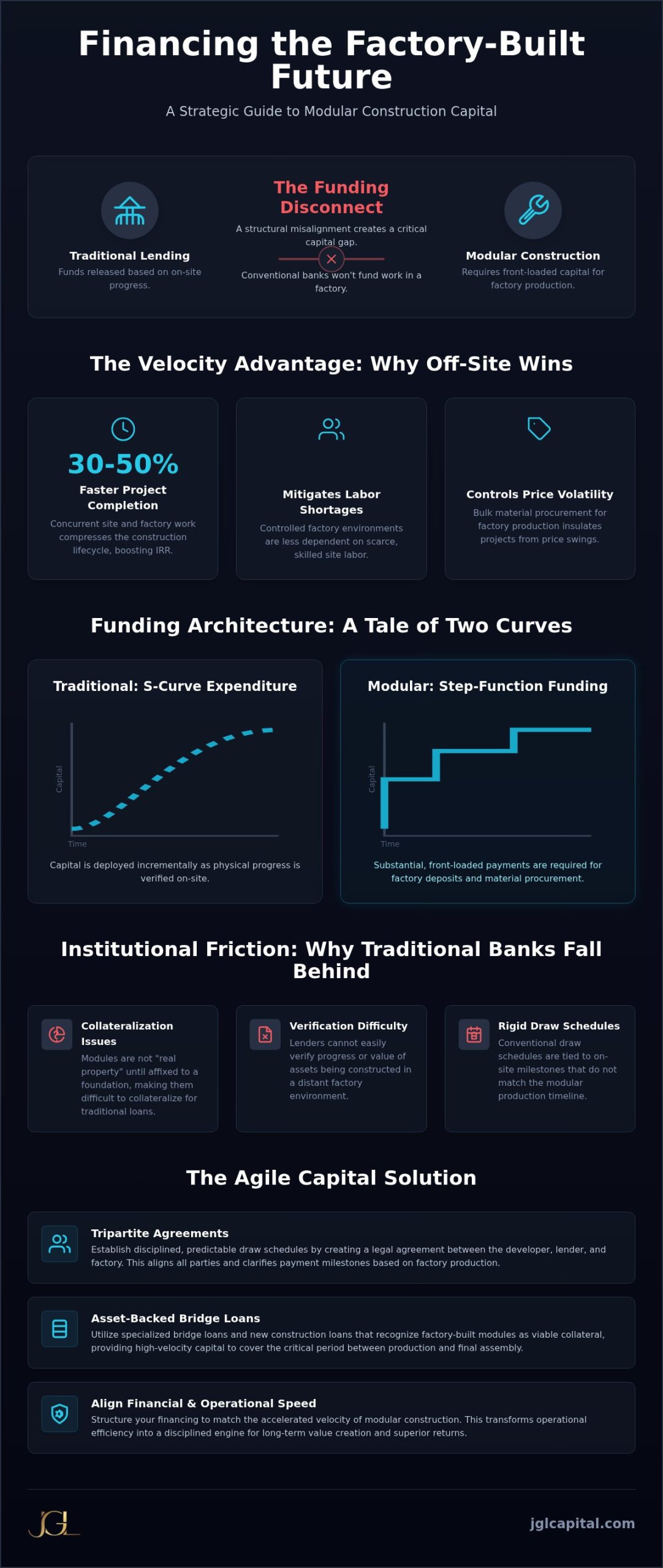
Traditional institutional lending remains fundamentally misaligned with the accelerated velocity and front-loaded capital requirements of modern off-site development. While modular construction can compress project timelines by 30% to 50% compared to traditional site-built methods, this efficiency is frequently undermined by conventional banks that refuse to release funds for work performed within a factory environment. Securing reliable financing for modular or prefab construction requires a sophisticated understanding of how to bridge the structural gap between initial manufacturer deposits and final onsite assembly.
You likely recognize that the primary obstacle to scaling multi-unit developments is not the technology itself, but rather a rigid financial landscape that fails to recognize factory milestones as viable collateral. This guide serves to illuminate the strategic path toward securing agile, high-LTV capital that respects the unique 60/40 cost split typical of volumetric projects. We will analyze methods for coordinating land acquisition with modular delivery, establishing predictable draw schedules that align with factory production, and utilizing specialized bridge loans to preserve project momentum. By aligning your financial structure with your operational speed, you can transform the complexity of off-site construction into a disciplined engine for long-term value creation.
Key Takeaways
- Understand the evolution of prefabricated construction into an institutional-grade asset class that effectively mitigates labor shortages and material price volatility.
- Analyze the specialized financial architecture required for financing for modular or prefab construction, with a focus on managing front-loaded factory deposits and production milestones.
- Identify the structural limitations within traditional banking that complicate the verification of off-site progress and the collateralization of unattached assets.
- Master the implementation of tripartite agreements between developers, lenders, and factories to establish disciplined and predictable draw schedules.
- Leverage asset-backed bridge loans and new construction loans as strategic tools to secure the high-velocity capital necessary for large-scale modular investment projects.
The Strategic Shift Toward Modular and Prefabricated Development
The shift toward off-site construction represents more than a technical evolution; it’s a disciplined response to the structural inefficiencies of traditional labor markets. By 2026, the industry has witnessed a transition where Modular construction is no longer viewed as a niche alternative but as an institutional-grade asset class. Sophisticated developers increasingly pivot to these methods to insulate their capital from the volatility of material pricing and the persistent scarcity of skilled site labor. This transition is essential for those seeking a predictable trajectory in the delivery of multi-family and commercial assets.
Securing appropriate financing for modular or prefab construction requires an analytical understanding of how these technological shifts alter the risk profile of a development. In a landscape defined by rapid housing demand, the ability to control the production environment allows for a level of precision that traditional site-built projects can’t replicate. This control directly translates to financial stability, as it limits the unknowns that typically lead to budget overruns and extended interest carry periods. For professional investors, these efficiencies are the primary catalyst for seeking specialized financing for modular or prefab construction that recognizes the unique milestones of off-site work.
Defining Real Property in Off-Site Construction
Institutional lenders maintain strict distinctions between modular, panelized, and manufactured housing. Modular units are constructed to the same state and local building codes as traditional structures, whereas manufactured homes adhere to federal standards. The legal transition from chattel to real estate collateral occurs precisely when the module is permanently affixed to its foundation. Ensuring that a project meets local standards, such as the 2025 California Building Standards Code that took effect on January 1, 2026, is vital for the eventual transition to permanent financing.
The Velocity Advantage for Investors
The most compelling argument for modular adoption is the compression of the construction lifecycle. By executing site work and factory fabrication concurrently, developers can achieve time savings of 30% to 50%. This acceleration directly enhances project IRR by reducing the duration of high-interest debt. Developers often utilize Bridge Loans or specialized New Construction Loans to cover the critical period between factory production and the securement of permanent financing. In high-density urban markets, this efficiency allows for a faster path to stabilized occupancy and the generation of worth for stakeholders.
Financial Architecture: How Modular Financing Differs from Traditional Builds
Traditional development cycles typically adhere to a linear S-curve expenditure model, where capital is deployed incrementally as physical progress is verified on-site. In contrast, modular projects demand a Step-function funding structure, characterized by substantial front-loaded payments to secure factory production slots and raw material procurement. This divergence creates a structural liquidity crunch for developers who rely on institutional lenders accustomed to conventional draw schedules. Mastering the architecture of financing for modular or prefab construction requires a shift toward a three-pillar funding model that accounts for land acquisition, factory fabrication, and final site assembly as distinct but integrated phases.
The primary challenge in this financial arrangement is the collateralization of assets. Conventional lenders often hesitate to release funds for components that exist only as work-in-progress within a distant factory, as their security interest is traditionally tied to the land and its permanent improvements. To overcome this, sophisticated developers seek out lenders who recognize factory-built modules as viable collateral prior to their arrival on-site. This alignment of strategic objectives ensures that capital remains available when the manufacturer requires it, rather than being gated by site-based inspections that don’t reflect the true state of project completion.
The Mechanics of Asset-Based Underwriting
Asset-based underwriting serves as the cornerstone of this specialized financial approach. Unlike traditional banks that may over-index on borrower credit, seasoned private lenders prioritize the project’s After-Repair Value (ARV) and the operational stability of the chosen manufacturer. This rigor extends to vetting the factory’s financial health and production capacity, ensuring that the capital remains secure even while the assets are not yet attached to a permanent foundation. This meticulous analysis is a hallmark of strategic partnerships that prioritize project viability over rigid institutional checkboxes.
Modular vs. Site-Built: A Cash Flow Comparison
Managing the liquidity requirements of the factory production phase is often the most significant hurdle for developers. While government initiatives like the Modular Housing Development Fund demonstrate an increasing public-sector recognition of these needs, private capital remains the primary driver of agile execution. Integrating new construction loans into the development timeline allows for a seamless transition from factory deposit to site stabilization. By aligning draw schedules with specific production milestones rather than just site inspections, developers can maintain the momentum necessary to realize the velocity advantages of off-site methods. For those seeking to optimize their capital stack, consulting with a strategic bridge financing partner can provide the necessary flexibility to navigate these complex cycles.
Institutional Friction: Why Traditional Banks Struggle with Prefab
Traditional banking institutions operate under a legacy framework that prioritizes physical verification of progress on a specific parcel of land. This site-centric approach creates significant friction when applied to off-site development, as banks often lack the internal mechanisms to inspect and verify work occurring within a factory environment. Because institutional capital is fundamentally risk-averse, the prospect of manufacturer insolvency or logistical disruptions during transit frequently leads to a refusal to release funds until modules are permanently affixed to a foundation. This structural limitation often forces developers to seek alternative financing for modular or prefab construction that accounts for the unique risks of the manufacturing phase.
The misalignment is further exacerbated by the inherent speed of prefabricated methods. While a factory can produce an entire multi-unit development in weeks, a typical institutional underwriting cycle can exceed 60 days. This speed gap effectively neutralizes the primary competitive advantage of modular construction: velocity. For a developer, waiting two months for a bank to approve a draw schedule isn’t just an inconvenience; it’s a strategic failure that increases carry costs and delays market entry. Institutional lending frameworks are simply not designed for the rapid-cycle deployment that modern off-site technology demands.
Private Money as a Strategic Bridge
Utilizing bridge loans allows developers to decouple the land acquisition phase from the factory production schedule. Private capital provides the necessary agility to place manufacturer deposits immediately, ensuring that production slots are secured without the delays of traditional bank underwriting. This transitional capital serves as a disciplined tool for maintaining momentum, allowing for a seamless transition to long-term institutional debt once the asset is stabilized on-site. By prioritizing project viability, private lenders release funds for off-site milestones that traditional banks find too complex to collateralize.
The Role of Asset-Backed Lenders
Sophisticated hard money lenders evaluate modular projects through the lens of asset viability rather than the rigid income-verification hurdles typical of commercial banks. By focusing on the project’s ultimate worth and the integrity of the modular design, these lenders facilitate complex construction cycles that institutional partners find too opaque. This expertise is particularly vital in high-growth markets where the ability to deploy capital rapidly is the defining factor in securing a competitive advantage. Bypassing the friction of traditional financing for modular or prefab construction requires a partner that understands the specialized logistics of the prefab supply chain.
Optimizing Draw Schedules and Risk Mitigation
Effective capital deployment in off-site projects hinges on a meticulously structured draw schedule that synchronizes factory production with capital availability. Unlike site-built projects where draws follow visible ground-up progress, financing for modular or prefab construction requires a nuanced framework that recognizes value creation within a controlled manufacturing environment. A disciplined approach to these milestones ensures that the developer maintains liquidity while providing the lender with the necessary verification of collateral growth.
To achieve this alignment, the development team must follow a rigorous multi-step process for capital management:
- Negotiation of Milestones: The manufacturer agreement must be structured with lender-approved milestones, ensuring that every factory invoice corresponds to a verifiable stage of production.
- Tripartite Agreements: Establishing a formal legal relationship between the developer, the lender, and the factory is essential. This agreement defines the responsibilities of each party and ensures that the lender has a direct path to verify progress.
- Third-Party Inspections: Independent inspectors must be deployed to the factory to certify that specific modules have reached the required state of completion before funds are released.
- The “Set” Draw: A dedicated funding phase must be reserved for the high-intensity logistics of transportation and crane assembly, often referred to as the “set.”
- Site-Work Finalization: The final portion of the capital stack is reserved for site-specific tasks, including utility connections, foundation tie-ins, and interior finish-out.
Mitigating Manufacturer Risk
The concentration of project value within a single manufacturing facility introduces a specific set of risks that must be managed through legal and financial instruments. Performance bonds and comprehensive insurance policies are non-negotiable requirements to protect the investment against factory insolvency or production defects. Developers should also secure a formal security interest in the modules during the production phase, often through UCC filings, to ensure the lender’s collateral remains protected before it is affixed to the land. For substantial deposits, escrow solutions can provide an additional layer of security for all stakeholders.
Managing Logistics and Soft Costs
Financing for modular or prefab construction must also account for “invisible” soft costs that traditional models often overlook. Engineering fees, specialized permitting for transport, and the logistics of moving oversized modules across state lines require early capital allocation. Contingency planning is vital; weather-related assembly delays can rapidly increase carry costs if the crane and set crew are idle. Ensuring that capital remains available for the intensive finish-out phase is the final step in preserving project IRR. To secure a capital partner that understands these operational complexities, developers should consult with JGL Capital LLC to align their funding with factory realities.
Securing Capital: The Path to Modular Execution with JGL Capital LLC
JGL Capital LLC functions as a disciplined steward of capital, specifically engineered to address the liquidity requirements of off-site development. While traditional institutions remain constrained by rigid underwriting protocols that struggle with factory-based milestones, our firm prioritizes the underlying viability of the project and its eventual market worth. This specialized approach to financing for modular or prefab construction ensures that professional developers can maintain the velocity necessary to capture market opportunities without the systemic delays of conventional banking. By focusing on asset-backed underwriting, we provide a stable foundation for projects that require agile, high-LTV capital solutions.
Our commitment to the creation and preservation of value is grounded in over 30 years of industry expertise. JGL Capital LLC recognizes that multi-family and residential modular developments are not merely construction projects; they’re sophisticated technological deployments that require an equally sophisticated financial partner. We provide national coverage for developers who seek to align their capital stack with the rapid cycles of factory production. This alignment of objectives is the hallmark of our strategic approach to financing for modular or prefab construction, allowing for a seamless transition from land acquisition to final site assembly.
The Application and Funding Lifecycle
The transition from capital request to deployment is characterized by analytical rigor and operational speed. Our intake process is streamlined to focus on project feasibility and the property’s After-Repair Value (ARV), allowing us to bypass the protracted income-verification hurdles that often stall institutional approvals. We move with the speed of your project, often moving from initial inquiry to funding in days rather than months. This collaborative stewardship ensures that every draw schedule is meticulously balanced to meet factory milestones while protecting the long-term integrity of the development.
Strategic Alliances for Long-Term Growth
Building a lasting legacy through real estate investing requires more than a transactional lender; it demands a discreet, institutional-grade partner. We frame our activities as a form of high-level strategic alliance, offering highly customized, individual solutions for complex modular builds. This disciplined approach to capital allocation allows our partners to scale their portfolios with confidence, knowing their financing partner understands the nuances of off-site logistics. We invite you to experience a more sophisticated path to project completion by initiating a strategic alliance for your next modular build.
Capitalizing on the Efficiency of Off-Site Construction
The evolution toward modular methodologies offers a definitive path to mitigating labor volatility and compressing development cycles, provided that the underlying financial structure is as innovative as the construction technology itself. By implementing a disciplined framework for draw schedules and tripartite agreements, developers can successfully bridge the gap between factory production and site stabilization. Professional investors must move beyond the constraints of traditional banking to secure specialized financing for modular or prefab construction that recognizes the unique value of off-site milestones. It’s essential to partner with a firm that understands the velocity of your production schedule rather than one that hinders it with outdated underwriting requirements.
JGL Capital LLC provides the analytical rigor and institutional stability required for these high-stakes projects. With 30+ years of private money expertise and national funding capability for residential and multi-family developments, we prioritize project viability through asset-based underwriting with no income verification required. We invite you to Secure Your Modular Construction Capital Today and transform the complexity of off-site development into a predictable engine for long-term growth. Your vision for a more efficient built environment deserves a financial ally that matches your ambition with disciplined, strategic action.
Frequently Asked Questions
Can I get a hard money loan for a modular home project?
Yes, asset-backed private money is frequently the most effective vehicle for these developments because it prioritizes the project’s viability and eventual market value over traditional borrower credit metrics. Professional developers utilize these loans to navigate the rapid cycles of factory production that institutional lenders often find too complex to underwrite. This flexibility allows for a disciplined deployment of capital that respects the unique logistics of off-site manufacturing.
How do draw schedules work for modular construction financing?
Draw schedules for financing for modular or prefab construction are structured around specific manufacturing and assembly milestones rather than incremental site progress. Capital is typically deployed in stages that include the initial factory deposit, verified production phases within the facility, and the final “set” once modules are transported to the site. This approach ensures that funding remains synchronized with the actual value creation occurring within the controlled factory environment.
What is the difference between financing a modular home and a manufactured home?
Modular homes are constructed to the same state and local building codes as traditional site-built structures, which allows them to be treated as real property for lending purposes once permanently affixed to a foundation. Manufactured homes are built to federal HUD standards and are often classified as personal property unless specific legal steps are taken. Institutional and private lenders view modular assets as institutional-grade collateral, whereas manufactured housing often requires specialized chattel financing.
Do I need to own the land before applying for prefab financing?
Ownership of the land is not a strict prerequisite for initiating a capital request, as Land Loans can be integrated into the overall funding strategy. Many developers choose to coordinate land acquisition simultaneously with the securement of construction financing to optimize their capital stack. Aligning these two phases ensures that site preparation and factory production can proceed concurrently, maximizing the velocity advantage inherent in prefab methods.
Can I use a bridge loan to fund the factory deposit for my modular build?
Bridge Loans serve as a vital strategic tool for bridging the gap between the substantial initial deposits required by manufacturers and the securement of long-term debt. This transitional capital allows developers to secure production slots immediately, preserving project momentum while traditional institutional underwriting is still in progress. By utilizing high-velocity private money for these front-loaded costs, you can ensure that the manufacturing phase begins without unnecessary delays.
Why do traditional banks often refuse to fund off-site construction milestones?
Traditional banks are structurally misaligned with off-site methods because their risk-management frameworks rely on physical inspections of work performed on a specific parcel of land. They often struggle to collateralize assets that are located in a distant factory and not yet attached to a permanent foundation. This institutional friction frequently creates a liquidity crunch for developers, necessitating the use of specialized financing for modular or prefab construction that recognizes factory-built components as viable collateral.
What are the minimum requirements for an asset-backed modular construction loan?
The primary requirements center on the project’s After-Repair Value (ARV) and the operational stability of the chosen manufacturer. Lenders conduct a rigorous analysis of the project’s feasibility, including the manufacturer’s financial health and the precision of the proposed draw schedule. While borrower credit is considered, the emphasis remains on the disciplined stewardship of the asset and the generation of worth through a successful build-out.
How does modular construction affect the appraisal and ARV of a property?
Modular construction generally has a neutral or positive impact on property appraisals, as these structures are built to the same rigorous standards as site-built homes. Once the modules are permanently affixed to the foundation, appraisers utilize the same comparable sales methodology used for traditional real estate. The accelerated timeline of modular projects can actually enhance the project’s financial profile by reducing the duration of interest carry and allowing for a faster path to stabilized occupancy.