

In the current environment of institutional credit contraction, the bridge loan for real estate investment has evolved from a secondary recourse into a sophisticated instrument for strategic capital allocation. While traditional regional banks often impose 90 day closing cycles, sophisticated investors recognize that such delays represent a significant opportunity cost in a competitive market. It’s a reality that the most lucrative, time-sensitive acquisitions demand a level of agility that credit-based underwriting simply cannot provide.
You’ve likely found that the rigid requirements of conventional lenders often impede your ability to stabilize distressed assets or expand a high-performing portfolio. This guide provides the analytical framework necessary to master bridge financing, ensuring you can secure swift, asset-backed capital to optimize your investment strategy. We’ll examine the technical nuances of SOFR-benchmarked pricing, currently yielding rates between 10% and 12% for investment properties, and explore how bespoke lending structures allow for capital deployment in as little as seven business days.
Key Takeaways
- Distinguish institutional-grade transitional capital from consumer swing loans to ensure your financing structure aligns with high-stakes investment objectives.
- Master the technical mechanics of asset-based underwriting by prioritizing Loan-to-Value and After-Repair-Value metrics over traditional credit-based constraints.
- Identify strategic deployment opportunities for a bridge loan for real estate investment, including the stabilization of multi-family assets and the acquisition of distressed properties.
- Reframe interest rates as a manageable project expense by calculating the potential ROI gained from rapid capital deployment versus the costs of institutional delay.
- Evaluate the long-term advantages of a partnership focused on stewardship and bespoke financial solutions to facilitate disciplined portfolio expansion.
Defining Bridge Loans within Professional Real Estate Investment
Professional real estate investment demands a level of agility that traditional banking institutions, often constrained by regulatory inertia, simply cannot provide. Within this context, the bridge loan for real estate investment functions as a high-velocity capital allocation tool designed to facilitate the acquisition of assets during critical transitional phases. While retail-facing products like “swing loans” focus on personal residential transitions, institutional bridge financing serves as a sophisticated mechanism for professional investors to secure properties that are currently non-stabilized or require immediate capital injection. This distinction is vital; it’s the difference between a simple consumer convenience and a rigorous investment strategy that prioritizes the alignment of interests and long-term value creation.
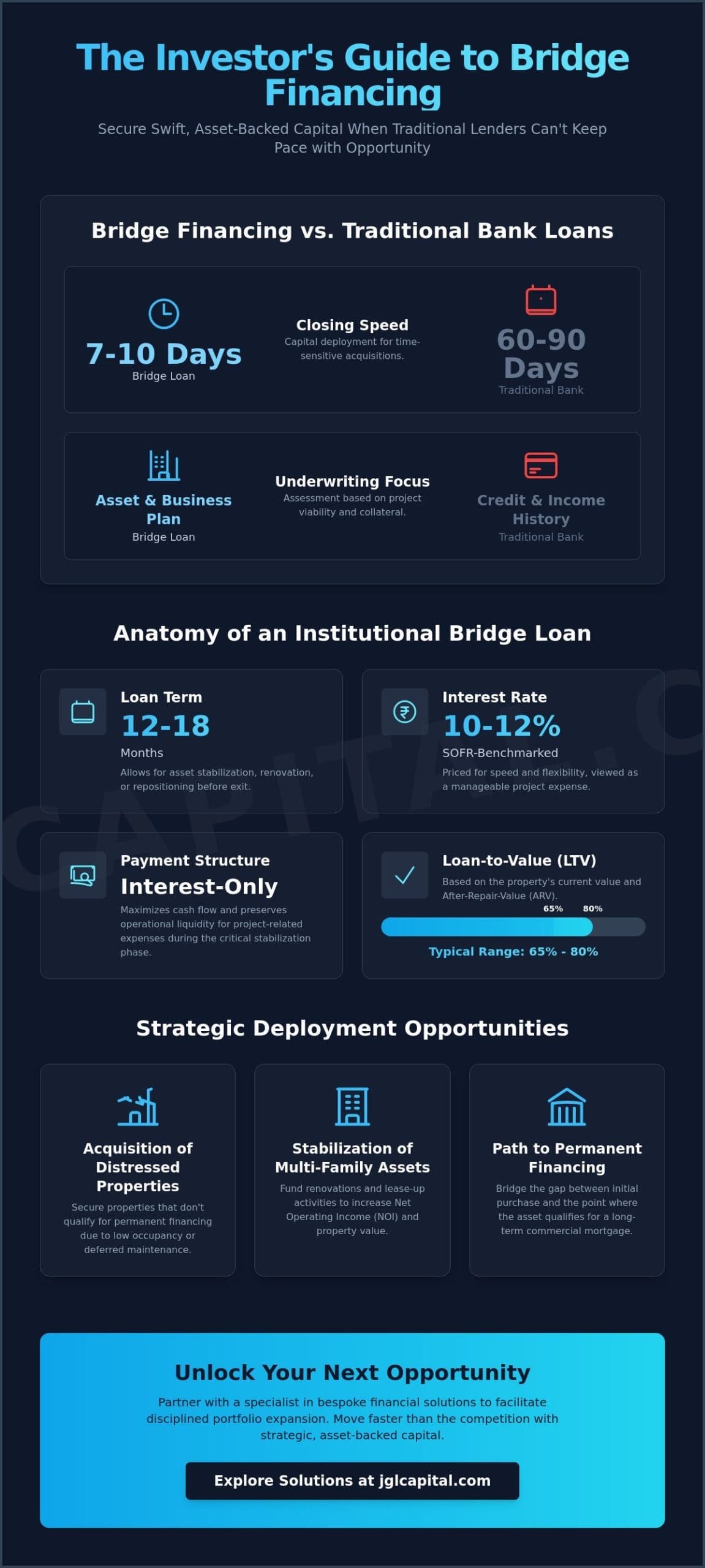
A foundational bridge loan overview reveals that these instruments are characterized by their short-term duration, often ranging from 12 to 18 months, and their interest-only payment structures. These features aren’t accidental; they’re strategically engineered to maximize cash flow during the critical early stages of a project. Speed of execution often takes precedence over the absolute cost of capital, as the ability to close a transaction within 7 to 10 business days can be the deciding factor in securing a high-yield opportunity in a fragmented market. The fundamental characteristics of these loans include:
- Duration: Typically 12 to 18 months to allow for asset stabilization or renovation.
- Payment Structure: Interest-only payments to preserve operational liquidity for project-related expenses.
- Deployment Speed: Rapid closing timeframes, frequently within 10 business days, bypassing the 60 to 90 day delays of conventional lenders.
The Role of Bridge Financing in Capital Stacks
Bridge financing acts as a vital layer within a diversified capital stack, allowing for the optimization of risk-adjusted returns during the stabilization period of an asset. It’s particularly effective for properties that don’t yet qualify for permanent financing due to low occupancy, deferred maintenance, or structural vacancies, making the bridge loan for real estate investment an essential component of modern portfolio management. By utilizing transitional debt, an investor can bridge the gap between the initial purchase and the point where the property generates sufficient net operating income to support a long-term commercial mortgage. A disciplined investor must always maintain a clearly defined exit strategy, whether through traditional refinancing or an asset disposition, to ensure the long-term stewardship of capital and the preservation of equity.
Asset-Backed vs. Traditional Mortgage Structures
Within the discipline of private lending, the focus shifts from the borrower’s personal credit history to the intrinsic value of the collateral and the feasibility of the professional business plan. This collateral-based risk assessment allows for greater flexibility, prioritizing the property’s potential and the borrower’s experience over rigid income-to-debt ratios found in traditional banking. Lenders provide strategic oversight by evaluating the asset’s current state and its projected value post-stabilization, ensuring that the capital allocation remains secure throughout the project lifecycle. Bridge financing serves as a strategic tool for capital preservation during property transitions.
Mechanics of Institutional Bridge Loan Underwriting
The underwriting methodology utilized by institutional private lenders represents a fundamental departure from the credit-centric models favored by traditional depository institutions. While regional banks often focus on personal debt-to-income ratios and historical credit scores, a sophisticated provider of a bridge loan for real estate investment prioritizes the intrinsic value of the underlying asset and the projected risk-adjusted returns of the specific project. This asset-based approach centers on the Loan-to-Value (LTV) ratio, typically ranging from 65% to 80% of the property’s current value, alongside the After-Repair-Value (ARV) for projects involving significant renovation. By anchoring the underwriting in collateral rather than personal financial history, lenders can offer a more flexible and realistic assessment of a project’s viability.
A rigorous due diligence process ensures that every capital allocation is grounded in analytical certainty. Beyond the physical appraisal, specialized lenders conduct a comprehensive evaluation of the investor’s track record and professional experience. This scrutiny isn’t merely a bureaucratic requirement; it’s a form of strategic oversight intended to confirm that the borrower possesses the operational capacity to execute the proposed business plan. Investors seeking to navigate these complexities benefit from a partnership grounded in strategic oversight and a shared commitment to long-term value creation. The goal is to establish a synergy between the lender’s capital and the developer’s expertise, ensuring that the exit strategy is both realistic and attainable within the condensed loan term.
Evaluating Collateral and Property Potential
Property type significantly influences the structure of bridge financing, as the risk profiles of new construction loans differ substantially from those of stabilized multi-family assets. Underwriting for ground-up development requires a meticulous review of construction budgets, entitlement status, and environmental reports to mitigate potential downstream liabilities. Conversely, bridge financing for existing assets often focuses on the speed of stabilization. Lenders prioritize assets with clear value-add potential, where a disciplined injection of capital can rapidly improve the property’s net operating income and overall market position.
The Private Money Advantage: Speed and Flexibility
The most compelling advantage of private money is the compression of the funding cycle, which allows investors to bypass the 60 to 90 day delays common in traditional banking. Institutional bridge lenders often close transactions within 7 to 10 business days, providing a critical competitive edge in time-sensitive acquisition scenarios. This speed is complemented by the ability to customize loan terms to align with specific project milestones, such as interest reserves or flexible draw schedules for renovations. By providing bespoke financial solutions, private lenders empower developers to secure distressed assets and capitalize on market inefficiencies that traditional institutions are simply too slow to address.
Strategic Use Cases for Real Estate Bridge Financing
The strategic deployment of transitional capital is best understood through its application in institutional-grade projects where speed and flexibility are paramount. While retail narratives often limit these instruments to simple residential contingencies, the professional bridge loan for real estate investment serves as a primary engine for asset repositioning and portfolio expansion. By providing immediate liquidity, these loans allow developers to capitalize on market inefficiencies, such as undervalued commercial properties or distressed multi-family units, that require a period of stabilization before qualifying for long-term, permanent financing structures.
Beyond simple acquisition, bridge financing facilitates a disciplined approach to capital allocation during the most volatile phases of a project’s lifecycle. Whether an investor is managing the complexities of ground-up development or the rehabilitation of a neglected urban asset, the ability to deploy capital rapidly ensures that momentum isn’t lost to bureaucratic delays. This agility is particularly critical in competitive urban markets where the window for securing a high-yield asset is often measured in days rather than months.
Maximizing Fix-and-Flip Profitability
For investors focused on high-velocity asset turnover, managing cash flow across multiple simultaneous projects is a significant operational challenge. Utilizing fix and flip loans allows developers to leverage their equity more effectively, ensuring that capital isn’t trapped in a single project while other opportunities emerge. The synergy between rapid market cycles and short-term debt allows for a higher volume of transactions, which, when executed with analytical rigor, leads to superior risk-adjusted returns. Balancing this leverage requires a precise understanding of project timelines, as the goal remains the swift execution of the renovation plan to trigger a profitable exit or a transition to long-term rental financing.
Stabilizing Multi-Family and Commercial Assets
Transitional debt is often the most effective tool for achieving the occupancy rates and net operating income required to satisfy the underwriting standards of permanent institutional lenders. When acquiring a multi-family property with high vacancy or deferred maintenance, investors often face a “gap” where traditional Debt Service Coverage Ratio (DSCR) requirements cannot be met. Navigating the complexities of commercial real estate loans during this stabilization phase requires a partner who understands the long-term value creation plan. By bridging this gap, the investor can complete necessary improvements and secure a stable tenant base, eventually transitioning the short-term debt into a permanent mortgage once the asset’s performance is fully optimized. This methodical approach ensures capital preservation while building a legacy of high-performing real estate assets.
Analyzing the Cost of Capital: ROI vs. Interest Rates
Sophisticated capital allocation requires a shift in perspective from viewing interest rates as a punitive cost to recognizing them as a strategic project expense. While conventional retail lenders emphasize low-coupon debt, they often ignore the substantial opportunity costs associated with their 60 to 90 day underwriting cycles. A bridge loan for real estate investment, typically priced between 10% and 12% for investment properties in the current 2026 market, provides the liquidity necessary to capture value-add opportunities that would otherwise be lost to more agile competitors. When the Secured Overnight Financing Rate (SOFR) sits at 3.60%, the spread on transitional debt reflects a premium for the speed and certainty that institutional partners require.
The true cost of capital must be measured against the projected risk-adjusted returns of the asset. Beyond the interest rate, investors must account for origination fees, which generally range from 1.5% to 3% of the loan amount. While these figures appear higher than traditional mortgages, they facilitate a high-leverage environment where equity can be deployed across a broader portfolio. A disciplined analysis often reveals that the cost of “waiting” for a bank—measured in missed appreciation and delayed cash flow—far exceeds the incremental interest paid on a short-term bridge facility. Secure your next acquisition with a bespoke capital allocation strategy designed for institutional-grade performance.
The ROI Framework for Bridge Debt
Calculating the profitability of a project requires a side-by-side comparison of the capital stack with and without transitional financing. The ability to execute a closing within seven business days often empowers investors to negotiate purchase price discounts that significantly outweigh the annualized interest expense of the debt. This “speed discount” serves as an immediate boost to the project’s equity position. Additionally, because these loans are structured for business purposes, the interest expenses are typically deductible as a legitimate investment expense, further optimizing the net return on investment. Professional stewardship of these funds ensures that every dollar of debt is working toward the eventual stabilization of the asset.
Exit Strategies and Refinancing Risks
A disciplined investor never enters a short-term debt obligation without a primary and secondary exit strategy. The risk of loan maturity in a fluctuating interest rate environment necessitates a robust “Plan B,” such as a pre-negotiated extension or an alternative liquidity source. In periods of market volatility, the role of hard money lenders becomes critical, as they provide the bridge to the bridge, ensuring project continuity when traditional refinancing markets tighten. Mitigating these risks requires constant strategic oversight and a deep understanding of benchmark rate movements, ensuring the transition from bridge capital to permanent financing is both seamless and predictable.
Partnering with JGL Capital for Bespoke Financing Solutions
Choosing a bridge loan for real estate investment requires more than a cursory review of interest rates; it demands a partnership with an entity that understands the gravity of high-stakes financial management. JGL Capital brings over 30 years of expertise in private money and capital allocation, positioning our firm as a disciplined steward of our partners’ interests. We don’t operate as transactional brokers; instead, we function as strategic allies who prioritize long-term growth and integrity. Our methodology is grounded in analytical rigor, ensuring that every financing structure we deliver is precisely tailored to the strategic objectives of our institutional and high-net-worth partners.
The JGL Capital process is designed for efficiency without sacrificing the thoroughness of professional due diligence. From the initial consultation, our principals engage in a deep analysis of the asset’s potential and the developer’s track record. This disciplined approach allows us to move from a mission-critical request to rapid funding with a speed that traditional institutions cannot replicate. By maintaining a steady and measured communication rhythm, we ensure that our partners are informed at every stage of the capital deployment process, fostering a sense of security and stability in even the most complex acquisition scenarios.
A Portfolio of Specialized Lending Programs
The firm provides access to a diverse range of capital solutions that extend far beyond standard bridge facilities. Our programs include sophisticated new construction loans specifically engineered for residential and multi-family developers who require flexible draw schedules and interest-only structures. By accessing national capital markets through a single, disciplined point of contact, our partners benefit from bespoke solutions across various asset classes. Whether you’re stabilizing a multi-family complex or repositioning an undervalued commercial property, our tailored bridge solutions provide the necessary liquidity to execute your vision while preserving your equity position.
Initiating Your Next Strategic Acquisition
Proactive engagement with a lending partner is a hallmark of the sophisticated investor. By involving JGL Capital at the earliest stages of a transaction, you benefit from our strategic oversight during the due diligence phase, allowing for a more precise articulation of the project’s risk-adjusted returns. Our principals are available to discuss your specific capital requirements and how our institutional-grade financing can be integrated into your broader portfolio optimization strategy. We invite you to contact our office to explore how a disciplined partnership can facilitate your next strategic acquisition and contribute to a lasting legacy of value creation.
Optimizing Portfolio Growth through Strategic Capital Allocation
Mastering the complexities of transitional financing requires a shift from transactional thinking to a long-term strategy of value creation. You’ve seen how a bridge loan for real estate investment serves as more than a temporary fix; it’s a precise instrument for capturing market inefficiencies and stabilizing non-performing assets. By prioritizing asset-based underwriting and rapid deployment, you can bypass the structural delays of traditional banking and maintain the momentum necessary for professional portfolio expansion.
JGL Capital remains a disciplined steward for institutional partners, offering over 30 years of industry-leading expertise and a national reach with bespoke, asset-backed solutions. Our principals are dedicated to the preservation of your capital through every property transition. We invite you to partner with JGL Capital for your next strategic real estate acquisition to secure the agility your portfolio demands. The right capital partner doesn’t just provide funding; they provide the strategic oversight required to build a lasting legacy in a competitive market. It’s time to leverage professional capital to realize your project’s full potential.
Frequently Asked Questions
What is a bridge loan for real estate investment?
A bridge loan for real estate investment is a specialized, short-term financing instrument designed to provide transitional capital for professional property acquisition and stabilization. Unlike conventional mortgages that rely on personal credit, these loans are asset-backed and prioritize the property’s intrinsic value and the feasibility of the investor’s business plan. This structure allows for rapid capital deployment, often within 7 to 10 business days, ensuring that time-sensitive opportunities aren’t lost to traditional banking delays.
How much does a bridge loan typically cost for a property investor?
Current market data for May 2026 indicates that interest rates for investment property bridge loans typically range from 10% to 12%. These rates are generally benchmarked against the Secured Overnight Financing Rate (SOFR), which sits at 3.60%. Investors should also budget for origination fees between 1.5% and 3% of the loan amount, along with common points ranging from 1.5 to 2.5, reflecting the premium for speed and flexible underwriting.
Can I get a bridge loan for an investment property with poor credit?
Yes, because institutional bridge financing is primarily asset-based rather than credit-based. Lenders focus on the property’s Loan-to-Value (LTV) ratio and the borrower’s professional track record instead of personal debt-to-income metrics. While a seasoned background is preferred, the strength of the collateral and a robust exit strategy are the primary drivers of the underwriting decision, allowing investors with credit challenges to secure necessary capital for viable projects.
What is the typical duration of a real estate bridge loan?
The standard duration for these transitional facilities ranges from 12 to 18 months. This timeframe is specifically engineered to provide sufficient liquidity for property renovations, lease-up periods, or the achievement of stabilization milestones. Some lenders may offer a one-time extension, such as the three-month provision recently introduced in some state legislations, to ensure the project reaches a point where it qualifies for permanent institutional refinancing or disposition.
How does a bridge loan differ from a hard money loan?
While both are asset-based, bridge loans are often viewed as a more institutional form of transitional debt used for multi-family or commercial stabilization. Hard money loans are frequently associated with high-velocity, distressed residential acquisitions where speed is the only priority. Bridge financing typically offers more sophisticated underwriting and slightly more favorable terms for experienced developers who have a clear path to permanent financing or asset sale.
What are the most common exit strategies for bridge financing?
The primary exit strategy involves refinancing the bridge debt into a long-term, permanent commercial mortgage once the asset reaches a stabilized occupancy level. Another common approach is the strategic sale of the property after the value-add renovations are complete. A disciplined investor must have a clearly defined “Plan A” and “Plan B” to ensure the timely repayment of the capital and the preservation of project equity.
Are bridge loans available for commercial real estate developments?
Yes, bridge financing is a vital tool for commercial repositioning and ground-up development projects that don’t yet qualify for traditional funding. They provide the early-stage capital necessary for site preparation, entitlements, or the renovation of undervalued office and retail spaces. By bridging the gap to stabilization, these loans allow developers to optimize the asset’s net operating income before seeking long-term, institutional-grade debt from regional or national banks.
What documents are required to secure an asset-based bridge loan?
Securing a bridge loan for real estate investment requires a comprehensive project executive summary and a detailed renovation budget or business plan. Lenders also demand a professional property appraisal to establish the current value and the projected After-Repair-Value (ARV). Additionally, investors must provide evidence of their professional experience and a documented exit strategy to demonstrate the project’s viability and ensure a proper alignment of interests with the lender.