

Could mezzanine financing fill a development capital gap while creating new repayment and coordination challenges? When senior debt falls short, another source of capital may reduce the amount of additional sponsor equity needed. But it can also increase repayment pressure and introduce control and intercreditor considerations. Evaluating commercial real estate development loans means looking beyond the amount available to understand how each layer affects project costs, obligations, and the planned exit.
Mezzanine financing generally sits between senior debt and equity, but its repayment priority, security, and rights depend on the transaction documents. Its fit turns on the complete cost, the negotiated terms, and whether the project’s business plan supports repayment at the intended exit. This guide compares mezzanine financing with senior debt and preferred equity, explains what to examine in repayment and intercreditor terms, and outlines the information to organize before making a financing request. JGL Capital LLC is a private-money broker and capital advisor, not a lender. It helps borrowers organize financing requests and identify prospective capital sources.
Key Takeaways
- Compare mezzanine financing with other capital sources by weighing its full cost, repayment demands, and negotiated rights against the project’s objectives.
- Assess whether the proposed structure fits the development budget, schedule, cash flow, sponsor liquidity, and planned exit.
- Prepare a focused request for commercial real estate development loans with a clear project narrative, budget, schedule, property details, and supporting documents.
- Organize transaction details, capital commitments, collateral information, sponsor financials, timing, and exit assumptions before discussing financing.
What Is Mezzanine Financing for Real Estate Development?
Mezzanine financing is a potential layer of capital between senior debt and a developer’s or sponsor’s equity in a business-purpose real estate project. A developer may consider it to address a funding gap, but the repayment position and rights depend on the transaction and governing documents. It is business-purpose financing, not consumer or owner-occupied mortgage financing.
For developers evaluating commercial real estate development loans, this distinction matters: adding a capital layer changes more than the total funds available. It may affect repayment priorities, decision-making rights, and the working relationship among capital providers. The overview of Mezzanine Capital describes its general position between debt and equity. The project’s actual structure, however, is determined by its agreements.
Where mezzanine financing sits in a development capital stack
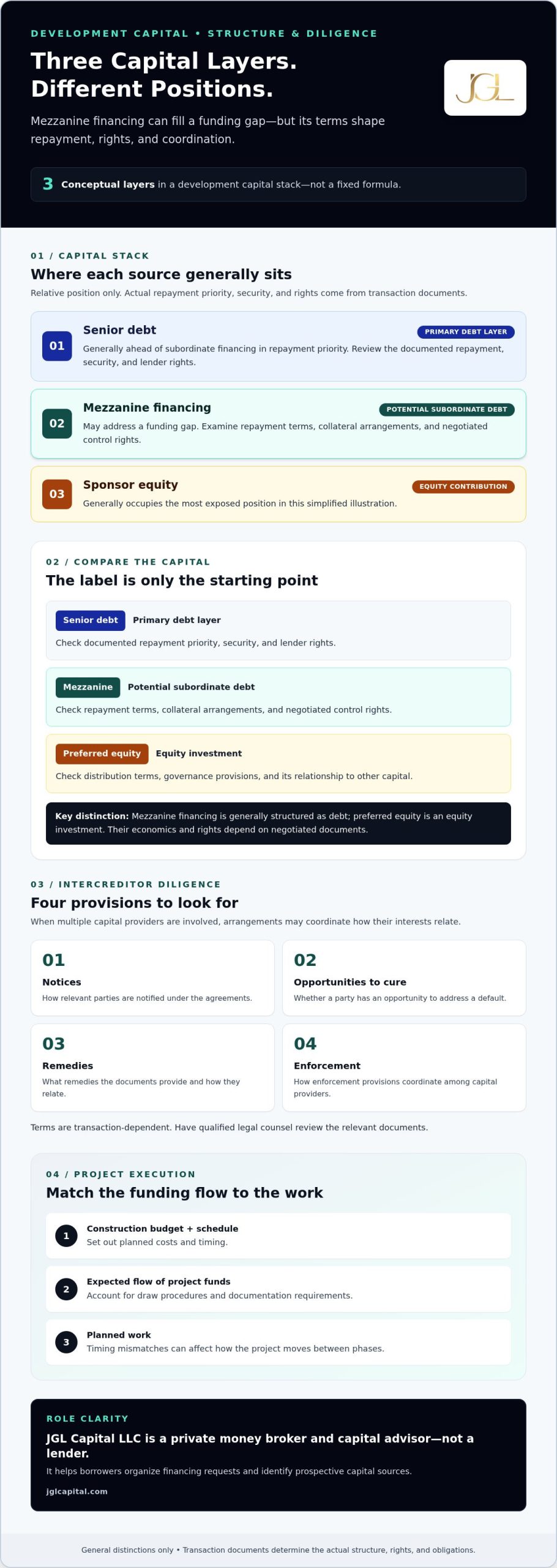
Think of the capital stack as three conceptual layers, not a fixed formula:
- Senior debt: The primary debt layer, with repayment and security arrangements described in its financing documents.
- Mezzanine financing: A potential subordinate financing layer between senior debt and sponsor equity.
- Sponsor equity: Capital contributed by the project sponsor, which generally occupies the most exposed position in this simplified illustration.
This is a picture of relative position only. It does not establish any particular lender’s rights, collateral arrangements, or repayment terms. Those details come from the transaction documents.
How it differs from senior debt and preferred equity
Senior debt and mezzanine financing are both forms of debt, but they occupy different positions in a capital structure. Senior debt is generally ahead of subordinate financing in repayment priority. The specific arrangement depends on the negotiated documents. Mezzanine terms may also address control and other rights, so evaluate them in the context of the complete transaction.
Preferred equity is different from mezzanine debt. It is an equity investment, while mezzanine financing is generally structured as debt. Their economic priorities and negotiated rights can differ, and the label alone does not explain how a particular arrangement works. JGL CAPITAL LLC is a private-money broker and capital advisor, not a lender. Its role is to help borrowers organize financing requests and compare prospective capital sources against the project’s facts.
How Mezzanine Financing Works Alongside Senior Debt
In a development capital structure, senior debt may provide the primary financing, with mezzanine capital considered as an additional layer and sponsor equity supporting the project. That additional layer may address a funding need, but it also adds another relationship to coordinate. When comparing commercial real estate development loans, examine the documents as closely as the conceptual capital stack: repayment priority, collateral arrangements, and control rights depend on negotiated terms.
| Capital type | General position | What to examine |
|---|---|---|
| Senior debt | Primary debt layer | Repayment priority, security, and lender rights as documented |
| Mezzanine financing | Potential subordinate debt layer | Repayment terms, collateral arrangements, and negotiated control rights |
| Preferred equity | Equity investment with negotiated economic terms | Distribution terms, governance provisions, and relationship to other capital |
These are general distinctions, not universal rules. Mezzanine debt and preferred equity are not interchangeable, and their practical effect depends on the transaction documents.
What an intercreditor agreement may address
When multiple capital providers are involved, intercreditor arrangements may coordinate how their interests relate. Review the documents for provisions addressing notices, opportunities to cure a default, remedies, and enforcement. The details are transaction-dependent, so have qualified legal counsel review the relevant documents. The New York Law School article Legal Aspects of Mezzanine Finance discusses legal structures and risks relevant to this diligence.
How a development draw schedule relates to financing
A construction budget and schedule should align with the expected flow of project funds. Draw procedures can affect when funds are available for planned work, while the selected lender determines applicable documentation and draw requirements. Account for those procedures in project planning. A financing structure is not separate from execution: timing mismatches can affect how the project moves from one phase of work to the next.
For more context on development funding, see the new construction financing guide. It helps borrowers organize requests and compare prospective capital sources. To discuss a project’s financing needs, explore JGL CAPITAL’s private money brokerage.
How to Evaluate Mezzanine Financing for a Development Project
Start with the project’s actual capital need, not a target financing amount. Set out the acquisition or development basis, project scope, line-item budget, construction schedule, and capital already committed. Then identify what the additional funds would cover and when they would be needed. This context frames commercial real estate development loans around the transaction rather than a headline amount.
No single financing layer suits every development. The right structure is the one whose costs, obligations, and timing align with the project and its planned exit.
Questions to resolve before comparing capital sources
Clarify the use of proceeds, project milestones, and timing constraints that could affect execution. Test the assumptions behind the project’s feasibility: what if costs rise, work takes longer, leasing progresses differently, or a sale happens later than planned? Consider the effect on projected cash flow, the available contingency, and the sponsor’s liquidity if the business plan changes.
Evaluate the intended exit just as carefully. Identify how repayment is expected to occur and whether that path depends on refinancing, an asset sale, or operating cash flow. Check that the budget and schedule support the repayment plan. Avoid relying on an optimistic sequence of events without considering how a delay could affect repayment.
Risks and trade-offs to examine
Compare the full structure, including fees, covenants, recourse, reserves, extension provisions, and execution requirements where available. A lower apparent cost may not tell the whole story if repayment terms or operational obligations put pressure on project liquidity. Additional capital can also mean more coordination among capital providers and more documentation to manage. Neither factor determines the project’s outcome, but both belong in the analysis.
Review proposed terms alongside existing commitments and exit assumptions. Qualified legal and tax professionals can assess transaction documents for their respective implications. It helps borrowers organize financing requests and compare prospective capital sources against transaction facts. Discuss a development financing request.
Preparing a Commercial Real Estate Development Financing Request
A well-organized request helps prospective capital sources understand the transaction, the funding need, and the intended repayment path. For commercial real estate development loans, present the project as a coherent plan. Make sure the narrative, budget, and schedule tell the same story and use consistent figures and milestones.
- Transaction: State the property type, project scope, current status, and requested use of funds.
- Capital: Summarize the total project budget, capital already committed, and the amount or purpose of the remaining need.
- Property: Provide site or property information and available materials that explain the project and its current position.
- Sponsor: Describe relevant development experience, capital invested, and financial capacity to support the plan.
- Timing: Set out project milestones, schedule assumptions, and material deadlines.
- Exit: Explain the expected repayment path and the assumptions that support it.
What to include in an initial deal summary
Keep the summary concise, then support it with a project narrative, detailed budget, development schedule, and available site or property documentation. Explain what is complete, what remains, and how the proposed financing fits with existing commitments. Include feasibility assumptions and flag factors that could affect costs, timing, or the exit. Check that the requested use of funds is consistent across the summary and supporting materials. Clear, consistent information helps prospective capital sources assess the request on its merits.
How a broker-led fit review can help
It helps organize financing requests, identify prospective capital sources, and compare lender programs against transaction facts. An initial financing-fit review can help clarify how to present the financing need and identify questions to resolve, without promising terms or approval.
This discussion concerns business-purpose real estate financing, not consumer or owner-occupied mortgage financing. Each lender independently assesses a request and determines whether to proceed, along with applicable terms and requirements. JGL CAPITAL does not control lender underwriting or approval decisions.
Bring Your Development Financing Plan Into Focus
Turn your financing objectives into a clear, workable brief. For commercial real estate development loans, that means explaining the project’s purpose and the funding need in a way prospective capital sources can assess. Keep the budget, schedule, capital commitments, and exit assumptions aligned, and be prepared to refine the request as the transaction is reviewed.
JGL CAPITAL LLC is a private-money broker, not a lender. Its broker-first process focuses on packaging the transaction, identifying prospective capital sources, and comparing structures against the project’s circumstances. JGL CAPITAL identifies 5 Star Service as a service differentiator, with a relationship-led approach that does not promise a financing outcome.
Ready to take a practical next step? Start a conversation about your development financing request. Share a concise summary of the project, funding need, timing, and intended exit to begin discussing potential paths forward.
Frequently Asked Questions
How is mezzanine financing different from preferred equity?
Mezzanine financing is generally structured as debt, while preferred equity is an equity investment with negotiated economic and governance terms. Payment priorities, remedies, and sponsor rights can differ, and the label alone does not establish how a particular arrangement operates. For example, a distribution preference in an equity agreement is not automatically equivalent to a debt repayment obligation. Have qualified counsel assess legal questions about specific documents.
Is mezzanine financing secured by the property?
Not necessarily. Some mezzanine structures use a pledge of ownership interests in the borrowing entity rather than a direct lien on the real estate, but arrangements vary. Review the senior loan documents, entity documents, and mezzanine papers together to understand what is pledged and how the interests interact. A qualified attorney should assess the actual security and enforcement provisions in the transaction documents.
Can mezzanine financing be combined with a senior construction loan?
It may be possible if the transaction structure and applicable lender requirements allow the two layers to operate together. Negotiated documents may address priority, notices, remedies, and construction funding procedures. Examine compatibility early, since unresolved intercreditor questions or mismatched funding procedures can complicate execution. The senior lender and mezzanine provider make decisions independently under their respective requirements.
What information should a developer prepare before exploring mezzanine financing?
Prepare a concise deal summary covering the project, requested use of funds, existing capital commitments, sponsor experience, schedule, and intended exit. Support it with a current budget, property or site information, feasibility assumptions, and available project documents. For commercial real estate development loans, make sure the sources-and-uses summary reconciles with the budget. JGL CAPITAL LLC is a private-money broker, not a lender; prospective lenders make their own decisions.