

A multifamily property’s rent may appear to cover its debt payments, yet that does not tell the whole financing story. DSCR loans for multifamily properties are not a cash-flow-only shortcut. Debt-service coverage is important, but lenders may also review operating expenses, occupancy, property condition, sponsor capacity, requested proceeds, and the planned exit. The review can vary between smaller residential properties and larger multifamily assets.
Investors are right to focus on rental income and debt coverage. The practical question is how a lender calculates each, and what else it considers. This guide explains how DSCR fits into a multifamily financing review, which property and sponsor information to organize, and how to compare potential structures against your business plan. JGL CAPITAL LLC is a private money broker and capital advisor, not a lender. It helps business-purpose borrowers prepare financing requests and compare potential lender options. Selected lenders make underwriting decisions and set terms.
Key Takeaways
- DSCR compares qualifying property income with debt service, but lenders may calculate both differently. Ask what assumptions are being used.
- For dscr loans for multifamily properties, organize the rent roll, leases, operating statements, property details, and available tax and insurance information.
- Summarize the sponsor, requested proceeds, transaction timing, and intended exit so the financing request is easy to assess.
- Compare potential structures by total costs, proceeds, recourse, reserves, covenants, extension provisions, and fit with the planned exit, not by rate alone.
What DSCR Loans for Multifamily Properties Evaluate
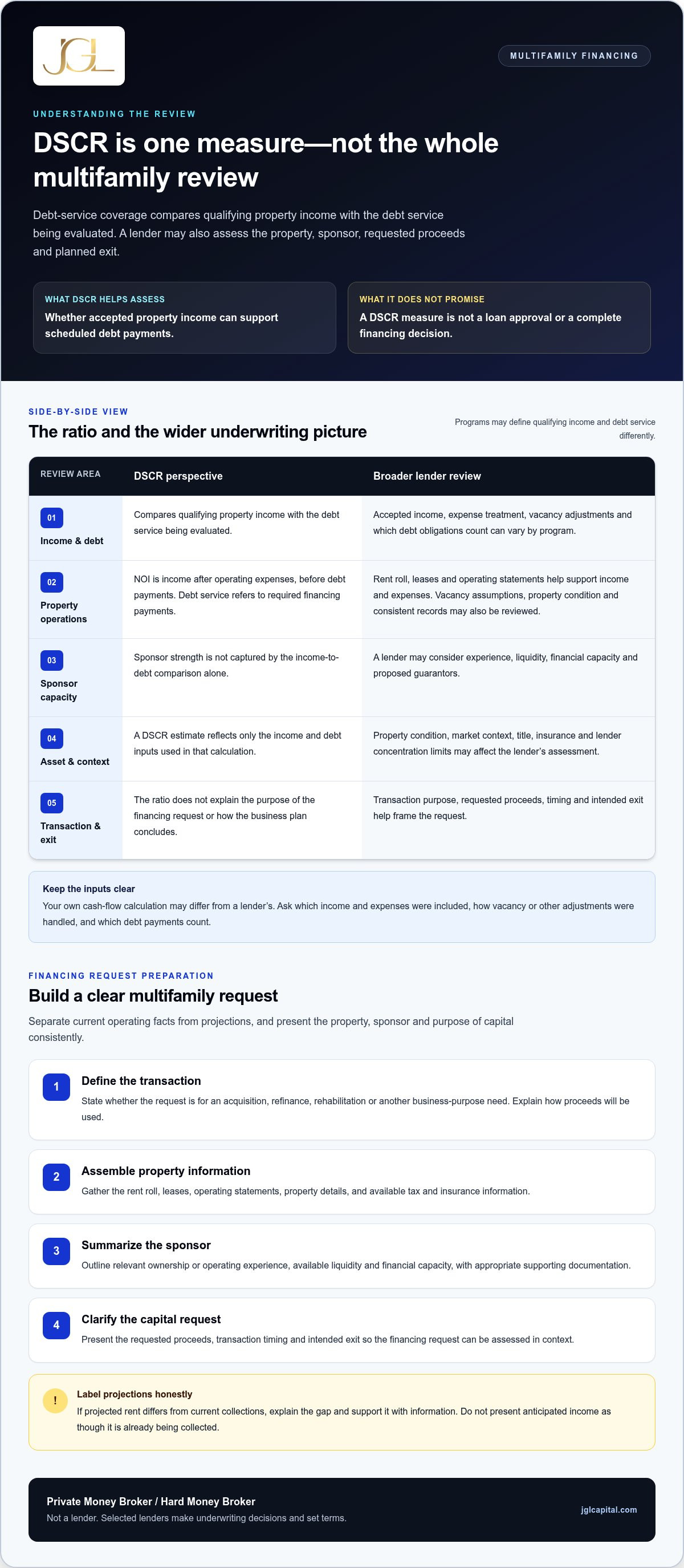
For income-producing multifamily rentals, the debt-service coverage ratio (DSCR) compares qualifying property income with the debt service being evaluated. In practical terms, it helps show whether the property’s operating income can support scheduled debt payments. DSCR is an evaluation measure of income relative to debt obligations, not a promise of loan approval. It is a useful starting point, but only one part of a lender’s review.
The phrase Debt Service Coverage Ratio (DSCR) describes this comparison. Lenders may define qualifying income and debt service differently, so the same property information may not produce the same calculation across programs. That distinction matters for dscr loans for multifamily properties, particularly for 5+ unit buildings, where operating performance is central to the analysis.
How debt service coverage relates to apartment cash flow
Net operating income, or NOI, is the income remaining after operating expenses are accounted for, before debt payments. Debt service refers to the required payments on the financing being evaluated. In a basic comparison, a lender measures its accepted version of property income against its calculation of debt service to assess coverage.
The inputs can change the result. Expense treatment, accepted income records, and which debt obligations count may vary by program. Your own cash-flow calculation may therefore differ from the figure a lender uses. When reviewing a DSCR estimate, ask which income and expense figures were included, how vacancy or other adjustments were handled, and which debt payments are part of the calculation. That helps clarify what the ratio indicates and what it leaves out.
Which properties and transactions may fit the discussion
This guide covers business-purpose financing for income-producing multifamily rentals, including 5+ unit properties. A lender may consider DSCR as part of an acquisition or refinance review, subject to its appetite and underwriting criteria. The transaction’s purpose, property operations, sponsor, documentation, and intended exit also contribute to the assessment.
JGL CAPITAL LLC acts as a private money broker and capital advisor, helping business-purpose borrowers organize financing requests and compare potential lender programs. It is not a lender. The selected lender determines its underwriting requirements, decisions, and financing terms.
Why Multifamily DSCR Is Not a Cash-Flow-Only Approval Test
A favorable DSCR can support a financing request, but it does not settle the decision by itself. For dscr loans for multifamily properties, lenders may assess the sponsor alongside property performance. Operating the asset and supporting the transaction involve more than the income calculation.
Property cash flow and sponsor strength are reviewed together
Leases and the rent roll show what tenants are obligated to pay; operating statements help explain the expenses behind reported income. Lenders may also review vacancy assumptions, property condition, and whether income is supported by consistent records. If projected rent differs from current collections, that gap may need explanation and supporting information. Do not present anticipated income as though it were already being collected.
A lender may also consider the sponsor’s experience, liquidity, financial capacity, and any proposed guarantors. Property condition, market context, title information, and insurance details can affect its view of the asset and transaction. Lender concentration limits may also influence appetite for a particular property or exposure.
Lender programs can define income and debt differently
Programs may treat particular expenses, income documentation, or debt obligations differently. As a result, the same property can receive different underwriting assessments, even when its leases and operating history have not changed. Do not assume that one DSCR threshold or documentation standard applies across lenders.
Each lender independently determines its underwriting requirements, including how it evaluates income, expenses, debt service, sponsor capacity, property condition, title, insurance, market context, and concentration limits. Broader financing conditions can also inform lender appetite. The Federal Reserve Financial Stability Report offers historical context on financial stability and real estate risks, but it is not a guide to current lender program terms.
Before approaching capital sources, organize the property and transaction details into a clear request. JGL CAPITAL LLC is a private money broker and capital advisor, not a lender. It helps borrowers prepare financing requests and compare lender programs. A multifamily financing request review can help clarify how the property, sponsor, requested proceeds, and intended exit fit together.
How to Prepare a Multifamily DSCR Financing Request
A well-organized request gives prospective lenders a clearer view of the property, sponsor, and purpose of the capital. For dscr loans for multifamily properties, prepare a concise package that separates current operating facts from projections and presents the transaction consistently.
- Define the transaction. State whether the request is for an acquisition, refinance, rehabilitation, or another business-purpose need. Explain how the proceeds will be used.
- Assemble property information. Gather the rent roll, leases, operating statements, property details, and available tax and insurance information.
- Summarize the sponsor. Outline relevant ownership or operating experience, available liquidity, and financial capacity, with appropriate supporting documentation.
- Clarify the capital request. Specify the proceeds sought, their intended use, the transaction timeline, and any material assumptions behind the request.
- Document the exit. Explain the intended hold, sale, or refinance path and the assumptions supporting it. Present projected outcomes as projections, not certainties.
Build a clear property and operating snapshot
Summarize the unit mix, occupancy, current rents, lease terms, operating expenses, and known property conditions. Include available records to support the figures and identify information gaps plainly. Separate documented results from projections. For example, distinguish current lease income from anticipated rents that depend on future leasing or improvements. Clear labels help prevent assumptions from being mistaken for established performance.
Make the requested structure and exit understandable
Connect the requested proceeds to the business plan, then explain how the proposed hold period and exit relate to the property’s operating strategy. If repayment depends on a future refinance or sale, describe the assumptions and relevant milestones without treating that path as assured. Requirements vary by lender, so an initial package may still need lender-specific documents or follow-up.
It helps business-purpose borrowers organize financing requests and compare lender programs. To present the property, sponsor, proceeds, timing, and exit in one coherent package, prepare your multifamily financing request.
Compare Multifamily DSCR Options and Plan the Next Step
Two proposals can look similar at first and still carry different obligations over the life of the financing. For dscr loans for multifamily properties, compare the full structure with the property’s operating plan, transaction timeline, and intended exit. A lower quoted rate alone does not establish the better fit if other terms affect proceeds, flexibility, or repayment.
Evaluate the complete financing structure, not one headline term
Put lender-provided terms side by side. Mark each item that is unknown, conditional, or still subject to underwriting so you do not treat an open item as settled.
Total costs: Record the costs stated in each proposal. Mark items not yet provided as unknown.
Proceeds: Compare the proposed amount and intended use of capital, subject to lender determination.
Recourse and reserves: Note the stated requirements and any conditions that remain unresolved.
Covenants and extensions: Record applicable provisions, conditions, and terms that have not yet been specified.
Exit fit: Assess how the structure aligns with the planned hold, sale, or refinance, including the timing assumptions behind that plan.
This side-by-side review makes trade-offs easier to spot. For instance, a lower rate may not suit a project if its proceeds, reserve requirements, or extension provisions conflict with the business plan.
What to expect when discussing a deal with JGL Capital LLC
It can help clarify the property, sponsor, requested proceeds, timing, and exit; organize the financing package; identify prospective private and institutional capital sources; and coordinate communication. Selected lenders retain authority over underwriting, approval, program terms, proceeds, and closing timelines.
Bring the transaction details and available property and sponsor information to an initial financing-fit review. A clear request supports a focused discussion, but does not guarantee an outcome. Discuss your multifamily financing request and its intended structure.
Set Your Financing Priorities Before Moving Forward
Before advancing a multifamily transaction, decide which terms are essential to the business plan and where flexibility may be possible. Clarify the timing, obligations the project can support, and intended exit. This keeps financing discussions grounded in the property’s needs rather than a single attractive term, and gives you a clearer basis for assessing dscr loans for multifamily properties against the transaction you plan to execute.
It helps business-purpose borrowers prepare deal packages, compare potential structures, identify private and institutional capital sources where the transaction and lender fit allow, and coordinate communication throughout the financing process. Selected lenders make their own underwriting and approval decisions.
If you’re ready to discuss the property, requested proceeds, and intended plan, Discuss your multifamily transaction with JGL CAPITAL. Submit a concise deal summary to request an initial financing-fit review and explore potential capital sources for the transaction.
Frequently Asked Questions
Can DSCR financing be used for a multifamily short-term rental?
Some DSCR and rental-loan programs consider short-term rental income, but eligibility and income treatment depend on the lender and transaction. A building operated as furnished nightly rentals may be evaluated differently from one with longer-term leases, particularly when revenue varies by season. For dscr loans for multifamily properties, describe the operating model and provide available revenue history. Do not assume projected bookings will count as qualifying income.
Are tax returns required for a multifamily DSCR loan?
Not in every program, but do not assume they will be unnecessary. Some asset-based or DSCR programs rely less on the borrower’s personal-income documentation, while lender requirements vary. A lender may still request property tax records, operating statements, entity documents, or borrower returns, depending on the transaction. In your initial summary, clarify which records are available and distinguish property-level tax information from personal income tax returns.
Can a multifamily property qualify if its DSCR is low?
Possibly, but a low DSCR can make a request more challenging and does not establish whether a lender will approve it. A lender may consider the broader transaction, including the property, borrower profile, requested proceeds, and exit. Explain why coverage is currently low, such as vacancy or transitional operations, and support any proposed improvement plan with relevant information. Approval and terms remain lender decisions.
Can a borrower refinance bridge financing into a DSCR loan?
A bridge-to-DSCR refinance may be possible if the property meets the future lender’s requirements when the refinance is pursued. For example, the property may need to reach an operating position that supports the lender’s income analysis. Treat the refinance as a plan, not a certainty. Consider the timing, remaining bridge obligations, property performance, and alternatives if the expected refinance is not available on schedule.
What should I include in an initial multifamily financing deal summary?
Include the property address and unit count, transaction type, purchase price or current value, requested proceeds, and use of funds. Add a brief summary of condition, current income, borrower experience, available liquidity, timing needs, and intended exit. Separate verified figures from estimates and identify the expected repayment source. A concise summary gives a broker useful context to discuss prospective lender fit and apparent information gaps.