
The assumption that high-stakes real estate development requires a physical presence on-site is a legacy constraint that often prevents sophisticated investors from scaling their national portfolios. While the risks of capital leakage and unverified milestones are real, they’re typically symptoms of a fragmented oversight framework rather than a byproduct of distance. You likely recognize that the traditional reliance on trust and sporadic site visits is insufficient when managing multimillion-dollar New Construction Loans or complex bridge financing projects across multiple time zones. Learning how to manage contractors remotely is no longer a secondary skill; it’s a core competency for the disciplined steward of capital.
This article provides the institutional-grade methodologies required to oversee development projects from a distance while preserving asset value and ensuring total project alignment. We’ll explore a repeatable system for remote oversight that mitigates project delays and aligns contractor performance with financing draw schedules. By implementing these rigorous verification protocols, you’ll transform a potential liability into a strategic advantage. This framework allows for the seamless expansion of your investment footprint without compromising on transparency or execution quality, ensuring that every dollar deployed is a dollar accounted for.
Key Takeaways
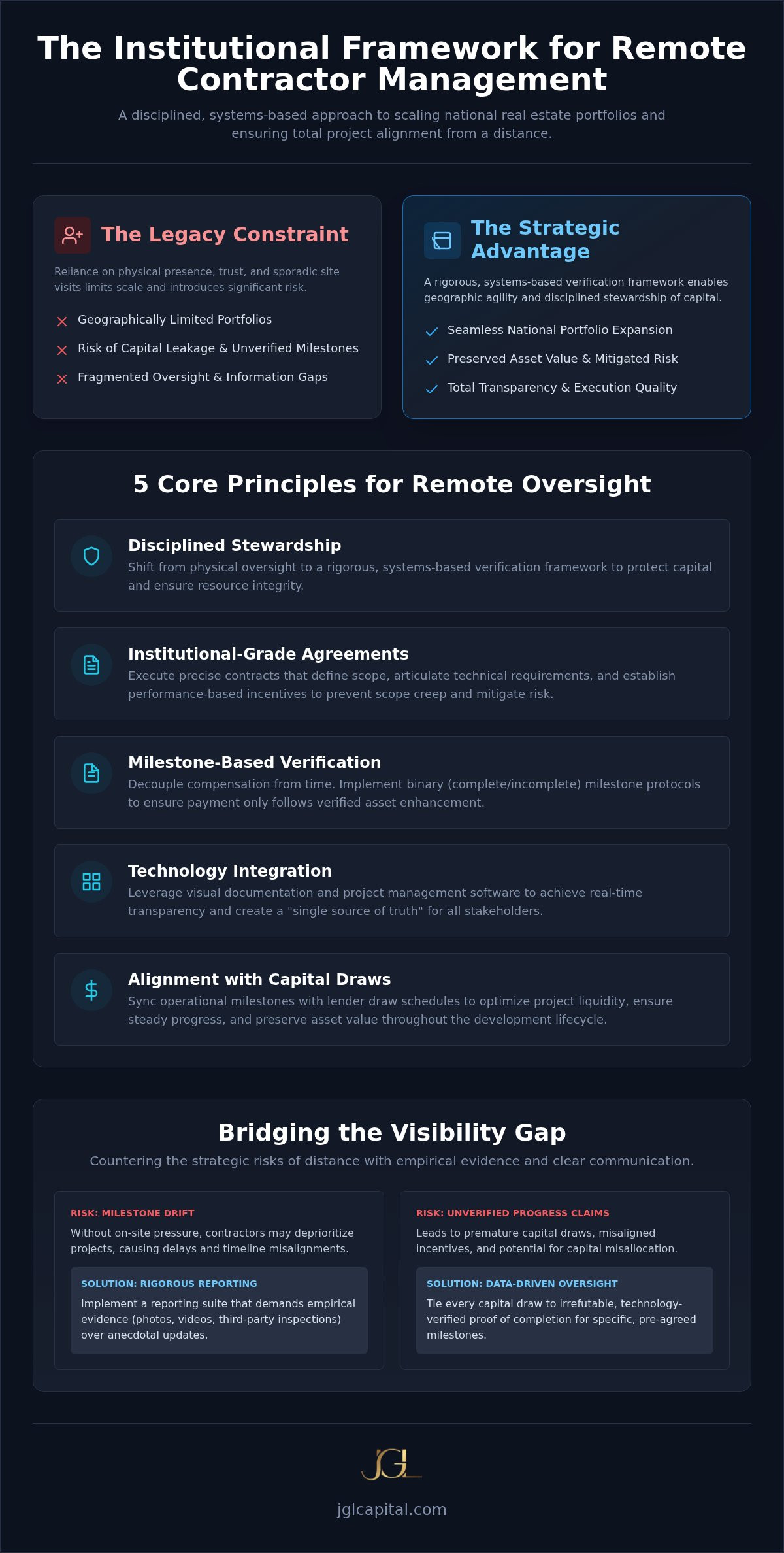
- Establish a disciplined stewardship of resources by shifting from physical oversight to a rigorous, systems-based verification framework.
- Master how to manage contractors remotely through the execution of precise, institutional-grade agreements that mitigate risk and prevent scope creep.
- Decouple compensation from time by implementing binary milestone-based verification protocols that ensure payment only follows verified asset enhancement.
- Integrate sophisticated visual documentation and project management technologies to achieve real-time transparency and rigorous resource allocation oversight.
- Align operational milestones with lender draw schedules to optimize liquidity and ensure the steady preservation of asset value throughout the development lifecycle.
The Strategic Framework for Remote Contractor Management
Remote contractor management is the disciplined stewardship of external resources across geographic boundaries, requiring a departure from traditional, presence-based supervision. In modern real estate development, the shift from physical oversight to systems-based verification is essential for maintaining the integrity of high-stakes investments. This framework ensures that project objectives and contractor execution remain in total alignment, regardless of the investor’s physical location. Mastering how to manage contractors remotely involves more than digital communication; it necessitates a rigorous application of project management principles to mitigate the inherent risks of information asymmetry and potential capital misallocation.
The necessity of alignment between ownership and execution cannot be overstated. When project objectives are clearly defined and contractor incentives are structured around those goals, the risk of divergence decreases significantly. Remote management relies on the creation of a “single source of truth” where both parties agree on what constitutes a completed milestone. This eliminates the ambiguity that often plagues construction projects and provides a stable foundation for remote collaboration, ensuring that every dollar deployed is tied to a specific, verifiable outcome.
The Shift Toward Geographic Agility
National investors must learn to decouple their physical location from their capital allocation to remain competitive. This geographic agility allows for the strategic deployment of funds into markets with the highest growth potential, rather than those within driving distance. By accessing specialized talent in diverse markets, investors can leverage local expertise while maintaining institutional control. This capability is particularly vital when scaling a multi-state real estate investing portfolio, where the reliance on local teams is balanced by centralized, remote oversight. Whether utilizing New Construction Loans or Bridge Loans, the ability to deploy capital nationally provides a significant edge in a fragmented market.
Identifying the Strategic Risks of Distance
The primary challenge of remote operations is the visibility gap, which can obscure critical performance metrics. When you aren’t physically present, the potential for milestone drift increases, as contractors may deprioritize projects that lack immediate, on-site pressure. This lack of transparency often results in unverified claims of progress, leading to premature capital draws and misaligned incentives. To counter these risks, investors must implement a reporting suite that emphasizes empirical evidence over anecdotal updates. Maintaining a high-register, professional rapport is equally critical; it signals to the contractor that the project is governed by a disciplined steward who values precision and integrity. This approach ensures that accountability remains high even when the distance is vast.
Establishing Institutional-Grade Contractor Agreements
In a remote environment where physical proximity is absent, the contract serves as the primary architecture for project governance. It’s the definitive instrument for risk mitigation, transforming abstract expectations into enforceable operational standards. Understanding how to manage contractors remotely begins with a shift in perspective; the agreement isn’t merely a legal formality but a strategic roadmap for performance. Precise scope definitions are mandatory to prevent scope creep, which often occurs when developers cannot observe daily site activities. By articulating every technical requirement and finish grade within the contract, you eliminate the ambiguity that contractors might otherwise exploit.
Performance-based incentives play a critical role in aligning contractor interests with your investment objectives. Rather than relying on a simple fixed-fee or cost-plus model, sophisticated investors structure agreements where profit margins are contingent upon meeting specific quality and timeline benchmarks. For national developers, these agreements must also navigate the legal nuances of multi-jurisdictional regulations. Ensuring that choice-of-law clauses and dispute resolution mechanisms are tailored to the specific state of development protects your capital from local legal volatility.
Essential Clauses for Remote Oversight
Effective remote oversight requires mandatory reporting cadences that are explicitly defined in the agreement. These should include daily digital logs and weekly high-definition video walkthroughs to bridge the visibility gap. The inclusion of a ‘right to audit’ clause is non-negotiable, allowing for both financial reviews and unannounced third-party inspections. These third-party observers act as your eyes on the ground, verifying that the physical progress matches the reported milestones. To instill a sense of urgency, liquidated damages clauses should be utilized for unexcused delays. These daily financial penalties ensure that the contractor remains focused on the schedule, as any deviation directly impacts their bottom line.
Compliance and Risk Allocation
Rigorous compliance protocols are the bedrock of capital protection, especially when utilizing new construction loans for large-scale projects. Insurance verification must go beyond a simple certificate; you must ensure that your entity is named as an additional insured with appropriate waivers of subrogation. Lien waiver management is equally critical. Implementing a system where payment is only released upon the receipt of executed conditional waivers protects the asset from future encumbrances. For projects exceeding institutional thresholds, performance bonds provide an extra layer of security, guaranteeing that the project will be completed even if the contractor faces insolvency. Strategic partners like JGL Capital recognize that these disciplined standards are essential for the long-term preservation of value in a national portfolio.
Implementing Milestone-Based Oversight and Verification
Traditional time-based billing is an antiquated model that introduces unnecessary risk into a development project. Instead, a sophisticated methodology must decouple payment from the passage of time, strictly coupling it to verified output. This ensures that the investor’s capital is only deployed when tangible asset enhancement has occurred. Mastering how to manage contractors remotely requires the definition of “Institutional Milestones,” which are binary, non-ambiguous benchmarks that leave no room for interpretation. A milestone is either achieved or it isn’t. There’s no middle ground of partial completion in a disciplined framework.
Third-party inspectors serve as the essential eyes and ears for the remote investor, providing an objective layer of verification that contractors cannot influence. Their presence on-site, even if sporadic, creates a powerful psychological impact. When a contractor knows that every claim of progress will be scrutinized by an independent professional, their discipline naturally increases. This rigorous verification culture discourages the “cutting of corners” and ensures that the project maintains its alignment with the original technical specifications. It’s a form of strategic oversight that values empirical data over verbal assurances.
The Verification Workflow
Establishing a standardized workflow for how to manage contractors remotely ensures that no payment is released without comprehensive documentation. This process must be linear and uncompromising:
- Submission of digital evidence: Contractors must provide high-definition, geotagged photos and comprehensive video walk-throughs of the specific work area.
- Technical review: The submitted evidence is reviewed against the predefined technical specifications and the approved budget to ensure compliance.
- Independent verification: A local professional or project manager conducts a site visit to confirm that the digital evidence accurately reflects the physical reality.
Managing the Communication Rhythm
Efficiency in remote management is achieved through a formal cadence of communication that distinguishes between high-level strategic reviews and daily operational updates. Sophisticated developers often utilize asynchronous communication tools to handle time zone disparities effectively, allowing for thoughtful responses rather than reactive ones. This approach supports a “management by exception” model, where the investor’s attention is only required when the project deviates from the established plan. It’s the most efficient model for those overseeing national portfolios, as it preserves the investor’s bandwidth for high-value decision-making while maintaining rigorous control over the development lifecycle.
Leveraging Technology for Transparent Resource Management
Effective resource management in a remote context requires more than basic communication tools; it demands a sophisticated technological ecosystem that serves as the project’s central nervous system. It’s not enough to talk; you must track. When evaluating how to manage contractors remotely, investors must prioritize software specifically engineered for the complexities of construction and fix and flip loans execution. Generic project management platforms often fail to capture the granular data required for site-specific oversight. Instead, institutional-grade solutions must facilitate a “Single Source of Truth” where project documents, architectural plans, and financial records are accessible to all strategic partners in real-time. This centralized repository eliminates information silos and ensures that every stakeholder operates from the most current data set, thereby protecting the integrity of the development.
Data security and the protection of intellectual property are equally paramount in these digital collaborations. As proprietary plans and sensitive financial structures move across geographic boundaries, the risk of unauthorized access or data leakage increases. Disciplined stewards of capital implement rigorous access controls and encrypted environments to safeguard their assets. By establishing clear protocols for data handling and ownership, you ensure that the project’s intellectual capital remains secure, even when collaborating with diverse external teams across the country. This technological approach is a cornerstone of how to manage contractors remotely without sacrificing the granular detail required for institutional-grade development.
Visual Evidence and Reality Capture
The integration of high-resolution visual documentation tools, such as drones and 360-degree cameras, provides an empirical layer of transparency that traditional reporting cannot match. These time-stamped, geotagged records are invaluable for resolving disputes and maintaining project momentum without the logistical burden of frequent travel. For larger commercial developments, the use of Building Information Modeling (BIM) allows remote investors to visualize progress against a digital twin of the asset. This reality capture ensures that the physical build aligns perfectly with the technical specifications, allowing for immediate course correction if deviations occur.
Financial Transparency and Reporting
Cloud-based accounting systems are essential for tracking budget variances in real-time, providing a level of financial oversight that is critical for remote projects. Transparent ledger access allows strategic partners to monitor capital flows and resource allocation as they happen. This digital footprint creates a comprehensive audit trail, which is vital when seeking future financing from hard money lenders florida or transitioning to permanent debt. A clear, verifiable history of financial discipline not only preserves the current asset’s value but also strengthens the investor’s position for subsequent portfolio expansion. To explore how these technological frameworks can support your next national project, consider a strategic alliance with JGL Capital.
Aligning Project Management with Capital Draw Structures
The efficacy of remote contractor stewardship is ultimately measured by its impact on the project’s financial fluidity. In a high-stakes development environment, remote management directly influences the liquidity and funding of the asset. When an investor masters how to manage contractors remotely, they create a seamless transmission of data that satisfies the rigorous requirements of institutional capital sources. This synchronization of contractor milestones with the lender’s draw schedule is essential. It ensures that capital is deployed only when value has been demonstrably added, maintaining a precise balance between debt service and physical progress.
A private money broker plays a vital role in this ecosystem, acting as a disciplined conduit between the borrower and the capital source. By facilitating clear communication and ensuring that all verification data meets the lender’s standards, the broker reduces the friction often associated with remote projects. JGL Capital serves as a strategic partner in this process, providing the intellectual capital and asset-backed financing required to execute complex development strategies. We understand the operational rigors of remote development and provide the stability necessary to preserve asset value across a national portfolio.
Optimizing the Draw Process
Rigorous remote documentation is the primary catalyst for accelerating the funding of bridge loans and construction debt. When geotagged visual evidence and third-party inspections are organized into a professional reporting suite, lenders can approve draws with higher confidence and greater speed. This proactive approach mitigates the risk of “funding gaps” that often stall projects when reporting is disorganized or unverified. Furthermore, the ability to move capital efficiently through a project allows for more effective capital recycling. By shortening the duration between milestone completion and capital reimbursement, investors can enhance their overall portfolio IRR and deploy resources into new opportunities with greater agility.
Conclusion: The Disciplined Path to National Scale
Successfully scaling a real estate portfolio across geographic boundaries requires a rejection of transactional management in favor of disciplined stewardship. The core philosophies of remote contractor oversight are rooted in analytical rigor, professional alignment, and the uncompromising verification of output. By implementing a framework that treats contractors as strategic allies governed by precise agreements and technological transparency, you eliminate the visibility gap that once limited investment horizons. Understanding how to manage contractors remotely is the differentiator between a localized operator and a national developer. We encourage sophisticated investors to leverage expert financing and institutional-grade methodologies to execute their remote strategies with confidence, building lasting legacies through careful and deliberate action.
Mastering Geographic Agility in Real Estate Development
The transition from localized oversight to a national investment strategy requires the adoption of a rigorous, systems-based verification framework. By prioritizing institutional-grade agreements and binary milestone reporting, you eliminate the visibility gap that often impedes remote growth. Understanding how to manage contractors remotely is the prerequisite for scaling a sophisticated portfolio while maintaining total capital control. This disciplined stewardship ensures that every development phase remains in strict alignment with your financial objectives and draw schedules.
As national asset-backed lending specialists with over 30 years of private money expertise, JGL Capital, led by CEO John E. Litton, provides the strategic partnership required to fund these complex operations. We invite you to Secure Strategic Capital for Your National Real Estate Portfolio and leverage our pattern-recognition expertise to preserve your asset value. Your ability to execute from a distance is the ultimate catalyst for long-term wealth preservation and institutional scale.
Frequently Asked Questions
How do I verify the quality of work performed by a remote contractor?
Verification requires a multi-layered approach involving high-definition visual evidence and independent site inspections. You must mandate that contractors submit geotagged, time-stamped photos and video walk-throughs of specific technical details before any draw is approved. These digital records should then be cross-referenced against the original architectural specifications. Engaging a local professional to conduct periodic, unannounced inspections provides an objective layer of quality control that digital documentation alone cannot replicate.
What are the most common pitfalls when managing construction projects from a distance?
The visibility gap is the most pervasive pitfall, often leading to unverified milestone claims and premature capital allocation. Investors frequently fall into the trap of relying on anecdotal updates rather than empirical data. This lack of transparency allows for subtle scope drift or the deprioritization of the project in favor of local, on-site clients. It’s essential to establish a rigorous reporting cadence from the outset as the primary defense against these operational failures.
Is it necessary to hire a local project manager for remote real estate investments?
While it’s not strictly mandatory for every project, a local representative often serves as a critical strategic ally in a remote framework. This individual provides the “eyes on the ground” necessary to verify physical progress and ensure that technical standards are met. For sophisticated investors learning how to manage contractors remotely, a local project manager acts as a bridge between the remote steward and the physical asset, reducing the risk of information asymmetry.
How do I handle project delays and disputes with a contractor in another state?
Disputes are best managed through the enforcement of pre-negotiated liquidated damages and clear choice-of-law clauses. If a delay occurs, the agreement should trigger financial penalties that align the contractor’s incentives with the project’s timeline. Professional communication must remain objective and rooted in the technical evidence provided by your reporting suite. Utilizing a third-party mediator familiar with the local jurisdiction can often resolve conflicts without the need for protracted litigation.
What software is best for tracking remote construction progress and budgets?
The optimal software suite integrates reality capture tools with cloud-based financial reporting to create a single source of truth. Platforms specifically designed for construction allow for the overlay of architectural plans with 360-degree site photos. This level of granularity is essential for maintaining oversight of complex budgets and schedules. By centralizing all project data, investors can monitor resource allocation in real-time, ensuring that every dollar deployed is accurately tracked against physical progress.
Can I use remote contractor management for commercial real estate loans and larger developments?
The principles of remote stewardship are particularly effective when applied to commercial real estate loans and institutional-scale developments. Larger projects often involve a more complex hierarchy of subcontractors, making a systems-based verification framework even more critical. The rigors of remote oversight provide the transparency required by sophisticated lenders and partners, ensuring that large-scale capital deployment remains secure and aligned with the long-term strategic objectives of the development.
How does remote management affect my ability to secure private money financing?
Demonstrating a mastery of how to manage contractors remotely significantly enhances your credibility with institutional lenders. Private money sources prioritize the preservation of asset value and the reliability of the exit strategy. When you present a project backed by a rigorous oversight framework, you signal that you are a disciplined steward of capital. This level of operational maturity often results in more favorable terms and a streamlined approval process for national projects.
What is the ‘right to audit’ clause and why is it essential for remote work?
The “right to audit” clause is an essential contractual provision that grants the investor the authority to review a contractor’s financial records and site activities. This clause ensures total transparency in resource allocation and serves as a powerful deterrent against capital misallocation. In a remote environment, it provides the legal basis for unannounced inspections and detailed financial scrutinies. It reinforces the professional alignment between the parties, confirming that the project is governed by institutional standards.