

In the pursuit of institutional-grade capital, is the perceived efficiency of a direct relationship actually compromising your portfolio’s long-term leverage? For developers managing high-balance assets, the choice between a private money broker vs direct lender often dictates the boundary between a successful exit and a restrictive capital bottleneck. You likely recognize that securing maximum leverage for complex, time-sensitive assets requires a disciplined approach to risk management that transcends simple interest rate comparisons. While the allure of a direct source suggests simplicity, the inherent rigidity of a single lender’s criteria can inadvertently stifle growth when market conditions shift or asset profiles evolve.
This article provides a rigorous strategic framework to help you determine when to leverage the internal speed of a direct lender or the sophisticated market access of a private money broker. You’ll gain the clarity necessary to minimize execution risk, eliminate fee transparency concerns, and establish a capital partnership grounded in analytical depth. We’ll begin by evaluating the operational realities of each model before identifying the specific scenarios where a brokered approach offers the superior path to value preservation and long-term wealth creation.
Key Takeaways
- Distinguish between the internal balance sheets of direct lenders and the strategic intermediary role of brokers to ensure capital alignment with specific project objectives.
- Analyze the performance metrics of a private money broker vs direct lender to determine whether internal speed or diversified market access offers the most reliable path to execution.
- Identify potential underwriting roadblocks early by leveraging pattern recognition, particularly for complex new construction and transitional asset classes.
- Implement a strategic framework for capital allocation based on deal size and asset complexity to select the most efficient funding structure for your portfolio.
- Discover the advantages of an institutional-grade partnership for securing high-leverage tranches on transactions exceeding $10M.
Defining the Mechanics: Private Money Brokers and Direct Lenders in 2026
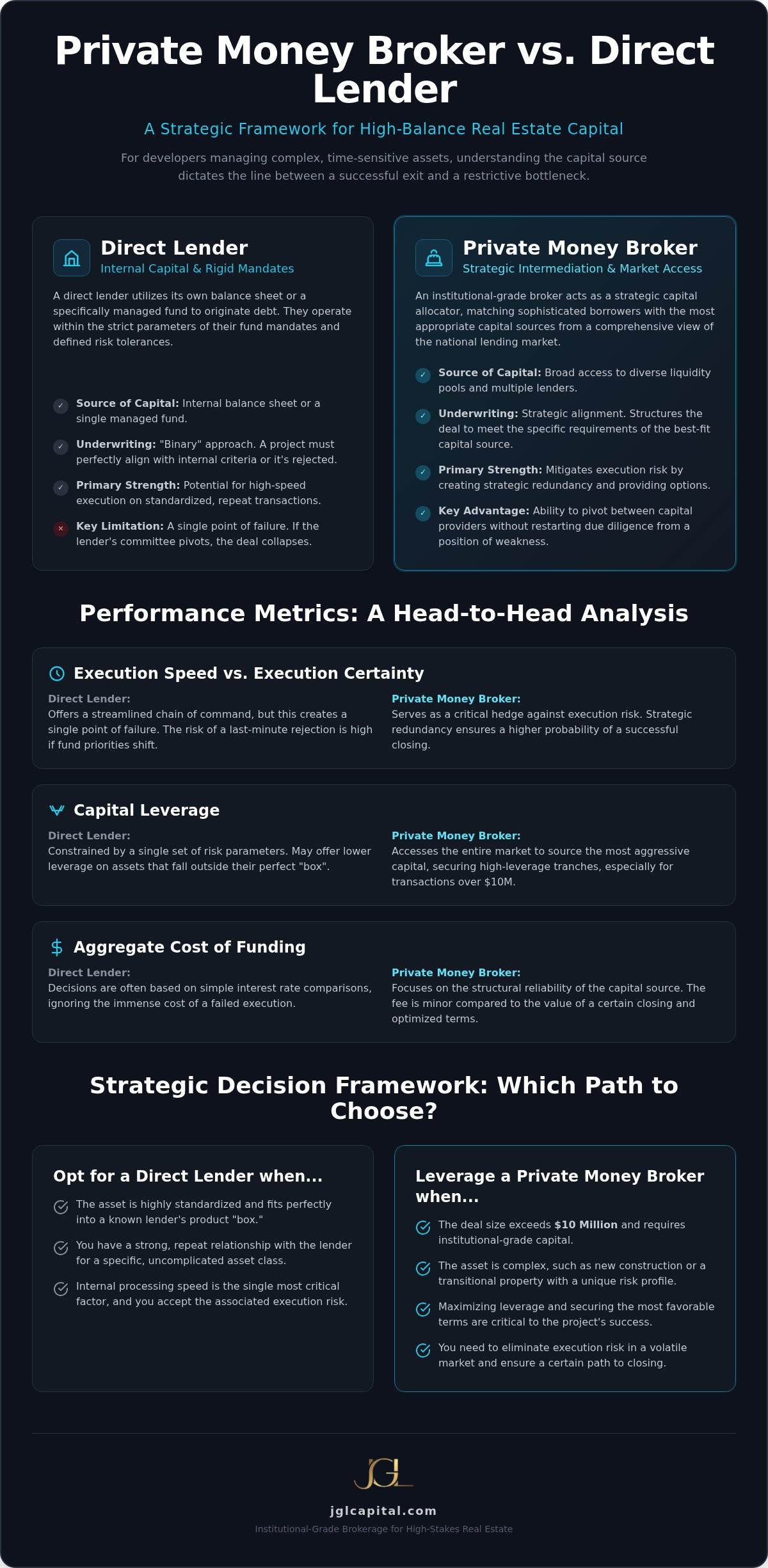
The contemporary real estate capital market requires a precise understanding of the structural differences between primary funding sources to ensure optimal portfolio performance. When evaluating a private money broker vs direct lender, the distinction begins with the origin of the capital and the fiduciary responsibility of the firm. A direct private lender is defined as an entity that utilizes its own balance sheet or a specifically managed fund to originate and service debt. Conversely, a private money broker operates as a strategic intermediary, meticulously matching sophisticated borrowers with the most appropriate capital sources based on the specific risk profile of the asset.
It’s vital to distinguish the institutional-grade private money broker from the consumer-grade mortgage brokers found in the residential sector. While the latter often focuses on standardized loan products for individual homeowners, the institutional broker specializes in high-balance transactions, typically exceeding $10 million, where asset complexity demands a bespoke structural approach. Some firms operate within a hybrid model, maintaining a direct origination arm for specific “box” products while offering brokerage services to provide clients with broader market access when a deal falls outside their internal mandate.
The Direct Lender: Internal Capital and Rigid Mandates
Direct lenders function within the parameters of specific fund mandates and clearly defined risk tolerances. These organizations are responsible to their own investors, which often results in a “binary” approach to underwriting. If a project does not perfectly align with their internal criteria, the response is a categorical rejection. While this model offers significant internal control and speed for repeat, standardized transactions, it presents substantial limitations for sponsors managing diverse or transitional portfolios. A single-product line cannot always accommodate the nuanced requirements of large-scale, complex real estate assets that face shifting market conditions.
The Private Money Broker: Strategic Intermediation and Market Access
Rather than acting as a mere middleman, the sophisticated broker serves as a capital allocator with a comprehensive view of the national lending environment. These professionals maintain real-time data on lender appetite, ensuring that a project is positioned before the specific institutions most likely to offer favorable terms. A private money broker is a strategic partner who structures deals to meet the specific requirements of alternative capital sources. This role is particularly critical when navigating the volatility of 2026, as it allows developers to pivot between capital providers without restarting the entire due diligence process from a position of weakness.
- Direct Lenders prioritize consistency and strict adherence to internal fund guidelines.
- Institutional Brokers prioritize strategic alignment and broad access to diverse liquidity pools.
- Hybrid Models offer a blend of internal funding and external placement capabilities.
Performance Metrics: Comparing Speed, Leverage, and Capital Costs
The allocation of capital within a sophisticated real estate portfolio is governed by three primary performance metrics: velocity of execution, capital leverage, and the aggregate cost of funding. Determining the optimal path between a private money broker vs direct lender requires a granular analysis of these variables against the project’s specific exit strategy. While direct lenders offer a streamlined chain of command, the strategic redundancy provided by a broker often serves as a critical hedge against execution risk. Decisions shouldn’t be made on interest rates alone; they must account for the structural reliability of the capital source.
Execution Speed and Internal Underwriting
Direct lenders operate with internal underwriting teams, which can facilitate a rapid transition from term sheet to closing for standard assets. However, this internal control creates a single point of failure. If a lender’s committee pivots or a fund reaches its concentration limit during the final stages of due diligence, the sponsor is left without recourse. A broker mitigates this risk through preliminary desk-underwriting. By vetting the asset against multiple institutional appetites simultaneously, a broker ensures that backup capital sources are already identified, preventing catastrophic delays if the primary option falters. It’s often more efficient to spend time on front-end structuring than to risk a mid-process collapse.
The Total Cost of Capital: Beyond Interest Rates
The frequent assumption that direct lenders are inherently the lowest-cost option ignores the “cost of no capital” and the nuances of wholesale pricing. An institutional broker often accesses non-bank capital or specialized tranches that remain inaccessible to individual borrowers. When evaluating the all-in cost, sponsors must account for origination points, processing fees, and exit requirements. In many instances, a broker can source higher-leverage tranches (LTV/LTC) that reduce the sponsor’s equity requirement, thereby increasing the overall return on investment despite the presence of a brokerage fee. This is particularly relevant when utilizing transitional capital, as detailed in our analysis of What Is a Bridge Loan?.
High-stakes transactions demand a level of precision that transcends simple transactional lending. For developers managing high-balance assets, the ability to evaluate your current capital structure against the broader market is essential for maintaining liquidity. A broker’s value is found in their ability to navigate these metrics to find the highest leverage possible while minimizing the execution risk that often plagues time-sensitive deals. Ultimately, the most expensive capital is the funding that fails to close on time.
- Direct Lenders: Best for repeat, low-complexity deals where internal speed is the primary driver.
- Private Money Brokers: Essential for complex assets where market access and redundancy protect the sponsor’s equity.
- Leverage Optimization: Brokers often identify specialized tranches that maximize LTV beyond standard lender “boxes.”
Complexity and Risk: Navigating New Construction and Transitional Assets
High-stakes real estate development requires a level of pattern recognition that transcends standard credit analysis, particularly when navigating the choice between a private money broker vs direct lender. For transactions exceeding $10 million, the project’s viability and intrinsic property value must serve as the primary drivers of capital allocation. Sponsors must consider who possesses the historical data and institutional depth to identify structural roadblocks before they manifest in the underwriting process. This analytical rigor is essential for preserving equity in environments where traditional credit parameters are often too rigid to accommodate complex asset profiles.
Direct lenders frequently encounter internal concentration limits or regional lender fatigue that can stall a project mid-cycle, regardless of the sponsor’s track record. If a fund has reached its maximum exposure for a specific asset class, its appetite for new risk diminishes. JGL Capital LLC mitigates this risk by maintaining a comprehensive, national view of the lending environment. This strategic oversight ensures that projects are positioned with institutions that have the current capacity and desire to fund high-balance, transitional transactions without the constraints of a single-fund mandate.
Structuring New Construction and Multi-Family Deals
Ground-up development presents unique challenges, including intricate draw schedules, rigorous budget contingencies, and the management of interest reserves. A direct lender’s internal mandate might be too restrictive to adjust for the fluid requirements of pre-development hurdles. Conversely, a broker provides strategic guidance by aligning the project’s specific scope with capital sources specializing in new construction loans. This alignment ensures that the funding structure supports the construction timeline, providing the necessary flexibility to reach vertical completion without capital disruptions.
Mitigating Execution Risk in Transitional Real Estate
Transitional assets, such as heavy rehab projects or properties requiring stabilization, carry inherent execution risks that can deter traditional institutions during periods of market volatility. When traditional banks retract, a broker acts as a disciplined steward, navigating these shifts by maintaining relationships across a broad spectrum of alternative capital. If a primary source falters, the broker’s ability to source hard money lenders or specialized bridge funds provides a necessary hedge. This national reach ensures the project reaches its intended exit without a liquidity crisis, regardless of localized credit contractions.
Strategic Stewardship: Choosing the Optimal Path for Your Portfolio
The determination to engage a private money broker vs direct lender must be predicated upon a rigorous evaluation of transactional complexity, the requisite scale of the capital stack, and the internal capacity of the sponsor’s management team. For the institutional investor, capital isn’t merely a commodity; it’s a strategic tool that requires disciplined allocation to preserve value across diverse asset classes. A decision framework grounded in analytical rigor ensures that the chosen funding path aligns with the long-term preservation of equity rather than just the immediate needs of a single closing.
When to Engage a Direct Lender Directly
Direct engagement with a lender is often the logical choice for “cookie-cutter” scenarios where the asset profile and the sponsor’s track record fit perfectly within a lender’s established underwriting box. High-volume, low-complexity investors may find value in establishing a “house line” of credit, which can provide marginal cost savings and operational efficiency for repetitive projects. This approach is effective when the market remains stable and the lender’s internal fund mandates don’t shift. However, sponsors must remain vigilant; relying solely on a single direct relationship creates a vulnerability if the “house” changes its criteria or reaches its concentration limits, potentially leaving a portfolio undercapitalized at a critical juncture.
The Broker as a Strategic Ally for Sophisticated Sponsors
For professional developers managing high-balance transactions, particularly those exceeding $10 million, the broker functions as a capital steward rather than a transactional middleman. Brokers manage capital allocation across a portfolio to maximize liquidity, ensuring that equity isn’t unnecessarily trapped in a single asset. This is especially vital in the context of fix and flip loans or transitional bridge debt where rapid capital recycling is required to maintain momentum. By acting as a single point of contact for multiple asset classes, including DSCR, construction, and bridge financing, the broker provides a level of market intelligence that a direct lender cannot replicate.
The sophisticated broker maintains a steady rhythm of market analysis, identifying shifts in lender appetite before they impact the borrower’s pipeline. This proactive approach allows sponsors to focus on asset management and acquisition while the broker handles the complexities of the capital markets. If your portfolio requires a disciplined approach to growth, you should secure a strategic capital allocation partner who understands the nuances of institutional-grade financing. Ultimately, the broker’s value is found in their ability to generate worth through the precise alignment of a project’s needs with the most favorable capital sources available nationally.
- Strategic Alignment: Brokers ensure that the capital structure supports the specific exit strategy of each asset.
- Market Intelligence: Access to real-time data on lender appetite prevents sponsors from pursuing misaligned funding sources.
- Portfolio Liquidity: Diversified capital sources protect the sponsor against regional or institutional credit contractions.
JGL Capital: Institutional-Grade Brokerage for High-Stakes Real Estate
JGL Capital LLC serves as a disciplined steward for professional sponsors whose projects demand a level of sophistication that transcends simple transactional lending. With over 30 years of combined industry pattern-recognition expertise, the firm specializes in high-balance transactions exceeding $10 million, providing a national scope of service that ensures projects are aligned with the most appropriate liquidity pools across the United States. When evaluating the strategic utility of a private money broker vs direct lender, the primary advantage of JGL Capital LLC lies in a deep-seated understanding of the internal motivations governing institutional capital. This perspective allows us to position complex commercial real estate loans with the precision necessary to ensure execution certainty for our partners.
The Power of Pattern Recognition and Market Intelligence
Decades of rigorous engagement within the capital markets have equipped JGL Capital LLC with the ability to anticipate underwriting challenges long before they reach a formal committee. This pattern recognition is a byproduct of having navigated multiple market cycles, allowing our team to understand the “lender side” of the desk with institutional clarity. We don’t merely submit files; we structure transactions to address the specific risk-mitigation requirements of alternative capital sources. This disciplined stewardship of the borrower’s vision ensures that even the most complex asset profiles are presented with the analytical depth required to secure favorable terms and high-leverage tranches.
Customized Solutions and Exit Planning
The creation and preservation of value in real estate require a forward-looking approach to capital structure. JGL Capital LLC prioritizes bridge-to-permanent planning, ensuring that every short-term funding solution is integrated into a broader, strategic exit strategy. Whether a project requires New Construction, Multi-Family, or DSCR financing, our programs are customized to meet the individual objectives of the sponsor. We recognize that the most successful developments are those supported by a stable, long-term capital alliance rather than a series of disconnected transactions. Our commitment to asset-backed evaluation ensures that property value and project viability remain the central focus of the underwriting process.
By framing our activities as a form of high-level strategic alliance, JGL Capital LLC carves out a distinct identity as a collaborative and deeply invested ally for high-net-worth stakeholders. We invite you to experience a level of professional guidance that values integrity and long-term growth above all else. Contact JGL Capital LLC for a strategic consultation on your next project.
- Institutional Expertise: Specialization in transactions exceeding $10 million with a focus on complex asset classes.
- Strategic Oversight: Decades of experience in anticipating and mitigating underwriting roadblocks.
- National Execution: A comprehensive reach that provides access to diverse and specialized capital sources.
- Aligned Objectives: A commitment to generating worth through customized financing and meticulous exit planning.
Advancing Your Portfolio Through Strategic Capital Allocation
The strategic framework established throughout this analysis underscores that the choice between a private money broker vs direct lender is fundamentally about risk management. For sponsors managing high-balance, transitional, or construction assets, the ability to pivot between liquidity pools is not a luxury but a necessity for portfolio stability. A direct source offers internal speed, yet the institutional broker provides the structural redundancy required to protect equity during periods of market volatility. Aligning your project with a capital partner who understands these nuances is the most effective way to ensure execution certainty.
JGL Capital LLC offers more than 30 years of institutional-grade expertise, specializing in high-balance $10M+ transactions on a national scale. Our focus on asset-backed evaluation and strategic exit planning allows us to function as a dedicated ally in the creation of long-term worth. By accessing a diversified network of alternative capital sources, we ensure that your development goals are met with precision and analytical rigor. Secure Strategic Capital with JGL Capital LLC. We are prepared to assist in the successful realization of your next large-scale objective.
Frequently Asked Questions
What is the primary difference between a private money broker and a direct lender?
The fundamental distinction lies in the origin of capital and the scope of market access. A direct lender utilizes its own balance sheet or managed fund to originate debt within a specific, often rigid, mandate. A private money broker functions as a strategic intermediary, aligning the sponsor’s project with the most compatible capital source from a broad national network. When evaluating a private money broker vs direct lender, the broker offers a more diversified approach to capital allocation.
Is it more expensive to use a private money broker than going direct?
Perceived cost savings from direct engagement are often offset by the “cost of no capital” or restrictive terms. While a broker charges a fee for strategic placement, they frequently secure higher-leverage tranches or wholesale rates that are inaccessible to individual sponsors. By maximizing the loan-to-value ratio and reducing the equity requirement, an institutional broker can improve the project’s overall return on investment, making the total cost of capital more efficient than a direct source.
How does a private money broker get paid compared to a direct lender?
Compensation structures reflect the specific value delivered by each entity. A direct lender generates revenue through origination points, interest spreads, and various servicing fees. Conversely, a private money broker typically earns a success-based fee, often represented as a percentage of the total loan amount, paid at closing. This fee compensates the broker for their market intelligence, preliminary underwriting, and the strategic alignment of the capital stack with the sponsor’s long-term objectives.
Can a broker help if I have been declined by a direct private lender?
Brokers are uniquely positioned to rescue transactions that have been declined due to institutional concentration limits or rigid fund mandates. A rejection from one direct lender doesn’t indicate a project’s lack of viability; it often reflects a simple misalignment with that specific lender’s current appetite. By leveraging pattern recognition, a broker identifies alternative capital sources whose risk tolerances and asset preferences are better suited to the project’s requirements, ensuring execution certainty.
Does using a broker slow down the closing process for a bridge loan?
Engaging a broker often accelerates the closing timeline by eliminating the need for multiple, redundant applications. While a direct lender’s internal process may seem faster initially, a broker performs critical front-end due diligence and desk-underwriting. This preparation ensures that when a project reaches a lender’s committee, it’s already structured for approval. This proactive approach prevents mid-process collapses that would otherwise force a sponsor to restart the entire funding cycle from a position of weakness.
What should I look for when choosing a private money broker for a $10M+ deal?
Professional sponsors managing high-balance transactions must prioritize institutional-grade expertise and a track record of successful $10M+ closings. The ideal partner possesses deep pattern recognition, allowing them to anticipate underwriting roadblocks before they materialize. You should seek a broker with a national service scope and a reputation for disciplined stewardship. Their ability to articulate complex exit strategies to alternative capital sources is vital for maintaining the stability and growth of a large-scale real estate portfolio.
Are private money brokers regulated the same way as mortgage brokers?
Institutional private money brokers operate within the commercial real estate sector, which is distinct from the consumer-grade residential mortgage market. While residential brokers are governed by consumer protection laws like TRID, private money brokers focus on business-purpose loans for professional developers. This environment requires a higher level of sophisticated analysis and a focus on property value rather than personal credit. Regulations vary by jurisdiction, so sponsors should verify that their partner maintains the necessary professional standing.
Can a direct lender provide the same variety of programs as a broker?
Direct lenders are inherently limited by the specific mandates of their managed funds or balance sheets. They can’t offer a variety of programs beyond their internal risk parameters. When comparing a private money broker vs direct lender, the broker’s primary advantage is their ability to access a vast array of programs, including new construction, bridge, and multi-family loans. This diversity allows the broker to provide a customized solution for every asset within a sponsor’s portfolio.