

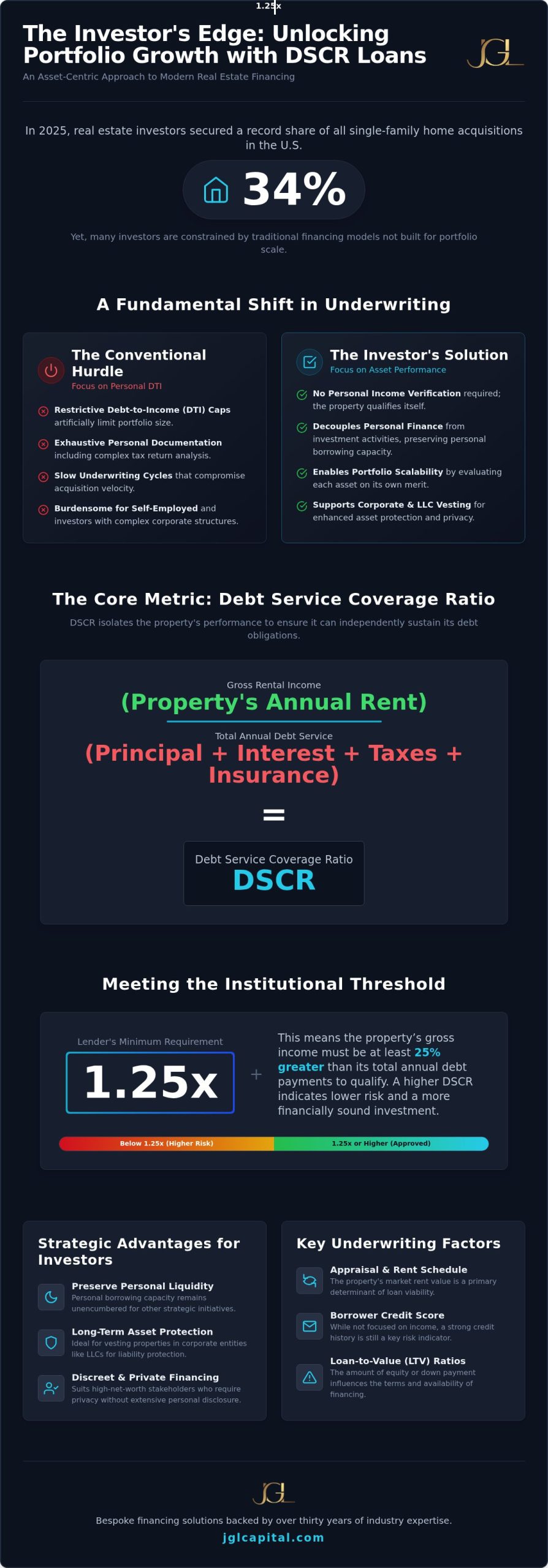
In 2025, real estate investors secured a record 34% share of all single-family home acquisitions in the United States, yet many sophisticated capital allocators remain unnecessarily constrained by the rigid debt-to-income frameworks of traditional banking. While traditional institutions often impose restrictive hurdles through exhaustive tax return analysis and slow underwriting cycles, dscr loans offer a disciplined, asset-based alternative that prioritizes the intrinsic value and cash flow of the underlying property. You likely find that the velocity of capital deployment is often the primary differentiator in securing high-yield assets, yet institutional friction frequently compromises your acquisition strategy.
This guide provides an analytical framework for utilizing these specialized instruments to decouple your personal financial profile from your investment activities. We’ll explore the evolving regulatory landscape following the 21st Century ROAD to Housing Act, current market benchmarks for loan-to-value ratios, and the precise underwriting criteria required to optimize your capital structure. By aligning debt obligations with property performance, you can preserve personal borrowing capacity and execute a deliberate, long-term growth strategy with institutional precision.
Key Takeaways
- Analyze the fundamental shift from personal debt-to-income constraints to asset-centric underwriting, allowing dscr loans to facilitate portfolio scalability without personal income verification.
- Identify the core components of the Debt Service Coverage Ratio calculation to ensure property performance aligns with institutional coverage thresholds of 1.25x or higher.
- Evaluate the advantages of corporate and LLC vesting structures in preserving personal liquidity and ensuring long-term asset protection for sophisticated holdings.
- Navigate the 2026 qualification landscape by understanding the interplay between appraisal rent schedules, credit scores, and maximum loan-to-value ratios.
- Align with a strategic capital resource that utilizes thirty years of industry expertise to structure bespoke solutions for high-stakes residential and multifamily transactions.
Understanding the DSCR Framework: A Shift from Personal Credit to Asset Performance
The evolution of institutional real estate finance has necessitated a departure from the conventional, consumer-centric underwriting models that historically dominated the market. While traditional lenders prioritize a borrower’s personal history, Debt Service Coverage Ratio (DSCR) financing represents a sophisticated transition toward asset-centric evaluation. This methodology establishes the property as a self-sustaining financial entity, ensuring that the capital allocation is predicated on the asset’s ability to generate sufficient yield to service its own debt obligations. By prioritizing the property’s yield, lenders can mitigate risk through analytical rigor rather than relying on the often-volatile metrics of personal employment or tax returns.
The Limitations of Traditional Mortgage Underwriting
Conventional financial institutions operate within a framework designed for the retail homebuyer, which frequently creates institutional friction for the professional investor. Debt-to-income (DTI) caps serve as an artificial ceiling, restricting the growth of multi-property portfolios regardless of a property’s actual profitability. Self-employed investors face an immense administrative burden, as traditional underwriters often struggle to decipher complex corporate structures and depreciation schedules. Additionally, traditional banking models often fail to account for the robust cash flow generated by short-term rentals, treating these high-yield assets with an unearned skepticism that hinders acquisition speed. These systemic hurdles often force investors to choose between personal liquidity and portfolio expansion.
The DSCR Paradigm: Asset-Backed Stability
Sophisticated real estate professionals prioritize dscr loans because they offer a disciplined approach to capital preservation. By utilizing asset-backed stability, investors can ensure that their personal borrowing capacity remains unencumbered for other strategic initiatives. JGL Capital leverages over 30 years of pattern-recognition expertise to identify the viability of these income-producing assets, providing a level of insight that goes beyond basic credit scoring. This methodology is particularly advantageous for high-net-worth stakeholders who require discreet financing solutions that respect their privacy. The focus remains on the strategic alignment of debt with property performance, ensuring that every acquisition contributes to a lasting legacy of value creation without compromising the borrower’s personal financial profile.
The implementation of dscr loans represents a strategic alliance between the investor and a capital resource that understands the gravity of high-stakes management. By moving away from the limitations of the individual and toward the quantifiable potential of the asset, investors can scale with a confidence grounded in objective data. This institutional approach ensures that the acquisition process remains seamless, even when navigating the complexities of large-scale multifamily projects or diversified residential portfolios. It’s a method that values long-term growth and integrity above the transactional nature of traditional lending.
The Analytical Mechanics: Calculating the Debt Service Coverage Ratio
The DSCR calculation is defined as the quotient of gross rental income and total debt service. This formula serves as the primary metric for evaluating the viability of dscr loans within an institutional framework. While traditional underwriting focuses on a borrower’s global cash flow, this specific ratio isolates the property’s performance to ensure it can independently sustain its capital requirements. Lenders typically analyze the Net Operating Income (NOI) in relation to the projected debt, though many programs utilize gross rental projections to streamline the assessment. An academic analysis of DSCR reveals its utility as a foundational indicator of financial health, providing a standardized benchmark for risk mitigation across diverse asset classes.
The Nuances of PITIA and Operational Expenses
The denominator of the DSCR equation is comprised of PITIA: principal, interest, taxes, insurance, and homeowners association (HOA) assessments. Each component requires precise verification to maintain the integrity of the ratio. Property taxes and insurance premiums aren’t static; they often fluctuate based on local municipal adjustments or updated risk assessments.
For multifamily assets or condo-hotel units, HOA fees represent a significant operational expense that must be meticulously integrated into the underwriting process. In the context of short-term rentals, lenders must also account for variable costs that differ from long-term lease structures. Professional investors often find that a private capital resource with deep-seated expertise can better navigate these operational complexities than a retail bank.
Interpreting Ratio Thresholds for Capital Access
The resulting ratio dictates the terms of financing and the overall leverage available to the stakeholder. A 1.00x ratio represents the ‘break-even’ point, where the property’s income exactly matches its debt obligations. While this provides a baseline for entry, most institutional-grade dscr loans target a coverage threshold of 1.25x or higher. These elevated ratios signal a margin of safety that often results in more favorable interest rates and higher loan-to-value (LTV) maximums.
For properties demonstrating a 1.50x ratio or greater, lenders may offer their most aggressive capital terms, recognizing the asset as a low-risk, high-yield performer. In specific high-growth markets where cash flow may be temporarily suppressed by rapid appreciation, some lenders offer ‘no-ratio’ or ‘No DSCR’ programs. These specialized instruments allow for the acquisition of strategically significant assets without the immediate requirement of surplus cash flow, provided the underlying collateral meets stringent secondary criteria.
Strategic Advantages of DSCR Financing for Sophisticated Investors
Professional investors often find that traditional agency limits, which typically cap at ten financed properties, serve as a significant barrier to institutional-scale growth. By utilizing dscr loans, capital allocators can bypass these artificial constraints, shifting the focus entirely to the performance of the individual asset. This transition allows for the rapid acquisition of income-producing properties in competitive environments where speed of execution is paramount. Unlike traditional banks that may require 60 to 90 days for closing, asset-based lenders can often facilitate transactions within a fraction of that time, ensuring that high-yield opportunities aren’t lost to bureaucratic delays.
The flexibility of this financing model is particularly evident in the short-term rental (STR) sector. While conventional lenders often struggle with the seasonal volatility of vacation rentals, sophisticated DSCR programs account for these fluctuations by utilizing historical performance data or specialized market metrics. This ensures that the Debt Service Coverage Ratio remains accurate across a full fiscal cycle, providing a more realistic assessment of a property’s worth. It’s a method that values long-term growth and integrity above all else.
Portfolio Expansion and Capital Velocity
Scaling a diverse portfolio requires a capital partner that understands the necessity of capital velocity. Because dscr loans don’t impose borrower-level debt-to-income (DTI) constraints, they allow for theoretically infinite scalability. This is essential for investors pursuing sophisticated real estate investing strategies that involve the simultaneous management of multiple residential and commercial assets. By leveraging specialized rental property loans, stakeholders can consolidate their financing efforts, aligning their debt structures with overarching long-term objectives.
Vesting Flexibility and Asset Protection
A primary advantage of asset-based financing is the ability to hold title within a corporate entity. This structure allows investors to close in the name of an LLC, S Corp, or Revocable Trust, thereby isolating liability to the specific asset and enhancing overall privacy. Such vesting flexibility is a cornerstone of disciplined risk management, ensuring that personal wealth remains shielded from property-specific litigation. Additionally, corporate ownership facilitates collaborative investment structures, allowing multiple partners to align their interests within a single, legally robust framework. This institutional approach to vesting reinforces the position of a disciplined steward focused on building lasting legacies through careful, deliberate action.
Navigating the Qualification and Underwriting Process for DSCR Loans
The successful execution of an asset-based financing strategy requires a methodical transition from theoretical yield projections to verified operational data. Underwriting for dscr loans is a rigorous process that centers on the property’s ability to sustain its own capital requirements while maintaining sufficient liquidity for the borrower. Central to this evaluation is the 1007 Rent Schedule, a specialized appraisal supplement that confirms market rent levels against actual lease agreements. This document serves as the linchpin for the entire transaction, as it provides the objective data necessary to calculate a reliable coverage ratio. For investors transitioning from bridge loans used for asset stabilization, this underwriting phase represents the move toward permanent, low-volatility debt structures.
While the property serves as the primary security, the borrower’s credit profile remains a significant determinant of the final leverage terms. Minimum credit scores typically range between 620 and 640, yet achieving a maximum loan-to-value (LTV) of 80% for purchases generally requires a score of 740 or higher. Furthermore, lenders in 2026 maintain strict cash reserve requirements to ensure operational stability across multi-unit portfolios. Stakeholders should expect to demonstrate three to six months of PITIA reserves for each financed asset, a requirement that reinforces the brand’s commitment to disciplined stewardship and the preservation of long-term value.
The Underwriting Phase: From Application to Commitment
The progression toward a formal loan commitment is characterized by three distinct analytical stages. Initially, a preliminary cash flow analysis is conducted to ensure the asset meets the baseline coverage thresholds established by the capital resource. Following this, the appraisal and rent survey verification process commences to confirm the DSCR ratio through independent market data. Finally, a comprehensive asset and reserve verification ensures the borrower possesses the necessary liquidity to navigate potential market fluctuations. This cumulative flow of information allows for a precise articulation of the property’s financial health before any capital is deployed.
Overcoming Common Underwriting Obstacles
Sophisticated deal structures often encounter complexities such as high vacancy rates or seasonal income fluctuations, particularly in short-term rental markets. Navigating these challenges, along with the strategic management of prepayment penalties, requires a level of pattern-recognition that traditional banks often lack. Engaging a private money broker can be essential for structuring solutions that align with specific portfolio objectives while maintaining future liquidity. By framing these activities as a high-level strategic alliance, investors can overcome institutional friction and secure the capital necessary for large-scale growth. Consult with our experts to refine your underwriting strategy and secure bespoke financing solutions.
JGL Capital: Bespoke Financing Solutions for Institutional-Scale Growth
JGL Capital LLC functions as a disciplined steward within the private lending sector, providing sophisticated partners with the analytical rigor required for high-stakes capital allocation. By leveraging over 30 years of combined industry expertise, the firm offers a level of pattern-recognition that ensures every transaction is structured to preserve and generate long-term worth. While transactional competitors focus on volume, JGL Capital LLC prioritizes the alignment of strategic objectives, acting as a collaborative ally for investors seeking to optimize their dscr loans. This commitment to excellence is particularly evident in the firm’s ability to facilitate large-balance transactions, including complex multifamily projects exceeding $10 million, where precision and discretion are non-negotiable.
Tailored Programs for Diverse Asset Classes
The firm provides comprehensive financing solutions across a broad spectrum of income-producing assets. Whether managing single-family rentals, 2-4 unit properties, or expansive 5+ unit multifamily complexes, JGL Capital LLC delivers customized capital paths that bypass the friction of traditional banking. This includes specialized support for new construction loans and ground-up development initiatives, providing the stability necessary for long-cycle projects. By offering alternatives for borrowers who fall outside conventional criteria, the firm ensures that sophisticated growth isn’t hindered by speculative market trends or rigid institutional mandates.
Engagement and Strategic Alliance
Our broker-first model provides investors with access to an expansive network of private capital, ensuring that every project receives the most competitive terms available in the current market. JGL Capital LLC provides essential guidance on exit-planning and capital velocity, allowing stakeholders to maintain a steady communication rhythm with their long-term objectives. This strategic alliance goes beyond simple service provision, offering a high-register, professional partnership designed to build lasting legacies through careful, deliberate action. We invite you to contact our team to discuss how our dscr loans and bespoke capital solutions can be meticulously aligned with your strategic objectives for 2026 and beyond.
Strategic Capital Alignment for the Next Era of Real Estate Growth
The transition toward asset-centric financing represents a fundamental maturation of the professional investor’s capital strategy. By prioritizing the intrinsic yield of a property over personal income metrics, you can effectively decouple your investment capacity from the institutional friction of traditional banking. We’ve explored how dscr loans serve as a precise instrument for this decoupling, facilitating the disciplined execution of large-scale portfolios through corporate vesting and streamlined underwriting. This methodology ensures that every acquisition is grounded in analytical rigor, preserving your personal liquidity while fostering the creation of a lasting legacy.
Navigating the complexities of the 2026 market requires a partner with deep-seated expertise and a national perspective on both residential and commercial assets. JGL Capital provides this stability, leveraging thirty years of private capital experience to handle even the most intricate deal structures, including transactions exceeding $10 million. We invite you to Secure Institutional-Grade Capital for Your Portfolio with JGL Capital. It’s a strategic alliance that values long-term growth and integrity above all else. We look forward to building a collaborative relationship that transforms your strategic objectives into tangible worth.
Frequently Asked Questions
What is the minimum DSCR ratio required for an investment property loan?
Lenders typically require a minimum ratio of 1.00x, which signifies that the property’s gross rental income is sufficient to meet its total debt service obligations. While this serves as the baseline for qualification, a ratio of 1.25x or higher is generally required to secure the most competitive interest rates and leverage terms. Achieving these higher thresholds demonstrates a margin of safety that aligns with disciplined, institutional-grade risk management.
Can I qualify for a DSCR loan if the property is currently vacant?
Qualification is indeed possible for vacant properties by leveraging a 1007 Rent Schedule during the formal appraisal process. This instrument allows the underwriter to utilize fair market rent projections rather than relying on existing lease agreements. It’s a strategic solution for investors acquiring assets that require immediate stabilization or are currently between tenancies, ensuring that acquisition speed isn’t hindered by temporary vacancy.
Are DSCR loans available for short-term rentals like Airbnb and VRBO?
Specialized dscr loans are available for short-term rental assets, including those listed on platforms like Airbnb and VRBO. Underwriting for these properties often utilizes historical revenue data or specialized market analysis to account for seasonal fluctuations in cash flow. This analytical approach ensures that high-yield vacation rentals are evaluated based on their true income potential rather than the more static metrics applied to long-term residential leases.
What are the typical down payment requirements for DSCR financing?
Standard down payment requirements for these instruments typically range from 20% to 25%, reflecting a maximum loan-to-value (LTV) of 75% to 80%. For cash-out refinancing, the maximum LTV is frequently restricted to 70% or 75% to maintain a conservative equity position. These requirements ensure that every transaction is grounded in stability, providing a secure foundation for the long-term preservation of value within a diversified real estate portfolio.
How do prepayment penalties work on a DSCR loan structure?
Prepayment penalties are a common feature of asset-based debt, often structured as a five-year step-down schedule where the penalty percentage decreases annually. This framework provides the capital resource with a predictable yield while offering the borrower a clear path to future liquidity. Sophisticated investors often select these terms to align with their broader exit strategies, ensuring that the debt structure supports their long-term objectives for capital velocity.
Can I vest the title of a DSCR-financed property in an LLC or Trust?
Vesting the title in a corporate entity such as an LLC, S Corp, or Trust is a standard practice and is often encouraged for enhanced asset protection. This institutional approach isolates liability to the individual asset level, ensuring that the borrower’s personal wealth remains unencumbered. JGL Capital possesses deep-seated expertise in handling these complex vesting structures, facilitating a seamless alignment between legal protection and strategic capital allocation.
Do DSCR loans require personal tax returns or employment verification?
No, dscr loans don’t require personal tax returns, W-2s, or employment verification, as the underwriting process focuses exclusively on the property’s performance. This asset-centric methodology allows investors to bypass the rigid debt-to-income caps that often restrict the growth of multi-property portfolios. By decoupling personal income from the financing equation, stakeholders can execute their acquisition strategies with greater speed and a heightened level of financial privacy.
What is the maximum loan amount available for a DSCR multifamily project?
Maximum loan amounts for multifamily projects are dictated by the property’s value and its ability to service the debt, with JGL Capital specializing in transactions exceeding $10 million. Unlike retail banks that may impose arbitrary limits, our firm utilizes a high-stakes management approach to fund large-scale developments and acquisitions. This capacity for institutional-scale growth ensures that sophisticated partners have the capital necessary to build lasting legacies in the commercial sector.