

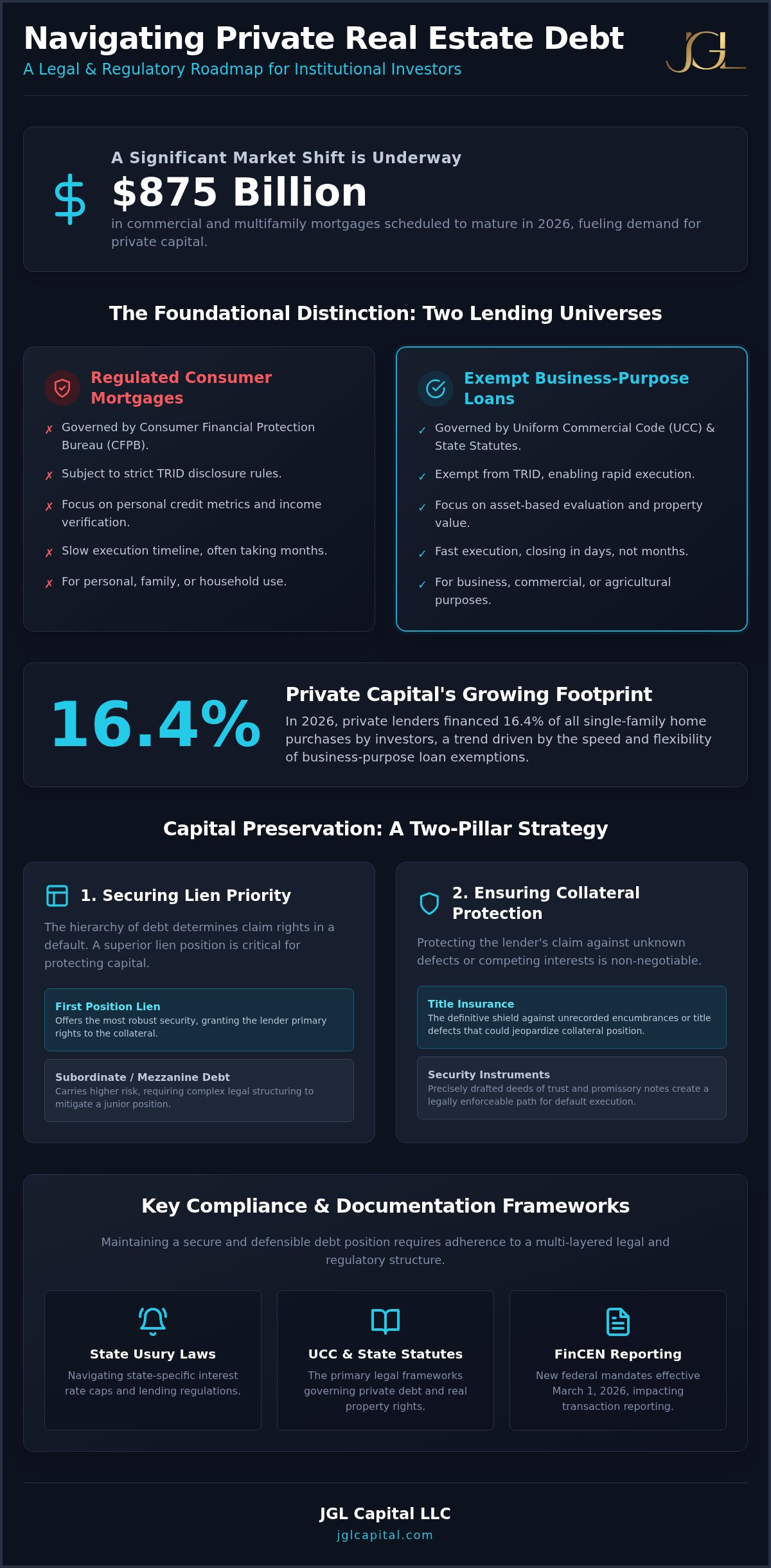
With an estimated $875 billion in commercial and multifamily mortgages scheduled to mature in 2026, the appetite for private capital is expanding, yet this growth necessitates a disciplined approach to risk mitigation. For the institutional lender, the core challenge isn’t the deployment of capital, but the navigation of the complex legal considerations for private real estate loans that vary significantly across state lines. You’re likely aware that the complexity of varying foreclosure laws and the risk of lien subordination in multi-layered capital stacks present significant hurdles to securing a durable debt position.
This article provides a rigorous analysis of the legal structures and regulatory mandates essential for sophisticated real estate debt transactions. We’ll examine the impact of the FinCEN reporting requirements effective as of March 1, 2026, and the specific federal exemptions that govern business-purpose lending. By the end of this guide, you’ll possess a clear roadmap for ensuring full compliance with evolving mandates. This roadmap establishes a legally enforceable path for default execution and exit strategy, ensuring your capital remains protected through every phase of the investment lifecycle.
Key Takeaways
- Define the critical distinction between regulated consumer mortgages and exempt business-purpose loans to ensure foundational compliance with federal mandates.
- Analyze the hierarchy of debt and the essential function of title insurance in mitigating the risk of lien subordination within complex, multi-layered capital stacks.
- Navigate the nuances of state usury laws and federal reporting requirements, including the 2026 FinCEN mandates, to maintain a secure and defensible debt position.
- Identify the core legal considerations for private real estate loans that must be articulated within promissory notes and deeds of trust to facilitate seamless default enforcement.
- Align with institutional stewards who utilize decades of pattern recognition to structure transactions that prioritize the preservation of capital and the delivery of customized debt solutions.
Understanding the Legal Landscape of Private Capital
Private real estate lending, specifically within the business-purpose sector, represents a specialized subset of the $11.7 trillion U.S. residential and commercial real estate market as of 2026. Unlike traditional retail banking, which operates under the rigorous oversight of the Consumer Financial Protection Bureau, private debt is governed primarily by the Uniform Commercial Code (UCC) and specific state-level real property statutes. These legal frameworks prioritize the contractual intent of sophisticated parties, allowing for a level of structural flexibility that’s unavailable in the highly regulated consumer mortgage space. The primary legal considerations for private real estate loans often hinge on the clear articulation of the borrower’s intent and the precise definition of the collateralized asset.
Private vs. Institutional Legal Frameworks
Traditional institutional frameworks rely on standardized underwriting and personal credit metrics, which often create rigid constraints for complex transactions. Private capital placement bypasses these limitations by shifting the legal focus from personal credit-based scrutiny toward asset-based evaluation. Hard money loans serve as a primary example of this philosophy, where the property’s intrinsic value and performance metrics serve as the foundation of the debt position. This shift carries significant legal implications, particularly regarding “fast-track” closing timelines. By operating outside the TRID (TILA-RESPA Integrated Disclosure) rules, private transactions can execute within days rather than months, provided the legal documentation accurately reflects the commercial nature of the debt.
The Concept of Business-Purpose Exemptions
The distinction between regulated consumer mortgages and exempt commercial loans is determined by the intended use of funds. To qualify for an exemption from the Truth in Lending Act (TILA), the loan must be designated for a business, commercial, or agricultural purpose rather than for personal, family, or household use. This distinction is critical because it determines whether the lender must comply with onerous disclosure requirements and interest rate caps that apply to primary residences. The business-purpose exemption allows lenders to bypass consumer protection disclosures, which fundamentally accelerates the funding cycle for time-sensitive commercial acquisitions and high-value development projects. In 2026, private lenders financed 16.4% of all investor single-family home purchases, a growth driven largely by the efficiency of these legal exemptions.
The “sophisticated investor” exemption further facilitates the placement of private capital by assuming that the parties involved possess the analytical rigor and financial resources to evaluate risk independently. This legal presumption allows for the creation of highly customized debt solutions, particularly for projects exceeding $10 million, where standardized legal templates are insufficient to address the complexities of the capital stack. By leveraging these exemptions, disciplined stewards can ensure that every strategy is clearly defined and every claim is qualified within a robust legal framework that values long-term integrity over speculative trends.
Securing the Asset: Lien Priority and Collateral Protection
The preservation of capital in high-stakes debt transactions rests upon the precision of the lien position and the integrity of the underlying security instruments. While the Federal Real Estate Loan Authority provides the statutory basis for national associations to secure interests in real property, the actual execution of private debt requires a more nuanced approach to the capital stack. First position liens offer the most robust security by granting the lender primary rights to the collateral, whereas mezzanine and subordinate debt positions necessitate complex legal structures to mitigate the inherent risk of being junior in the hierarchy. These legal considerations for private real estate loans are fundamental to ensuring that the lender’s claim remains defensible against competing interests.
Title insurance serves as the definitive shield against unrecorded encumbrances or defects that could jeopardize a lender’s collateral position. In the context of commercial assets, a comprehensive security interest often extends beyond the land and improvements to include personal property components, such as equipment or tenant fixtures. These assets require the filing of UCC-1 financing statements to perfect the lender’s interest under the Uniform Commercial Code. When managing multi-property portfolios, legal mechanisms for cross-collateralization allow lenders to tie multiple assets together, ensuring that a default on one property triggers recourse against the entire pool, thereby strengthening the overall debt position.
Establishing Absolute Lien Priority
The principle of “First in Time, First in Right” generally dictates the priority of claims, yet several legal exceptions can threaten a lender’s status if not properly addressed. Mechanic’s liens are a primary concern for new construction projects, as these claims can sometimes relate back to the commencement of work, potentially priming a later-recorded mortgage. Intercreditor agreements are vital when multiple capital sources are involved, as they establish a clear hierarchy for repayment and define the specific rights of each creditor during a workout or foreclosure. These agreements ensure that the relationship between senior and subordinate lenders is governed by predictable, contractually defined parameters rather than ambiguous statutory interpretations.
Collateral Valuation and Legal Recourse
Loan-to-Value (LTV) ratios are not merely underwriting metrics; they function as legal benchmarks that define the equity cushion available in a default scenario. Environmental indemnities further protect the lender by shifting property-related liabilities to the borrower, ensuring the debt position isn’t eroded by unforeseen remediation costs or regulatory penalties. For developers, new construction loans necessitate specific legal draw schedules to ensure that the release of funds matches the verifiable increase in collateral value. Aligning with JGL Capital LLC ensures these protective structures are rigorously enforced, providing the analytical rigor required to preserve value in complex transactions.
Regulatory Compliance: Federal and State-Level Mandates
Compliance in the private debt markets requires a meticulous understanding of the interplay between federal oversight and state-level statutes. While Federal Real Estate Lending Regulations provide a baseline for institutional standards, private lenders must navigate a more fragmented landscape. One of the primary legal considerations for private real estate loans involves the navigation of state usury laws, which establish interest rate caps to prevent predatory practices. However, these caps often apply exclusively to individuals, prompting sophisticated lenders to require that borrowers operate as legal entities, such as an LLC or C-Corp.
Usury Laws and Corporate Structuring
Structuring a loan through a corporate entity provides a layer of legal protection that aligns with the business-purpose exemption. To further insulate the transaction, disciplined lenders include a “Savings Clause” within the promissory note. This provision serves as a contractual safeguard, stipulating that if an interest rate is found to exceed the legal limit, it will automatically be reduced to the maximum allowable rate, with any excess payments applied to the principal balance. Corporate borrowing structures allow parties to circumvent individual usury caps, facilitating the deployment of capital at market-clearing rates.
Federal Oversight of Private Capital
Federal oversight has intensified with the implementation of the new FinCEN reporting requirements effective March 1, 2026. This rule mandates that certain residential real estate transfers involving trusts or entities be reported to the Financial Crimes Enforcement Network, a move designed to enhance transparency in non-financed transactions. Additionally, the Bank Secrecy Act requires private lenders to maintain robust Anti-Money Laundering (AML) and Know Your Customer (KYC) protocols. These measures ensure that the source of capital is legitimate and that the transaction doesn’t facilitate illicit financial activity.
The Dodd-Frank Act primarily targets consumer protection for primary residences, but its reach still influences the legal documentation for non-owner-occupied investment properties. Lenders must verify the business-purpose of the loan to remain outside the scope of the Truth in Lending Act (TILA). State-specific licensing also remains a critical hurdle, as private lenders must adhere to diverse regulatory frameworks that vary significantly across jurisdictions. For institutions managing assets exceeding the 2026 HMDA threshold of $59 million, the burden of data collection further emphasizes the need for analytical rigor in regulatory alignment.
SEC oversight also comes into play when real estate debt is syndicated or offered through private placements. Ensuring compliance with Regulation D ensures that capital raising activities remain within legal boundaries, protecting both the firm and its sophisticated partners from the risk of litigation. By maintaining a serious and disciplined approach to these mandates, lenders preserve the integrity of their portfolios while fostering trust with high-net-worth stakeholders.
Strategic Loan Documentation and Exit Planning
The enforceability of a debt position relies on the precision of the underlying documentation, where the Promissory Note serves as the legal heart of the obligation. While the note establishes the borrower’s personal promise to repay, the Mortgage or Deed of Trust provides the necessary security interest in the property. These instruments must clearly define the power of sale and specific foreclosure rights, as the distinction between judicial and non-judicial foreclosure can significantly impact the timeline for capital recovery. For sophisticated lenders, the primary legal considerations for private real estate loans involve the careful calibration of these documents to ensure a predictable path to resolution in the event of a default.
Sophisticated legal structuring isn’t a barrier to execution speed; rather, it’s the catalyst for rapid capital deployment. By pre-defining every contingency through rigorous documentation, parties avoid the protracted negotiations that often stall less disciplined transactions. This clarity allows for the “fast-track” closings that characterize the private debt market, provided that the legal framework is established with analytical rigor from the outset. Whether the structure is recourse, involving a personal guarantee, or non-recourse with specific “bad boy” carve-outs, the documentation must leave no room for ambiguity regarding the lender’s path to recourse.
Essential Covenants for High-Stakes Loans
Financial covenants serve as early warning systems, requiring the borrower to maintain specific performance markers such as a minimum Debt Service Coverage Ratio (DSCR) or liquidity thresholds. Negative covenants further protect the lender by restricting the borrower’s ability to further encumber the asset or alter the ownership structure without prior consent. In the context of commercial real estate loans, these performance markers ensure that the asset’s cash flow remains sufficient to service the debt while preserving the lender’s priority position throughout the loan term.
Legal Structuring of the Exit Strategy
The exit strategy is a critical legal component of the loan agreement, encompassing everything from prepayment penalties to yield maintenance provisions. These clauses protect the lender’s anticipated return by defining the legal cost of an early exit. Release clauses are equally vital in phased developments, as they legally free portions of the collateral as specific milestones are met and partial repayments are made. Understanding what is a bridge loan highlights how these instruments provide a legal bridge to permanent financing, necessitating a clear, contractually defined roadmap for the transition of debt. To ensure your next transaction is anchored in this level of professional discipline, consult with the experts at JGL Capital today.
Institutional Stewardship: How JGL Capital LLC Structures Private Debt
In a financial environment where significant commercial and multifamily maturities necessitate a disciplined intermediary, JGL Capital LLC serves as a strategic filter. We utilize over 30 years of combined industry pattern recognition to match sophisticated borrowers with capital sources that prioritize legally sound, asset-backed structures. Our role transcends simple service provision; we act as a collaborative ally to ensure that the legal considerations for private real estate loans are addressed with the analytical rigor required for high-stakes management. By focusing on the alignment of objectives, we ensure that every transaction is anchored in a framework that supports the creation and preservation of long-term worth.
While many participants in the private lending space focus on small-scale “hard money” or residential flips, JGL Capital LLC specializes in the complex architecture of transactions exceeding $10 million. This institutional-grade focus requires a deep understanding of multi-layered capital stacks and the intricate legal relationships between senior and mezzanine debt holders. We reject speculative trends in favor of timeless principles, ensuring that the legal structure of every debt position is defensible, transparent, and perfectly tailored to the unique strategic objectives of our high-net-worth stakeholders.
The JGL Brokerage Advantage
Our firm provides access to a national network of capital partners who maintain proven records of legal compliance and institutional stability. This network allows JGL Capital LLC to deliver highly customized solutions for complex multifamily and new construction projects that often fall outside the rigid constraints of traditional bank underwriting. We provide strategic guidance on capital stack optimization, ensuring that the legal considerations for private real estate loans include a clear roadmap for exit execution. This disciplined oversight ensures that the transition from bridge financing to permanent capital is seamless and contractually defined, mitigating the risk of lien subordination or unforeseen regulatory hurdles.
A Disciplined Approach to Real Estate Finance
Asset-centric underwriting de-emphasizes personal credit history in favor of a property’s intrinsic value and performance metrics, but this approach only succeeds when paired with absolute legal certainty. JGL Capital LLC maintains stability and trust through professional transparency, ensuring that every claim is qualified and every strategy is clearly articulated within the loan documentation. This commitment to integrity allows our partners to focus on their development objectives with the security of a legally enforceable debt position. Whether you’re navigating the complexities of a new construction project or a large-scale commercial acquisition, the path to a secure capital solution begins with a serious and disciplined conversation. Contact JGL Capital LLC today to discuss the financing structure of your next high-value project.
Securing the Future of High-Stakes Debt Transactions
The 2026 financial landscape requires a transition from speculative approaches to established, asset-backed principles. We’ve examined how the interplay between lien priority, state usury exemptions, and federal mandates like the March 2026 FinCEN rules creates a defensible position for capital preservation. These legal considerations for private real estate loans aren’t merely administrative hurdles; they’re the fundamental pillars of deal certainty and institutional stability. Precise documentation and a clear roadmap for exit execution ensure that sophisticated partners can deploy capital with absolute confidence.
Achieving this level of precision demands a partner who values long-term integrity above transactional speed. With over 30 years of industry expertise and a specialization in $10M+ asset-backed transactions, JGL Capital LLC provides the analytical rigor and strategic national brokerage network necessary to optimize your capital stack. We invite you to Secure Institutional-Grade Financing with JGL Capital LLC to ensure your next project is anchored in professional discipline and strategic alignment. Your legacy of value creation deserves a foundation of absolute legal certainty.
Frequently Asked Questions
Are private real estate loans subject to the same regulations as bank mortgages?
Private real estate loans operate under a distinct legal framework that prioritizes the contractual intent of sophisticated parties. They aren’t constrained by consumer protection mandates like the Truth in Lending Act; instead, private debt is primarily governed by the Uniform Commercial Code and state real property statutes. These legal considerations for private real estate loans allow for the creation of customized debt solutions that bypass the rigid underwriting standards of traditional depository institutions.
What is the legal difference between a recourse and a non-recourse loan?
The legal distinction lies in the lender’s ability to pursue assets beyond the collateralized property. A recourse loan permits the lender to seek a deficiency judgment against the borrower’s personal assets if the sale of the property doesn’t satisfy the debt. Conversely, a non-recourse loan restricts the lender’s recovery to the asset itself, though institutional agreements often incorporate specific carve-outs for acts of fraud or gross negligence.
How do state usury laws affect interest rates on private commercial loans in 2026?
State usury laws in 2026 continue to provide significant exemptions for business-purpose transactions, especially those involving corporate entities. While individual borrowers are protected by interest rate caps, these limits are frequently waived in the context of commercial-purpose debt. Lenders maintain compliance by incorporating “Savings Clauses” in promissory notes, ensuring that any rate inadvertently exceeding legal limits is automatically recalibrated to the maximum allowable threshold.
Why do private lenders often require borrowers to close in the name of an LLC?
Requiring a borrower to close in the name of an LLC serves as a primary mechanism to ensure the loan is classified as a business-purpose transaction. This structure triggers exemptions from consumer-focused regulations and usury caps that apply to individuals. It doesn’t just facilitate a more disciplined approach to asset-based underwriting; it also focuses the legal scrutiny on the property’s performance rather than the borrower’s personal credit history.
What legal protections does a first-position lien provide to a private lender?
A first-position lien establishes absolute priority in the hierarchy of debt, granting the lender primary rights to the collateral’s value. In the event of a liquidation or foreclosure, the first-position holder is satisfied in full before any proceeds are distributed to junior lienholders or mezzanine lenders. This position is a cornerstone of the legal considerations for private real estate loans, providing a secure and defensible claim against the asset.
Can a private loan agreement include a prepayment penalty?
Prepayment penalties and yield maintenance clauses are standard, legally enforceable provisions in private commercial debt agreements. These clauses are designed to protect the lender’s projected internal rate of return by defining the financial cost of an early capital exit. Such provisions ensure that the lender is compensated for the loss of interest income that results when a borrower refinances or sells the asset prior to maturity.
What happens legally if a borrower defaults on a private real estate loan?
Lenders don’t just wait; they initiate the foreclosure process as defined by the “power of sale” clause within the Mortgage or Deed of Trust. This legal mechanism allows the lender to seize and liquidate the collateral to recover the outstanding principal and interest. The specific path, whether judicial or non-judicial, depends on state statutes and the precision of the default covenants articulated in the original loan documentation.
How does a bridge loan differ from a permanent mortgage in its legal documentation?
Bridge loan documentation is characterized by its focus on transitional milestones and short-term maturity dates. Unlike permanent mortgages, which utilize long-term amortization schedules, bridge loans include specific release clauses and performance markers tailored to the project’s immediate lifecycle. These documents are structured to provide a legal bridge that remains in place only until the borrower achieves a defined exit event, such as stabilization or sale.