

The most advantageous financing structures in the 2026 private credit market are rarely presented as standard offerings; they are meticulously engineered through the strategic alignment of asset quality and sophisticated risk mitigation. While many high-net-worth stakeholders accept prevailing rates as fixed costs, the reality is that negotiating hard money loan terms remains a nuanced exercise in value preservation and capital optimization. It’s understandable if you’ve felt constrained by rigid lender requirements or opaque fee structures that don’t seem to account for the unique strengths of your specific real estate project.
We recognize that the high cost of private capital can significantly impact your project margins if left unaddressed. This guide provides the strategic framework necessary to master the sophisticated art of private capital negotiation to optimize your real estate leverage and project profitability. We’ll examine the specific mechanisms required to secure lower interest rates, achieve higher Loan-to-Value ratios, and implement flexible exit strategies that safeguard your long-term legacy through disciplined capital management.
Key Takeaways
- Identify the core components of private capital agreements, including the critical balance between interest rates, origination points, and fundamental risk metrics like LTV.
- Recognize that negotiating hard money loan terms involves more than price; it requires securing operational flexibility through extension options and customized exit strategies.
- Enhance your negotiating leverage by presenting a professional sponsor resume and a detailed project business plan that minimizes perceived lender risk.
- Adopt a methodical approach to capital acquisition by using a structured Letter of Intent to anchor negotiations and clearly define strategic objectives from the outset.
- Leverage the intellectual capital and market access of experienced private money brokers to identify lenders whose current mandates align with your specific project needs.
The Variables of Private Capital: What Constitutes Hard Money Loan Terms?
Successful asset management requires a granular understanding of the contractual levers that define private capital. These agreements aren’t monolithic; they’re composed of distinct variables that, when properly calibrated, protect project margins and enhance overall liquidity. When negotiating hard money loan terms, one must distinguish between the headline interest rate and the total cost of capital, as the latter often includes hidden friction points that can erode profitability if left unexamined.
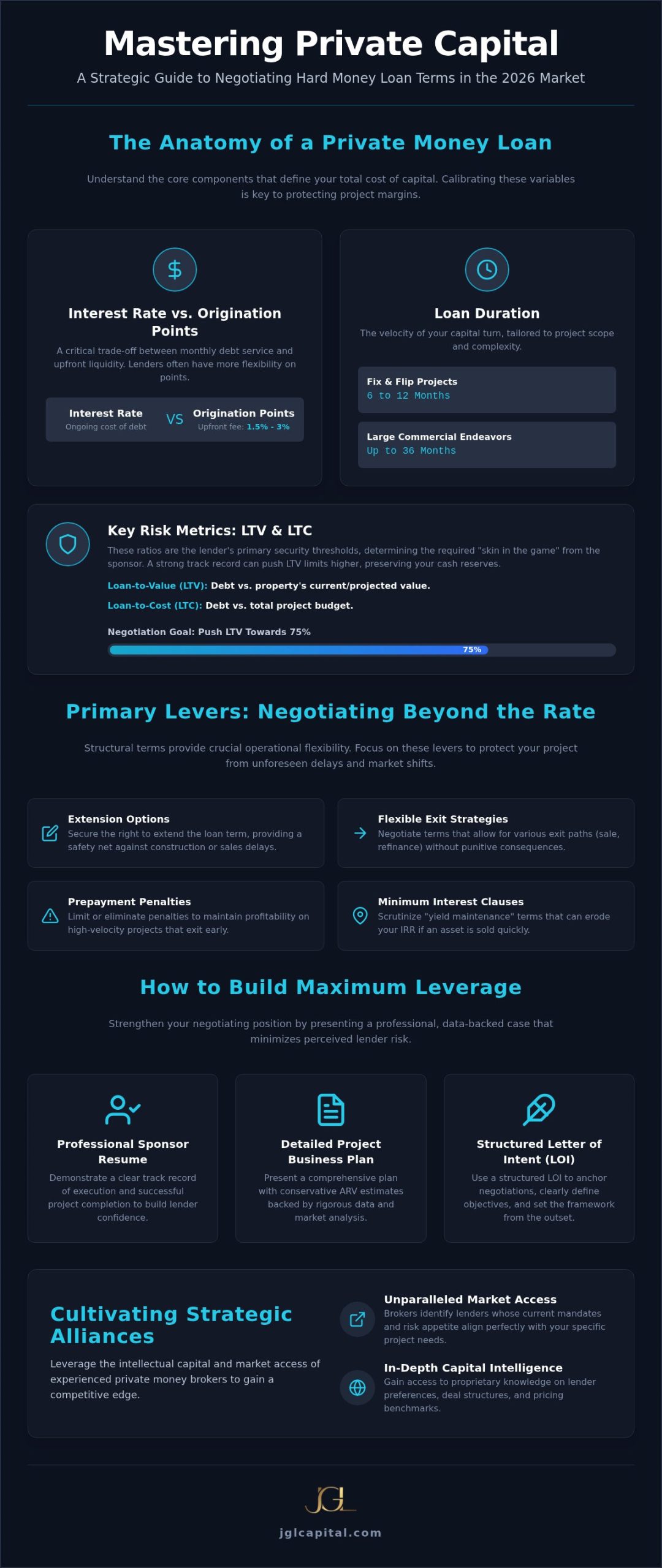
The fundamental components of any private money agreement include the interest rate, origination points, and the loan duration. Interest represents the ongoing cost of debt service, while points are upfront fees paid at closing, typically ranging from 1.5% to 3% of the loan amount in the current 2026 market. Duration dictates the velocity of the capital turn, with standard terms for fix and flip projects spanning 6 to 12 months, while larger commercial endeavors may extend to 36 months.
Risk metrics such as Loan-to-Value (LTV) and Loan-to-Cost (LTC) serve as the primary security thresholds for institutional lenders. LTV measures the debt against the property’s current or projected value, whereas LTC evaluates the loan relative to the total project budget. These ratios determine the “skin in the game” required from the sponsor, directly influencing the lender’s risk appetite and the subsequent pricing of the capital.
Understanding the distinction between hard and soft costs is equally essential for maintaining project momentum. Lenders prioritize funding for hard costs, such as physical materials and vertical construction, because these assets provide tangible collateral. This distinction is particularly relevant for those securing new construction loans, where the allocation between land acquisition and development costs dictates the draw schedule and the release of funds.
Interest Rates vs. Origination Points
There’s a constant trade-off between upfront liquidity and monthly debt service. Lenders frequently exhibit greater flexibility regarding origination points than they do with the base interest rate. This preference stems from the immediate revenue points provide to the lending institution. With global private credit assets expected to exceed $2 trillion in 2026, benchmarks have stabilized, yet the effective annual percentage rate remains a function of how these two variables interact over the loan’s lifespan. A disciplined sponsor will calculate the total cost over the projected hold period to determine which lever to prioritize.
The Significance of the LTV Ratio
The LTV ratio functions as the ultimate risk mitigation tool, providing a safety margin against market volatility. Sophisticated sponsors often seek higher leverage by emphasizing conservative After-Repair Value (ARV) estimates backed by rigorous data. By demonstrating a track record of execution, a sponsor can often push LTV limits toward the 75% threshold, thereby preserving their own cash reserves for additional opportunities. This remains a critical component of negotiating hard money loan terms effectively, as higher leverage must always be balanced against the increased cost of debt.
Primary Levers in Hard Money Negotiations: Beyond the Interest Rate
The headline interest rate is merely the beginning of a sophisticated capital discussion. Seasoned sponsors recognize that the structural integrity of a private money arrangement is often determined by secondary terms that provide essential operational breathing room. When negotiating hard money loan terms, one must look toward levers that protect the project from unforeseen market shifts or vertical construction delays. These components dictate a sponsor’s ability to pivot without incurring punitive financial consequences that could otherwise jeopardize the project’s viability.
A critical factor in this process is the evaluation of prepayment penalties and “minimum interest” clauses. These provisions are designed to ensure a lender achieves a specific yield, regardless of how quickly the project reaches its exit. For a high-velocity renovation, a six-month interest guarantee can significantly erode the internal rate of return if the asset is ready for disposition in four. Aligning these exit terms with the project’s realistic timeline is a hallmark of disciplined capital management and risk mitigation.
Extension Options and Maturity Dates
Real estate development timelines are rarely static. Securing “as-of-right” extension options at the outset provides a necessary buffer against supply chain disruptions or municipal regulatory delays. These extensions typically involve a fee, often calculated as a percentage of the remaining principal balance. While it might seem advantageous to seek the shortest possible term to minimize costs, opting for a longer initial duration can be more cost-effective than negotiating multiple short-term extensions under duress. This proactive approach ensures the sponsor maintains control over the asset’s disposition timeline.
Draw Schedules and Interest Reserve Requirements
The efficiency of a project is inextricably linked to the structure of its draw schedule. Negotiating for draws that align precisely with construction milestones ensures that capital is available when needed without carrying unnecessary interest on unutilized funds. Many institutional lenders also require an interest reserve, which is a portion of the loan set aside to cover monthly debt service. While this reduces net proceeds at closing, it preserves the sponsor’s liquidity during capital-intensive phases. Utilizing private money broker services can assist in structuring these reserves to maximize operational cash flow throughout the project lifecycle.
By focusing on these structural nuances, investors ensure their financing acts as a tool for growth rather than a source of friction. Mastering the art of negotiating hard money loan terms requires a meticulous review of every clause to ensure a perfect alignment of objectives between the sponsor and the capital provider.
Establishing Leverage Through Asset Analysis and Sponsor Strength
In the institutional lending sphere, leverage is a direct consequence of perceived risk reduction. While traditional negotiation tactics might focus on identifying a counterparty’s vulnerabilities, negotiating hard money loan terms effectively requires the sponsor to demonstrate undeniable execution capability. This is best achieved through the presentation of a professional Sponsor Resume, a document that serves as a chronological testament to past project successes and realized returns. By illustrating a consistent history of profitable exits, the sponsor transitions from a mere applicant to a preferred partner, commanding more favorable pricing based on their established reliability.
For developers seeking new construction loans, a comprehensive business plan is non-negotiable. This plan must articulate the project’s vertical development milestones and provide a rigorous analysis of the local submarket. When combined with a high-quality, third-party appraisal, these documents validate the asset’s intrinsic value and its projected After-Repair Value (ARV). This transparency allows lenders to offer higher leverage, as the uncertainty regarding the asset’s terminal value is significantly mitigated.
The Power of the Exit Strategy
A singular exit strategy is often viewed as a structural weakness. Reassuring capital providers necessitates a multi-path approach that accounts for various market conditions. Demonstrating a viable “Plan B,” such as transitioning the asset into a long-term hold via DSCR loans, provides a safety net that protects the lender’s principal. Aligning the initial loan term with realistic market absorption rates ensures that the sponsor isn’t forced into a distressed sale, further strengthening their position during the initial term discussions. This forward-thinking approach signals a disciplined management style that values long-term stability over speculative gains.
Documentary Rigor as a Negotiation Tool
Professional discipline is signaled through the meticulous preparation of “deal books.” These comprehensive dossiers should include specific, high-fidelity data points that leave little room for ambiguity. Providing this level of documentary rigor reduces the “uncertainty premium” that lenders typically bake into their rates. When a sponsor responds with speed and precision, it fosters a collaborative relationship rooted in mutual trust. This transparency is a potent tool when negotiating hard money loan terms, as it allows the lender to underwrite the deal with greater confidence. Essential components of a deal book include:
- Fully executed contractor bids and detailed line-item budgets.
- Approved municipal permits or a clear path to entitlement.
- Recent market comparables that reflect the specific 2026 landscape.
- A clear timeline for project completion and disposition.
By presenting a case founded on analytical rigor and documented history, the sponsor shifts the focus from a transactional request to a strategic alliance. This method ensures that every claim is qualified and every strategy is clearly defined, reinforcing the sponsor’s position as a leader in their field who values precision over speed.
A Disciplined Methodology for Executing the Negotiation Process
Execution of a real estate strategy requires a structured approach to capital procurement. Negotiating hard money loan terms is a process best initiated through a formal Letter of Intent (LOI). This document serves as the anchor for all subsequent discussions, articulating the sponsor’s preferred terms with analytical clarity. By presenting a well-reasoned initial offer, the sponsor establishes a baseline that reflects the project’s intrinsic value rather than passively accepting a lender’s standard pricing. Lenders don’t always lead with their most aggressive terms; it’s the sponsor’s responsibility to define the starting point of the dialogue.
A sophisticated negotiator identifies the lender’s internal objectives. These often center on capital deployment speed or the management of risk concentration as the U.S. private lending market grows toward an estimated $339.22 billion in 2026 according to data from Mordor Intelligence. If a lender is seeking to diversify their portfolio, they may offer concessions in exchange for a certainty of close. Maintaining an institutional posture throughout this phase ensures that the dialogue remains focused on the alignment of strategic objectives rather than a transactional tug-of-war. Trust is built through this steady, cumulative presentation of principles.
The Initial Inquiry and Term Sheet Review
Comparing multiple term sheets is vital for determining the current market equilibrium for specific asset classes. This comparative analysis reveals discrepancies in fees, such as underwriting charges or origination points that may deviate from the industry standard of 1.5% to 3%. Sponsors should ask targeted questions regarding LTV improvements. Specifically, inquire what adjustments to the project’s risk profile could unlock higher leverage or lower points. This methodical inquiry signals a level of professional discipline that institutional lenders respect and reward with more favorable terms.
Closing the Gap: Concessions and Compromise
A disciplined negotiation often involves a “give-to-get” strategy. For instance, offering an expedited closing timeline might justify a reduction in origination fees. However, one must recognize when terms jeopardize project feasibility. If a lender isn’t willing to move on points that erode the margin of safety, walking away is the only professional choice. When a consensus is reached, ensure all negotiated points are meticulously reflected in the final hard money loan documents, as the discipline of negotiating hard money loan terms is only as effective as the final executed agreement.
To ensure your capital structure is optimized through a disciplined negotiation process, engage JGL Capital LLC for institutional-grade brokerage support.
Cultivating Strategic Alliances with Private Money Brokers
The acquisition of private capital is fundamentally a collaborative endeavor rather than a mere series of isolated transactions. While individual sponsors may possess significant project-specific knowledge, they often lack the “pattern recognition” required to navigate the shifting mandates of institutional lenders. Engaging in negotiating hard money loan terms through a professional intermediary provides a layer of strategic advocacy that direct-to-lender inquiries cannot replicate. This approach allows the sponsor to leverage the broker’s established history and intellectual capital to identify which capital providers are currently aggressive on specific terms, such as higher LTV ratios or reduced origination points.
JGL Capital LLC utilizes over 30 years of industry expertise to act as a disciplined steward for sophisticated borrowers. By positioning a loan request within a broader portfolio strategy, we ensure that every financing arrangement contributes to the long-term preservation and generation of worth. This perspective transforms the borrowing process from a reactive necessity into a proactive component of a lasting legacy. Our national reach allows us to represent complex commercial and residential projects with the analytical rigor required to secure optimal placement in a competitive credit environment.
The Broker as a Strategic Intermediary
Accessing “off-market” capital sources is a primary advantage of the broker-led model. Many institutional funds and private credit platforms don’t interface directly with the public, preferring to work with trusted partners who can “pre-underwrite” deals to ensure they meet specific risk appetites. Having an advocate during the what is a bridge loan structuring process ensures that transitional capital is deployed efficiently. This professional oversight reduces the time-to-close and ensures that the structural nuances of the agreement are meticulously aligned with the sponsor’s operational requirements.
Building a Repeatable Capital Engine
The ultimate objective of a strategic alliance is the transition from transactional borrowing to a collaborative partnership. In high-stakes real estate management, the “certainty of execution” often carries more weight than the lowest possible headline rate. A lender who understands a sponsor’s long-term objectives is more likely to provide flexibility during periods of market volatility. By fostering these relationships, JGL Capital LLC helps sponsors build a repeatable capital engine that supports continuous growth. This commitment to integrity and deliberate action ensures that negotiating hard money loan terms remains a predictable, value-added component of the sponsor’s overall investment philosophy.
Optimizing Your Capital Structure for Long-Term Value
Securing optimal financing in the 2026 private credit market requires a transition from transactional requests to a disciplined, analytical framework. It’s essential to recognize that negotiating hard money loan terms effectively involves calibrating structural levers, such as extension options and draw schedules, while demonstrating execution capability through a rigorous sponsor resume. By prioritizing transparency and documentary rigor, you reduce the uncertainty premium and align your project’s objectives with the lender’s risk appetite. This methodical approach ensures that your capital structure acts as a catalyst for growth rather than a source of financial friction.
JGL Capital LLC provides the strategic guidance required for high-net-worth stakeholders to navigate these complex capital markets with confidence. With 30+ years of private capital expertise, we specialize in $10M+ complex transactions that demand a sophisticated approach to value preservation and long-term asset growth. Consult with JGL Capital LLC to optimize your financing terms today. We’re committed to helping you build a lasting legacy through disciplined capital management and the cultivation of strategic alliances that endure beyond a single project.
Frequently Asked Questions
Can you actually negotiate terms with a hard money lender?
Yes, private capital is inherently flexible and designed for customization based on the specific risk profile of the asset. Institutional lenders often prefer tailored agreements over rigid, one-size-fits-all products. This flexibility allows for negotiating hard money loan terms that align with your project’s specific cash flow requirements and exit strategy. Success depends on presenting a case grounded in analytical rigor and documented execution capability.
What is the most negotiable part of a hard money loan?
Origination points and extension options are frequently the most negotiable components of a private money agreement. Lenders often prioritize immediate capital deployment and upfront yield, making them more willing to adjust points than the base interest rate. Additionally, securing “as-of-right” extensions provides essential operational flexibility. By focusing on these structural levers, a sponsor can preserve liquidity without significantly altering the headline cost of debt.
How does my experience as an investor affect my ability to negotiate?
Your track record serves as a primary risk mitigation tool for any capital provider. Experienced investors who demonstrate a history of successful exits and professional management are viewed as lower-risk partners. This established reliability allows for more aggressive negotiating hard money loan terms, as lenders are often willing to provide “preferred borrower” pricing to sponsors with proven execution capability. New investors must rely more heavily on asset quality.
Should I negotiate interest rates or origination points first?
The priority depends entirely on your projected hold period and project velocity. For high-velocity projects lasting under six months, reducing upfront origination points often yields the greatest impact on your internal rate of return. Conversely, for longer-term commercial or rental endeavors, a lower interest rate provides superior ongoing debt service coverage. A disciplined sponsor calculates the total cost of capital over the entire lifecycle before initiating the negotiation.
Is it possible to negotiate the LTV (Loan-to-Value) ratio?
Negotiating a higher LTV is possible when supported by rigorous data and conservative After-Repair Value estimates. Lenders are often willing to increase leverage if the sponsor provides high-quality third-party appraisals and a detailed budget that clarifies the project’s intrinsic worth. This allows you to preserve cash for other opportunities while maintaining a sufficient safety margin. Demonstrating significant “skin in the game” through equity further reassures the capital provider.
What documents should I prepare to increase my negotiation leverage?
Preparing a comprehensive “deal book” is essential for establishing professional leverage. This dossier should include a professional sponsor resume, detailed contractor bids, and approved municipal permits. Providing this level of documentary rigor signals professional discipline and reduces the “uncertainty premium” typically found in private lending. When a sponsor presents a transparent, data-driven case, it fosters a collaborative relationship rooted in mutual trust and institutional stability.
When is the best time to start negotiating loan terms?
The optimal time to initiate the dialogue is during the preliminary Letter of Intent phase. This early stage allows you to anchor the negotiation with a well-reasoned offer that reflects your project’s specific strengths. Waiting until the final term sheet is issued often limits your ability to influence structural components like draw schedules or prepayment penalties. Establishing your strategic objectives early ensures that the final agreement remains a collaborative alliance.
How do I know if a hard money term sheet is competitive?
A competitive term sheet is identified through a methodical comparison of multiple offers and the calculation of the effective APR. You must look beyond the headline interest rate to identify hidden fees, such as excessive underwriting charges or draw inspection costs. Utilizing a professional broker’s pattern recognition can also help you determine if the proposed terms align with current market benchmarks for your specific asset class and geographical region.