

A hard money term sheet is not merely a preliminary pricing document; it is a strategic framework that dictates project liquidity and risk allocation across the entire investment lifecycle. For the institutional investor, the delta between an optimized capital stack and a compromised margin often rests within the technical nuances of these private capital agreements. Truly understanding a hard money term sheet requires a disciplined approach to analyzing how specific clauses, from draw requirements to restrictive exit covenants, interact with your long-term strategic objectives.
You’ve likely encountered the erosion of profit margins caused by unforeseen fees or the operational friction of misunderstood draw schedules during a critical build phase. This article provides the analytical framework necessary to evaluate these offers with the same rigor you apply to asset selection. We’ll detail how to align financing with project timelines and preserve equity through the precise calibration of leverage. By the end of this discussion, you’ll possess the insights needed to transform private debt into a sophisticated tool for the preservation and generation of worth, ensuring your capital partner acts as a disciplined steward of your project’s success.
Key Takeaways
- Recognize that it’s a strategic blueprint for risk allocation, serving as the foundational document for institutional trust and project viability.
- Enhance capital stack optimization by understanding a hard money term sheet through the precise differentiation of Loan-to-Value (LTV) and Loan-to-Cost (LTC) parameters.
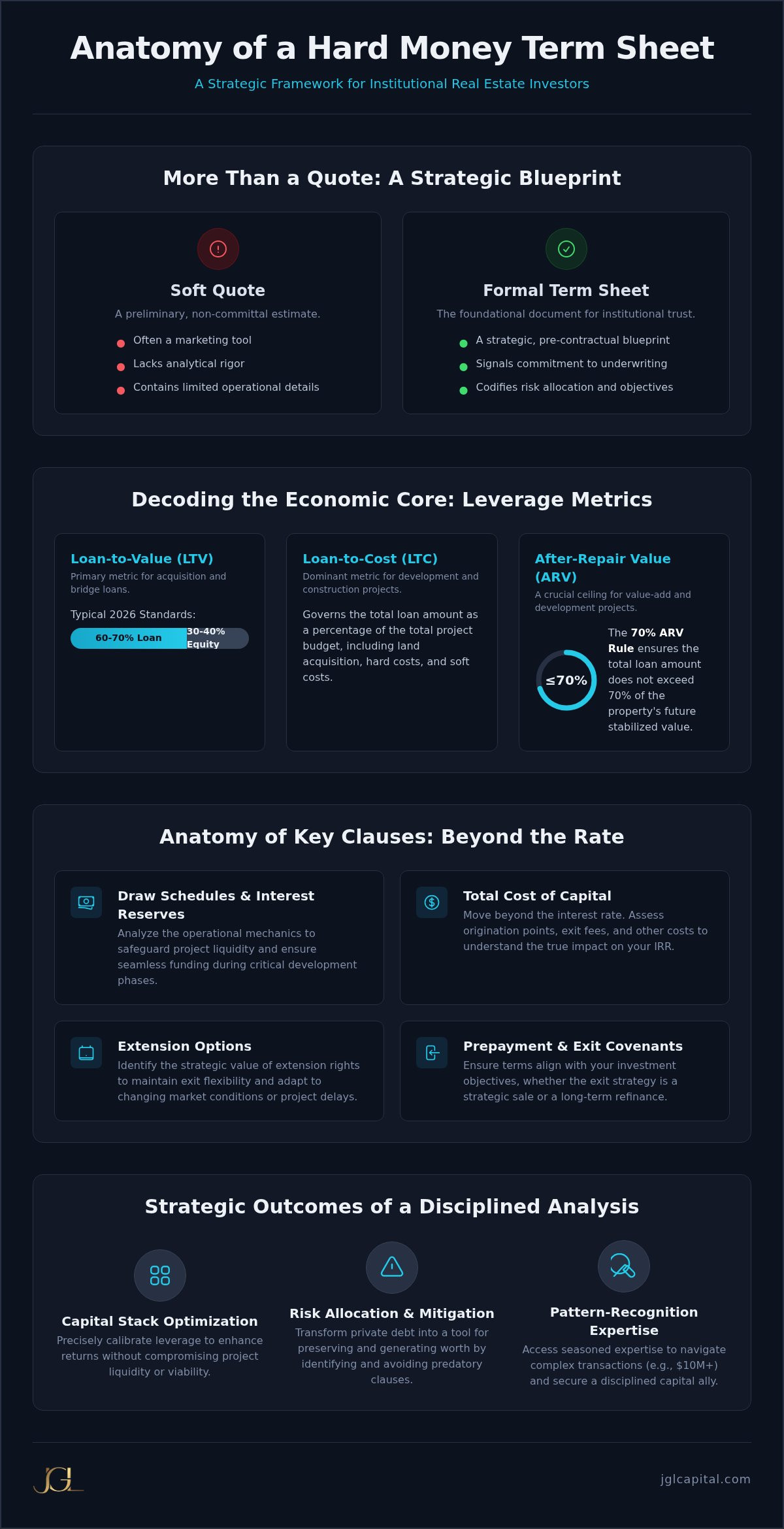
- Safeguard project liquidity by analyzing the operational mechanics of draw schedules and interest reserves to ensure seamless funding during critical development phases.
- Identify the strategic value of extension options and prepayment clauses to maintain exit flexibility and align financing with your investment objectives.
- Access seasoned pattern-recognition expertise to navigate the complexities of $10 million plus institutional transactions and secure a committed capital ally.
The Strategic Significance of the Hard Money Term Sheet
The term sheet functions as a pre-contractual blueprint, delineating the essential economic and operational parameters of a private capital allocation. In high-stakes real estate management, this document serves as the primary foundation for institutional trust. It ensures that both the borrower and the lender maintain an alignment of objectives before significant resources are committed to the formal underwriting process. A Hard money loan requires a rigorous level of transparency, and the term sheet is where that transparency is first codified. Understanding a hard money term sheet is a prerequisite for ensuring that the financing does not become a liability as the project progresses.
Sophisticated investors recognize the critical distinction between a soft quote and a firm term sheet. A soft quote is often a marketing tool, lacking the analytical rigor of a disciplined capital partner. Conversely, a formal term sheet signals a commitment to move toward a definitive agreement. Relying on pattern-recognition expertise allows seasoned professionals to identify deal structures that offer strategic flexibility versus those that contain predatory clauses. This distinction is vital for maintaining project viability in volatile markets, where the certainty of execution is as valuable as the capital itself.
Defining the Document: More Than a Quote
While a term sheet is generally non-binding regarding the final funding, its legal standing is significant as it sets the rules of engagement for the due diligence phase. It initiates the transition from conceptual discussion to active underwriting, providing the framework through which the asset’s value and the project’s viability are measured. Within the context of professional resource management, the term sheet is a strategic alignment tool that transforms a complex financing request into a structured capital solution. It serves as a roadmap for the collaborative relationship between the steward of capital and the developer, ensuring that every claim is qualified and every strategy is clearly defined.
The Investor’s Perspective: Capital Allocation vs. Cost
Evaluating a proposal requires moving beyond the surface-level interest rate to assess the total cost of capital. This includes origination points, exit fees, and the impact of leverage on project liquidity. For institutional stakeholders, understanding a hard money term sheet involves verifying that the financing structure supports the specific exit strategy of the asset, whether that involves a refinance or a strategic sale. Stability is paramount. A partner who demonstrates a disciplined approach to value preservation provides the certainty required for long-term project success. Aligning these terms with the asset’s lifecycle ensures that the capital stack remains optimized throughout the duration of the hold period.
Deciphering the Economic Core: Leverage, Pricing, and Capital Stack
The economic variables within a term sheet dictate the project’s financial equilibrium. In the 2026 economic environment, these metrics have shifted to reflect higher baseline interest rates and a more cautious approach to asset-backed risk. For the institutional borrower, the primary objective is capital stack optimization. This requires a precise calibration of leverage against the asset’s projected performance. It’s about the balance. A term sheet that provides excessive leverage without a corresponding alignment in pricing can inadvertently compromise the internal rate of return (IRR) by inflating debt service requirements beyond the property’s cash flow capacity.
Leverage Metrics: LTV, LTC, and ARV
Lenders utilize different metrics depending on the project’s lifecycle. Loan-to-Value (LTV) typically governs bridge and acquisition scenarios. Current 2026 standards require borrowers to maintain 30% to 40% equity in a property for a refinance, which translates to a 60% to 70% LTV. Conversely, Loan-to-Cost (LTC) is the dominant metric for development. Understanding a hard money term sheet involves recognizing how these ratios interact with the 70% After-Repair Value (ARV) rule. This rule ensures the total loan amount doesn’t exceed 70% of the property’s future value. Strategic developers often utilize new construction loans to maximize their leverage while maintaining rigorous cost controls and sufficient skin-in-the-game to satisfy institutional risk parameters.
The Real Cost of Private Capital
Pricing is more than just the coupon rate. While first-position interest rates currently range from 9.5% to 13%, the total cost of capital includes origination points and administrative fees. Industry standards for origination points sit between 1.5 and 3 points. These are calculated based on the total commitment, not just the initial funding. Institutional partners must weigh the Pros and Cons of Hard Money when evaluating these fees against the speed and flexibility provided by private debt. Interest-only payment structures are common, serving to preserve monthly project cash flow during the renovation or construction phase. However, the impact of these payments on the project’s overall liquidity requires careful modeling. A disciplined steward of capital looks beyond the headline rate to understand how processing and underwriting fees affect the net proceeds at closing, ensuring that every dollar allocated contributes to the generation of worth.
Operational Covenants: Draw Schedules, Holdbacks, and Liquidity
Operational covenants represent the engine room of a private capital agreement. While pricing dictates the cost, these covenants dictate the pace and feasibility of execution. Institutional investors often find that the administrative friction within these clauses carries a higher risk profile than the interest rate itself. Precision is mandatory. Understanding a hard money term sheet necessitates a granular analysis of how draw schedules and interest calculations impact project-level liquidity during the most intensive phases of development.
Managing the Draw Process for New Construction
For developers utilizing new construction loans, the draw schedule is the most critical operational document. It outlines the specific milestones required for fund disbursement, including third-party inspections and the submission of unconditional lien waivers. Stalls in funding often occur when the borrower and lender haven’t aligned on the documentation standards required for each tranche. The administrative burden of construction draws often serves as a silent friction point that can derail even the most disciplined development timelines.
A significant factor in the total cost of capital is the distinction between interest on drawn funds and “Dutch Interest,” where the borrower pays interest on the total loan commitment from day one. This choice alone can shift the project’s internal rate of return by several percentage points. A meticulously calibrated draw schedule ensures that capital is deployed in lockstep with value creation, thereby insulating developer equity from unnecessary erosion. To maintain momentum, sophisticated partners establish clear protocols for standardizing inspection reporting timelines and pre-approving third-party inspectors to reduce scheduling delays.
Reserves and Holdbacks: Protecting the Asset
Holdbacks and interest reserves serve as the lender’s primary risk mitigation tools. In the context of bridge loans, capital expenditure holdbacks ensure that funds for stabilization are preserved and spent solely on value-add improvements. These reserves are typically calculated based on the debt service coverage ratio or a fixed period of interest-only payments to bridge the gap until the asset reaches its target performance metrics.
As noted in the Forbes guide to hard money lenders, the structure of these reserves can vary significantly between institutional platforms. A disciplined steward of capital uses these holdbacks to provide a safety net for the asset during the lease-up or renovation phase. Understanding a hard money term sheet means recognizing that these funds, while technically borrowed, remain under the lender’s control until specific performance hurdles are met. This disciplined approach ensures that the project remains solvent and aligned with the long-term strategic objectives of all stakeholders.
Evaluating Flexibility: Extensions, Prepayment, and Exit Alignment
Strategic flexibility isn’t a luxury in institutional real estate; it’s a structural requirement for effective risk mitigation. Understanding a hard money term sheet requires a precise evaluation of how exit provisions align with the asset’s projected lifecycle and current market conditions. If a project reaches stabilization ahead of schedule, a restrictive minimum interest clause can effectively penalize efficiency by forcing the borrower to pay for capital they no longer require. Conversely, in a market where permanent financing liquidity fluctuates, the presence of pre-negotiated extension options provides a necessary buffer against maturity risk. Lenders scrutinize your exit strategy with the same rigor you apply to your pro forma, often verifying the feasibility of transitioning into permanent commercial real estate loans before issuing a commitment.
Exit Strategy and Prepayment Nuances
The structure of prepayment penalties often dictates the viability of a short-term investment. Yield maintenance and step-down structures are common in institutional debt, designed to protect the lender’s anticipated return. However, for transitional assets or fix-and-flip scenarios, prioritizing zero-prepayment-penalty terms is essential to maintain liquidity. For those seeking a long-term hold, DSCR loans represent a primary exit for bridge financing. Ensuring the initial term sheet doesn’t contain “lock-out” periods that hinder this transition is a critical step in capital stack optimization. A disciplined steward of capital ensures that the debt structure remains a tool for growth rather than an obstacle to strategic disposition.
The Cost of Time: Extension Clauses
Time is the fundamental enemy of the internal rate of return. A project that overruns its timeline by even a single quarter faces a significant drag on equity multiples due to compounding debt service. Negotiating extension fees, typically expressed as a percentage of the loan balance, should occur during the initial term sheet phase rather than under the duress of a looming maturity date. Distinguishing between discretionary extensions, which require unilateral lender approval, and automatic extensions, which trigger upon meeting specific performance hurdles, is a hallmark of sophisticated capital management. Flexibility is often worth a premium, provided that the conditions for that flexibility are clearly codified and achievable.
Beyond the economic parameters, the term sheet outlines the boundaries of asset-backed recourse through default clauses and “bad boy” guaranties. These provisions serve as a deterrent against unauthorized actions, reinforcing the gravity of the high-stakes management involved. For investors seeking to navigate these complexities with a partner who prioritizes strategic alignment, consult with the experts at JGL Capital LLC to optimize your next institutional transaction.
Executing with Confidence: The JGL Capital Strategic Alliance
Navigating the transition from a preliminary agreement to a funded transaction requires more than technical proficiency; it demands a partner who functions as a strategic ally. Understanding a hard money term sheet is the first step, but the subsequent execution phase is where the preservation of value is truly tested. JGL Capital utilizes over 30 years of combined industry experience to identify the most favorable structures among leading hard money lenders and across the broader national market. By specializing in allocations exceeding $10 million, the firm acts as a discreet steward for sophisticated partners, ensuring that the gravity of high-stakes management is met with analytical rigor rather than marketing hyperbole.
The benefit of a broker-first model lies in the ability to access a broad network of alternative capital, which allows for the delivery of highly customized, individual solutions. This approach moves the relationship from a transactional provision of funds to a collaborative strategic alliance. Every strategy is clearly defined, and every claim is qualified through a methodical presentation of principles. This disciplined pace suggests a firm that takes the time to conduct thorough analysis, valuing precision over speed to build a lasting legacy through careful, deliberate action.
The JGL Capital Advantage: Precision and Speed
Underwriting focuses on the underlying asset value and project scope rather than relying solely on personal credit metrics. This specialized approach is designed for the pace of professional developers who require certainty of execution. We don’t rely on speculative trends, prioritizing instead a return to the fundamental principles of asset-backed finance. Transparency remains our linguistic signature. We ensure that every nuance of the capital stack is articulated within the term sheet, rejecting the ambiguity common in less sophisticated platforms. It’s about stability. Our commitment to clear communication instills a sense of security in high-net-worth stakeholders, emphasizing a serious approach to the creation and preservation of worth.
Securing Your Next Allocation
Professional sponsorship and clear documentation are the primary vehicles for establishing institutional trust. Understanding a hard money term sheet within the JGL ecosystem involves a collaborative review of project fundamentals to ensure a complete alignment of objectives. This process ensures that the financing structure supports your long-term investment goals while protecting project-level liquidity. Initiating a strategic consultation with our senior leadership allows for the precise articulation of your strategic goals. This measured and steady rhythm mirrors our patient approach to long-term growth, ensuring that your capital stack is optimized for the entire investment lifecycle.
Contact JGL Capital for a strategic capital consultation to align your next project with a partner dedicated to your long-term success and the generation of significant worth.
Optimizing the Capital Stack for Long-Term Value Preservation
Mastering the technical nuances of private debt allows institutional investors to maintain project liquidity while safeguarding their internal rate of return. Understanding a hard money term sheet is the critical first step in transforming a financing agreement into a collaborative strategic alliance. By precisely calibrating leverage, draw schedules, and exit provisions, you ensure that your capital allocation remains a tool for wealth generation rather than a source of operational friction. This disciplined approach to documentation protects developer equity and ensures project viability even in volatile market cycles.
JGL Capital brings over 30 years of industry pattern recognition to every transaction, specializing in the complex requirements of $10 million plus commercial assets. Our national reach and commitment to institutional-grade execution provide the stability required for high-stakes management. We act as a discreet steward for your strategic objectives, offering the analytical rigor necessary to navigate the alternative capital markets with confidence. It’s our priority to ensure your financing is perfectly aligned with your long-term vision. Secure strategic private capital for your next project with JGL Capital. We look forward to building a lasting legacy together.
Frequently Asked Questions
What is the difference between a hard money term sheet and a commitment letter?
A term sheet serves as a preliminary, non-binding blueprint outlining the proposed economic and operational parameters of a transaction, whereas a commitment letter represents a formal obligation issued after the completion of comprehensive underwriting. The term sheet initiates the due diligence phase to ensure an alignment of objectives between all parties. Conversely, the commitment letter signifies the lender’s definitive intent to fund, contingent only upon the satisfaction of specific closing conditions and final legal documentation.
Can I negotiate the interest rate or points on a hard money term sheet?
Borrowers may negotiate the interest rate and origination points, provided the request is supported by analytical rigor and project-specific merits. Lenders often adjust these economic variables based on the sponsor’s track record, the asset’s loan-to-value ratio, and the overall complexity of the capital stack. Understanding a hard money term sheet allows sophisticated investors to leverage their pattern-recognition expertise to advocate for terms that better align with their project’s internal rate of return objectives.
What are ‘junk fees’ and how can I identify them on a private money term sheet?
Junk fees are non-standard administrative charges that do not correspond to a specific, value-added service during the underwriting or closing process. These are often identified as inflated “processing,” “document review,” or “underwriting” fees that exceed industry norms for high-stakes management. A disciplined steward of capital scrutinizes the term sheet to ensure that every administrative cost is clearly defined and justified by the operational complexity of the transaction, preventing the erosion of project profit margins.
How long is a typical hard money term sheet valid before it expires?
A typical hard money term sheet remains valid for a period of 7 to 14 days, reflecting the rapid pace of the private capital sector. This expiration window ensures that the proposed pricing and leverage metrics remain aligned with the prevailing economic environment and the lender’s current liquidity requirements. Investors must act with precision to execute the document and initiate the due diligence phase before the offer expires, as market volatility can necessitate a timely recalibration of terms.
What happens if my project timeline exceeds the term listed on the sheet?
If a project timeline exceeds the initial loan term, the borrower must typically exercise a pre-negotiated extension option or request a discretionary renewal from the lender. These extensions usually require the payment of additional points and may be contingent upon the project meeting specific performance hurdles or stabilization milestones. Failure to address a looming maturity date can result in default interest rates or the initiation of asset-backed recourse, making the negotiation of extension clauses a strategic priority.
Is a hard money term sheet legally binding for the lender or the borrower?
A hard money term sheet is generally not legally binding regarding the final allocation of capital, though specific clauses such as confidentiality and expense reimbursement often carry legal weight. It functions as a roadmap for the collaborative relationship rather than a definitive contract. Both the lender and the borrower retain the right to withdraw from the transaction during the due diligence phase if the asset’s fundamentals or the sponsor’s claims don’t meet the required institutional standards.
How do lenders determine the LTV and ARV listed on the term sheet?
Lenders determine Loan-to-Value (LTV) and After-Repair Value (ARV) through a combination of independent third-party appraisals and internal feasibility analyses. This process involves a rigorous examination of comparable market data, current replacement costs, and the projected income potential of the stabilized asset. By prioritizing property value over personal credit, the lender ensures that the capital stack remains optimized and that the asset provides sufficient collateral to mitigate institutional-grade risk during the entire investment lifecycle.
Why do some hard money term sheets require an interest reserve?
An interest reserve is required to ensure consistent debt service during the construction or stabilization phase when the asset is not yet generating sufficient cash flow. This reserve is typically funded at closing and held in escrow to cover interest-only payments for a specified duration. Understanding a hard money term sheet involves recognizing that these reserves serve as a risk mitigation tool, protecting the project’s solvency and ensuring that the lender’s return objectives are met without stressing the developer’s liquidity.