

The most sophisticated real estate investors recognize that the total cost of private capital is not a liability to be minimized, but a strategic premium paid for the preservation of equity and the acceleration of acquisition timelines. You likely understand that while interest rates often capture the headlines, the true complexity of a high-stakes transaction resides within the nuances of the closing statement. Analyzing typical hard money loan fees requires a disciplined approach to ensure that every basis point contributes to the successful execution of your investment strategy rather than the erosion of your project’s terminal value.
This guide provides an institutional-grade breakdown of origination points, administrative costs, and ancillary fees to help you optimize your capital structures with precision. We’ll establish a clear framework for evaluating loan offers by identifying the delta between interest rates and total closing costs. By the conclusion of this analysis, you’ll possess the specialized knowledge required to distinguish between legitimate service fees and predatory charges, ensuring that your partnerships remain rooted in transparency and mutual alignment.
Key Takeaways
- Recognize that origination points, typically ranging from 1.5 to 3 percent, function as a strategic premium for capital access and the expedited execution of asset-based underwriting.
- It’s essential to develop a comprehensive understanding of typical hard money loan fees, encompassing processing, underwriting, and legal review, to eliminate ambiguity within the final closing statement.
- Distinguish the nuanced roles of broker and lender fees to facilitate a transparent alignment between your project’s capital requirements and institutional sourcing strategies.
- Quantify the impact of ancillary costs on your project’s internal rate of return (IRR) to ensure that capital structures remain optimized for long-term value preservation.
- Leverage institutional expertise to navigate the complexities of high-value transactions, ensuring that capital allocation for projects exceeding $10 million is both disciplined and strategically sound.
The Financial Architecture of Private Capital: Understanding the Premium for Speed
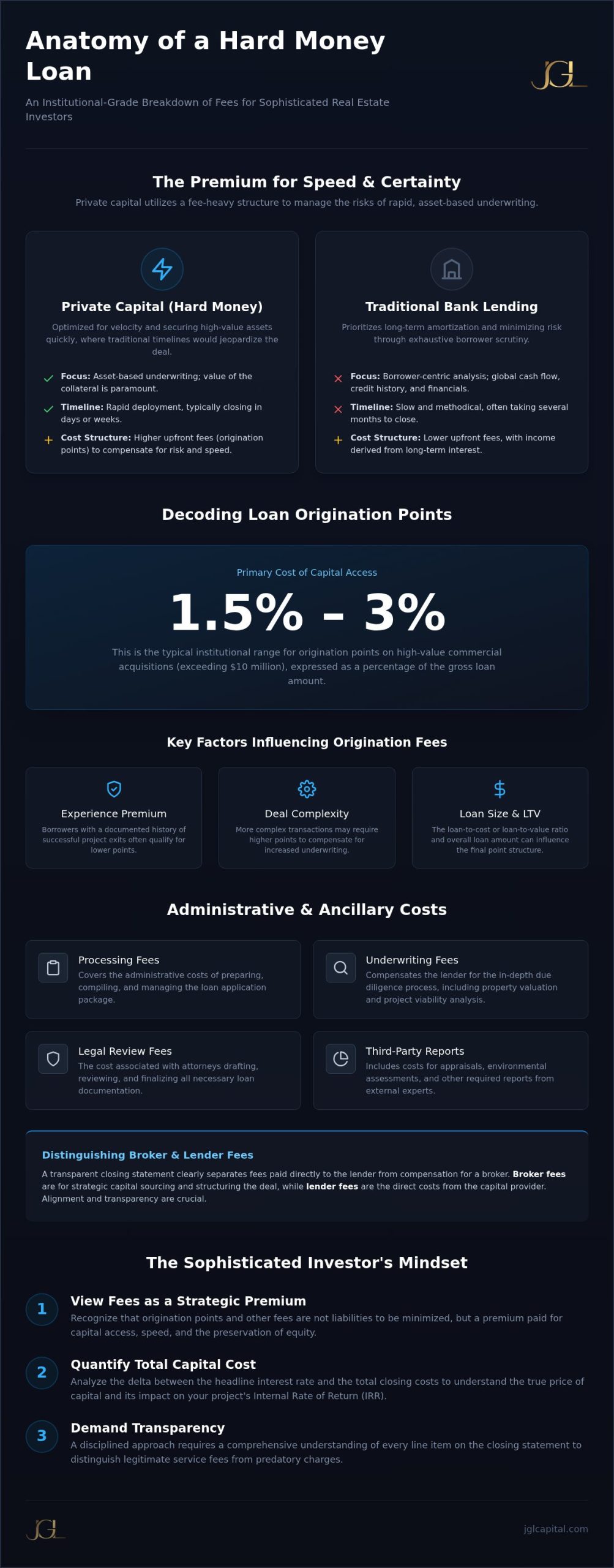
Within the ecosystem of sophisticated real estate finance, the cost of capital is fundamentally tied to the velocity of its deployment. A hard money loan serves as a specialized instrument designed for scenarios where traditional institutional timelines would jeopardize a project’s viability. Unlike conventional banking models that prioritize interest income derived from long-term amortization, private capital utilizes a fee-heavy structure to manage the risks inherent in rapid, asset-based underwriting. It’s a deliberate framework where the borrower pays a premium for certainty and speed, rather than for the privilege of a low-interest, slow-moving debt obligation.
Private money fee structures are distinct because they represent a risk-adjusted capital allocation that favors the asset over the individual. While a bank might spend months scrutinizing a borrower’s global cash flow, a private lender focuses on the collateral’s intrinsic value and the project’s exit strategy. The typical hard money loan fees seen in 2026 reflect this meticulous calculation of risk. By charging higher upfront costs, lenders can provide the liquidity necessary for high-stakes acquisitions without the exhaustive contingencies required by traditional mortgage underwriters. This strategic trade-off allows seasoned investors to secure properties that would otherwise be lost to more agile competitors.
Asset-Based Underwriting vs. Traditional Scrutiny
The primary differentiator in private capital is the shift from borrower-centric analysis to asset-centric valuation. By focusing on the property’s potential rather than the borrower’s historical credit performance, lenders can drastically compress the due diligence timeline. This streamlined approach provides investors with significant competitive bidding power in high-demand markets. While the entry costs are higher, the opportunity cost of losing a deal to a slower, low-fee lender often far outweighs the premium paid for private capital. It’s about securing the asset first and optimizing the long-term debt later.
For investors targeting specific regional markets, such as the Kansas City area, localized expertise can be invaluable; you can learn more about KC Home Offers LLC to see how regional investment firms align their lending strategies with these asset-centric principles.
2026 Market Dynamics and the Cost of Private Capital
As we navigate the fiscal environment of 2026, the cost of private capital remains sensitive to broader economic shifts and institutional risk appetites. Typical hard money loan fees are influenced by the secondary markets that provide the liquidity for these high-value deals. Current dynamics suggest that while interest rates may fluctuate, the requirement for upfront points serves as a stabilizing force for lenders. This ensures that capital remains available for complex projects, even during periods of volatility. Strategic partners who understand these mechanics can better align their capital structures with their long-term project objectives, treating fees as a necessary component of a successful acquisition strategy.
Decoding Loan Origination Points: The Primary Cost of Capital Access
Origination points represent the most significant component of the upfront capital requirement. Expressed as a percentage of the gross loan amount, these fees compensate the lender for the immediate commitment of capital and the administrative burden of rapid deployment. While speculative sources often cite origination points reaching double digits, the institutional reality in 2026 remains anchored between one and three percent for high-value commercial acquisitions. For sophisticated investors, typical hard money loan fees for origination generally range between 1.5 and 3 percent, particularly when the transaction exceeds the $10 million threshold. These points are traditionally settled at the time of closing, though certain institutional structures allow for them to be capitalized into the total loan balance to preserve immediate liquidity during the early phases of a project.
Factors Influencing Origination Fees
The “Experience Premium” remains a decisive factor in the determination of these costs. Lenders prioritize certainty of execution; therefore, a borrower with a documented history of successful project exits often qualifies for the lower end of the point spectrum. Loan size also plays a pivotal role. In large-scale $10M+ projects, the fixed costs of underwriting are distributed over a larger base, allowing lenders to offer more competitive point structures compared to smaller, more fragmented deals. Property type further influences the calculation. A bridge loan on a stabilized multi-family asset typically commands fewer points than a high-risk, ground-up new construction project, reflecting the delta in operational risk and the intensity of the required monitoring throughout the loan lifecycle.
Negotiating Points in High-Stakes Transactions
Negotiation is not merely about the reduction of a single number, but the optimization of the entire capital structure. High-net-worth stakeholders often utilize cross-collateralization to lower their loan-to-value (LTV) ratios, which in turn reduces the risk profile and the associated origination premium. Investors managing the complexities of private money broker services often find that a strategic equity position can serve as a powerful lever during these discussions. By modeling the impact of points on the project’s internal rate of return (IRR), a disciplined steward can determine whether paying points at closing or rolling them into the loan balance serves the long-term preservation of value more effectively. This analytical rigor ensures that the cost of capital access remains aligned with the project’s projected performance metrics and cash flow requirements.
Administrative and Ancillary Costs: Navigating the Closing Statement
Beyond the headline origination points, the closing statement reveals the logistical reality of private capital deployment. These administrative and ancillary costs represent the necessary expenditures for analytical rigor and institutional compliance. Sophisticated partners recognize that typical hard money loan fees extend to processing and underwriting, which cover the comprehensive verification of property value and legal standing. These aren’t mere line items; they are the financial signatures of a disciplined underwriting process that ensures the viability of the deal for both parties involved in the transaction.
Third-party costs, such as professional appraisals and feasibility studies, provide the objective data required to determine the “As-Is” and “After-Repair Value” (ARV) of the asset. While some firms may conduct internal reviews, institutional-grade lenders often require external validation to maintain a high level of transparency and risk mitigation. This transparency must be established early, ideally within the initial Term Sheet, to prevent the confusion that arises when ancillary costs appear unexpectedly at the conclusion of the transaction. A clear articulation of these costs at the outset is the hallmark of a seasoned, strategic partner.
Construction-Specific Fees for Developers
For developers utilizing new construction loans, the fee structure becomes considerably more granular to reflect the ongoing monitoring required. Draw inspection fees are typically charged each time a portion of the renovation or construction budget is released, ensuring that capital disbursement aligns precisely with physical progress. Additionally, fund control charges and interest reserve requirements are often integrated into the loan structure. This allows for the meticulous management of capital during zero-cash-flow periods, providing a necessary financial buffer for complex, multi-phase developments that require steady liquidity without immediate repayment pressure.
Distinguishing Legitimate Costs from ‘Junk’ Fees
Distinguishing legitimate administrative costs from predatory ‘junk’ fees is a critical skill for the seasoned investor seeking to protect project margins. In 2026, standard closing costs, including all administrative and third-party charges, generally range between 3% and 5% of the total loan amount. Red flags often include undisclosed ‘application fees’ or excessive ‘expediting’ charges that weren’t clearly outlined in the preliminary agreement. A meticulous review of the HUD-1 or Settlement Statement serves as the final safeguard against these irregularities. By insisting on a detailed breakdown of typical hard money loan fees early in the engagement, investors can maintain their margins and build lasting, collaborative relationships with their capital partners.
The Broker Advantage: Fee Structures in Strategic Capital Sourcing
Sophisticated investors often perceive the inclusion of a broker as an additional layer of expense, yet a rigorous analysis reveals that professional representation frequently yields a lower net cost of capital. The distinction between the ‘Broker Fee’ and the ‘Lender Fee’ is rooted in a fundamental division of specialized labor. While the lender assesses the risk of the asset, the broker functions as the architect of the capital stack, aligning the borrower’s long-term objectives with the specific risk appetites of institutional hard money lenders. In the context of typical hard money loan fees, the broker’s compensation is a reflection of their ability to navigate a fragmented market and secure terms that remain inaccessible to those who approach the market without institutional backing.
For transactions exceeding the $10 million threshold, the complexity of the deal requires a level of presentation that matches the analytical rigor of the capital provider. A seasoned broker acts as a disciplined steward, ensuring that the project’s narrative is framed through the lens of institutional viability. By managing the competitive bidding process among multiple capital sources, a broker can often compress the interest rate or reduce the origination points, effectively offsetting their own fee through superior deal structuring. This strategic alignment ensures that the borrower is not merely an applicant, but a preferred partner in a high-stakes transaction.
To further refine your understanding of how these costs are structured within professional lending agreements, you may explore Loan Origination and Brokerage Fees to ensure full transparency during the sourcing process.
The Value Proposition of Capital Sourcing
Streamlining the underwriting process is a primary benefit of professional capital sourcing. Rather than incurring multiple application and processing fees by approaching various lenders independently, the broker prepares a single, institutional-grade package that meets the requirements of diverse capital providers. This efficiency reduces the ‘time-to-capital’ costs and protects the investor’s competitive position. By negotiating terms that a solo investor might not access directly, such as lower prepayment penalties or higher leverage ratios, the broker enhances the project’s overall financial health. The objective is to secure the most favorable capital structure while minimizing the administrative friction that often stalls large-scale developments.
Fee Transparency and Collaborative Relationships
Transparency is the cornerstone of a successful strategic alliance. At JGL Capital LLC, the approach to fee disclosure is grounded in the belief that objective alignment is paramount for long-term growth. When evaluating the ROI of a broker’s expertise in real estate investing, the logic is often cumulative. For example, a 1% broker fee can be strategically justified if the broker’s market access results in a 2% reduction in lender interest or a significant deferment of typical hard money loan fees until the project’s exit. This analytical approach transforms the broker fee from a transactional cost into a value-generating investment. To explore how professional representation can optimize your next high-value acquisition, consider the advantages of our Private Money Broker Services.
Strategic Capital Allocation: Optimizing Your Loan-to-Cost Ratio
The ultimate measure of a capital structure’s efficacy resides in its impact on the project’s internal rate of return (IRR). While the focus often remains on interest rates, a disciplined modeling of typical hard money loan fees is essential for accurate financial forecasting. Sophisticated investors understand that front-end costs, while appearing substantial on a closing statement, are often a secondary concern compared to the certainty of execution. A project that fails to close due to a lender’s inability to perform represents a far greater financial loss than a few additional basis points in origination. By structuring deals with fee deferment or capitalization, investors can minimize their immediate cash-to-close requirements, preserving liquidity for operational contingencies and enhancing their overall loan-to-cost (LTC) ratios.
Exit Strategy and Fee Recoupment
The viability of high-cost bridge capital is inextricably linked to the clarity of the project’s exit strategy. For those utilizing fix and flip loans, the objective is to maximize leverage to accelerate the velocity of capital across a portfolio. Understanding what is a bridge loan in the context of transitional assets allows developers to calculate the precise break-even point where the speed of acquisition justifies the strategic premium. Refinancing into long-term, lower-cost debt remains the primary tool for replacing bridge debt once the asset has been stabilized. This transition ensures that the initial typical hard money loan fees are viewed as a necessary bridge to a more permanent and stable capital structure.
Conclusion: The JGL Capital LLC Approach to Disciplined Lending
JGL Capital LLC operates on a foundation of timeless principles and analytical rigor that transcends speculative market trends. With over 30 years of industry expertise, our firm specializes in complex $10 million plus transactions where precision and discretion are paramount. We don’t view ourselves as mere service providers, but as strategic allies dedicated to the preservation and creation of worth for our partners. This commitment to long-term legacy over transactional gains ensures that every capital structure we facilitate is designed for stability and success. We invite you to initiate a consultation to discuss how our institutional-grade sourcing and deep-seated expertise can optimize your next high-stakes project.
Advancing Your Portfolio through Disciplined Capital Structuring
Navigating the intricate landscape of private finance requires a fundamental shift in perspective, moving from a view of costs as mere liabilities to recognizing them as strategic instruments of execution. We’ve analyzed how origination points and administrative costs serve as the necessary premiums for institutional speed and certainty in high-stakes environments. A granular understanding of typical hard money loan fees ensures that your project’s terminal value remains protected, allowing for the precise optimization of your capital stack from inception to exit.
JGL Capital LLC offers over 30 years of strategic lending expertise, specializing in $10M+ commercial transactions through a disciplined model of asset-based underwriting with national reach. Our approach is grounded in the preservation of value and the alignment of long-term objectives, ensuring that every transaction reflects the analytical rigor our partners expect. We invite you to Secure Institutional-Grade Capital for Your Next Project and experience the stability of a partner dedicated to your enduring legacy. Your most ambitious objectives are within reach when supported by a capital structure designed for excellence.
Frequently Asked Questions
What is a reasonable range for origination points in 2026?
In the 2026 fiscal environment, a reasonable range for origination points on institutional-grade commercial deals typically falls between 1.5 and 3 percent of the gross loan amount. While speculative or high-risk residential projects might see higher premiums, sophisticated capital providers for transactions exceeding $10 million prioritize competitive structures to attract seasoned partners. These points represent the primary cost of immediate capital access and remain a standard benchmark across the private lending landscape for professional developers.
Are hard money loan fees negotiable for repeat borrowers?
Hard money loan fees are frequently negotiable for repeat borrowers who have established a consistent track record of successful project exits and timely repayments. Lenders value the certainty of execution that comes with a proven partnership, which often results in a reduction of origination points or the waiver of certain administrative charges. Establishing a long-term strategic alliance with a broker can further facilitate these negotiations by demonstrating a borrower’s reliability to multiple institutional capital sources.
Do I have to pay fees upfront before the loan is funded?
Most typical hard money loan fees, such as origination points and processing charges, are settled at the time of closing rather than as upfront requirements. However, borrowers are generally responsible for third-party costs, including professional appraisals and feasibility studies, which must be paid during the due diligence phase. It’s essential to review the initial Term Sheet to distinguish between these necessary third-party expenditures and any predatory application fees that legitimate institutional lenders typically avoid.
What is the difference between an origination fee and a processing fee?
An origination fee serves as the primary compensation for the lender’s commitment of capital, whereas a processing fee covers the administrative costs associated with document gathering and file preparation. The origination fee is usually calculated as a percentage of the total loan amount, reflecting the risk-adjusted premium for the debt. In contrast, processing fees are typically fixed administrative charges that facilitate the logistical movement of the transaction through the specialized underwriting department.
How do construction draw fees work for new builds?
Construction draw fees are administrative charges applied each time a portion of the renovation or build budget is released to the developer following a successful site inspection. These fees compensate the lender or a third-party fund control manager for the analytical rigor required to verify that the work completed aligns with the disbursement request. This structure ensures that capital remains protected and is only deployed as value is physically added to the asset during the construction lifecycle.
Can hard money fees be rolled into the loan amount?
Many institutional lenders allow typical hard money loan fees to be rolled into the total loan balance, which effectively capitalizes the costs and reduces the borrower’s immediate cash-to-close requirements. This strategy is particularly beneficial for high-value acquisitions where preserving liquidity for operational contingencies is a priority. While this increases the total amount of debt on which interest is calculated, it serves as a sophisticated tool for optimizing a project’s initial loan-to-cost ratio during the transition phase.
Why are hard money fees higher than traditional bank mortgage fees?
Hard money fees are higher than traditional bank mortgage fees because they reflect a premium for the speed of execution and the flexibility of asset-based underwriting. Unlike banks that rely on exhaustive borrower credit scrutiny and long-term amortization, private lenders assume higher immediate risks and provide capital on compressed timelines. These fees compensate for the specialized nature of bridge capital and the intensive management required for transitional or high-value commercial assets that don’t meet conventional lending criteria.