

In the competitive arena of high-stakes real estate acquisition, speed is often misconstrued as a compromise of diligence, yet the ability to execute a ten-day closing remains the ultimate hallmark of institutional precision. You’ve likely experienced the frustration of seeing a high-value asset slip away because a traditional lender’s inflexible underwriting or lack of transparency couldn’t match the velocity of the market. It’s a common grievance among sophisticated partners who find their strategic objectives hindered by the sluggishness of conventional banking institutions that fail to appreciate the time-sensitive nature of institutional-grade opportunities.
This guide provides the analytical framework necessary to master the capital structures and institutional protocols required to secure fast closing loans for real estate investors, ensuring you remain positioned as a preferred buyer in any transaction. We’ll examine the disciplined due diligence cycles and the strategic alliances with capital partners that allow for the seamless preservation of value within a rigorous ten-day window. By aligning your operational strengths with a reliable capital steward, you can transform the funding lifecycle from a source of friction into a decisive competitive advantage that secures high-value assets ahead of the competition.
Key Takeaways
- Analyze the critical correlation between capital velocity and the successful acquisition of high-value, competitive assets in a volatile real estate environment.
- Identify the fundamental differences between traditional lending cycles and the streamlined, asset-backed underwriting processes utilized by sophisticated private capital partners.
- Develop a state of “Capital Readiness” by organizing a comprehensive borrower data tape and establishing strategic alliances with preferred vendors for title and legal review.
- Master the specific day-by-day protocol required to secure fast closing loans for real estate investors and execute fundings within a rigorous ten-day window.
- Leverage institutional expertise and disciplined capital stewardship to navigate complex acquisitions and preserve the long-term value of your investment portfolio.
The Strategic Necessity of Speed in Modern Real Estate Capital Allocation
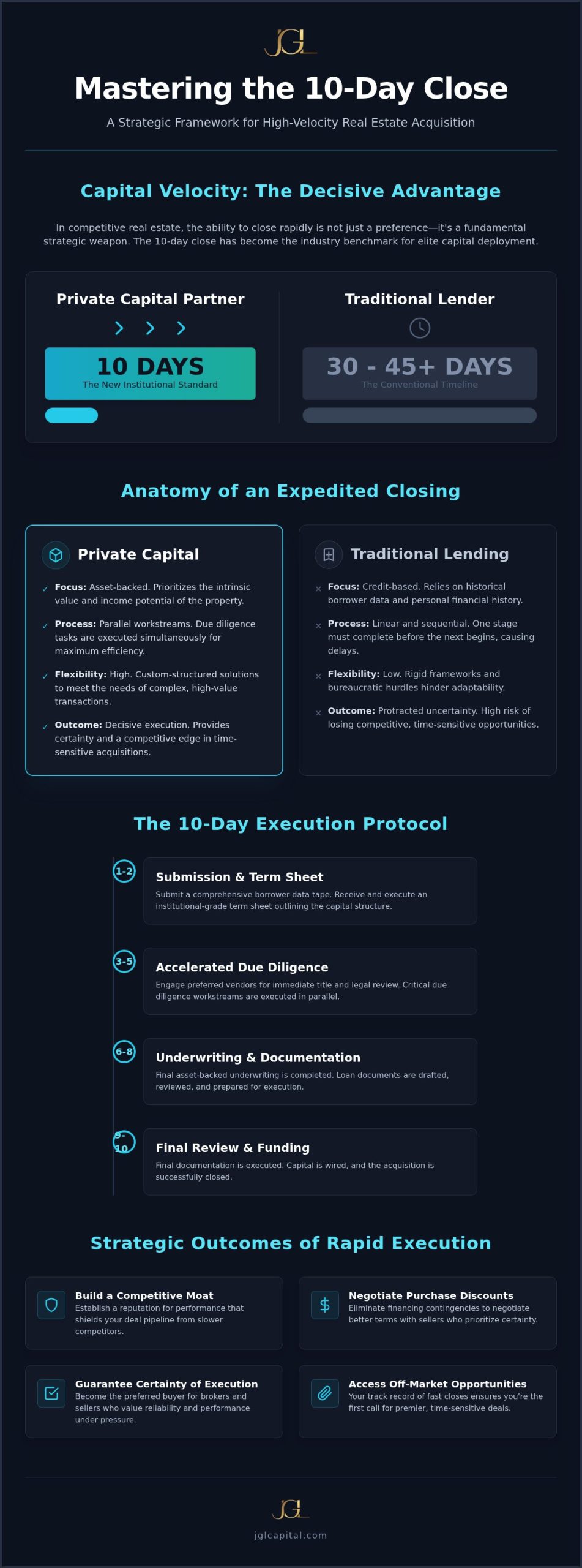
In the institutional real estate market, capital velocity isn’t merely an operational metric; it’s a fundamental pillar of strategic advantage. While the standard real estate closing process often spans thirty to forty-five days, sophisticated stakeholders recognize that such timelines frequently result in lost opportunities. The ten-day benchmark has emerged as the definitive industry standard for elite capital deployment, serving as a critical differentiator for those seeking to capture distressed or highly competitive assets. By utilizing fast closing loans for real estate investors, practitioners can bypass the systemic delays that characterize traditional financing routes, ensuring that capital is deployed exactly when the market presents its most lucrative openings.
Capital Velocity as a Competitive Moat
The ability to execute with extreme celerity functions as a formidable moat, protecting an investor’s pipeline from competitors who remain tethered to slower, more conventional capital sources. When an acquisition is finalized within a ten-day window, the investor effectively eliminates financing contingencies, a move that often permits the negotiation of significant discounts on purchase prices. Sellers, particularly those managing distressed portfolios or operating under strict liquidation timelines, prioritize the certainty of execution over a marginally higher offer that carries the risk of a protracted underwriting cycle. In competitive environments, firms like Nuhome Capital exemplify this strategy by providing the cash-certainty required to bypass traditional financing hurdles entirely. Transforming speed into a quantifiable metric allows a firm to optimize its internal rate of return by drastically shortening the duration between capital commitment and asset stabilization.
The Limitations of Traditional Depository Institutions
Traditional depository institutions are structurally incapable of meeting the rigorous requirements of high-stakes real estate acquisitions. Their bureaucratic frameworks are built upon credit-based underwriting models that prioritize historical borrower data and personal financial history over the intrinsic value of the underlying asset. This approach creates an inherent conflict between rigid regulatory compliance and the situational flexibility required for complex, high-value transactions. Consequently, sophisticated stakeholders are increasingly migrating toward private capital brokerage to secure fast closing loans for real estate investors. This shift isn’t driven by a lack of access to traditional credit, but by a strategic preference for capital partners who operate with the same analytical rigor and decisiveness as the investors themselves.
Anatomy of an Expedited Closing: Private Capital vs. Traditional Lending
The fundamental divergence between conventional depository institutions and private capital providers lies in the core philosophy of risk assessment. Traditional banks operate within a rigid framework of credit-based underwriting, which often mandates an exhaustive review of the borrower’s personal financial history, spanning several years of tax returns and liquidity statements. In contrast, fast closing loans for real estate investors prioritize the intrinsic value and income potential of the subject property. This asset-backed approach allows for a significantly more efficient timeline, as the primary security for the capital is the real estate itself rather than the individual’s historical credit profile.
The underwriting lifecycle in an expedited closing is characterized by the simultaneous execution of critical due diligence workstreams. While a traditional bank might follow a linear path, waiting for credit approval before ordering an appraisal, private capital partners engage in the parallel processing of property valuation, title search, and legal review. This methodology ensures that all necessary components for a secure funding are finalized within the ten-day window. A sophisticated private money broker acts as a strategic intermediary, aligning the investor’s project requirements with the most suitable discretionary capital sources to facilitate fast closing loans for real estate investors. By utilizing transitional real estate capital, investors can bridge the temporal gap between the immediate acquisition of an asset and its eventual transition to permanent financing. Engaging with a seasoned private capital partner provides the stability required to execute on high-value acquisitions without the uncertainty of traditional banking delays.
The Asset-Based Underwriting Model
The preference for asset-level scrutiny over personal financial forensics is a calculated strategy designed to mitigate risk through the tangible worth of the collateral. Lenders typically focus on Loan-to-Value (LTV) and Loan-to-Cost (LTC) ratios as primary risk mitigants, with standard LTV thresholds often ranging between 60% and 75% for investment properties. Property-level due diligence replaces months of personal income verification, allowing the lender to assess the viability of the deal based on market data and the asset’s specific performance metrics. The significance of a clearly defined exit strategy cannot be overstated, as the lender’s approval is contingent upon a disciplined plan for capital repayment, whether through refinancing or the eventual sale of the asset.
Structural Advantages of Private Capital
Private capital offers a level of situational flexibility that is simply unavailable through committee-based bank approvals. Discretionary capital sources allow for the creation of customizable term sheets that reflect the specific strategic objectives of a project, rather than forcing the borrower to adhere to a one-size-fits-all product. The efficiency of private capital allocation in multi-family and commercial sectors is particularly evident when navigating complex acquisitions that require rapid deployment. This structural agility ensures that sophisticated stakeholders can preserve the integrity of their investment timelines while maintaining a focus on long-term growth and value creation.
Critical Prerequisites for a Ten-Day Execution Cycle
Achieving a ten-day closing window requires more than just a willing lender; it demands a state of “Capital Readiness” on the part of the investor. This readiness is characterized by a pre-organized borrower data tape that allows for immediate analysis by institutional partners. Without this structural preparation, even the most robust fast closing loans for real estate investors can be delayed by administrative friction. Establishing a strategic alliance with preferred vendors for title and insurance is equally vital, as these partners understand the exigencies of a compressed timeline. For projects involving development, leveraging specialized construction financing ensures that the long-term project viability is established from day one, preventing the need for mid-cycle capital restructuring.
The Essential Documentation Portfolio
A rigorous approach to documentation is the foundation of an expedited funding lifecycle. Investors must maintain a comprehensive “Entity Box” that includes updated Articles of Incorporation, Operating Agreements, and Tax Identification numbers. As of 2026, new FinCEN reporting requirements for LLCs and trusts mean that beneficial ownership information must be readily available to avoid compliance bottlenecks during the underwriting process. Furthermore, a well-maintained Schedule of Real Estate Owned (SREO) serves as a testament to the investor’s track record, instilling confidence in the lender’s risk management committee. Proactive procurement of preliminary title reports and environmental assessments, where applicable, allows the capital partner to move directly to the final approval stage without awaiting third-party deliverables.
Operational Alignment with the Broker
Transparency is the catalyst for speed in private capital markets. Early disclosure regarding complex ownership structures or existing property encumbrances is non-negotiable; if a property has unique legal nuances, the brokerage firm needs to know immediately to structure the fast closing loans for real estate investors effectively. Establishing clear communication channels between your legal counsel and the brokerage firm ensures that document revisions occur in real-time. Additionally, investors must guarantee immediate access to the subject property for appraisal or site visitation. In a ten-day cycle, a single day lost due to a lack of property access can jeopardize the entire closing timeline, making operational synchronization between the borrower and the capital steward a critical necessity for success.
A Step-by-Step Protocol to Close on Investment Property in 10 Days
The execution of a ten-day acquisition cycle is a deliberate exercise in operational discipline, requiring a seamless integration of borrower readiness and lender efficiency. This rigorous protocol ensures that capital deployment occurs with the celerity required to dominate competitive markets without sacrificing the analytical rigor necessary for risk mitigation. When securing fast closing loans for real estate investors, success isn’t the result of shortcuts, but of a highly synchronized methodology that moves from initial submission to funding with institutional precision.
- Day 1-2: Submission of the comprehensive deal package and initial term sheet issuance.
- Day 3-5: Simultaneous execution of property valuation and title search protocols.
- Day 6-8: Underwriting review and finalization of the loan agreement.
- Day 9-10: Closing coordination, document execution, and wire transfer of funds.
Phase I: Initiation and Preliminary Approval
The initial submission serves as the definitive catalyst that triggers the entire institutional response. It’s the moment where the borrower’s “Capital Readiness,” as established in previous stages of preparation, meets the lender’s capacity for rapid deployment. A sophisticated broker doesn’t merely facilitate paperwork; they conduct a rapid yet rigorous analysis of the property’s financial potential to ensure the deal meets the high standards required for fast closing loans for real estate investors. This stage is fundamental for confirming the alignment of objectives between the investor and the capital source, ensuring that the proposed term sheet reflects the specific strategic needs of the acquisition.
Phase II: Due Diligence and Underwriting Synthesis
Success in the mid-cycle depends on a “Parallel Path” strategy where title, insurance, and property valuation workstreams move concurrently rather than in a traditional linear sequence. This approach requires constant vigilance and the ability to address underwriting conditions in real-time to avoid the late-stage delays that often plague conventional banking institutions. The final 48 hours of the cycle demand a disciplined approach to document management, ensuring that every legal and financial requirement is satisfied before the window closes. By maintaining this level of operational intensity, sophisticated partners can secure institutional-grade financing that facilitates the immediate capture of high-value assets. This methodical synthesis of due diligence and underwriting ensures that the closing coordination and wire transfer of funds occur without friction, allowing the investor to finalize the acquisition within the rigorous ten-day benchmark.
JGL Capital: Facilitating Rapid Capital Deployment for Sophisticated Investors
JGL Capital LLC functions as an institutional-grade bridge between sophisticated capital and high-stakes real estate opportunities. Our firm operates with a steadfast commitment to the creation and preservation of value, acting as a disciplined steward rather than a mere transactional service provider. By leveraging over thirty years of industry expertise, we assist our partners in navigating complex real estate investment strategies that require both analytical depth and decisive execution. Our specialization in $10M+ loans serves as a clear indicator of our institutional strength and our capacity to handle the most significant acquisitions in the multi-family and commercial sectors. We don’t just provide funding; we establish collaborative strategic alliances that are designed to build lasting legacies through careful, deliberate action.
Expertise Grounded in Analytical Rigor
Our internal review process is meticulously designed to identify and mitigate structural risks while maintaining the velocity necessary for fast closing loans for real estate investors. We don’t rely on the rigid, credit-heavy models used by traditional depository institutions; instead, we apply a sophisticated lens to the intrinsic value of the asset and the long-term viability of the project. This rigorous approach ensures that every capital allocation is qualified and every strategy is clearly defined, providing our partners with a sense of security that is grounded in data rather than marketing hyperbole. As a discreet partner for high-net-worth stakeholders, we prioritize the alignment of objectives and the generation of worth. It’s our hallmark to facilitate rapid funding for complex acquisitions where the ability to bypass traditional committee-based delays is the primary factor in securing a competitive asset.
Initiating Your Strategic Alliance
Engaging with JGL Capital is a deliberate process designed to establish a professional relationship from the outset. When you approach our firm with a high-priority acquisition, you can expect a consultation with seasoned principals who understand the gravity of high-stakes management. We don’t offer generic, one-size-fits-all products. Instead, we deliver highly customized, individual solutions that reflect your specific strategic vision and performance metrics. During this initial phase, we conduct a thorough analysis of the deal package to ensure it meets our standards for fast closing loans for real estate investors. This ensures that when we issue a term sheet, it carries the full weight of our commitment to fund within the established ten-day benchmark. We invite you to connect with our principals to discuss how our capital can be aligned with your strategic vision to ensure the preservation of your investment legacy.
Securing Your Competitive Edge in High-Stakes Acquisitions
The mastery of the ten-day closing window represents a fundamental shift from reactive purchasing to proactive capital allocation. By prioritizing asset-backed underwriting and maintaining a state of continuous capital readiness, sophisticated stakeholders can effectively eliminate the bureaucratic friction that often compromises high-value opportunities. This strategic guide has outlined the rigorous protocols and institutional alignments necessary to leverage fast closing loans for real estate investors, ensuring that your firm remains positioned as a preferred buyer in an increasingly volatile market. Success in this arena isn’t a matter of chance; it’s the result of meticulous preparation and the selection of a capital partner who operates with the same analytical rigor as your own organization.
JGL Capital LLC stands as a disciplined steward for those seeking to build lasting legacies through complex acquisitions. Our approach is grounded in over 30 years of strategic industry expertise, focusing on the intrinsic value of the collateral through an asset-backed model that prioritizes property worth over personal credit history. We specialize in high-value $10M+ loan structures, providing the intellectual capital and stability required for significant projects. Secure your next acquisition with JGL Capital’s strategic capital solutions. We look forward to aligning our resources with your long-term strategic vision.
Frequently Asked Questions
Is it truly possible to close a real estate loan in 10 days without compromising due diligence?
Execution within a ten-day window is entirely feasible when due diligence workstreams are managed concurrently rather than through the linear processes favored by traditional banks. Institutional private lenders utilize parallel processing to conduct property valuations, title searches, and legal reviews simultaneously. This disciplined methodology ensures that all necessary risk-mitigation protocols are satisfied with analytical rigor while meeting the rigorous demands of a compressed closing timeline.
How do interest rates for fast-closing private loans compare to traditional bank mortgages?
Interest rates for private capital reflect the premium placed on capital velocity and situational flexibility. As of early 2026, conventional 30-year fixed rates for investment properties range from approximately 7.309% to 7.809%. In contrast, industry data suggests that hard money rates generally span from 9.5% to 12.5%. This variance represents the cost of securing fast closing loans for real estate investors who prioritize the immediate capture of high-value assets.
What are the primary reasons a 10-day closing might be delayed, and how can they be avoided?
Delays are typically the result of administrative friction, such as incomplete entity documentation or undisclosed property encumbrances. The 2026 FinCEN reporting requirements for beneficial owners in LLC transactions have added a necessary layer of compliance that must be addressed at the outset. Maintaining a pre-organized borrower data tape and ensuring immediate property access for site visitations are critical steps to mitigate these potential bottlenecks.
Does a 10-day closing timeline apply to complex commercial or multi-family properties?
A ten-day execution cycle is achievable for multi-family and commercial assets provided the capital steward possesses the intellectual capital to analyze property-level performance metrics rapidly. These complex acquisitions require a partner with the institutional strength to handle $10M+ structures without the delays of a traditional credit committee. Strategic preparation by the borrower ensures these larger deals move through the underwriting synthesis with the same celerity as residential projects.
What is the minimum documentation required to initiate an expedited loan request?
To initiate the cycle, a borrower must provide a comprehensive deal package including an updated Schedule of Real Estate Owned (SREO), entity formation documents, and property-specific financial data. This initial submission serves as the definitive catalyst for the entire funding lifecycle. Providing a clear project scope and a documented exit strategy during the first 24 hours allows the lender to issue a term sheet and begin parallel underwriting immediately.
Can bridge loans be transitioned into long-term rental property financing after the 10-day close?
Bridge loans are specifically designed as transitional capital that can be refinanced into permanent structures once the asset is secured or stabilized. This “bridge-to-perm” strategy allows investors to utilize fast closing loans for real estate investors to win a bid and subsequently transition into a DSCR loan for long-term hold. This approach ensures capital velocity during the acquisition phase while securing the long-term preservation of the investment’s worth.
How does the asset-backed nature of the loan facilitate such a rapid funding cycle?
The asset-backed model shifts the focus of underwriting forensics from the borrower’s personal financial history to the intrinsic value and income potential of the property. By prioritizing Loan-to-Value (LTV) and Loan-to-Cost (LTC) ratios as primary risk mitigants, lenders can bypass the protracted personal credit reviews that define traditional banking. This structural alignment allows for a more efficient assessment of the deal’s viability, facilitating a significantly faster funding lifecycle.
What role does the private money broker play in ensuring the certainty of execution?
A private money broker functions as a strategic intermediary who navigates the capital markets to align each project with the most suitable discretionary capital source. This role involves more than simple service provision; it’s a form of high-level strategic alliance that ensures the deal structure matches the lender’s specific appetite. By managing the flow of information and addressing underwriting conditions in real-time, the broker provides the certainty of execution required for high-stakes acquisitions.