

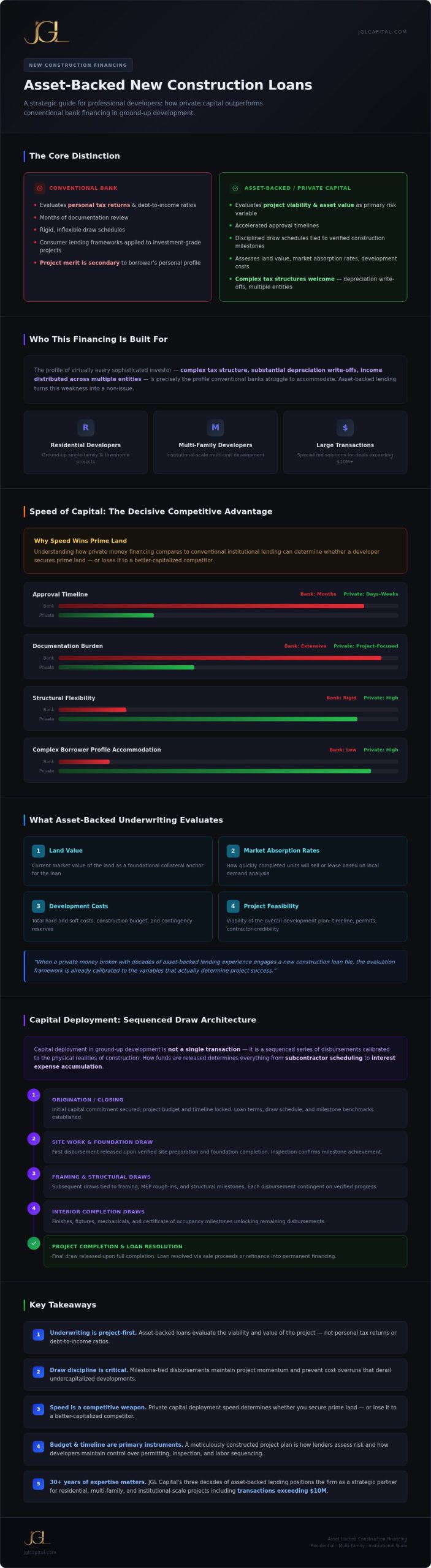
Your tax returns shouldn’t determine whether a viable development project gets built. For professional real estate investors, this is precisely the friction that conventional bank underwriting introduces into an otherwise sound capital strategy: months of documentation review, rigid debt-to-income thresholds, and inflexible draw schedules that bear little relationship to actual construction timelines. The project’s merit becomes secondary to the borrower’s personal financial profile, and opportunities are lost while underwriters deliberate.
If that frustration is familiar, you already understand why sophisticated developers are increasingly turning to asset-backed new construction loans as a primary financing instrument rather than a last resort. The underlying logic is straightforward: when a lender’s credit decision is anchored to the value and viability of the asset itself, the entire capital deployment process accelerates and aligns with the realities of ground-level execution.
This guide provides a comprehensive analysis of institutional construction financing for professional investors seeking to optimize leverage, streamline draw processes, and secure strategic capital partnerships built on over three decades of asset-backed lending expertise. What follows covers loan structure, underwriting criteria, draw mechanics, and the strategic considerations that distinguish a well-capitalized development portfolio from one perpetually constrained by conventional lending limitations.
Key Takeaways
- Asset-backed new construction loans are evaluated on the viability and value of the project itself, not the borrower’s personal tax returns or debt-to-income ratios, fundamentally reorienting the underwriting process in favor of professional developers.
- The mechanics of private capital disbursement—including disciplined draw schedules tied to verified construction milestones—are critical to maintaining project momentum and preventing the cost overruns that derail undercapitalized developments.
- Speed of capital deployment is a decisive competitive advantage: understanding how private money financing compares to conventional institutional lending can determine whether a developer secures prime land or loses it to a better-capitalized competitor.
- A meticulously constructed project budget and timeline are not merely administrative requirements—they are the primary instruments through which lenders assess risk and through which developers maintain control over permitting, inspection, and labor sequencing.
- JGL Capital’s three decades of asset-backed lending expertise positions the firm as a strategic capital partner for residential and multi-family developers pursuing projects at institutional scale, including specialized financing solutions for transactions exceeding ten million dollars.
The Evolution of New Construction Loans for Real Estate Investors
At their structural core, new construction loans are short-term, asset-backed financing instruments designed to fund the ground-up development of residential and commercial properties. Unlike conventional mortgages, which amortize over decades against an existing asset, construction loans are deployed in stages against a project that is, by definition, incomplete at origination. This fundamental characteristic, the absence of a fully realized collateral asset at the point of commitment, is precisely what conventional banks have historically struggled to underwrite with any meaningful speed or flexibility.
The financing landscape has shifted considerably as professional developers have recognized that institutional private capital is not a fallback position but a deliberate strategic choice. Where consumer-facing banks were designed to serve owner-occupants purchasing finished homes, the contemporary development environment demands a capital structure that reflects the operational realities of ground-level execution: compressed acquisition timelines, fluctuating material costs, and the competitive premium placed on rapid project commencement.
Shifting from Owner-Occupied to Investment-Centric Financing
The distinction between a bank’s risk appetite and that of a private capital provider is not merely philosophical; it manifests directly in underwriting criteria, approval timelines, and structural flexibility. Conventional institutions apply consumer lending frameworks to investment-grade development projects, a category mismatch that produces the friction professional developers encounter repeatedly. Private lenders, by contrast, evaluate project feasibility as the primary risk variable, assessing land value, market absorption rates, and development costs rather than the borrower’s personal debt obligations. This reorientation allows experienced developers to deploy leverage across multiple concurrent projects, preserving liquidity that would otherwise be consumed by the equity-heavy requirements of traditional bank financing.
The Critical Role of Asset-Based Underwriting
Asset-backed lending is, at its most precise definition, a credit discipline that anchors risk assessment to the property’s demonstrated and projected value rather than to the borrower’s financial history. The practical consequences of this approach are significant. A developer with a complex tax structure, substantial depreciation write-offs, or income distributed across multiple entities, the profile of virtually every sophisticated investor, can access capital on the strength of a well-underwritten project rather than a simplified personal income statement.
Institutional expertise accelerates this process materially. When a private money broker with decades of asset-backed lending experience engages a new construction loan file, the evaluation framework is already calibrated to the variables that actually determine project success. That accumulated analytical infrastructure compresses the origination timeline in ways that a generalist bank underwriter, applying consumer lending protocols to a development transaction, simply cannot replicate.
Mechanics of Private Capital Allocation in Construction Projects
Capital deployment in ground-up development is not a single transaction; it is a sequenced series of disbursements calibrated to the physical realities of construction. Understanding this architecture is foundational for any developer seeking to manage project economics with precision, because the structure of how funds are released determines everything from subcontractor scheduling to interest expense accumulation.
Understanding the Construction Draw Schedule
A draw schedule is the operational backbone of any new construction loan, defining the specific milestones at which the lender releases successive tranches of committed capital. Rather than depositing the full loan amount at closing, the lender disburses funds incrementally as verified construction phases reach completion. Typical milestones triggering draw requests include foundation completion, framing, mechanical rough-in, drywall installation, and final certificate of occupancy. Each release is contingent on an independent third-party inspection confirming that the corresponding phase meets both contractual specifications and applicable building codes.
The discipline embedded in this structure serves both parties. For the lender, phased disbursement limits exposure to an incomplete asset at any given point in the project lifecycle. For the developer, it imposes a rigorous documentation rhythm that, when managed proactively, prevents the administrative bottlenecks that stall capital release and cascade into labor delays. Developers who maintain a continuously updated budget reconciliation and pre-stage their draw documentation before inspections are scheduled consistently experience shorter disbursement cycles than those who treat the draw request as an afterthought.
Loan-to-Cost (LTC) vs. Loan-to-Value (LTV) Metrics
Two metrics govern the capital structure of virtually every institutional construction transaction, and conflating them produces material errors in equity planning. Loan-to-Cost (LTC) expresses the loan amount as a percentage of the total verified project cost, encompassing land acquisition, hard construction costs, soft costs such as architecture and permitting, and carrying costs. A lender offering an LTC ratio of, for example, 80% is committing to finance that proportion of the total project budget, with the developer responsible for the remaining equity contribution.
Loan-to-Value (LTV), by contrast, anchors the loan amount to the property’s projected market value upon completion, commonly referred to as After-Repair Value (ARV) or After-Construction Value. Sophisticated private capital providers apply both metrics simultaneously, using LTC to bound their exposure relative to verified costs and LTV to confirm that the completed asset will support the debt load at stabilization. The interplay between these two figures dictates the developer’s required equity injection more precisely than either metric alone:
- LTC governs cost-side exposure: a higher LTC ratio reduces the developer’s upfront equity requirement but increases lender risk relative to budget overruns.
- LTV governs value-side exposure: a strong ARV relative to total project cost creates favorable LTV headroom, often enabling higher LTC ratios on well-underwritten deals.
- The equity gap: the difference between what the lender will commit under both constraints and the total project cost represents the developer’s required equity position, a figure that must be resolved at origination, not mid-construction.
Interest-only payment structures during the construction phase address a related cash flow imperative: because the asset generates no revenue while under development, requiring principal amortization during construction would impose a capital burden with no corresponding income offset. Interest-only periods preserve developer liquidity for operational requirements, with principal repayment deferred to the take-out phase, when a permanent financing instrument retires the construction loan against the completed, income-producing asset.
Developers who want to stress-test their project capital structure against institutional underwriting standards before committing to a site can consult with JGL Capital’s lending specialists to model LTC and LTV scenarios specific to their development program.
Traditional Institutional Lending vs. Private Money Brokerage
The distinction between a conventional bank and a private money broker is not simply a matter of interest rate differential. It is a structural divergence in how risk is conceptualized, how decisions are made, and how capital reaches a project. For professional developers who have navigated both environments, the operational consequences of that divergence are neither abstract nor marginal; they are the difference between closing on a prime parcel and watching a competitor take it.
Analytical Rigor in Speed and Execution
Conventional banks apply regulatory compliance frameworks that were designed, fundamentally, for consumer protection. That is an appropriate mandate for owner-occupied residential lending. It is a poor fit for investment-grade development transactions, where the relevant risk variables are market absorption rates, comparable sales data, and contractor execution capacity rather than a borrower’s W-2 history. The due diligence that a private money broker conducts is not less rigorous than a bank’s; it is differently rigorous, calibrated to the variables that actually determine whether a project succeeds.
A broker with over 30 years of asset-backed lending expertise brings a pre-built analytical infrastructure to every file. Comparable valuations, local market dynamics, and development cost benchmarks are evaluated through an accumulated institutional lens that a generalist bank underwriter cannot replicate. This depth of experience compresses the origination timeline materially, because the questions that would stall a bank review for weeks are answered, in a private capital context, through pattern recognition and sector-specific knowledge developed across hundreds of completed transactions. Developers who want to understand how this translates across deal types can review the broader framework outlined in New Construction Loans: A Strategic Guide for Real Estate Developers (2026).
Speed, in competitive land markets, is not a convenience. It is a strategic asset. When a seller is evaluating multiple offers, the buyer who can demonstrate certainty of execution, backed by a committed private capital relationship, occupies a categorically stronger negotiating position than one whose financing is contingent on a bank committee review scheduled three weeks out.
Bypassing Personal Income and Credit Constraints
The Debt-to-Income ratio is the instrument through which conventional lenders translate a borrower’s personal financial profile into a lending decision. For the sophisticated developer, this metric is structurally adversarial. Depreciation schedules, entity distributions, cost segregation strategies, and the ordinary complexity of a multi-asset portfolio all compress reported personal income in ways that are entirely rational from a tax perspective but devastating under a DTI-based underwriting framework.
Asset-backed new construction loans resolve this conflict by reorienting the credit decision around what actually matters: the project’s projected value, the developer’s exit strategy, and the structural integrity of the capital stack. The exit strategy, whether a sale to an end buyer, a refinance into permanent financing, or a DSCR-based rental hold, functions as the primary security instrument. A lender who understands how to evaluate exit viability can extend capital to a developer with a complex tax structure that would disqualify the same borrower under conventional DTI thresholds.
The practical consequence is straightforward. Sophisticated investors don’t optimize for the lowest available interest rate on a construction loan; they optimize for certainty of close, flexibility of structure, and a capital partner whose underwriting framework aligns with the operational realities of professional development. A marginally higher rate on a loan that closes in two weeks is a superior outcome to a marginally lower rate on a loan that may not close at all.
Strategic Project Management for Successful Construction Financing
Capital structure and underwriting criteria establish the foundation of any construction financing arrangement, but it’s the quality of project management execution that determines whether that foundation holds through to certificate of occupancy. Lenders who specialize in new construction loans have evaluated enough development files to recognize a pattern: projects that encounter mid-construction capital crises almost invariably trace their difficulties to inadequate budget preparation and reactive rather than anticipatory schedule management. The discipline required to construct a defensible project budget is the same discipline that sustains a productive lender relationship through the full duration of the build.
Preparing the Comprehensive Project Budget
A construction budget that meets institutional underwriting standards is not a rough estimate; it is a documented, line-item accounting of every anticipated expenditure, segregated into hard costs and soft costs with the precision that a third-party cost reviewer can independently verify. Hard costs encompass direct construction expenditures: site preparation, foundation work, structural framing, mechanical and electrical systems, exterior envelope—often managed by specialized teams like SW Roofing & Construction LLC—and interior finishes. Soft costs constitute the administrative and professional infrastructure surrounding the build: architectural and engineering fees, permitting and inspection charges, title insurance, legal fees, and lender-required carrying costs across the projected construction timeline.
In 2026, the verification of contractor bids and material pricing carries particular analytical weight. Developers who submit budgets supported by executed subcontractor agreements and current supplier quotes, rather than historical cost benchmarks, present a materially more credible file to institutional reviewers. The lender’s LTC calculation is only as reliable as the cost data underlying it; a budget constructed on unverified estimates introduces basis risk into the capital stack that sophisticated lenders will price accordingly, or decline to accept.
Managing Contingency Reserves and Cost Overruns
The strategic importance of maintaining an adequate contingency position extends beyond budget management. Cost overruns that consume equity reserves without a corresponding increase in the completed asset’s market value compress the project’s LTV ratio at the worst possible moment, precisely when the developer is approaching the take-out financing phase. Protecting LTV integrity through disciplined contingency management is, in effect, protecting the exit.
- Pre-qualify alternative suppliers: identifying secondary material sources before they’re needed eliminates the premium pricing that accompanies emergency procurement.
- Maintain milestone-specific cost tracking: reconciling actual expenditures against the budget at each draw phase surfaces variances early, when corrective action remains viable.
- Communicate proactively with the lender: a capital partner informed of a developing cost variance before a draw request is submitted is far better positioned to collaborate on a solution than one encountering the issue for the first time at disbursement.
That collaborative relationship with the lender is not incidental to project success; it’s a strategic asset in its own right. Private capital providers with deep asset-backed lending expertise function most effectively when they have accurate, current project intelligence, and developers who maintain that transparency consistently experience more responsive draw cycles and more constructive problem-solving when conditions deviate from the original plan. Connect with JGL Capital’s lending specialists to discuss how disciplined budget structuring translates into a stronger capital partnership from origination through project completion.
JGL Capital: A Disciplined Approach to New Construction Financing
Professional developers operating at institutional scale require more than a lender; they require a capital partner whose analytical framework, risk tolerance, and operational tempo align with the demands of ground-up development. JGL Capital has spent over three decades building precisely that kind of partnership infrastructure, functioning not as a transactional intermediary but as a disciplined steward of capital for sophisticated real estate investors pursuing projects where the stakes are commensurately serious.
Customized Solutions for Residential and Multi-Family Projects
The financing requirements of a twelve-unit multi-family development and those of a single luxury residential build share a common structural logic but diverge substantially in their capital complexity. JGL Capital’s specialization in large-scale transactions, including those exceeding ten million dollars, reflects a deliberate commitment to the segment of the development market where conventional bank lending is least equipped to perform. At that transaction scale, the approval delays, committee review cycles, and rigid underwriting criteria that characterize institutional bank lending don’t merely create friction; they create genuine competitive disadvantage.
New construction loans structured through JGL Capital bypass those systemic constraints by anchoring the credit decision to the asset’s verified value and the project’s structural integrity rather than the borrower’s personal financial profile. The result is a financing process calibrated to the actual timeline of competitive land acquisition and project commencement. Developers seeking to understand how this approach extends across the broader commercial development landscape can find additional analytical context in Commercial Real Estate Loans: A Strategic Guide to Capital Allocation in 2026.
Leveraging Thirty Years of Institutional Expertise
Institutional expertise is not a marketing abstraction. It’s the accumulated pattern recognition that allows an experienced private money broker to evaluate a complex development file with the kind of sector-specific precision that compresses origination timelines and surfaces structural risks before they become capital events. JGL Capital’s thirty-year lending history represents exactly that kind of intellectual capital, applied consistently across residential and multi-family transactions at the national level.
The firm’s objectives are deliberately aligned with those of its development partners. A project that reaches certificate of occupancy on schedule, within budget, and with a defensible exit strategy is the outcome that serves both parties. That alignment of interest is not incidental; it’s the organizing principle of every capital relationship JGL Capital maintains.
Developers who are ready to engage a capital partner whose underwriting discipline matches the gravity of their development program are encouraged to connect with JGL Capital’s lending specialists to discuss how asset-backed financing can be structured to the specific requirements of their next project.
Position Your Next Development for Institutional-Grade Execution
The case for asset-backed new construction loans ultimately rests on a straightforward proposition: capital that evaluates a project on its own merits moves faster, structures more flexibly, and aligns more precisely with the operational demands of professional development than financing instruments designed for a different borrower entirely. For developers who have absorbed the mechanics of draw schedules, LTC and LTV dynamics, and the strategic value of a disciplined budget, the remaining variable is the quality of the capital partner.
That’s where accumulated expertise becomes the decisive differentiator. Over 30 years of asset-backed lending experience, national coverage, and a specialization in transactions exceeding ten million dollars position JGL Capital as a capital partner built for the scale and complexity that sophisticated developers actually operate at.
Your next project deserves a financing structure that reflects its institutional merit. Secure your development capital with JGL Capital and bring the same analytical discipline to your capital stack that you bring to every other phase of the build.
Frequently Asked Questions About New Construction Loans
What is the primary difference between a construction loan and a traditional mortgage?
A construction loan is a short-term financing instrument disbursed in staged tranches against a property that doesn’t yet exist as a completed asset, whereas a traditional mortgage is a long-term amortizing loan secured against a finished, habitable structure. The collateral relationship is fundamentally different: a mortgage lender evaluates a property that can be appraised today, while a construction lender evaluates a project’s projected value upon completion.
This distinction also shapes repayment structure. Construction loans typically carry interest-only payment obligations during the build phase, with principal retirement deferred to a take-out financing event. Traditional mortgages begin amortizing principal from the first payment cycle.
How much of a down payment is typically required for a private new construction loan?
Private new construction loans don’t use the term “down payment” in the conventional sense; the relevant metric is the developer’s required equity contribution, which is derived from the lender’s Loan-to-Cost and Loan-to-Value calculations applied to the specific project. The gap between what the lender will commit under both constraints and the total verified project cost represents the equity position the developer must bring to closing.
Because private capital providers evaluate each transaction on its own structural merits, equity requirements vary considerably across deal types, asset classes, and market conditions. Developers are best served by modeling their specific project’s capital stack with a lender before committing to a site.
Can I obtain a construction loan if I have a low credit score but high-value collateral?
Asset-backed new construction loans are specifically structured to prioritize collateral value and project viability over personal credit metrics. A private money lender’s credit decision is anchored to the property’s projected after-construction value, the integrity of the capital stack, and the credibility of the developer’s exit strategy rather than to consumer credit scoring models.
This reorientation is particularly consequential for sophisticated investors whose credit profiles are complicated by depreciation schedules, entity distributions, or cost segregation strategies. The asset’s demonstrated value, not the borrower’s personal financial history, is the primary security instrument in this lending framework.
What are “hard costs” versus “soft costs” in a construction loan budget?
Hard costs are direct construction expenditures: site preparation, foundation work, structural framing, mechanical and electrical systems, exterior envelope, and interior finishes. These are the physical costs of building the asset. Soft costs are the professional and administrative expenditures surrounding the build, including architectural and engineering fees, permitting charges, title insurance, legal fees, and the interest carry accumulated across the projected construction timeline.
Both categories require precise line-item documentation for institutional underwriting review. A budget supported by executed subcontractor agreements and current supplier quotes carries materially more credibility than one constructed on historical cost benchmarks, particularly given the material pricing environment developers are navigating in 2026.
How does the draw process work for ground-up real estate development?
Rather than depositing the full committed loan amount at closing, the lender releases capital in sequential tranches as verified construction milestones reach completion. Common trigger points include foundation completion, structural framing, mechanical rough-in, drywall installation, and final certificate of occupancy. Each draw request requires an independent third-party inspection confirming that the corresponding phase meets both contractual specifications and applicable building codes before funds are released.
Developers who pre-stage their draw documentation before inspections are scheduled, and who maintain a continuously updated budget reconciliation, consistently experience shorter disbursement cycles. Treating the draw request as a proactive administrative function rather than a reactive one is one of the more consequential operational disciplines in ground-up development.
What happens to the construction loan once the project is completed?
Construction loans are short-term instruments designed to be retired at project completion through a take-out event. The three most common exit strategies are a sale to an end buyer, a refinance into permanent long-term financing, or a transition to a DSCR-based loan structure for developers who intend to hold the completed asset as an income-producing rental. The selected exit strategy is evaluated by the lender at origination as a primary component of the project’s overall risk profile.
The viability of the exit is not a secondary consideration; it’s the mechanism through which the lender recovers the committed capital. Developers with a clearly articulated and credibly supported exit strategy present a materially stronger underwriting file than those who treat the take-out phase as a problem to solve after construction concludes.
Is a licensed contractor required for all new construction financing?
Most institutional private lenders require that construction work be performed by licensed, insured general contractors, particularly on transactions of meaningful scale. This requirement reflects the lender’s interest in protecting the asset’s value through verified execution capacity; an unlicensed contractor introduces material completion risk that directly threatens the collateral underlying the loan. Some lenders may evaluate experienced developer-builders on a case-by-case basis, but this is the exception rather than the standard.
Beyond the lender’s requirements, local permitting authorities in most jurisdictions mandate licensed contractor involvement for permitted ground-up construction. Developers should confirm both the lender’s contractor requirements and the applicable local licensing standards before structuring their project team.
How do Loan-to-Cost (LTC) ratios impact my equity requirements?
The LTC ratio directly determines how much of your total verified project cost the lender will finance, with the remainder representing your required equity contribution. A lender offering an LTC of 80% on a project with a total cost of two million dollars is committing to finance 1.6 million, leaving the developer responsible for the remaining 400,000 in equity. A higher LTC ratio reduces the developer’s upfront capital requirement but correspondingly increases the lender’s exposure to budget overruns.
LTC doesn’t operate in isolation; it’s applied alongside the LTV constraint, and the more restrictive of the two figures governs the actual loan amount. Projects with strong after-construction values relative to total costs often create favorable LTV headroom that supports higher LTC ratios, which is why a credible appraisal and a well-documented budget are both essential components of a competitive financing application.