

In the arena of high-stakes acquisitions, a proof of funds letter for real estate offer is not merely a bureaucratic requirement; it’s a strategic instrument that signals institutional readiness and professional discipline to a sophisticated seller. As new regulatory frameworks like the 2026 FinCEN reporting requirements for legal entities increase transparency, the manner in which you verify your liquidity determines the gravity with which your offer is received. Momentum often stalls when traditional banks fail to provide timely documentation or when personal bank statements expose sensitive data that should remain confidential.
You recognize that in a competitive environment, speed is as critical as capital. This guide provides the intellectual framework to master the nuances of institutional proof of funds, ensuring you can secure high-value properties with both confidence and discretion. We’ll examine the essential distinctions between bank-issued and broker-backed letters, the impact of recent legislative shifts influencing cash sale protocols, and the methodologies for building immediate credibility with the most discerning sellers.
Key Takeaways
- Establish the critical distinction between creditworthiness and immediate liquidity to ensure your financial verification meets the rigorous demands of sophisticated sellers.
- Identify the specific elements required in a professional proof of funds letter for real estate offer to maintain consistency between your acquisition entity and your financial backing.
- Evaluate the strategic advantages of utilizing broker-backed verification over traditional bank statements to preserve privacy and signal a disciplined approach to capital management.
- Streamline the verification process by initiating relationships with asset-based lenders who prioritize property value and institutional-grade documentation over personal credit metrics.
- Utilize three decades of specialized expertise to position your financial verification as a definitive indicator of deal certainty and long-term value preservation.
Defining the Strategic Role of Proof of Funds in Real Estate Acquisitions
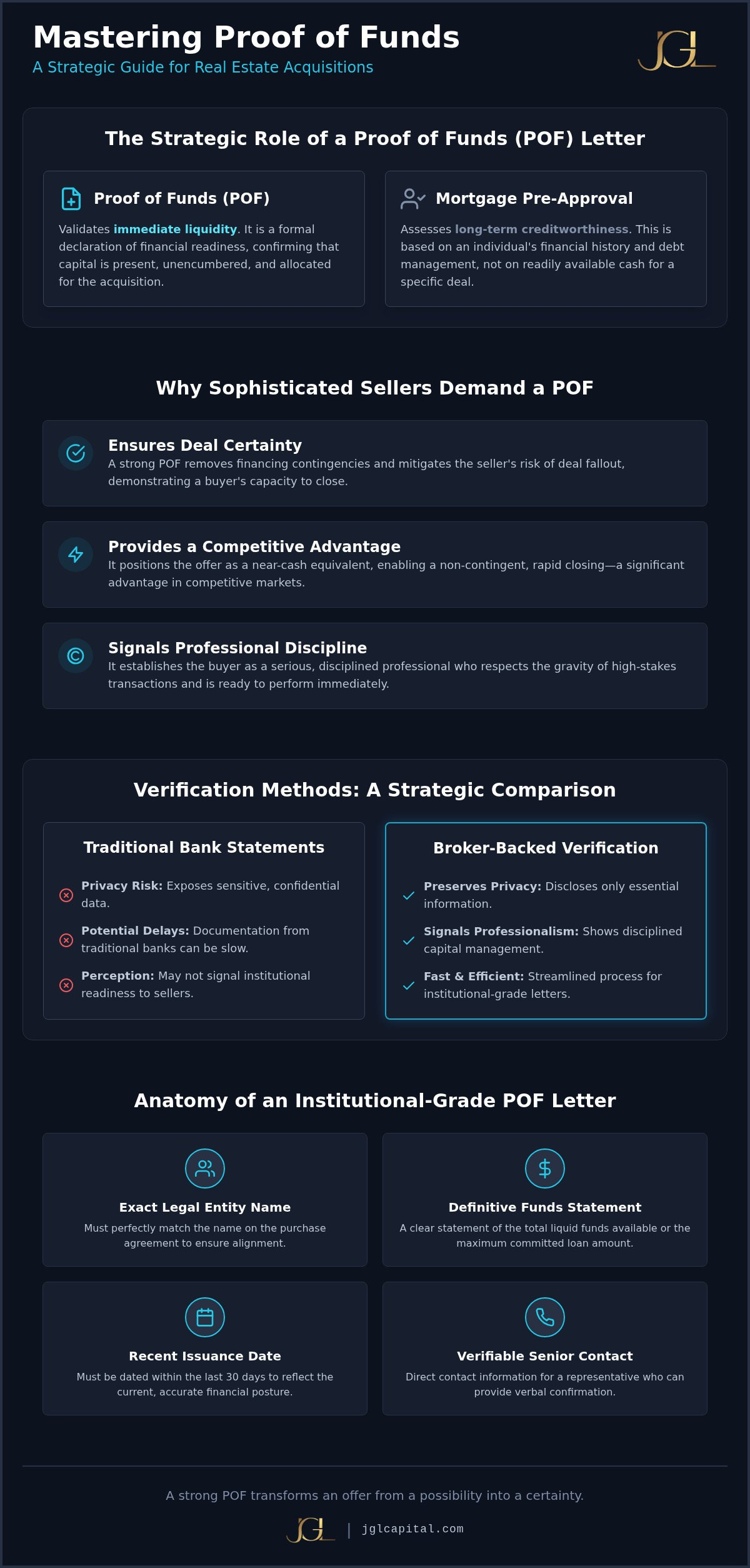
Understanding What is Proof of Funds (POF) begins with recognizing it as the primary verification that an entity possesses the liquid capital necessary to satisfy the terms of a specific transaction. Within the framework of institutional real estate, this document is a formal declaration of financial readiness. It’s distinct from a traditional mortgage pre-approval. While a pre-approval assesses an individual’s creditworthiness and historical debt management, a proof of funds letter for real estate offer validates immediate liquidity. It confirms that the capital is not only present but also unencumbered and allocated for the acquisition at hand.
In the competitive 2026 market, the POF has evolved into a critical trust-building mechanism. Sophisticated sellers require more than a verbal commitment; they demand analytical proof of a buyer’s capacity to close. By presenting a verified capital position, you mitigate the seller’s risk of deal fallout. Financing contingencies often create vulnerabilities in a contract. A strong POF removes these uncertainties, positioning the offer as a near-cash equivalent that ensures a seamless transfer of value and professional alignment between all parties involved.
Why a POF is Mandatory for Sophisticated Sellers
Institutional sellers and high-net-worth stakeholders prioritize deal certainty. They don’t have the patience for speculative offers that lack firm financial backing. A professional POF demonstrates the capacity for a non-contingent, rapid closing, which is a significant competitive advantage. It establishes the buyer as a disciplined professional who respects the gravity of high-stakes management. This level of verification is especially vital for off-market acquisitions and institutional auctions. In these environments, the window for execution is narrow; sellers won’t engage with parties who can’t prove their ability to perform immediately.
Qualifying Assets for Capital Verification
Sophisticated verification requires a clear distinction between theoretical wealth and deployable capital. Not every asset is viewed with equal weight by a seasoned seller. Verification typically focuses on the following:
- Liquid cash maintained in standard checking or savings accounts.
- Marketable securities and money market funds that are easily converted to cash within a standard closing window.
- Documented lines of credit and committed private capital from recognized institutional partners.
The objective is to present a transparent view of unencumbered assets. This transparency builds a sense of security for the seller, confirming that the transaction will proceed without the friction of asset liquidation delays; for investors looking to convert physical assets into cash, ctgoldandsilver.com specializes in the acquisition of precious metals and high-value collectibles to help bolster your liquid position. By providing a proof of funds letter for real estate offer that highlights these specific asset classes, an investor signals a serious and disciplined approach to the creation of value.
Essential Components of an Institutional-Grade POF Letter
A sophisticated seller evaluates the medium as much as the message. For a proof of funds letter for real estate offer to carry the necessary weight, it must adhere to a strict institutional standard. This isn’t a mere formality; it’s a presentation of your financial infrastructure and operational readiness. A credible document originates from a recognized financial institution or a specialized private money broker, presented on formal letterhead that conveys stability and deep-seated expertise. It serves as a definitive statement that your strategic objectives are backed by verified capital.
The technical precision of the document is paramount. To satisfy the scrutiny of institutional stakeholders, the letter must include:
- The exact legal entity name that appears on the purchase agreement to ensure a perfect alignment of objectives.
- A definitive statement of the total liquid funds available or the maximum committed loan amount for the transaction.
- An issuance date within the last 30 days, confirming that the data reflects your current financial posture.
- Direct contact information for a senior representative capable of providing verbal confirmation during the seller’s due diligence process.
The Importance of Verifiability
Experienced listing agents quickly identify the lack of depth in ‘instant’ online PDF generators. These automated tools often lack the human oversight required to satisfy official proof of funds requirements during the high-stakes management of a transaction. A dedicated loan officer serves as a quiet expert, confirming your position through analytical rigor rather than a generic template. Submitting outdated or fraudulent documentation doesn’t just jeopardize the deal; it can lead to severe legal implications and the permanent erosion of your professional reputation among sophisticated partners.
Customizing the Letter for Specific Acquisitions
Strategic disclosure is a hallmark of a disciplined investor. You shouldn’t reveal excess liquidity that might compromise your negotiating leverage or expose sensitive financial metrics. Instead, tailor the dollar amount to closely align with the specific offer. This precision is especially critical when pursuing specialized projects, such as new construction loans, where the seller needs to see a commitment to the full project scope. Ensure the expiration date on your proof of funds letter for real estate offer extends beyond the anticipated escrow period to maintain deal momentum. If you value a partner who understands these nuances, consider how a strategic alliance with an asset-based specialist can elevate your acquisition strategy.
Bank Statements vs. Broker-Backed Proof of Funds
The choice between a raw bank statement and a broker-backed verification is a choice between transparency and strategic discretion. Direct bank statements, while functional, often expose an intrusive level of transactional history and sensitive personal data that should remain confidential. A proof of funds letter for real estate offer issued by an institutional partner provides a more refined alternative. It validates your capacity without compromising your privacy. This approach is standard in high-level real estate investing, where the focus is on the availability of deployable capital rather than a complete audit of one’s financial life.
Speed is another critical differentiator. Traditional banking institutions are frequently encumbered by bureaucratic protocols that delay the issuance of customized letters. In contrast, a private money broker operates with the agility required for high-stakes acquisitions. When JGL Capital LLC issues a verification, it carries the weight of 30 years of industry expertise. It signals to the seller that the deal has already passed an initial asset-based review. This level of professional endorsement creates an immediate sense of security for the seller, often moving an offer to the top of the stack.
Privacy and Security Considerations
Sharing unredacted bank statements with multiple parties increases the risk of identity theft and financial compromise. A disciplined professional minimizes this exposure by using a broker-backed letter of intent to shield their personal balance sheet. While redacting sensitive account numbers is a common practice, it can sometimes raise questions about the document’s integrity. A formal letter from a recognized lender eliminates these concerns, providing a clean, authoritative verification that satisfies the seller’s due diligence without revealing unnecessary metrics.
Leverage and the Private Money Advantage
Sellers of high-value assets prefer to see a committed lender involved in the transaction. A verification from hard money lenders or asset-based partners proves that you have the requisite “skin in the game” alongside a robust debt facility. This dual-layered verification is more persuasive than a buyer presenting just enough cash for a down payment. It demonstrates a sophisticated capital structure and a disciplined approach to asset management. The psychological impact of a professional broker’s endorsement shouldn’t be overlooked; it transforms a simple offer into a strategic alliance with a high probability of successful closure.
How to Obtain a POF for Private Money
Securing a proof of funds letter for real estate offer through a private money partner requires a shift from reactive to proactive capital management. Unlike the automated systems of retail banks, the process for obtaining institutional-grade verification is built upon a foundation of analytical rigor and mutual alignment of objectives. By establishing a collaborative relationship with an asset-based lender prior to the identification of a specific property, an investor ensures that their capital verification process is grounded in institutional stability rather than last-minute urgency. This methodical approach allows the lender to conduct a thorough review of the investor’s financial posture, ensuring that when a high-stakes opportunity arises, the documentation is ready for immediate deployment.
The sequence for obtaining this verification is divided into two distinct operational phases. Each phase is designed to instill trust in the seller by demonstrating that the buyer’s financial backing is the result of a serious and disciplined underwriting process. Coordination with your lender is essential to ensure the document is issued within the critical window of an offer, providing the speed necessary to secure properties under contract before competitors can mobilize.
Phase 1: Pre-Underwriting and Capital Review
The initial phase focuses on establishing the investor’s track record and liquidity profile. This involves submitting preliminary financial documentation for internal review, which allows the lender to verify the source of funds and ensure compliance with institutional standards. During this stage, the lender sets the parameters for future financing, such as a bridge loan or fix-and-flip facility. This pre-underwriting process serves as a linguistic signature of a professional investor, signaling to all parties that the capital is not only available but has already undergone a high-level strategic review.
Phase 2: Deal-Specific Issuance
Once a target asset is identified, the proof of funds letter for real estate offer must be updated to reflect the specific details of the transaction. This includes the current offer price and the property address, ensuring the letter precisely matches the purchase contract. It’s also the stage where the document is tailored to reflect the appropriate commercial real estate loans structure, whether the acquisition involves multi-family units or land development. Finalizing the verification protocol with the lender’s closing department ensures that if a seller’s agent calls for verbal confirmation, the response is authoritative and reinforces the buyer’s credibility. To begin this process and align your acquisition strategy with institutional-grade backing, you can request a strategic capital consultation with our team.
JGL Capital: Aligning Capital Verification with Investor Objectives
Choosing a partner for financial verification is a decision that reflects an investor’s internal standards. JGL Capital provides more than a document; we offer the strategic weight of 30 years of industry expertise to every transaction. Our proof of funds letter for real estate offer is backed by a rigorous understanding of asset-based lending and property value, ensuring that your financial standing is presented with institutional authority. We serve as a streamlined alternative to traditional banking, removing the administrative friction that often causes sophisticated offers to lose momentum in fast-moving markets.
As a national partner, we support developers and investors in scaling their portfolios across diverse jurisdictions. Whether you’re pursuing multi-family acquisitions or complex land developments, our verification process is designed to align with your long-term growth objectives. We act as a disciplined steward of your interests, valuing the preservation of deal integrity above all else. This commitment to professional excellence ensures that your capital verification is never a bottleneck but rather a catalyst for successful execution.
The Value of a Disciplined Partnership
Institutional sellers require a level of certainty that generic letters simply cannot provide. Our underwriting rigor enhances your credibility by signaling that a deal has already undergone a high-level strategic review by a seasoned partner. We specialize in providing customized solutions for complex projects, including multi-family units and new construction. By acting as a quiet expert, we offer a sense of security to your stakeholders, emphasizing a serious and disciplined approach to value creation. This collaborative relationship transforms a simple service provision into a high-level strategic alliance that sophisticated partners recognize and respect.
Securing Your Next Acquisition
The JGL Capital process is defined by a commitment to precision and speed. We understand that in the arena of high-stakes management, a delay of even a few hours can jeopardize a multi-million dollar acquisition. Our team prioritizes proactive communication, ensuring that every proof of funds letter for real estate offer is perfectly synchronized with your contract terms. By prioritizing the intrinsic value of the real estate asset over the nuances of personal credit history, JGL Capital provides developers with a streamlined verification process that translates property potential into immediate financial credibility. We prepare you for a successful closing by providing the intellectual capital and financial backing required to navigate the most competitive acquisition environments with absolute confidence.
Advancing Your Acquisition Strategy with Institutional Backing
Mastering the nuances of capital verification is a prerequisite for any investor seeking to operate within the arena of high-value real estate. A meticulously prepared proof of funds letter for real estate offer serves as a definitive signal of your professional discipline, ensuring that sensitive financial data remains protected while your capacity to close is never in doubt. It’s a strategic instrument that transforms a simple bid into a credible commitment. By prioritizing asset-based analysis over traditional credit metrics, you align your objectives with the realities of the modern market, ensuring that every acquisition is backed by a rigorous understanding of property value.
JGL Capital brings over 30 years of industry expertise to your side, specializing in $10M+ loans that require sophisticated capital structures and analytical rigor. Our focus on property value and deal viability provides the intellectual capital necessary to secure properties under contract with speed and absolute precision. We invite you to Secure Your Strategic Proof of Funds with JGL Capital and experience the stability that comes from a disciplined, institutional partnership. Your next landmark acquisition deserves the weight of a seasoned ally dedicated to your long-term growth and the preservation of value.
Frequently Asked Questions
Is a proof of funds letter the same as a pre-approval letter?
No, these documents serve distinct functions in a transaction. A pre-approval letter evaluates an individual’s creditworthiness and a lender’s willingness to extend debt based on historical financial behavior. Conversely, a proof of funds letter for real estate offer verifies the existence of unencumbered liquid capital. It confirms you have the deployable cash required to satisfy the purchase price or the necessary down payment and closing costs immediately.
How long is a proof of funds letter typically valid for?
Institutional sellers generally require documentation dated within the last 30 to 60 days. A letter that exceeds this window suggests your financial position might’ve shifted, potentially compromising the deal’s certainty. Maintaining a current verification is a hallmark of professional discipline. It ensures your offer reflects your current liquidity profile and operational readiness, providing the seller with a sense of security regarding your capacity to perform.
Can I use a 401(k) or investment account as proof of funds?
You can utilize these accounts provided the funds are readily accessible for liquidation. However, sophisticated sellers often apply a “haircut” to the value of stocks or retirement accounts to account for market volatility and potential tax liabilities. It’s often more persuasive to present a letter from an institutional partner that has already performed this analytical review on your behalf, confirming the net deployable value of those assets.
Do sellers always verify the proof of funds letter?
Verification is a standard component of professional due diligence in high-stakes acquisitions. Listing agents for high-value properties will almost certainly contact the issuing representative to confirm the document’s authenticity and the availability of funds. Providing direct contact information in your proof of funds letter for real estate offer facilitates this process and reinforces your credibility as a seasoned partner who values transparency and deal integrity.
How much money should a proof of funds letter show?
The document should reflect an amount equal to or slightly exceeding the total offer price for all-cash transactions. For financed deals, the letter must cover the down payment, earnest money, and anticipated closing costs. Aligning the documented amount precisely with your offer price is a disciplined strategy. It prevents the unnecessary disclosure of excess liquidity and maintains your negotiating leverage throughout the acquisition process.
Is it safe to send a bank statement as proof of funds?
While bank statements are technically sufficient, they often reveal an intrusive level of transactional history. If you choose this route, redacting sensitive account numbers is a mandatory security measure to mitigate the risk of identity theft. A formal letter from a private money broker is a more discreet and professional alternative. It provides the necessary verification without exposing your entire personal balance sheet to multiple third parties.
What happens if a buyer submits an offer without a POF?
Submitting an offer without financial verification often results in immediate rejection by sophisticated sellers. Without a formal letter, your proposal is perceived as speculative rather than a firm commitment. In an environment defined by high-stakes management, sellers prioritize deal certainty above all else. They’re unlikely to engage in serious negotiations with a party that hasn’t demonstrated the immediate capacity to satisfy the financial terms.
Can a private money broker issue a proof of funds letter?
Private money brokers specializing in asset-based lending are perfectly positioned to issue these letters. Unlike traditional banks that focus on personal credit, these organizations prioritize property value and the investor’s strategic objectives. A letter from an established partner signals to the seller that the transaction has already undergone a rigorous internal review. This professional endorsement transforms a simple offer into a strategic alliance with a high probability of closure.