

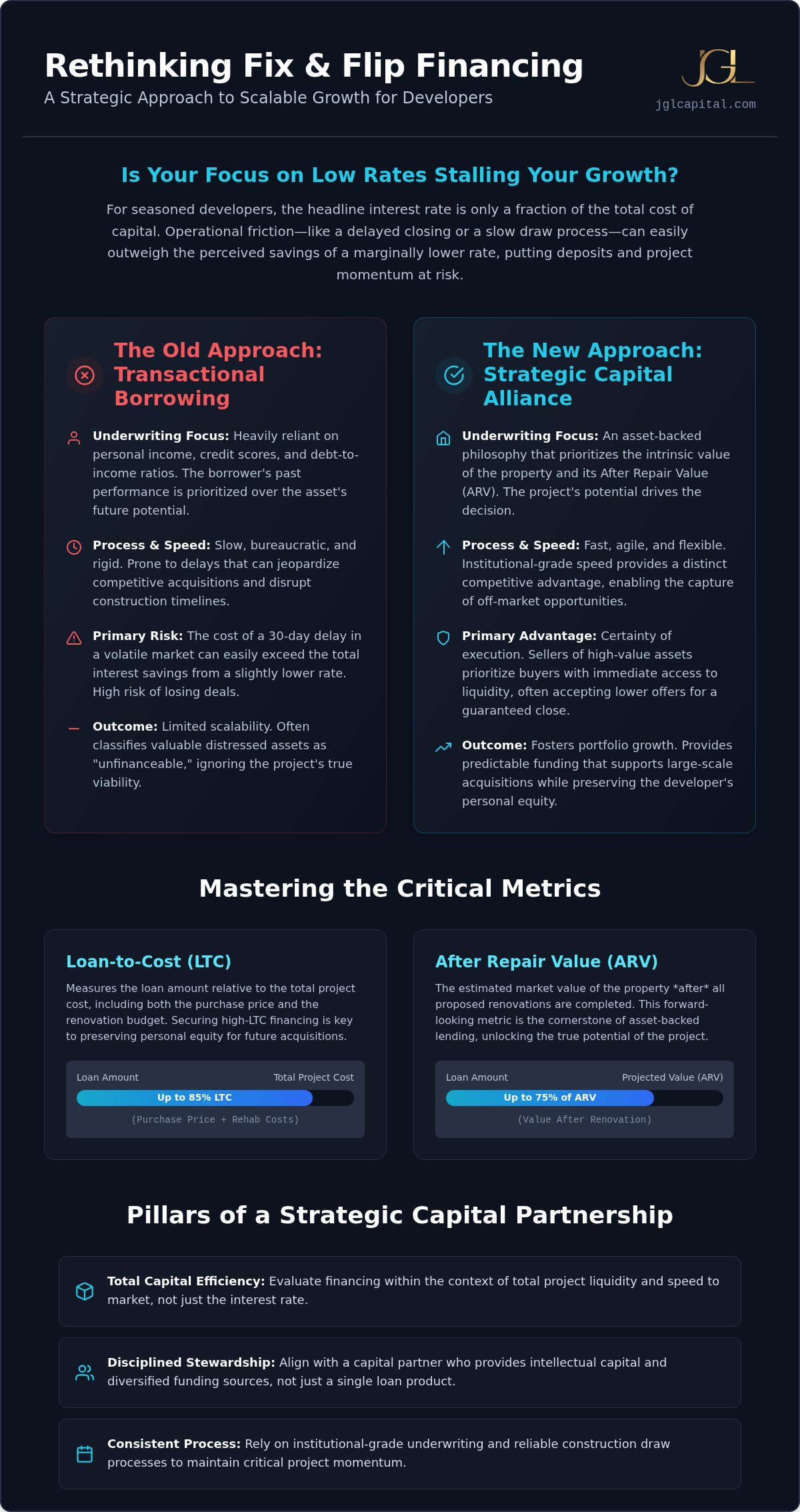
What if the pursuit of the lowest possible fix and flip loan rates is actually the primary obstacle to your firm’s scalable growth? For the seasoned developer, it’s often understood that the headline interest rate represents only a fraction of the total cost of capital. You’ve likely experienced the frustration of a delayed closing that puts a significant deposit at risk or a cumbersome draw process that stalls a project’s momentum during critical phases of construction. These operational frictions frequently outweigh the perceived savings of a marginally lower rate, particularly when restrictive credit-based underwriting ignores the intrinsic value of the asset itself.
This article provides a strategic framework for navigating the complexities of private capital to optimize your liquidity and secure institutional-grade funding for high-value projects. We’ll explore how a disciplined approach to capital allocation allows you to maintain high leverage while preserving your personal equity for future acquisitions. By shifting the focus from transactional borrowing to a long-term strategic alliance, you can establish a foundation of predictable funding that supports a growing portfolio of large-scale real estate assets. We’ll examine the mechanisms of asset-backed financing and the specific benchmarks that define the current 2026 lending environment.
Key Takeaways
- The transition toward private capital signifies a strategic shift for investors who require the agility and specialized underwriting that traditional banking institutions can no longer provide.
- Evaluating fix and flip loan rates within the context of total capital efficiency allows for the preservation of personal equity and the optimization of project liquidity.
- Mastery of critical metrics, such as Loan-to-Cost and After Repair Value, is fundamental to securing high-leverage financing that aligns with long-term portfolio objectives.
- Institutional-grade underwriting and consistent construction draw processes are necessary components for maintaining the momentum required in high-stakes real estate development.
- Aligning with a disciplined capital steward provides the intellectual capital and diversified funding sources needed to execute large-scale, national acquisitions.
The Evolution of Fix and Flip Financing in the Modern Real Estate Market
Fix and flip financing serves as a sophisticated capital instrument specifically engineered for transitional real estate assets. Unlike permanent financing, these short-term facilities provide the necessary liquidity for the acquisition and renovation of properties that require significant capital expenditure to reach their highest and best use. The Evolution of Fix and Flip Financing has seen a profound shift from local, fragmented lending toward institutional-grade private capital. This transition was largely precipitated by the increased regulatory constraints placed upon traditional depository institutions, which often lack the agility or risk appetite required for non-stabilized assets. For the professional investor, fix and flip loan rates are viewed as a cost of production rather than a simple interest expense, balanced against the project’s projected yield and speed to market.
The emergence of private capital as a dominant force in this sector reflects a broader trend toward specialized debt allocation. Professional developers require a partner that understands the nuances of complex renovations and the intrinsic value of the underlying asset. By operating outside the rigid frameworks of conventional mortgage lending, private capital providers offer a level of flexibility that is essential for the preservation and creation of value in volatile markets. This specialized lending environment prioritizes the viability of the project, ensuring that capital is deployed where it can generate the most significant risk-adjusted returns.
Asset-Backed Lending vs. Traditional Mortgages
Traditional mortgages rely heavily on the personal income and debt-to-income ratios of the borrower, a methodology that frequently fails the sophisticated developer managing multiple concurrent projects. While traditional banks focus on past performance, it’s the future potential of the asset that drives private capital allocation. Private capital utilizes an asset-backed philosophy that prioritizes the intrinsic value of the property and its After Repair Value (ARV). This approach allows for the acquisition of distressed assets that traditional lenders typically classify as unfinanceable due to habitability issues or structural deficiencies. For investors dealing with such issues, partnering with specialized contractors like Crown Leveling Inc. ensures that the property’s structural integrity is restored, which is often a prerequisite for securing institutional-grade capital. By centering the underwriting on project viability, disciplined lenders ensure that the capital structure supports the asset’s potential rather than the borrower’s personal balance sheet.
The Strategic Necessity of Speed in Competitive Acquisitions
In the current national real estate environment, the ability to execute with precision and speed provides a distinct competitive advantage. Sellers of high-value transitional assets prioritize certainty of execution, often accepting lower offers from investors who demonstrate immediate access to liquidity. The cost of a thirty-day delay in a volatile market can easily exceed the total interest carry of a private money loan. Institutional-grade speed allows developers to secure off-market opportunities and maintain momentum during the construction phase. This strategic debt allocation ensures that acquisitions are not lost to the bureaucratic delays inherent in conventional banking processes, fostering a environment where sophisticated partners can build lasting legacies through deliberate action.
Distinguishing Between Direct Lenders and Strategic Private Money Brokers
Institutional investors recognize that the structural composition of a capital partner significantly influences project execution. While direct lenders are often constrained by the specific liquidity mandates of their own balance sheets, a strategic private money broker operates with a broader market perspective. This objective approach is essential when Distinguishing Between Direct Lenders and Strategic Private Money Brokers, as it ensures that the debt structure is tailored to the asset’s intrinsic value rather than a lender’s internal volume targets. By leveraging a vast network of national capital providers, JGL Capital LLC serves as a disciplined steward, matching high-value projects with the optimal funding source.
Sophisticated developers frequently find that generic lending platforms lack the nuance required for institutional-grade acquisitions. Although these platforms may provide competitive fix and flip loan rates, the underlying terms often include restrictive covenants that can impede a project’s operational momentum. JGL Capital LLC provides a layer of professional advocacy, ensuring that every facet of the capital stack is aligned with the investor’s long-term objectives. This bespoke approach mitigates the friction common in transactional lending, allowing partners to focus on the preservation and creation of value in a volatile market.
The Advantage of Capital Diversity
A primary benefit of a strategic brokerage relationship is the ability to adapt as a project’s requirements evolve. A developer might initiate a project with bridge financing but later determine that new construction loans are more appropriate for the terminal vision of the asset. Direct lenders, typically siloed into specific product categories, often lack this flexibility. In contrast, JGL Capital LLC negotiates points and interest rates across a diverse spectrum of programs, ensuring that the fix and flip loan rates remain competitive without sacrificing the project’s structural integrity.
Expertise and Advocacy in Complex Transactions
With over 30 years of industry expertise, JGL Capital LLC brings a profound level of intellectual capital to every transaction. This experience is vital for navigating the administrative complexities of high-stakes real estate development, from initial deal submission to the final exit. The firm doesn’t merely facilitate a loan; it acts as a collaborative ally, advocating for the investor’s interests during the underwriting and servicing phases. For those seeking a long-term strategic alliance, partnering with a disciplined capital advisor provides the reliability and security needed to build lasting legacies.
Critical Metrics for Evaluating Fix and Flip Capital Partners
A sophisticated evaluation of a lending partner requires an analytical lens that extends far beyond the headline fix and flip loan rates. While the interest rate is a visible component of the debt structure, the underlying metrics of Loan-to-Cost (LTC) and Loan-to-Value (LTV) serve as the true determinants of a project’s financial viability. In the current 2026 market, institutional-grade lenders typically offer up to 90-95% LTC, ensuring that the developer’s equity is deployed with maximum efficiency. However, these ratios must be weighed against strict After Repair Value (ARV) limits, which often cap total exposure at 75-80% of the property’s stabilized worth. Understanding these Critical Metrics for Evaluating Fix and Flip Capital Partners allows an investor to anticipate the total capital requirement and protect the project’s terminal profit margins.
Operational efficiency is equally dependent on the structural integrity of the draw schedule. A cumbersome or inconsistent draw process can stall construction momentum, leading to increased carry costs that effectively erode the benefits of a competitive interest rate. Transparency in the fee structure is paramount; a disciplined partner provides a clear accounting of origination points, processing costs, and interest-only payment obligations. This clarity ensures that the developer can model cash flows with precision, avoiding the liquidity traps that often plague less sophisticated borrowing arrangements. By focusing on these metrics, investors can ensure their capital partners are aligned with the project’s operational realities.
Leverage and Capital Efficiency
High-leverage financing is a strategic tool for the preservation of personal capital, allowing sophisticated investors to pursue concurrent real estate investing opportunities. While increased leverage may occasionally result in slightly higher fix and flip loan rates, the resulting liquidity often provides a superior internal rate of return by enabling portfolio expansion. Calculating the true cost of capital requires a comprehensive view of all debt service requirements and points. It’s the alignment of these costs with the project’s timeline that defines capital efficiency, rather than the pursuit of the lowest nominal rate in isolation.
The Reliability of the Funding Process
Reliability is the cornerstone of a successful strategic alliance. In an unregulated private money sector where “bait and switch” tactics are unfortunately common, a lender’s history of consistent closing performance across the United States is an invaluable asset. A seasoned broker’s vetting process is essential for identifying the best fix and flip lenders who demonstrate a commitment to their initial terms. This disciplined approach to partner selection mitigates the risk of forfeited deposits and ensures that the capital stack remains stable from acquisition through the final exit. It’s this commitment to stability that distinguishes a professional capital partner from a transactional lender.
Navigating the Institutional Underwriting and Draw Process
The institutional underwriting process represents a critical juncture where project theory meets financial reality. Moving from initial deal submission to final loan payoff requires a methodical approach to documentation, beginning with a comprehensive asset-backed analysis. Lenders prioritize property value and renovation viability, necessitating a robust package that includes professional appraisals, detailed rehab budgets, and project pro formas. While market participants often fixate on fix and flip loan rates, the administrative efficiency of the underwriting phase often determines whether a developer can meet a strict closing deadline. Streamlining this phase involves proactive coordination between the investor’s team and the lender’s analysts to ensure all risk mitigants are clearly articulated.
Third-party inspections serve as the objective arbiter of construction progress, providing the necessary validation for draw releases. These site visits verify that the work described in the draw request has been completed to professional standards before capital is disbursed. This disciplined oversight ensures that the project remains sufficiently capitalized throughout its lifecycle. By adhering to a rigorous draw schedule, developers maintain the liquidity required to satisfy contractors and keep the renovation on track. Documentation isn’t just a hurdle. It’s a verification of viability. This systematic approach to capital deployment is a hallmark of institutional-grade financing, distinguishing it from the more haphazard practices of localized private lenders.
Preparing a Professional Project Pro Forma
A professional project pro forma is more than a simple spreadsheet; it’s a strategic roadmap that demonstrates a developer’s mastery of the asset. The core of this document is a detailed Scope of Work (SOW) that breaks down every line item of the renovation. Institutional lenders require this level of granularity to ensure the budget is sufficient to achieve the projected After Repair Value. By aligning the renovation timeline with the loan’s term length, investors avoid the necessity of costly extensions that can erode the project’s profitability. A disciplined budget serves as a safeguard against unforeseen market shifts, ensuring the capital structure remains resilient.
Managing the Construction Draw Lifecycle
Effective draw management is essential for maintaining project momentum and fostering a collaborative relationship with the lender’s servicing team. Best practices include submitting detailed documentation for completed work and maintaining clear records of all expenditures. As a project nears completion, the investor’s strategy may evolve from a quick sale to a long-term hold. In such instances, understanding what is a bridge loan becomes vital, as it allows for the transition from construction debt to more stable, transitional financing. For those ready to secure a disciplined capital partner for their next high-value acquisition, apply for institutional-grade financing through JGL Capital today.
Strategic Debt Allocation with JGL Capital LLC
JGL Capital LLC operates as a seasoned, strategic partner rather than a mere intermediary in the national capital markets. With over 30 years of industry expertise, the firm’s approach is grounded in the belief that debt should serve as a catalyst for long-term growth and legacy creation. While the broader market often fixates on the fluctuations of fix and flip loan rates, JGL Capital LLC provides a stable, institutional-grade alternative through disciplined capital stewardship. This expertise is particularly evident in the firm’s ability to facilitate large-scale financing for projects exceeding $10 million, providing the sophisticated underwriting required for complex, high-value acquisitions. By prioritizing the intrinsic value of the asset over traditional credit metrics, the firm ensures that project viability remains the central focus of every capital allocation decision.
Professional advocacy is the cornerstone of the firm’s philosophy. Each transaction is viewed as an opportunity to align financial structures with the broader objectives of high-net-worth stakeholders. This commitment to stability and analytical rigor allows investors to navigate the complexities of transitional real estate with confidence. Whether a project requires immediate bridge financing or a more permanent debt structure, JGL Capital LLC provides the intellectual capital needed to secure superior terms. This high-register approach to service distinguishes the firm from transactional competitors, fostering a collaborative environment where sophisticated partners can execute their visions with precision.
Beyond Residential: Multi-Family and Commercial Opportunities
The firm’s reach extends far beyond single-family renovations, offering a comprehensive product suite that includes land loans and multi-family financing. This breadth of expertise allows investors to transition seamlessly from residential flips to ground-up development and large-scale commercial real estate loans. Having a single point of contact for all national real estate capital needs provides an unparalleled level of operational efficiency. It ensures that as an investor’s portfolio grows in complexity, their financing remains cohesive and strategically aligned. This capability is essential for developers seeking to scale their operations into higher asset classes while maintaining a relationship with a disciplined steward who understands their history and long-term goals.
Partnering for Long-Term Portfolio Growth
JGL Capital LLC views every loan as a strategic alliance, prioritizing the generation of worth over simple transaction volume. For investors focused on expanding rental property portfolios, the firm provides access to specialized products like DSCR loans, which prioritize the property’s cash flow over personal income verification. This focus on performance metrics allows for the rapid accumulation of stabilized assets without the constraints of traditional bank underwriting. Sophisticated investors are invited to experience a higher register of professional service, where fix and flip loan rates are just one component of a meticulously crafted capital strategy. By partnering with an organization that values integrity and deliberate action, you can ensure that your real estate portfolio remains a resilient foundation for future generations.
Establishing a Foundation for Institutional-Grade Growth
The successful execution of transitional real estate projects requires a sophisticated shift in perspective from transactional borrowing to strategic capital alignment. While many in the market focus narrowly on nominal fix and flip loan rates, the professional developer understands that project velocity and predictable liquidity are the true drivers of portfolio expansion. By prioritizing asset-backed underwriting and a disciplined draw process, investors can maintain the momentum necessary for high-stakes acquisitions. It’s this commitment to analytical rigor that allows our partners to scale with confidence, ensuring that every debt facility supports the long-term preservation of value.
JGL Capital LLC brings over 30 years of industry leadership to every alliance, specializing in the complex requirements of institutional-grade loans exceeding $10 million across a national footprint. This seasoned expertise ensures that your capital structure is designed to meet the demands of large-scale development while providing the professional advocacy you require. We invite you to Secure Your Strategic Capital with JGL Capital LLC Today and experience the stability of a partner committed to your long-term objectives. Your next high-value project deserves a foundation built on intellectual capital and a shared vision for excellence.
Frequently Asked Questions
What are the typical requirements for a fix and flip loan in 2026?
Institutional requirements center on a detailed scope of work, a professional project pro forma, and a verified track record of successful development. While fix and flip loan rates are influenced by broader market trends, approval is primarily driven by the asset’s intrinsic value and the feasibility of the renovation budget. Lenders require a rigorous analysis of the property’s potential to ensure the capital structure remains resilient throughout the project lifecycle.
How do fix and flip lenders calculate the After Repair Value (ARV)?
After Repair Value is determined through a professional appraisal that evaluates the property’s projected worth following the completion of the proposed renovation. This analysis incorporates comparable sales of recently stabilized assets in the immediate submarket to establish a realistic terminal value. It’s a forward-looking metric that serves as the cornerstone for institutional-grade underwriting, ensuring that the total debt remains within disciplined limits to protect profit margins.
Can I secure a fix and flip loan with no previous investment experience?
Securing financing without a track record is feasible, though it often necessitates more conservative leverage and a higher capital contribution from the developer. Lenders may adjust fix and flip loan rates to reflect the increased operational risk of an unproven partner. In these instances, the project’s viability and the quality of the third-party construction team become the primary drivers for securing institutional-grade capital.
What is the difference between a hard money lender and a private money broker?
A hard money lender typically utilizes its own balance sheet, which limits the flexibility of the capital provided to a single set of internal criteria. Conversely, a private money broker functions as a strategic ally, accessing a diverse range of capital providers to secure bespoke terms. This brokerage model offers a more sophisticated level of advocacy, matching each project with the optimal funding source based on its unique structural requirements.
How much of a down payment is required for an asset-backed flip loan?
Down payment requirements are typically calculated as a percentage of the total project cost, with many institutional lenders offering up to 90-95% Loan-to-Cost. The specific equity requirement depends on the developer’s history and the project’s risk profile. This high-leverage approach allows sophisticated investors to preserve their personal capital for concurrent acquisitions, optimizing the overall efficiency of their national real estate investment strategy.
How quickly can a fix and flip lender fund a new acquisition?
Funding timelines for transitional assets generally range from 10 to 19 days, depending on the complexity of the underwriting and the speed of the appraisal process. Institutional-grade lenders prioritize certainty of execution, ensuring that acquisitions aren’t lost to the bureaucratic delays inherent in traditional banking. By maintaining a streamlined administrative process, professional capital partners provide the agility required to compete effectively in high-demand markets.
Are fix and flip loans interest-only, and how do monthly payments work?
Fix and flip loans are almost exclusively structured with interest-only monthly payments to maximize project liquidity during the renovation phase. The principal balance remains deferred until the project’s exit, whether through a sale or a transition to permanent financing. This debt structure ensures that cash flow is preserved for construction costs, allowing the developer to maintain momentum without the burden of principal amortization during the build.
What happens if the renovation takes longer than the initial loan term?
If a renovation exceeds the initial loan term, developers must typically negotiate a term extension, which may involve additional fees or updated interest terms. This scenario underscores the importance of a strategic alliance with a disciplined lender who understands the transitional nature of real estate. Proactive communication and a detailed project update are essential for maintaining capital stability when timelines shift due to unforeseen operational challenges.