

The misidentification of a bridge loan vs hard money loan often serves as the primary catalyst for capital inefficiency in the acquisition of non-stabilized assets. You’ve likely recognized that the rigid underwriting and protracted timelines characteristic of traditional banking institutions frequently fail to align with the exigencies of time-sensitive real estate transactions. This institutional friction creates a substantial opportunity cost, where the velocity of capital becomes as critical as its underlying cost for the sophisticated investor.
By engaging with this strategic comparison, you will gain a comprehensive understanding of the structural differences between these two financing vehicles, ensuring that your capital allocation remains optimized for long-term value creation. We will examine the divergent underwriting priorities of each instrument, the necessity of a well-defined exit strategy, and the essential characteristics of a disciplined capital partner. This methodical analysis provides the precise framework needed to secure rapid funding while maintaining the analytical rigor required for successful asset stabilization.
Key Takeaways
- Discern the fundamental underwriting distinctions where bridge financing prioritizes future stabilized valuations, whereas hard money remains anchored in current “as-is” asset equity.
- It’s essential to determine the most advantageous application of a bridge loan vs hard money loan by aligning the capital structure with the project’s specific stabilization requirements.
- Conduct a rigorous yield analysis that incorporates origination points and ancillary fees to understand the true total cost of capital beyond simple interest rates.
- Formulate a definitive exit strategy that mitigates the risks associated with transitional capital and ensures a seamless path toward permanent financing or asset disposition.
- Access deep-seated intellectual capital and over 30 years of experience to facilitate complex multi-family acquisitions through disciplined strategic partnerships.
Defining the Strategic Role of Transitional Capital in Real Estate
In the sophisticated environment of institutional real estate investment, transitional capital functions as a precise liquidity tool rather than a mere debt obligation. Sophisticated investors recognize that the structural inertia of traditional banking often results in missed opportunities, particularly when an asset requires immediate action or stabilization. By utilizing flexible financing vehicles, market participants can bypass the protracted underwriting cycles of conventional lenders, ensuring that capital remains as agile as the strategies it supports. This agility is the primary driver behind the persistent demand for both bridge and hard money solutions.
The choice between a bridge loan vs hard money loan ultimately depends on the specific lifecycle stage of the underlying asset. While both instruments prioritize speed and flexibility over institutional bureaucracy, they serve distinct tactical purposes within a diversified portfolio. Bridge loans are typically utilized to span the temporal gap between an initial acquisition and the securing of long-term, permanent financing. Conversely, hard money loans emphasize the intrinsic, “as-is” value of the real estate asset itself, providing a high-velocity solution for scenarios where collateral value outweighs borrower credit profiles. Understanding these distinctions is essential for maintaining a disciplined approach to capital allocation.
The Institutional Context of Bridge Financing
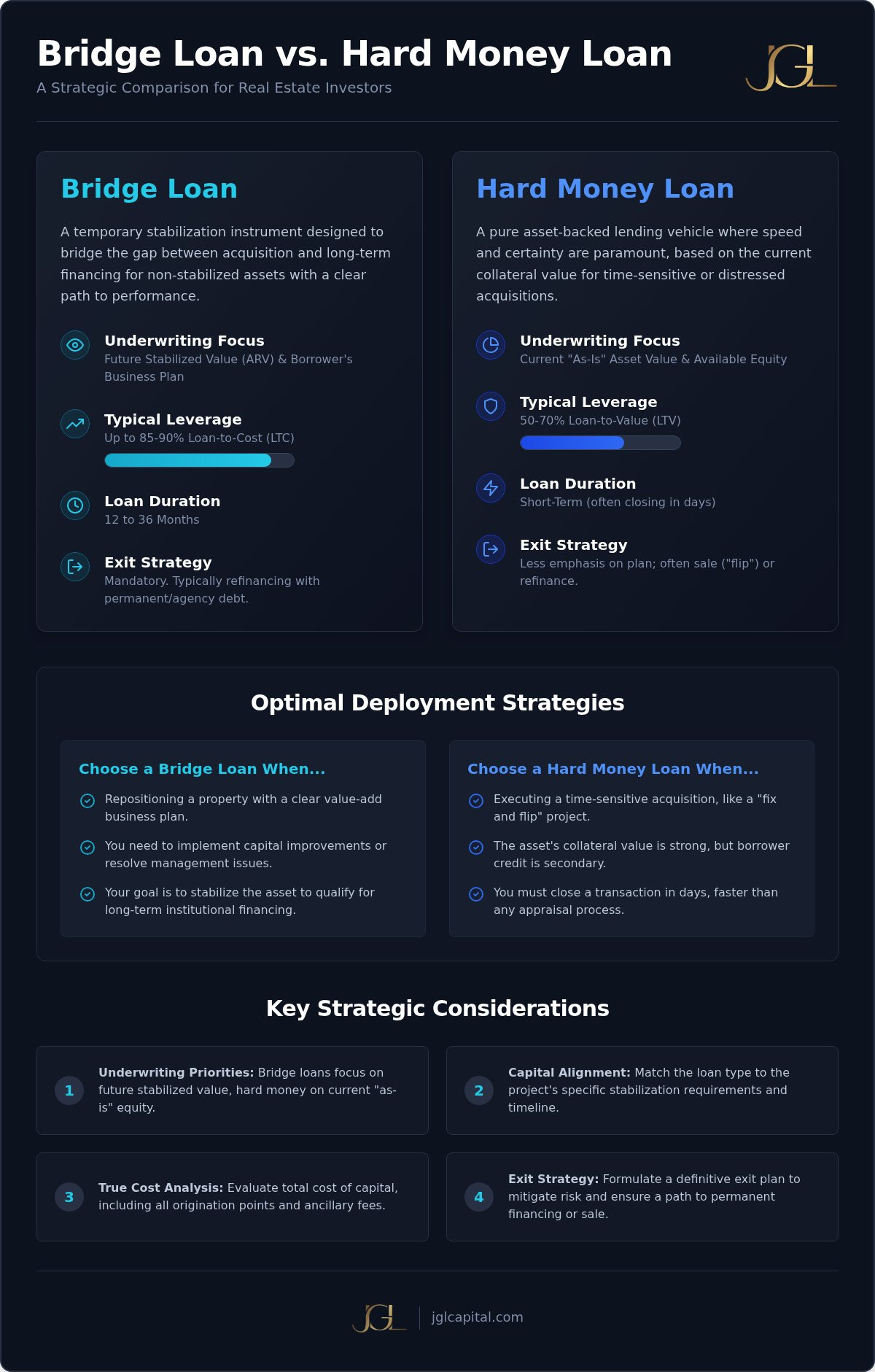
A Bridge loan serves as a temporary stabilization instrument designed for assets that are currently “non-stabilized” but possess a clear path toward performance. These loans are frequently employed during property re-positioning, where an investor intends to implement capital improvements or resolve management inefficiencies to improve the debt-service coverage ratio (DSCR). Because the underwriting focuses on the future viability of the project, the duration of these loans typically spans 12 to 36 months. A credible, well-articulated exit strategy is not merely a preference in this context; it’s a mandatory component of the risk management framework. Investors use this time to bridge the gap to agency debt or other permanent institutional capital.
Hard Money as a Tactical Acquisition Tool
Hard money functions as a pure asset-backed lending vehicle where the primary underwriting metric is the current collateral value. In highly competitive or distressed markets, the ability to close a transaction in a matter of days provides a significant tactical advantage. These loans are often the preferred choice for time-sensitive “fix and flip” acquisitions or when an investor needs to move faster than a traditional appraisal process allows. The shift in focus from the borrower’s creditworthiness to the collateral’s liquidation value allows for a more streamlined approval process. While the cost of capital is generally higher, the trade-off for speed and certainty of execution often justifies the expense in high-stakes scenarios.
Analytical Framework: Key Structural Differences in Underwriting
The underwriting process for a bridge loan vs hard money loan represents a fundamental divergence in risk assessment philosophy. While both instruments provide transitional liquidity, the underlying analytical framework used to evaluate risk is inherently different. Bridge financing is typically predicated on the future stabilized value of the asset, requiring the lender to validate a borrower’s business plan and the eventual execution of a repositioning strategy. In contrast, hard money underwriting is firmly anchored in the current “as-is” market value and the available equity within the collateral. This distinction dictates the level of scrutiny applied to both the property and the individual sponsor.
Collateral Evaluation and Loan-to-Value (LTV) Metrics
When assessing collateral, bridge lenders prioritize the After Repair Value (ARV) or the projected value upon stabilization. This forward-looking approach allows for higher leverage on the total project cost, often reaching up to 85-90% Loan-to-Cost (LTC) for value-add acquisitions. Hard money lenders adopt a more defensive posture, generally limiting exposure to 50-70% of the current market value to ensure a substantial equity cushion in the event of a rapid liquidation. Loan-to-Value (LTV) serves as the primary risk metric in asset-based lending, representing the ratio of the loan amount to the appraised value of the property. Understanding these bridge loan costs and considerations is vital for investors who must balance the need for leverage against the total cost of capital.
The Role of Borrower Financial Strength
The depth of the internal review process further distinguishes these two capital sources. Bridge lenders frequently require a robust documentation package, including personal financial statements, global cash flow analysis, and evidence of prior experience with similar asset classes. They seek to confirm that the sponsor possesses the liquidity to carry the project through its stabilization phase. Hard money remains a viable solution for scenarios where a sponsor may be asset-rich but credit-challenged, as the lender’s primary security is the real estate itself rather than the borrower’s balance sheet. This streamlined approach allows for the expedited funding of Fix and Flip Loans and other time-sensitive acquisitions. The complexity of the review process is a direct reflection of the lender’s reliance on the borrower’s operational competence versus the collateral’s intrinsic worth.
Deployment Strategies: Optimal Use Cases for Each Instrument
Strategic capital deployment requires a nuanced understanding of where an asset resides within its operational lifecycle. The efficacy of a bridge loan vs hard money loan is contingent upon the alignment of the financing structure with the asset’s specific risk profile and the investor’s ultimate objective. While bridge financing facilitates the transition toward stabilization, hard money provides the necessary velocity for opportunistic acquisitions. For sophisticated investors, these instruments are not interchangeable; they’re tactical tools selected with mathematical precision to maximize the yield on every dollar of equity deployed.
In the multi-family sector, bridge debt serves as the primary engine for value-add initiatives. These projects often involve properties with high vacancy rates or deferred maintenance that precludes them from qualifying for agency debt. Investors utilize these funds to execute renovations and improve management, eventually reaching a debt-service coverage ratio (DSCR) that permits a transition to permanent commercial real estate loans. This methodical approach to stabilization ensures that the asset is positioned for long-term preservation of value before committing to a permanent capital structure.
Stabilization and Value-Add Scenarios
Understanding what is a bridge loan in a commercial context reveals its utility as a sophisticated stabilization tool. Beyond simple renovations, bridge structures allow investors to navigate periods of interest rate volatility or temporary market dislocations. A significant strategic advantage in this space is the availability of non-recourse options, which protect the sponsor’s global balance sheet while the asset undergoes re-positioning. This layer of protection is essential when managing large-scale multi-family portfolios where the goal is to improve the property’s net operating income (NOI) to meet institutional lending standards.
Opportunistic Acquisition and Distressed Assets
When speed of execution is the paramount variable, the standard hard money loan definition takes center stage as an acquisition catalyst. In low-inventory or highly competitive markets, the ability to provide a proof of funds and close within days is often the deciding factor in securing a distressed asset. Hard money is particularly effective for REO purchases, auction acquisitions, or properties in sub-optimal condition that traditional lenders would reject outright. Many sophisticated sponsors rely on hard money lenders to capture these high-margin opportunities, accepting a higher cost of capital in exchange for the certainty of execution. This allows for a disciplined capture of equity through rapid acquisition and immediate renovation, often referred to as the fix-and-flip strategy.
Evaluating the Cost of Capital and Strategic Exit Planning
A rigorous yield analysis is the only way to evaluate the true financial impact of transitional financing. While many investors focus exclusively on nominal interest rates, a sophisticated approach requires the calculation of the total cost of capital. This comprehensive metric includes origination points, processing fees, and the temporal value of capital velocity. In the strategic comparison of a bridge loan vs hard money loan, the total cost must be weighed against the projected return on investment and the speed at which the capital can be deployed to capture market inefficiencies. When rapid execution generates a higher net worth through timely acquisition, the nominal cost of debt becomes secondary to the preservation of opportunity. Capital that sits idle while waiting for traditional bank approval represents a significant drain on potential portfolio growth.
Structuring Points and Interest-Only Payments
Transitional loans are typically structured with interest-only payments to maximize cash flow during the critical stabilization or renovation phase. This structure prevents the depletion of operating reserves while the asset is not yet generating its full potential net operating income. Points are typically paid at closing as a percentage of the total loan amount and represent a significant component of the initial capital outlay. These upfront costs must be amortized over the expected duration of the loan to accurately determine the project’s internal rate of return (IRR). A disciplined partner will provide full transparency regarding these fees, ensuring that the cost of capital remains aligned with the project’s strategic objectives. This transparency allows for more accurate forecasting and risk mitigation throughout the lifecycle of the investment.
Exit Strategy: Refinancing vs. Asset Disposition
The hallmark of a successful transitional loan is a clearly defined and meticulously executed exit strategy. Whether the objective is a transition to long-term real estate investing debt or a strategic asset sale, the repayment vehicle must be viable under various market conditions. Investors must also scrutinize the clarity of pre-payment penalties within short-term contracts. A rigid penalty structure can impede the ability to refinance or sell the asset when market conditions are most favorable. Understanding the nuances of a bridge loan vs hard money loan requires a partner who recognizes the gravity of these high-stakes decisions. By prioritizing flexibility in the exit phase, sponsors maintain the agility needed to optimize their capital stack as the asset achieves stabilization. It’s this level of strategic foresight that distinguishes institutional-grade management from transactional speculation. To ensure your capital structure is optimized for your next acquisition, you can explore tailored financing options at JGL Capital.
Executing High-Stakes Transactions with JGL Capital
The decision-making process involving a bridge loan vs hard money loan requires more than just a calculation of interest rates; it demands a partnership with a firm that possesses the intellectual capital to navigate complex capital stacks. JGL Capital brings over 30 years of industry expertise to every transaction, serving as a disciplined steward for investors who value stability and precision. By operating with a national footprint, the firm provides access to a broad spectrum of asset-backed financing programs, ensuring that the capital structure is meticulously aligned with the unique requirements of diverse investment portfolios. This commitment to the creation and preservation of long-term investor value is the foundation of every strategic alliance we form.
The JGL Capital Advantage: Professional Stewardship
JGL Capital understands the gravity of high-stakes management and the critical nature of timing in competitive real estate environments. Unlike traditional banking institutions that are often hindered by bureaucratic inertia, our streamlined processing is designed to eliminate unnecessary delays while maintaining the highest standards of analytical rigor. This commitment to efficiency allows sophisticated partners to secure funding for multi-family assets and new construction loans without sacrificing the thoroughness required for risk mitigation. Every underwriting decision is anchored in the preservation of value, providing a sense of security for high-net-worth stakeholders who require a serious and disciplined approach to resource management. By providing access to customized, individual solutions nationwide, we ensure that your capital velocity remains high without compromising on the integrity of the underwriting process.
Strategic Alliance and Collaborative Growth
The firm’s philosophy is rooted in the belief that a lender should function as a collaborative ally rather than a merely transactional service provider. JGL Capital projects the persona of a quiet expert, relying on an established history and deep-seated intellectual capital to generate worth for its partners. This approach fosters a strategic alliance where the firm’s objectives are perfectly synchronized with the long-term growth and integrity of the borrower’s portfolio. By prioritizing the creation of lasting legacies over speculative trends, JGL Capital distinguishes itself as a knowledgeable entity dedicated to individual solutions. It’s this rejection of marketing hyperbole in favor of analytical rigor that has solidified our position as a leader in the field. We invite you to contact JGL Capital to discuss the alignment of your next strategic acquisition and discover how our disciplined capital can serve as the foundation for your continued success.
Optimizing Capital Structures for Long-Term Value Preservation
The strategic selection of a bridge loan vs hard money loan represents a fundamental exercise in capital optimization. This decision must be grounded in a meticulous analysis of the asset’s lifecycle, where the choice between stabilization support and acquisition velocity determines the ultimate success of the investment. A disciplined approach to yield analysis ensures that the total cost of capital is always measured against the temporal advantages of rapid execution. By prioritizing these structural nuances, you ensure that your capital stack remains as sophisticated as the assets it supports.
JGL Capital provides the institutional-grade stewardship required to execute these high-stakes transactions with confidence. With over 30 years of industry expertise and a national footprint for commercial lending, the firm utilizes asset-backed underwriting that prioritizes property value to eliminate the protracted delays of traditional banking. This focus on analytical rigor and the alignment of objectives fosters a strategic alliance dedicated to the preservation of stakeholder worth. We invite you to Consult with JGL Capital to Secure Your Strategic Transitional Funding. It’s a partner’s responsibility to ensure that your next acquisition is supported by a legacy of integrity and deep-seated expertise.
Frequently Asked Questions
Is a bridge loan more expensive than a hard money loan?
Generally, bridge loans represent a lower cost of capital than hard money loans. Market data indicates that bridge interest rates typically range from 8.5% to 12.5%, while hard money rates often scale from 11% to 18% or higher in distressed scenarios. The total expense depends on the duration of the debt and the efficiency of the exit strategy, as a shorter-term hard money loan can occasionally result in lower absolute costs than a longer-term bridge hold.
Can I use a bridge loan for new construction projects?
Bridge structures are frequently utilized for new construction, particularly during the transition from horizontal development to vertical construction. These loans provide the necessary liquidity to maintain project momentum before the developer secures permanent financing or completes a strategic asset disposition. This application ensures that capital remains available during the critical phases of project stabilization and value creation.
What is the typical duration of a hard money loan versus a bridge loan?
Bridge loans are designed for intermediate stabilization and typically feature terms spanning 12 to 36 months, often with extension options. Hard money loans are more tactical and shorter in duration, generally ranging from 6 to 24 months. These timelines reflect the divergent goals of each instrument, where bridge financing supports property re-positioning and hard money facilitates rapid acquisition or immediate renovation.
Do bridge lenders require a minimum credit score for commercial projects?
While asset-based underwriting prioritizes the intrinsic value of the property over personal credit history, bridge lenders typically conduct a more thorough review of the sponsor’s financial strength. This evaluation focuses on global liquidity, experience with similar asset classes, and the viability of the proposed business plan. A specific credit score is often less critical than the evidence of a disciplined exit strategy and the borrower’s ability to carry the project through stabilization.
How quickly can JGL Capital fund a hard money transaction?
JGL Capital leverages a streamlined underwriting process to provide rapid funding, often closing hard money transactions within 5 to 14 days. This velocity is essential for investors participating in auctions or low-inventory markets where traditional banking delays would result in a lost opportunity. The firm’s commitment to analytical rigor ensures that speed doesn’t compromise the integrity of the capital structure.
What are the primary exit strategies for transitional real estate capital?
The primary exit strategies involve refinancing the debt into long-term institutional financing or the outright sale of the asset upon stabilization. A credible repayment vehicle is a mandatory component of the underwriting process for a bridge loan vs hard money loan. Sophisticated sponsors must ensure that the property’s net operating income or market value supports the chosen exit path within the loan’s term.
Are these loans available for owner-occupied residential properties?
No, these financing programs are strictly limited to commercial and investment-grade real estate. JGL Capital does not provide owner-occupied residential mortgages or unsecured personal loans. The firm’s expertise is focused exclusively on asset-backed commercial loans, multi-family assets, and investment properties intended for income generation or capital appreciation.
What is the maximum LTV typically offered for asset-backed bridge loans?
Bridge loans typically offer a maximum Loan-to-Value (LTV) of 75% to 80% of the current appraised value. In value-add scenarios, lenders may also evaluate the Loan-to-Cost (LTC), which can reach 85% to 90% for acquisition and renovation costs. This higher leverage is predicated on the anticipated increase in property value once the sponsor’s stabilization plan is fully executed.