

The 2026 Housing Law and the implementation of stringent FinCEN reporting requirements have fundamentally altered the mechanics of real estate acquisition, rendering the traditional reliance on personal-income-based lending increasingly obsolete for the serious investor. As you seek to understand how to finance an investment property in this sophisticated environment, it becomes clear that the primary hurdle isn’t a lack of opportunity, but rather the friction created by institutional bureaucracy and rigid debt-to-income constraints. You’re likely aware that the documentation burdens and lethargic closing timelines of conventional banks often result in lost momentum and missed capital deployment.
This guide promises to equip you with the strategic insights required to utilize private capital structures and asset-backed financing to scale your portfolio beyond the arbitrary limits of traditional mortgages. We’ll explore the shift toward non-recourse models and the optimization of debt service coverage ratios to ensure your growth remains disciplined, secure, and entirely unconstrained by personal liability.
Key Takeaways
- Identify the limitations of traditional retail banking and learn how private capital structures provide the speed and flexibility required for sophisticated portfolio growth.
- Master the technical mechanics of how to finance an investment property by utilizing Debt Service Coverage Ratio (DSCR) loans that emphasize asset performance over personal income.
- Evaluate the strategic advantages of specialized funding, including bridge and multi-family loans, to ensure your capital allocation aligns with specific property objectives.
- Navigate the shift toward entity-based underwriting by preparing professional track records and property pro-formas that meet the standards of institutional-grade lenders.
The Strategic Landscape of Investment Property Financing in 2026
The acquisition of real estate assets requires more than mere capital; it demands a sophisticated deployment of leverage designed to amplify returns while mitigating systemic risk. Professional real estate acquisition requires a nuanced understanding of how to finance an investment property through structures that emphasize strategic leverage rather than personal debt. Understanding real estate investment financing is no longer about securing a simple mortgage; it’s about architecting a capital stack that supports the long-term preservation of value. Determining how to finance an investment property in 2026 requires a departure from retail banking methodologies that prioritize personal tax returns over the intrinsic performance of the asset.
The strategic allocation of capital in the current market necessitates a shift from transactional borrowing to a partnership-driven approach. Traditional retail banking, while offering lower nominal interest rates, frequently fails the professional investor due to its reliance on rigid debt-to-income ratios and onerous documentation. These institutions are often unable to move at the velocity required to secure high-yield assets in a competitive environment. Instead, sophisticated investors utilize transitional capital to bridge the gap between acquisition and long-term stabilization. This disciplined approach ensures that capital is deployed where it generates the highest worth.
Primary financing categories include:
- Conventional Financing: Government-sponsored enterprise (GSE) loans that offer stability but impose strict limits on the number of properties held.
- Private Capital: Asset-backed solutions such as bridge loans and fix-and-flip financing that prioritize speed and property potential.
- Institutional Debt: Large-scale commercial real estate loans tailored for multi-family or industrial portfolios.
The Shift Toward Asset-Backed Lending Models
Market dynamics in 2026 reward investors who can decouple their personal credit profile from the performance of the property. Lenders now increasingly prioritize the underlying value of the asset. This evolution is critical for those looking to move beyond the traditional ten-loan limit imposed by conventional programs. Success depends on capital agility. By focusing on asset-backed models, you ensure that your ability to scale isn’t restricted by personal liquidity or traditional underwriting bottlenecks. Speed is the differentiator.
Identifying Your Financing Objectives
Strategic capital allocation requires an alignment between your investment timeline and your debt structure. Short-term objectives, such as ground-up development, are best served by new construction loans that offer flexible draw schedules. Conversely, long-term holds require permanent financing that optimizes the internal rate of return (IRR). You must evaluate the trade-off between the cost of capital and the certainty of execution. A lower rate is meaningless if the lender fails to close on time. High-leverage structures can significantly enhance your IRR, provided the debt service is supported by disciplined cash flow projections.
Conventional vs. Private Capital: Evaluating the Optimal Funding Source
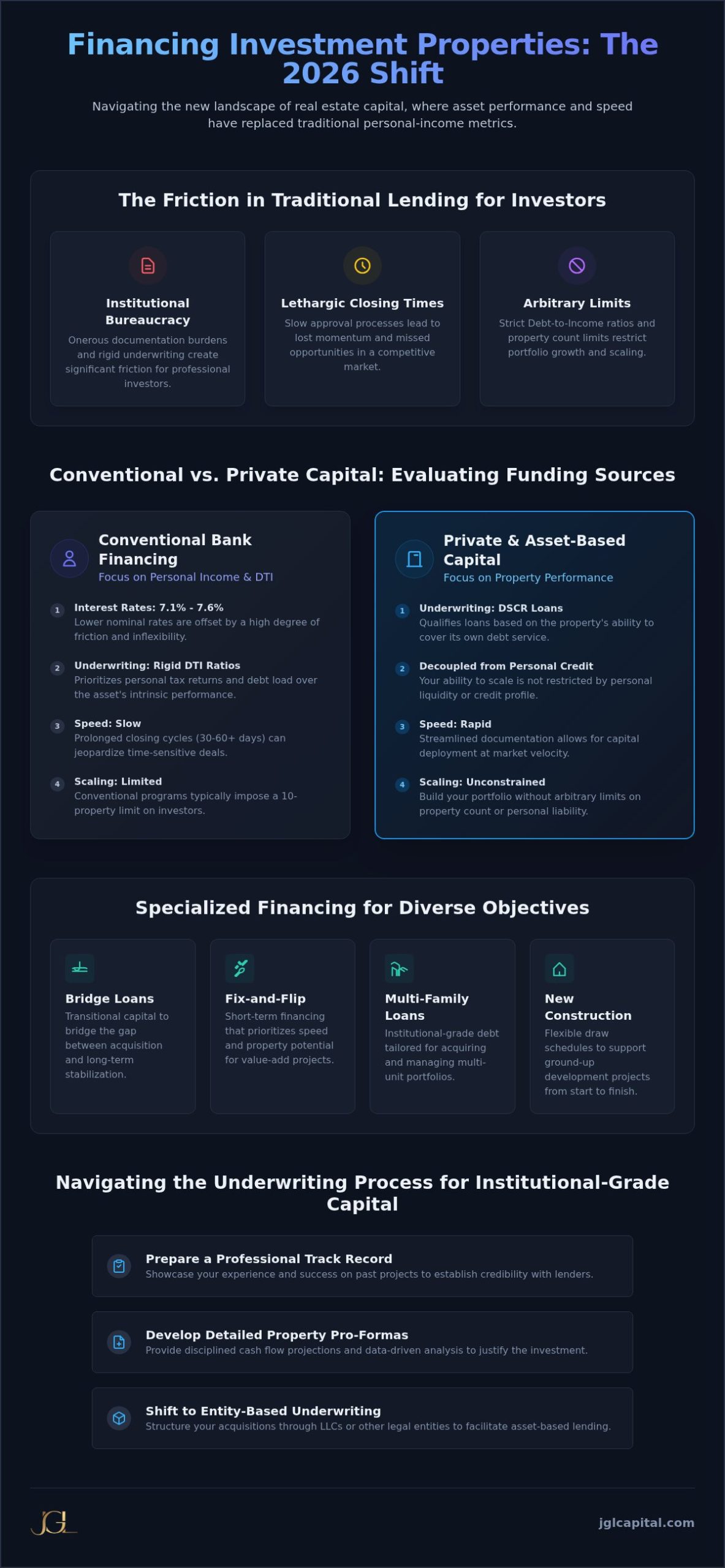
The decision of how to finance an investment property often begins with a fundamental choice between conventional institutional debt and private capital structures. While conventional mortgages frequently offer the most attractive interest rates, ranging from 7.1% to 7.6% for 30-year fixed-rate investment loans as of July 2026, they’re characterized by a high degree of friction. These products require meticulous adherence to institutional underwriting standards, which prioritize personal income stability and rigid debt-to-income ratios over the intrinsic worth of the acquisition. For the professional investor, this rigidity often translates into prolonged closing cycles that can jeopardize time-sensitive opportunities.
In contrast, private money and bridge financing prioritize the collateral’s performance and the sponsor’s track record. This shift in focus allows for a streamlined documentation process where the property appraisal and pro-forma data take precedence over years of personal tax returns. Although the nominal cost of private capital may exceed that of traditional debt, the resulting certainty of execution provides a critical buffer against the inherent volatility of competitive acquisition environments. This is particularly relevant when competing against all-cash buyers who are now subject to the expanded 2026 FinCEN reporting rules, which require the disclosure of beneficial ownership for non-traditionally financed transactions.
The Limitations of Traditional Mortgages for Investors
Conventional lending models are fundamentally designed for stability rather than scalability. Strict debt-to-income (DTI) constraints and the 15% to 25% down payment requirements can quickly deplete an investor’s personal borrowing capacity, effectively capping growth at the common 10-loan limit. Retail banks are also historically averse to financing distressed assets that require significant rehabilitation. The bankability gap represents the critical disconnect between the rigid risk parameters of traditional depository institutions and the capital requirements of high-performance, transitional real estate assets.
Private Capital as a Strategic Advantage
Utilizing private capital provides the agility necessary to capture value in transitional assets. Investors frequently employ fix and flip loans to secure properties that would fail a standard bank inspection, allowing for the rapid deployment of renovation capital. Bridge loans facilitate the acquisition of underperforming multi-family assets, providing the necessary runway to stabilize occupancy and improve net operating income before seeking permanent financing. Establishing a collaborative relationship with a dedicated capital partner ensures that your financing strategy is a deliberate component of your long-term legacy. For those managing a diverse portfolio, aligning with a partner who understands institutional-grade capital allocation is essential for sustained growth.
Asset-Based Lending: Prioritizing Property Performance Over Personal Metrics
The strategic transition from personal financial scrutiny to property-level performance metrics represents a hallmark of sophisticated capital management. When evaluating how to finance an investment property for long-term growth, the Debt Service Coverage Ratio (DSCR) serves as the definitive metric for institutional-grade lenders. This asset-based methodology allows for the procurement of capital based strictly on the property’s capacity to generate sufficient net operating income to satisfy debt obligations. By decoupling the loan approval process from personal debt-to-income ratios, investors can accelerate portfolio expansion without the constraints typically imposed by traditional retail underwriting.
Adopting an asset-based approach also facilitates the utilization of non-recourse or limited-recourse financing structures. These arrangements serve to preserve personal wealth by ensuring that the lender’s primary recourse in the event of default is the property itself rather than the investor’s personal assets. Such structures are essential for those seeking to minimize personal financial disclosure. By borrowing through corporate entities like LLCs, sophisticated partners can maintain a layer of separation between their individual holdings and their real estate operations, a practice that remains highly effective despite the increased transparency required by the 2026 FinCEN reporting rules.
Understanding the Debt Service Coverage Ratio (DSCR)
The mathematical precision of the DSCR formula serves as the gold standard for rental property loans. Lenders calculate this ratio by dividing the gross monthly rental income by the total monthly debt service, encompassing principal, interest, taxes, insurance, and association fees. While a 1.0x ratio indicates a neutral cash flow, most institutional lenders require a threshold of 1.2x or 1.25x to provide a safety margin against vacancy and maintenance. Optimizing property performance through disciplined management directly translates into superior financing terms, as higher ratios often unlock lower interest rates and more favorable leverage options.
Portfolio Financing for Scaled Operations
For organizations managing a diverse array of assets, portfolio financing offers a streamlined alternative to individual loan management. Consolidating multiple properties under a single, strategic blanket loan reduces administrative friction and provides a cohesive view of total capital exposure. Cross-collateralization allows you to leverage the collective equity of your portfolio to secure additional acquisitions without the need for asset liquidation. This strategy is particularly effective for managing interest rate risk across a high-performance portfolio. By architecting a unified debt structure, you ensure that your capital remains aligned with long-term objectives for the preservation of worth.
Specialized Financing Structures for Diverse Investment Objectives
Sophisticated investors recognize that the methodology of how to finance an investment property depends heavily on the asset’s specific lifecycle stage and the overarching objectives of the portfolio. While previous sections addressed stabilized assets, ground-up development and large-scale commercial acquisitions require a more intricate capital stack that often incorporates subordinated layers of debt. These projects typically begin with land loans to secure the site, followed by senior debt and potentially mezzanine debt or preferred equity to optimize the leverage profile. By architecting a capital stack that utilizes these advanced layers, sophisticated partners can maximize their return on equity while maintaining a disciplined approach to senior debt obligations.
The strategic use of mezzanine debt and preferred equity allows for a higher total loan-to-cost (LTC) ratio without increasing the risk profile of the primary lender. This is essential for large-scale projects where the preservation of liquidity is paramount. In these high-stakes environments, the focus shifts from simple interest rates to the total cost of capital and the flexibility of the repayment terms. Each layer of the stack must be meticulously balanced to ensure that the project’s projected cash flow can support the cumulative debt service throughout the various phases of development and stabilization.
Capitalizing New Construction and Development
Development projects require a precise management of draw schedules and interest-only periods to maintain liquidity during the build phase. Underwriters for new construction loans focus heavily on the as-completed value, ensuring that the projected market worth justifies the total capitalization of the project. Construction financing requires a lender with deep technical expertise because the underwriting must account for fluctuating material costs, contractor reliability, and the precise timing of vertical construction milestones. Successful developers align themselves with capital partners who can conduct thorough architectural reviews and provide the certainty of execution necessary to keep a project on schedule.
Multi-Family and Commercial Acquisition Strategies
Large-scale assets demand a nuanced approach to risk management and capital allocation. Professional sponsors frequently utilize commercial real estate loans to capture value-add opportunities within the multi-family sector. When acquiring underperforming complexes that require renovation, understanding what is a bridge loan becomes essential for providing the transitional capital needed for stabilization. This allows you to understand how to finance an investment property that may not currently meet the occupancy requirements of permanent, long-term financing. Once the asset’s net operating income is optimized, the bridge debt is replaced with permanent institutional debt, securing a long-term legacy of value. If you’re ready to architect a custom capital solution for your next development or commercial acquisition, consult with the strategic advisors at JGL Capital LLC to ensure your financing aligns with your long-term objectives.
Navigating the Underwriting Process for Institutional-Grade Capital
The transition toward institutional-grade capital requires a fundamental shift in how to finance an investment property, moving away from the limited scope of personal financial scrutiny. In the sophisticated environment of 2026, the underwriting process is characterized by entity-based due diligence that prioritizes the stability and performance of the asset over the individual’s debt-to-income ratio. This methodical approach ensures that every loan is grounded in analytical rigor, providing a sense of security for both the lender and the investor. Professional real estate acquisition is no longer a simple transaction; it’s a strategic alliance that requires a precise articulation of long-term objectives and a thorough understanding of the capital stack’s impact on portfolio health.
Finalizing the capital allocation for a high-performance asset involves a logical progression from the initial term sheet to the definitive closing. During this phase, a private money broker serves as a discreet partner, sourcing bespoke capital that aligns with the specific needs of the acquisition. The documentation required is extensive and meticulously scrutinized, focusing on the preservation of worth and the mitigation of systemic risk. Successful investors understand that the speed of execution is often tied to the clarity and accuracy of their initial submission. By providing a transparent view of the entity’s structure and the property’s potential, you facilitate a more steady and predictable path to funding.
The Asset-Backed Underwriting Checklist
Institutional underwriters utilize a disciplined checklist to evaluate the viability of a deal, placing significant emphasis on the physical condition of the property and its market-level comparables. While a borrower’s credit history is reviewed, it’s the industry track record and the specific experience of the sponsor that carry the most weight. Lenders in 2026 are particularly focused on “skin in the game,” valuing a meaningful equity contribution as a primary indicator of a project’s potential for success. This focus on property-level metrics allows for a more nuanced understanding of risk than the rigid FICO thresholds used by traditional retail banks. Essential documentation for this process includes:
- Personal Financial Statement (PFS): A comprehensive overview of the sponsor’s liquidity and net worth.
- Professional Track Record: A detailed history of previous successful acquisitions and project stabilizations.
- Property Pro-Formas: Rigorous cash flow projections that account for market volatility and operational expenses.
Partnering with JGL Capital LLC for Professional Funding
Navigating the complexities of high-stakes real estate financing requires a partner with deep-seated expertise and a commitment to timeless principles. JGL Capital LLC serves as a disciplined steward for your investment goals, leveraging over 30 years of industry experience to secure the capital required for your most ambitious projects. Our streamlined, asset-focused approval process is designed to eliminate the friction and ambiguity inherent in traditional banking. By focusing on the intrinsic value of the asset and the strength of the sponsor, we provide the certainty of execution that professional investors demand. Whether you’re scaling a multi-family portfolio or embarking on a new construction project, our collaborative approach ensures that your financing strategy is a deliberate driver of long-term growth and integrity.
Architecting a Legacy Through Disciplined Capital Allocation
The synthesis of these strategies, from optimizing Debt Service Coverage Ratios to architecting complex capital stacks, is fundamental to understanding how to finance an investment property with institutional precision. As the 2026 regulatory environment continues to favor transparency and asset-level performance, the professional investor must move beyond transactional borrowing toward long-term strategic alliances. This disciplined approach ensures that your portfolio remains unconstrained by the rigid limitations of conventional debt; it allows for the preservation of wealth and the generation of lasting worth through careful, deliberate action.
JGL Capital LLC serves as a collaborative ally in this pursuit, offering over 30 years of institutional expertise and national coverage for both residential and commercial assets. Our streamlined, asset-backed underwriting process is designed to bypass traditional bank delays, providing the speed and certainty of execution required to secure high-performance properties in a competitive landscape. Secure your next investment with a strategic capital partner at JGL Capital LLC. By aligning your objectives with a seasoned steward of transitional capital, you can confidently scale your operations and build a legacy grounded in analytical rigor and operational excellence.
Frequently Asked Questions
What is the minimum down payment required for an investment property loan in 2026?
Conventional financing for single-unit assets as of July 2026 requires a minimum down payment of 15%, while multi-unit properties necessitate a more substantial commitment of 20% to 25%. In the private capital sector, equity requirements are determined by the asset’s intrinsic value and the sponsor’s specific experience, often aligning with these institutional thresholds to ensure a disciplined alignment of interests between the steward of capital and the investor.
Can I finance an investment property using an LLC instead of my personal name?
Utilizing a limited liability company (LLC) is a standard practice among sophisticated partners seeking to minimize personal liability and facilitate professional, entity-based underwriting. While this structure supports long-term growth and the preservation of worth, investors must adhere to the 2026 FinCEN reporting requirements. These regulations mandate the disclosure of beneficial ownership for non-traditionally financed residential acquisitions made by legal entities to ensure greater market transparency.
How does a DSCR loan differ from a traditional residential mortgage?
A Debt Service Coverage Ratio (DSCR) loan prioritizes the property’s capacity to generate sufficient net operating income over the borrower’s personal debt-to-income metrics. Unlike traditional residential mortgages that rely on extensive personal tax returns and income verification, DSCR structures evaluate the asset’s performance as the primary qualifying factor. This methodology allows for greater scalability in a high-performance portfolio by focusing on property-level cash flow rather than individual borrowing limits.
What are the typical interest rates for private money or hard money loans?
Interest rates for private money and bridge financing are typically higher than those of conventional 30-year fixed-rate loans, reflecting the increased flexibility and speed of execution provided by these capital sources. As of July 2026, while conventional investment rates range from 7.1% to 7.6%, private capital rates are determined by the transitional nature of the asset and the specific risk profile of the project. This premium is often justified by the certainty of execution.
Is it possible to finance a property that needs significant repairs?
Properties requiring substantial rehabilitation are ideal candidates for transitional capital solutions, such as fix and flip or bridge loans. Traditional institutional lenders often reject assets with significant deferred maintenance due to rigid safety standards, but asset-backed lenders evaluate the “after-repair value” to provide the necessary funding for both acquisition and renovation. This approach allows investors to stabilize underperforming assets before seeking permanent, long-term financing once the property’s value is realized.
How quickly can a private money bridge loan be funded compared to a bank?
Private money bridge loans offer a significant advantage in certainty of execution, often reaching the closing stage within one to two weeks. This pace stands in stark contrast to traditional banking institutions, where the documentation requirements and committee-based approval processes frequently extend closing timelines to 45 days or longer. For the professional investor, this capital agility is essential for securing high-yield opportunities in competitive markets where speed defines the success of an acquisition.
What documents are required for an asset-backed investment loan?
Understanding how to finance an investment property through asset-backed channels requires a shift toward entity-level documentation that reflects the professional nature of the acquisition. Essential requirements typically include a comprehensive personal financial statement, a documented track record of previous real estate successes, and a detailed property pro-forma. These documents allow the lender to perform a rigorous analysis of the asset’s worth and the sponsor’s operational competence rather than relying on personal income history.
Do I need a high credit score to qualify for private real estate financing?
While a high credit score is not the primary determinant in asset-backed lending, it serves as a secondary indicator of financial stability and integrity. Private lenders prioritize the property’s performance and the sponsor’s industry experience; however, maintaining a score of 740 or higher remains the standard for securing the most favorable interest rates and leverage tiers. Lower scores don’t necessarily preclude funding, but they may result in more conservative loan-to-value ratios to mitigate perceived risk.