

The prevailing assumption that direct access to capital inherently ensures superior execution is a simplification that often overlooks the strategic value of broad-market placement. As the private credit market is projected to reach $5 trillion by 2029, the distinction between a direct hard money lender vs broker becomes a critical pivot point for the disciplined institutional investor. You likely recognize the friction inherent in rigid underwriting mandates that fail to accommodate complex, multi-layered projects. The uncertainty of execution at the closing table remains a persistent risk, especially with $1.4 trillion in commercial real estate loans maturing through 2025, which places a premium on reliable capital partners.
This strategic analysis promises to refine your approach to private capital by dissecting the structural differences between direct balance-sheet lenders and professional brokers. We will establish a clear framework for choosing a capital source that prioritizes flexibility and certainty over mere proximity to the source. By understanding these nuances, you can better manage administrative friction and secure loan terms that reflect the true worth of your asset. We explore how sophisticated developers use strategic alliances to navigate the complexities of bridge and construction financing, ensuring that every mandate is met with analytical rigor and institutional-grade asset management.
Key Takeaways
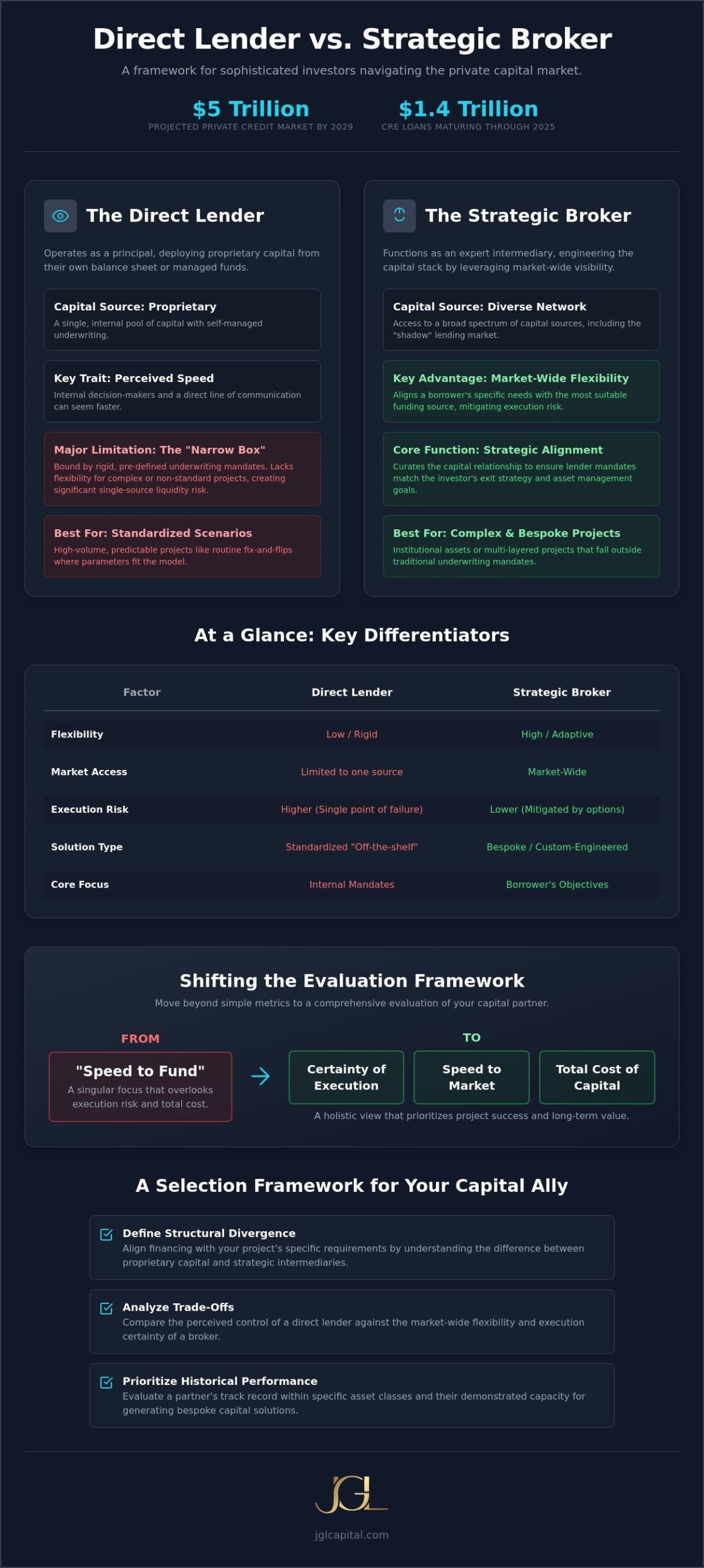
- Define the structural divergence between proprietary capital pools and strategic intermediaries to align financing with project-specific requirements.
- Analyze the trade-offs in the direct hard money lender vs broker landscape, specifically comparing the perceived control of direct funding against the market-wide flexibility of a professional intermediary.
- Identify how specialized brokers mitigate execution risk by accessing diverse capital sources that accommodate complex institutional assets falling outside traditional underwriting mandates.
- Shift focus from simple “speed to fund” metrics toward “speed to market” and a comprehensive evaluation of the total cost of capital, including the impact of missed opportunities.
- Implement a sophisticated selection framework that prioritizes a partner’s historical performance within specific asset classes and their capacity for generating bespoke capital solutions.
Understanding the Architecture of Private Capital: Direct Lenders vs. Brokers
The distinction between a direct hard money lender vs broker is not merely a matter of transactional preference but a foundational decision regarding the architecture of a project’s capital. A Hard money loan serves as a critical bridge in the lifecycle of high-stakes real estate development, and the source of that capital dictates the operational constraints of the entire venture. Direct lenders operate as principals, deploying proprietary capital or managed funds through internal underwriting processes. Conversely, a strategic broker functions as an expert intermediary, leveraging extensive market visibility to align a borrower’s specific requirements with the most suitable funding source from a diverse network. The preference for a direct hard money lender vs broker often hinges upon the investor’s tolerance for rigid underwriting mandates versus their requirement for market-wide strategic access. In volatile markets, where the preservation of value is paramount, understanding these structural nuances is essential for disciplined asset management.
The Role of Proprietary Capital
Direct lenders typically utilize balance sheet capital or dedicated credit lines, a structure that allows internal underwriting committees to execute with significant autonomy. This model is often prized for its perceived speed, as the decision-makers are usually the same individuals who manage the capital. However, this internal control comes with inherent limitations. Because they’re bound by specific proprietary mandates, direct lenders often have a narrow “box” for acceptable projects. If a development’s risk profile shifts or a project requires a customized solution that falls outside these pre-defined parameters, the direct lender may lack the flexibility to adapt. This single-source liquidity risk can be particularly acute during periods of market retrenchment, where a lender’s internal capital constraints might suddenly halt a project’s momentum.
The Strategic Brokerage Function
A strategic broker transcends the traditional referral model by actively engineering the capital stack to suit the underlying asset’s unique requirements. Rather than being limited to a single balance sheet, the broker acts as a disciplined steward of the borrower’s long-term objectives, navigating the “origination to funding” lifecycle with professional rigor. This function is characterized by several key advantages:
- Market-Wide Visibility: Accessing a broad spectrum of capital sources, including the “shadow” lending market, to find the optimal fit for complex projects.
- Strategic Alignment: Ensuring that the lender’s mandates align perfectly with the investor’s exit strategy and asset management goals.
- Execution Certainty: Mitigating the risk of a single lender’s withdrawal by maintaining multiple capital relationships and exit strategies.
By framing their activities as a high-level strategic alliance, a broker provides a streamlined alternative to the administrative friction often found in traditional banking. They don’t just identify capital; they curate the relationship, ensuring that the generation of worth remains the central focus of the partnership.
The Direct Lender Model: Proprietary Mandates and Execution Risk
While the appeal of a direct relationship is often centered on the perceived control over the funding mechanism, the reality for institutional investors is often more nuanced and fraught with hidden operational hurdles. Direct lenders operate as principals, deploying capital from their own balance sheets or managed funds, which ostensibly simplifies the communication chain. This model excels in high-volume, standardized scenarios, such as routine fix-and-flip projects where the asset parameters are predictable and the underwriting can be systematized. However, evaluating the structural trade-offs of a direct hard money lender vs broker requires a candid assessment of the execution risk that arises when a project deviates from a lender’s specific “box.”
Standardized asset classes provide a level of comfort for proprietary funds, yet this focus often results in a rigid adherence to internal mandates that ignore the complexities of institutional-grade asset management. While this structure suggests a shorter path to decision-making, it simultaneously introduces a significant concentration risk, as the investor’s entire project pipeline becomes tethered to the specific liquidity position and risk appetite of a single institution. If that institution’s internal fund mandates shift or their credit lines tighten, the investor may find their capital source evaporated at a critical juncture. For those seeking to bypass these proprietary bottlenecks, identifying a strategic ally who navigates the broader market can provide the necessary flexibility.
Underwriting Rigidity and ‘Last-Minute’ Denials
Proprietary lenders often maintain strict underwriting committees that can tighten criteria without prior notice, leading to what many professionals describe as a “bait and switch” environment. This phenomenon occurs when a term sheet is issued based on initial projections, only to be clawed back or significantly altered during the final stages of due diligence because of shifting internal mandates. With the Explosive Growth of Private Credit fueling a more competitive environment, many direct funds have responded by narrowing their underwriting parameters to ensure stability for their own limited partners. This rigidity often impacts loan-to-cost (LTC) ratios, forcing investors to inject more equity than originally planned just weeks before the closing table.
Draw Management and Post-Closing Stability
Beyond the initial funding, the administrative reality of direct lender draw schedules can introduce significant friction into the construction lifecycle. Proprietary funds manage construction inspections and disbursements through internal teams that may be overwhelmed by volume, leading to delays that disrupt contractor schedules. The relationship between a fund’s immediate liquidity and its funding speed is direct; if a fund is nearing its deployment limit for the quarter, draw requests may be scrutinized with excessive rigor to slow the outflow of capital. This post-closing instability can jeopardize project timelines and the overall generation of worth, highlighting the need for a capital partner who prioritizes the project’s success over their own balance sheet limitations.
The Strategic Brokerage Model: Market Access and Capital Alignment
The strategic brokerage model is often mischaracterized as a mere layer of intermediation; however, for the institutional stakeholder, it represents an essential mechanism for capital optimization. While a proprietary fund is bound by its own balance sheet, a strategic intermediary operates with market-wide visibility, accessing a vast “shadow” lending market comprised of private family offices and discreet institutional funds that do not maintain public-facing origination teams. Choosing between a direct hard money lender vs broker involves evaluating whether your project requires a single capital source or a partner capable of maintaining multiple capital exit strategies. By diversifying the potential funding sources, a broker mitigates the execution risk inherent in single-lender mandates, ensuring that a project remains viable even if a specific fund’s appetite shifts mid-transaction.
A professional broker functions as a sophisticated underwriter long before a file reaches a lender’s committee. This preparatory rigor involves scrubbing data, verifying asset valuations, and structuring the narrative to align with specific institutional requirements. This proactive approach reduces the likelihood of last-minute denials and ensures that the generation of worth remains the primary focus. While some investors hesitate at the inclusion of an additional fee, the right capital alignment typically lowers the total cost of capital by securing superior leverage or more favorable interest rates that a direct, non-competitive environment rarely offers.
Engineering the Optimal Capital Stack
Strategic brokers leverage their volume and relationships to foster competition between lenders, effectively driving down points and interest rates for their clients. This competitive pressure is particularly valuable when structuring complex new construction loans or multi-family acquisitions where the capital stack may require senior debt, mezzanine financing, or preferred equity components. Rather than forcing a project into a pre-existing “box,” the broker engineers the terms to fit the project’s specific cash flow and exit timeline. For developers managing a diversified property portfolio, a broker provides a single point of contact that can navigate varied asset classes with consistent professional discipline.
The Broker as a Shield Against Market Volatility
In a volatile economic climate, the ability to pivot is a strategic necessity. Brokers are uniquely positioned to act as a shield, quickly identifying alternative capital sources if a primary fund suddenly halts lending due to internal liquidity constraints. They manage the complexities of difficult appraisals or title issues by leveraging their established history with multiple vendors and legal teams, ensuring that administrative friction doesn’t derail the closing. This relationship is a form of high-level strategic alliance rather than a simple transactional service. It allows the investor to build a long-term capital roadmap, relying on an ally who understands their broader legacy and the disciplined preservation of value across multiple cycles.
Performance Metrics: Speed, Cost, and Certainty of Execution
Evaluating the efficacy of a capital source requires a shift in focus from simplistic timelines to a more comprehensive “Certainty of Execution” index. While direct lenders often prioritize “Speed to Fund” as their primary value proposition, this metric is frequently detached from the investor’s actual “Speed to Market.” A direct fund’s internal approval might occur within the industry-standard 3 to 5 days, yet the time spent vetting individual lenders to find a suitable “box” often exceeds the time required for a strategic broker to scan the entire landscape. In the debate of direct hard money lender vs broker, the institutional investor must consider the total cost of capital, which encompasses not only the 1.5 to 3 points typically charged as origination fees but also the substantial cost of missed opportunities resulting from last-minute funding failures.
Asset-based lending principles are applied with varying degrees of flexibility across these models. Direct lenders often rely on rigid, automated valuation models that may undervalue non-standard assets, whereas a broker’s professional discipline allows for a more nuanced presentation of an asset’s After Repair Value (ARV). The analytical choice between a direct hard money lender vs broker should be rooted in the generation of worth rather than the simplicity of a single relationship. For those seeking to optimize their capital deployment, partnering with a seasoned intermediary ensures that performance metrics are aligned with long-term growth rather than short-term transactional speed.
The Cost of Capital vs. The Value of Certainty
A slightly higher fee structure often serves as a rational hedge against the catastrophic risk of a failed closing. While direct fund managers may offer lower initial points, their lack of a secondary capital exit strategy means that any internal policy shift can derail a project entirely. Sophisticated stakeholders recognize that paying for market visibility is an investment in stability. For instance, hard money lenders in Florida have seen significant shifts in fee structures as the market matures, with 2026 standards reflecting a premium on lenders who can guarantee liquidity despite regional volatility. This premium is a small price for the assurance that capital remains available when the project reaches its most critical milestones.
Execution in Complex Scenarios
New construction and large-scale land development projects rarely fit the narrow underwriting mandates of proprietary funds. These complex scenarios require a strategic brokerage approach to engineer a capital stack that accommodates multi-phase disbursements and fluctuating market conditions. Transitional assets, in particular, benefit from the flexibility of bridge loans, which provide the necessary liquidity to stabilize a property before long-term financing is secured. Within an institutional portfolio, these instruments aren’t merely temporary fixes; they’re strategic tools used to navigate the gap between acquisition and peak valuation. A broker’s ability to access the shadow market ensures that these bridge facilities are structured with the specific leverage and terms required for institutional-grade asset management.
Selecting Your Capital Ally: A Framework for Sophisticated Investors
The final determination in the selection of a capital partner requires a rigorous assessment of how a provider’s underlying structure influences long-term asset performance. For the high-net-worth stakeholder, the choice of a direct hard money lender vs broker shouldn’t be a reactionary decision based on immediate liquidity needs but a strategic alignment with an organization that understands the gravity of wealth preservation. A project’s complexity, particularly in multi-family redevelopment or large-scale land development, necessitates a level of leverage and underwriting flexibility that proprietary funds often fail to provide. Selecting an ally who demonstrates an established history in your specific asset class ensures that the capital stack remains a stable foundation for a lasting legacy. It’s essential to prioritize a partner whose intellectual capital matches the sophistication of your own management team.
A partner’s track record serves as the most reliable indicator of their performance during periods of market retrenchment. When the private credit market faces volatility, the distinction between a direct hard money lender vs broker becomes a matter of execution certainty. While direct lenders are bound by the limitations of their own balance sheets, a strategic intermediary maintains the capacity to pivot across a diverse network of capital sources. This market-wide visibility is a critical hedge against the concentration risk inherent in single-source lending. By choosing a partner who values long-term growth and integrity above transactional volume, you ensure that your capital source remains a collaborative and deeply invested ally.
Questions to Ask Any Potential Capital Partner
Before entering into a strategic alliance, a disciplined investor must conduct thorough due diligence on the provider’s operational strengths. Consider the following inquiries to determine the level of professional rigor you can expect:
- Mandate Structure: Do you operate under a dedicated, rigid mandate, or do you maintain discretionary market access to accommodate non-standard assets?
- Liquidity Contingencies: What established protocols do you have for handling capital stack shifts if a primary fund suddenly becomes illiquid?
- Underwriting Philosophy: What is your internal process for asset-based underwriting, and how do you account for the project’s long-term generation of worth?
The JGL Capital Advantage: Strategic Stewardship
JGL Capital provides a disciplined alternative to the rigid constraints of traditional banking and single-source lending. With 30+ years of industry expertise, the firm operates as a strategic steward, leveraging a deep history to provide national market access for sophisticated developers. We view real estate investing as a collaborative strategic alliance rather than a simple service provision, ensuring that every loan is precisely calibrated to the investor’s strategic objectives. By emphasizing property value and project viability over conventional credit metrics, we offer a streamlined path to bridge and construction financing. Initiating the process with an organization that relies on intellectual capital rather than aggressive promotion is the first step in securing professional capital that aligns with your long-term legacy.
Optimizing Capital Allocation for Long-Term Asset Growth
The strategic imperative for institutional investors remains the alignment of capital mandates with the inherent complexities of their underlying assets. While the direct hard money lender vs broker debate often centers on transactional speed, the more critical performance metric is the certainty of execution across diverse market conditions. Professional intermediaries provide a necessary shield against the rigidity of proprietary underwriting; they ensure that your project isn’t derailed by internal fund shifts or liquidity constraints. By maintaining market-wide visibility, a strategic ally transforms capital procurement from a simple transaction into a form of high-level asset management.
JGL Capital leverages over 30 years of industry-leading expertise to provide national reach combined with precise local market intelligence. Our disciplined approach to asset-backed financing ensures that your next bridge or new construction project is met with analytical rigor and a commitment to long-term value. We invite you to Secure Your Strategic Capital Allocation with JGL Capital and experience the stability of a partner who understands the gravity of high-stakes management. Your pursuit of institutional-grade excellence deserves a capital ally that prioritizes your legacy through every stage of the development lifecycle.
Strategic Insights: Frequently Asked Questions
Is a direct lender always cheaper than a hard money broker?
A direct lender isn’t always the most cost-effective option because they lack the competitive pressure that a strategic broker introduces to the marketplace. While a broker’s fee represents an additional line item, their ability to leverage multiple capital sources often results in superior interest rates and higher leverage, which ultimately lowers the total cost of capital for the project. When evaluating a direct hard money lender vs broker, the institutional investor must look beyond the initial points and consider the long-term impact of the financing terms on the asset’s net worth.
How do hard money brokers get paid, and who pays their fees?
Hard money brokers typically receive compensation through origination points or success fees that are settled at the closing table. These fees are generally incorporated into the loan proceeds, meaning they’re paid out of the capital being deployed rather than as an out-of-pocket expense for the investor. This structure ensures that the broker’s incentives are perfectly aligned with the successful and timely execution of the transaction.
Can a broker close as fast as a direct lender in a competitive market?
Brokers often achieve a superior “speed to market” by bypassing the time-intensive process of vetting individual proprietary funds. While a direct lender may fund quickly once a file is approved, the investor might spend weeks searching for a lender whose mandates fit the project. A strategic broker identifies the correct capital source immediately, ensuring that the time from initial inquiry to the closing table is minimized during time-sensitive acquisitions.
Why would an institutional investor choose a broker over a direct fund?
Institutional investors choose brokers to gain access to the “shadow” lending market and diverse capital exit strategies that aren’t available through public-facing funds. The analytical choice between a direct hard money lender vs broker often hinges on the need for flexibility; a broker acts as a disciplined steward who can pivot between lenders if a project’s needs change or if a specific fund’s liquidity tightens. This market-wide visibility provides a level of security that a single proprietary source cannot replicate.
What are the risks of working with a direct lender who has a rigid mandate?
The primary risk of a rigid mandate is a last-minute denial when a project falls slightly outside a lender’s pre-defined underwriting “box.” Because direct lenders are principals of their own capital, they lack a secondary exit strategy if their internal credit committee shifts its risk appetite. This can lead to a “bait and switch” environment where terms are altered or funding is withdrawn just days before the scheduled closing, jeopardizing the investor’s earnest money and project timeline.
Do brokers handle the draw management process for construction loans?
Strategic brokers often serve as professional intermediaries during the draw management lifecycle to ensure that administrative friction doesn’t delay construction progress. They facilitate communication between the developer, the third-party inspector, and the funding source to ensure that disbursements are processed with professional rigor. This oversight is particularly valuable for complex new construction projects where maintaining contractor schedules is essential for the preservation of value.
How do I verify the track record of a private money broker?
Verifying a track record involves assessing the firm’s historical performance within specific asset classes and their tenure in the private credit space. A firm with 30+ years of expertise provides a level of stability and intellectual capital that signals a serious approach to value creation. Investors should look for a partner who demonstrates national reach and a history of successfully navigating diverse market cycles rather than one that relies on aggressive marketing hyperbole.
Can a broker help with asset-based lending if I have poor credit?
Asset-based lending focuses on the property’s intrinsic value and the project’s potential for the generation of worth rather than the borrower’s personal credit history. A broker leverages this philosophy to secure financing for sophisticated investors whose liquidity might be tied up in other complex holdings. By prioritizing the asset’s After Repair Value (ARV) and the developer’s experience, a broker can structure bridge or construction financing that traditional, credit-dependent banks would otherwise reject.