

The prevailing reliance on conventional retail banking for multi-family development represents a significant operational bottleneck that frequently compromises the momentum of sophisticated urban density projects. You’ve likely encountered the systemic friction of institutional bureaucracy, where restrictive debt-to-income ratios and protracted approval cycles fail to account for the robust pro forma projections of your specific site. This analysis serves as a disciplined framework for developers seeking institutional-grade financing for a 4-plex construction, emphasizing the deployment of private capital that prioritizes asset-level performance and established developer experience.
We’ll explore the technical metrics of private debt structures, the rigorous management of construction draw schedules, and the strategic alignment required to transition from ground-break to permanent stabilization. With multifamily construction starts contracting to approximately 55,000 units in the first quarter of 2026, the strategic selection of a capital partner who understands the nuances of the current regulatory environment is essential for project success. By framing these activities as a form of high-level strategic alliance, developers can move beyond transactional hurdles to build lasting legacies through deliberate, well-funded action.
Key Takeaways
- Identify the systemic limitations of conventional lending and the strategic shift toward asset-backed private capital for high-stakes multi-family assets.
- Analyze the critical performance metrics, specifically Loan-to-Cost (LTC), required to secure competitive financing for a 4-plex construction.
- Evaluate the structural benefits of bridge financing and interest-only periods in maintaining project liquidity and operational momentum.
- Master the technical requirements of professional draw schedules to ensure disciplined capital deployment and rigorous milestone verification.
- Recognize the value of a professional capital alliance in navigating complex underwriting cycles and facilitating the long-term scaling of your development portfolio.
The Strategic Landscape of Financing for a 4-Plex Construction
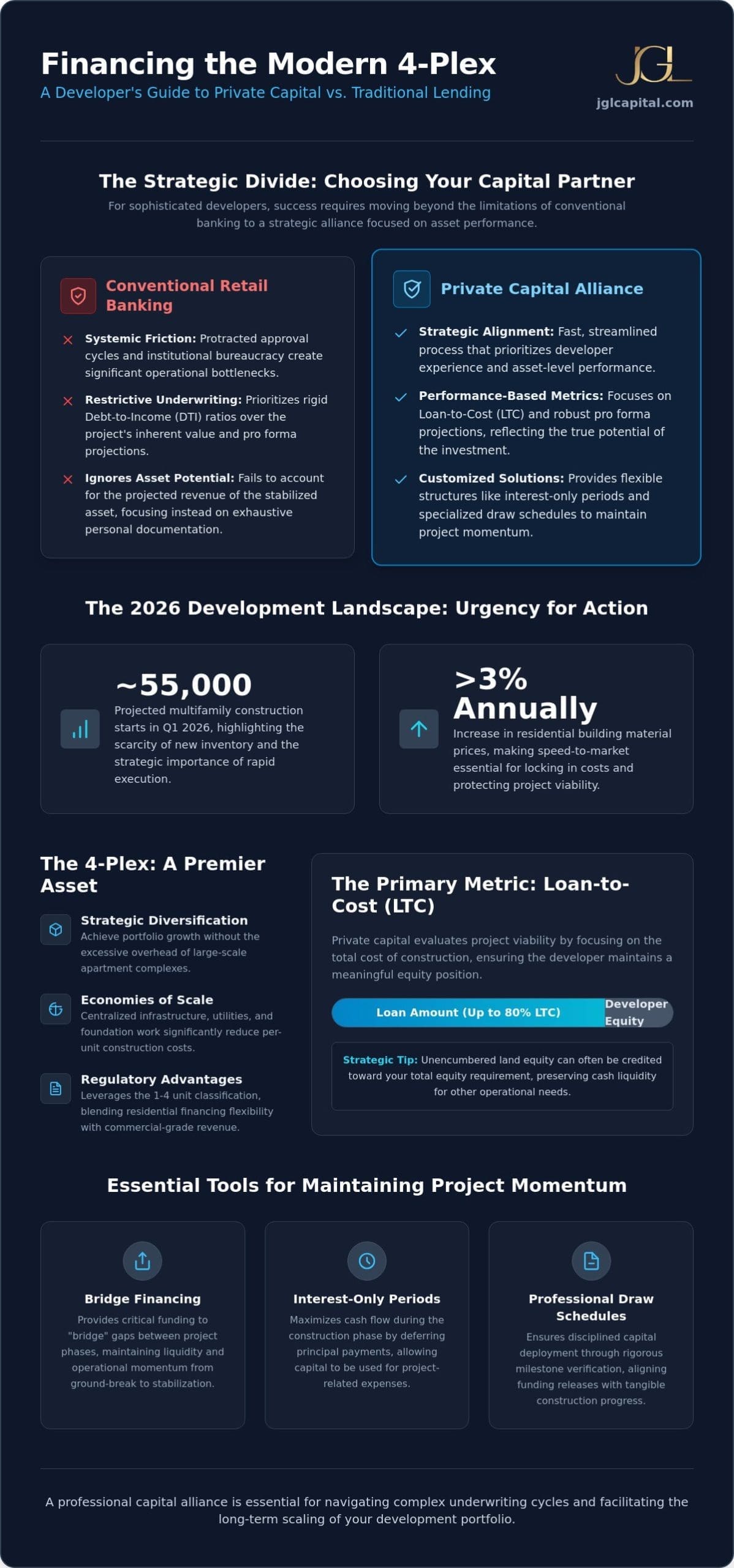
The 4-plex represents a critical threshold in the real estate development process, serving as a sophisticated pivot point between residential scale and institutional density. For the disciplined developer, these assets provide a strategic mechanism for diversifying portfolios without the excessive overhead typical of large-scale apartment complexes. However, securing financing for a 4-plex construction through traditional channels often introduces systemic delays. Conventional banks frequently prioritize rigid debt-to-income metrics over the inherent value of the project’s pro forma. This creates a fundamental misalignment between the developer’s strategic objectives and the lender’s conservative risk appetite.
Private capital addresses this disconnect by focusing primarily on asset-level performance and the developer’s historical execution. This specialized approach preserves developer liquidity and ensures that capital deployment aligns with the project’s specific milestones. In an environment where residential building material prices have increased by over 3% annually as of early 2026, the ability to lock in funding and commence construction quickly is a vital competitive advantage. With multifamily construction starts falling to approximately 55,000 units in the first quarter of 2026, the scarcity of new inventory heightens the strategic importance of rapid execution.
Traditional vs. Private Capital: A Paradigm Shift
Conventional underwriting is often characterized by protracted approval cycles that fail to account for the nuances of ground-up multi-family builds. These institutions often require exhaustive personal documentation that ignores the projected revenue of the stabilized asset. Private money brokers act as strategic allies instead. They provide customized solutions that accommodate the complexities of 4-plex projects, such as specialized draw schedules and interest-only periods. Speed-to-market is not merely a preference; it’s a necessity for maintaining project viability amidst fluctuating labor costs and elevated material prices. By bypassing the bureaucracy of retail banking, developers can secure New Construction Loans that reflect the true potential of their investment.
The 4-Plex Advantage in Multi-Family Portfolios
The 1-4 unit classification allows developers to leverage specific regulatory advantages while achieving superior economies of scale compared to single-family rental strategies. By centralizing infrastructure, utility connections, and foundation work, developers significantly reduce the per-unit cost of construction. This efficiency is enhanced when paired with Multi-Family Loans designed for the 4-plex asset class. In the fiscal environment of 2026, the 4-plex remains a premier vehicle for risk-adjusted returns, offering a unique convergence of residential financing flexibility and commercial-grade revenue potential.
Essential Metrics for Securing Multi-Family Development Capital
Professional underwriting for multi-family assets necessitates a departure from the credit-centric models of retail banking, favoring instead a rigorous analysis of project-specific performance indicators. While traditional institutions often emphasize personal debt ratios, the provision of financing for a 4-plex construction requires a more nuanced evaluation of the total capital stack. This evaluation begins with the Loan-to-Cost (LTC) ratio, which serves as the primary metric for assessing the viability of ground-up developments. By focusing on the total cost of construction rather than speculative market valuations, lenders ensure that the developer maintains a meaningful equity position throughout the lifecycle of the build.
Loan-to-Cost (LTC) and Equity Requirements
The calculation of LTC is fundamental to the structural integrity of the project’s financing. Private capital partners typically require a developer contribution that reflects a commitment to the asset’s long-term worth, though this requirement can often be mitigated through the strategic use of land equity. If a developer possesses unencumbered title to the parcel, the appraised value of the land may be credited toward the total equity requirement, thereby preserving cash liquidity for operational contingencies. Understanding how construction loans work in this institutional context reveals that private lenders prioritize the “as-completed” pro forma value. This forward-looking perspective allows for a more aggressive capital deployment than historical cost-basis models would permit, provided the pro forma demonstrates a robust debt service coverage ratio upon stabilization.
Developer Experience and Project Feasibility
A developer’s historical track record serves as a linguistic signature of competence in the eyes of institutional capital stewards. Previous completions of multi-family projects don’t just instill confidence; they directly influence the risk premium applied to interest rates and the flexibility of the loan’s structural covenants. A comprehensive project feasibility study must accompany the developer’s resume, detailing local market absorption rates, zoning compliance, and the impact of the 2025 California Energy Code or relevant regional standards. For those seeking a deeper understanding of these requirements, our guide to new construction loans provides an analytical framework for preparing a professional submission package. Success in this arena is predicated on the alignment of the developer’s vision with the lender’s disciplined approach to risk management.
Adequate liquidity remains a non-negotiable requirement for sophisticated builds, particularly regarding the establishment of interest reserves. These reserves ensure that debt service is maintained during the non-income-producing phase of construction, preventing the erosion of project equity. Developers who prioritize these metrics are better positioned to secure multi-family loans that offer the stability and precision necessary for high-stakes urban development. By adhering to these institutional standards, you ensure that your project is viewed not as a speculative venture, but as a disciplined creation of lasting value.
Bridge Financing vs. Traditional Construction Loans: A Comparative Analysis
The choice between traditional construction-to-permanent products and private bridge financing represents a fundamental decision in the capital allocation strategy of any multi-family developer. Traditional institutional models often prioritize a single-close process, yet they frequently come with rigid underwriting constraints that ignore the dynamic nature of urban density projects. Securing financing for a 4-plex construction through a bridge structure provides a tactical advantage by decoupling the construction phase from long-term debt obligations. This separation allows developers to navigate the build-out with a focus on execution, leveraging the flexibility of interest-only payments to maintain a healthy cash position until the asset is ready for permanent placement.
The Utility of Bridge Debt in Multi-Family Projects
A comprehensive understanding of what is a bridge loan reveals its function as a high-velocity catalyst for transitional real estate assets. These loans are specifically engineered for shorter durations, typically ranging from twelve to thirty-six months, providing the necessary capital to reach a value-add or completion milestone. Bridge financing for a 4-plex construction is often the preferred choice for developers who require expedited funding to lock in material costs, which have seen sustained annual growth of over 3% according to recent 2026 data. By aligning loan terms with specific construction milestones, private capital partners ensure that the flow of funds mirrors the physical reality of the site, facilitating a more disciplined approach to resource management.
Stabilization and the Permanent Debt Transition
Stabilization occurs when the 4-plex achieves the requisite occupancy and net operating income to support long-term, amortizing debt. This phase is the ultimate objective of the bridge financing strategy, signaling that the project has successfully transitioned from a high-risk construction venture to a stable, income-producing asset. Once this threshold is met, the developer can seek permanent commercial real estate loans to replace the temporary bridge capital. Executing the bridge-to-permanent refinance at the precise moment of stabilization allows the developer to maximize the asset’s valuation and optimize the long-term yield of the portfolio. This methodical progression ensures that the capital stack remains efficient, preserving the integrity of the project’s worth from ground-break to maturity.
Navigating the Underwriting Lifecycle and Draw Schedules
The administrative lifecycle of financing for a 4-plex construction requires a level of precision that mirrors the physical engineering of the asset itself. Once the initial capital commitment is secured, the developer must transition into a rigorous management of the construction draw schedule. This schedule isn’t merely a request for funds; it’s a strategic roadmap that aligns capital deployment with verified physical milestones. Professional draw schedules typically categorize expenses into granular line items such as site preparation, foundation, framing, and mechanical systems. Each of these categories is subject to institutional scrutiny to ensure the project remains within the parameters of the original pro forma. Meticulous documentation is the primary defense against funding delays, as every dollar deployed must be justified by tangible progress.
The Mechanics of Asset-Backed Underwriting
Risk assessment in the private capital sector prioritizes the intrinsic worth of the real estate over the developer’s personal credit profile. This shift toward property-based evaluation allows for more flexible financing for a 4-plex construction, provided the budget reflects current market realities. Institutional underwriters conduct exhaustive internal reviews to validate the feasibility of every line item. For instance, as of early 2026, residential building material prices have experienced an annual growth of over 3%. This factor must be accounted for in any professional budget submission to avoid capital shortfalls. Developers seeking capital through specialized hard money lenders in florida or other high-growth markets understand that this national context of rising costs necessitates a more robust contingency reserve.
Managing the Draw Process for Efficient Execution
Efficient execution depends on the seamless coordination between the developer, the general contractor, and the lender’s third-party inspection team. Every draw request triggers a site visit where an inspector verifies that the reported progress matches the physical reality of the build. Delays in this process can lead to a liquidity trap, where the developer lacks the cash flow to sustain labor momentum while waiting for capital deployment. Proactive management of these milestones is essential for protecting the project’s internal rate of return (IRR). By maintaining meticulous documentation and facilitating timely inspections, developers ensure a steady flow of funds that supports a disciplined construction timeline. If you are ready to align your project with a seasoned, strategic partner, contact our team for a construction loan analysis to ensure your capital deployment remains steady and predictable.
Facilitating Growth Through Institutional-Grade Capital Solutions
JGL Capital LLC functions as a disciplined steward of investment-grade capital, offering a level of stability and expertise that is essential for the execution of high-stakes urban density projects. Our firm leverages thirty years of institutional experience to streamline complex multi-family transactions that might otherwise be compromised by the systemic friction and protracted cycles of traditional retail banking. By maintaining an extensive national reach and offering a broad spectrum of specialized financing programs, we provide developers with the structural agility required to capitalize on emerging opportunities across diverse markets. This institutional-grade approach ensures that financing for a 4-plex construction is structured not merely as a transactional loan, but as a strategic alliance designed to preserve capital and generate significant worth through rigorous resource management.
Why Sophisticated Investors Choose JGL Capital LLC
Sophisticated partners choose JGL Capital LLC because of a shared commitment to analytical rigor and the preservation of long-term value in a fluctuating economic environment. The personality that defines our organization is that of a seasoned and discreet partner, one that relies on its established history and intellectual capital rather than aggressive self-promotion to instill trust in high-net-worth stakeholders. We understand that every multi-family development represents a unique set of strategic objectives, which is why we prioritize the delivery of highly customized, individual solutions. This disciplined approach to capital allocation ensures that every project is positioned for sustainable growth, allowing our partners to build lasting legacies through careful, deliberate action that rejects speculative trends in favor of timeless principles.
Initiating Your 4-Plex Development Strategy
The process of engaging with our senior underwriting team begins with a methodical and comprehensive review of your project’s pro forma and feasibility study. During this initial asset evaluation phase, we conduct a thorough analysis to ensure that the proposed capital stack aligns perfectly with the strategic requirements of the development and the developer’s historical execution. This evaluation transcends simple credit metrics, focusing instead on the generation of worth and the alignment of partner objectives with our own institutional risk management principles. Securing the appropriate financing for a 4-plex construction is a foundational milestone that necessitates a capital partner with a deep-seated understanding of the multi-family sector. We invite you to contact JGL Capital LLC to discuss your next multi-family development and begin the process of securing a capital solution that reflects the gravity of your investment objectives.
Securing a Legacy Through Strategic Capital Allocation
The successful execution of a multi-family development project is predicated on the alignment of capital with long-term strategic objectives. It’s essential to prioritize asset-level performance over traditional credit metrics, allowing you to navigate the complexities of ground-up builds with greater precision. The transition from bridge financing to permanent debt requires a disciplined approach to project stabilization and a rigorous management of construction draw schedules as detailed in the preceding analysis. Securing financing for a 4-plex construction through an institutional-grade partner ensures that your project is insulated from the systemic delays and bureaucratic friction of retail banking.
JGL Capital LLC provides a streamlined alternative to conventional bureaucracy, leveraging over 30 years of industry expertise to deliver asset-backed solutions that prioritize property value and developer experience. Our commitment to analytical rigor and the preservation of partner worth allows you to focus on the physical creation of value while we manage the complexities of the capital stack. We invite you to partner with JGL Capital LLC for your 4-plex construction financing needs and take the first step toward building a lasting legacy. Your vision deserves a capital partner that values stability as much as growth.
Frequently Asked Questions
Can I obtain financing for a 4-plex construction with a low credit score?
Asset-backed lending prioritizes the intrinsic worth of the development and the developer’s execution history over personal credit metrics. While traditional institutions may reject applicants based on a rigid credit score threshold, private capital stewards evaluate the project’s pro forma and the sponsor’s ability to deliver the asset. This approach ensures that financing for a 4-plex construction remains accessible to professional developers who demonstrate significant project viability and sufficient equity participation.
What is the typical down payment required for private 4-plex construction financing?
The required equity contribution typically ranges from 20% to 30% of the total project cost, though this figure is often mitigated by the inherent value of the land. If the developer holds unencumbered title to the parcel, the appraised land equity can serve as a substantial portion of the required capital, thereby reducing out-of-pocket requirements. This structural flexibility allows sophisticated partners to preserve cash liquidity for operational contingencies while maintaining a disciplined capital stack.
How does a construction draw schedule work in multi-family development?
A construction draw schedule facilitates the orderly disbursement of funds based on the completion of specific physical milestones. Each request for capital triggers a verification process, often involving a third-party inspector who confirms that the work performed aligns with the submitted budget line items. This methodical approach ensures that capital deployment mirrors the physical progress of the 4-plex, protecting the interests of both the developer and the capital partner throughout the build.
Is a personal guarantee required for a private money 4-plex loan?
Most private capital structures for multi-family developments require a personal guarantee to ensure the alignment of interests between the sponsor and the lender. However, for projects with exceptionally high equity positions or sponsors with extensive institutional track records, non-recourse or limited-recourse options may be negotiated during the underwriting phase. These determinations are made through a rigorous analysis where the gravity of the project’s risk profile is meticulously evaluated against the sponsor’s history.
What is the difference between LTC and LTV in construction underwriting?
Loan-to-Cost (LTC) measures the loan amount against the actual expenses of construction, whereas Loan-to-Value (LTV) evaluates the debt against the stabilized pro forma valuation. In the context of financing for a 4-plex construction, underwriters utilize LTC to govern the initial build phase and LTV to assess the asset’s worth upon completion. Maintaining a precise balance between these two metrics is fundamental to the creation and preservation of project equity during the transition to permanent debt.
How long does the approval process take for private construction financing?
Private capital solutions offer an expedited deployment of funds, typically reaching a commitment within two to four weeks depending on the complexity of the project. This streamlined alternative to traditional bank bureaucracy allows developers to capitalize on market opportunities without the delays of protracted institutional committee reviews. The speed of this process is predicated on the developer’s ability to provide a professional documentation package and a clear execution strategy that reflects analytical rigor.
Can I use a bridge loan for the initial phase of 4-plex construction?
Bridge loans serve as a high-velocity catalyst for the initial phases of development, including land acquisition and site preparation. These transitional capital solutions provide the flexibility needed to secure a site or commence infrastructure work before transitioning to a long-term construction facility. By utilizing bridge debt, developers can maintain project momentum while refining final architectural plans and securing the necessary municipal entitlements required for the full construction phase.
What happens if construction exceeds the initial loan term?
If a project’s timeline extends beyond the initial loan maturity, developers can typically negotiate an extension or transition into a new bridge facility. Most institutional-grade private loans include specific covenants that outline the process for term modifications, provided the project remains in good standing and continues to show physical progress. Proactive communication with the capital steward is essential for ensuring that the financing remains aligned with the project’s evolving operational needs and long-term objectives.