

The traditional reliance on personal FICO scores as the primary arbiter of creditworthiness represents an antiquated methodology that often stifles the potential of high-value real estate acquisitions. You’ve likely experienced the institutional friction of bank rejections based on rigid debt-to-income ratios or historical credit blemishes that bear little relation to a specific project’s viability. Understanding how to get a real estate investment loan with bad credit in 2026 requires a fundamental shift in perspective, moving away from personal history toward the intrinsic revenue potential of the asset itself.
As the global asset-based lending market surpasses $1 trillion, sophisticated investors are leveraging these disciplined mechanisms to ensure execution certainty and accelerated capital velocity. This article provides a rigorous evaluation of asset-based lending, examining how the 2026 regulatory environment, including the FinCEN Reporting Rule and the Homebuyers Privacy Protection Act, impacts your strategic options. We’ll analyze the balance of higher capital costs against the significant benefits of 100% bonus depreciation and increased SALT deductions, offering a clear roadmap for establishing a scalable funding partnership that prioritizes long-term value over transient personal metrics.
Key Takeaways
- Understand the shift from borrower-based to property-based underwriting to bypass the institutional friction inherent in traditional banking models.
- Achieve superior execution certainty with funding cycles as short as five to ten days, ensuring you never lose a time-sensitive acquisition to slow bank underwriting.
- Evaluate the strategic balance between higher capital costs and the generation of significant worth through accelerated equity recycling and portfolio expansion.
- Learn the institutional methodology for how to get a real estate investment loan with bad credit by focusing exclusively on the asset’s intrinsic value and revenue potential.
- Forge a disciplined partnership with a capital steward to optimize loan-to-value ratios and align your financing structure with long-term strategic objectives.
Shifting the Paradigm: From Credit-Based to Asset-Based Real Estate Financing
Collateral-First Underwriting vs. Traditional Credit Analysis
Traditional retail banking relies heavily on a borrower’s past behavior, utilizing FICO scores and debt-to-income (DTI) ratios as the primary barometers of risk. This approach frequently disregards the actual revenue-generating capacity of a commercial or residential investment project, leading to missed opportunities for growth. Asset-based lending is a financing structure where the loan is primarily secured by the value of a specific hard asset, typically real estate, rather than the borrower’s creditworthiness. In this professional context, the personal DTI ratio becomes secondary to the property’s ability to service its own debt or provide a substantial return upon disposition.
This methodology aligns the interests of the lender and the investor by focusing on the preservation and creation of value. When considering how to get a real estate investment loan with bad credit, the pivot to a collateral-first model allows for execution certainty that conventional bank underwriting simply cannot match. It’s a disciplined approach that recognizes that a high-performing asset shouldn’t be penalized for the investor’s historical credit challenges, provided the underlying collateral is robust and the exit strategy is sound.
The Role of Property Valuation in Private Money Brokerage
Within this property-centric framework, the rigor of the valuation process serves as the primary risk mitigation strategy. Instead of scrutinizing personal tax returns or employment history, the underwriting focus shifts to Loan-to-Value (LTV) and After-Repair Value (ARV) metrics. JGL Capital leverages over 30 years of institutional expertise to conduct these feasibility studies with meticulous precision. These evaluations ensure that every allocation of capital is grounded in analytical rigor rather than speculation, providing a sense of security for all stakeholders involved in the transaction.
A property-centric data approach streamlines the approval process, allowing for rapid deployment of capital. By utilizing precise performance metrics and industry-specific language, investors can secure funding based on the asset’s intrinsic worth. This clarity is essential for maintaining portfolio growth in a competitive environment where speed and reliability are paramount. It’s through this rigorous evaluation of property potential that investors find the capital necessary to build lasting legacies, regardless of their personal credit history.
The Strategic Advantages of Asset-Based Financing for Investors
Asset-based financing provides a level of agility that conventional lending institutions, burdened by bureaucratic underwriting and rigid compliance frameworks, simply cannot replicate. While the initial inquiry for many developers centers on how to get a real estate investment loan with bad credit, the true value of this capital source lies in its capacity to facilitate rapid acquisitions. In a market where high-quality inventory is scarce, the ability to present a “cash-like” offer backed by private capital ensures that sophisticated partners maintain a competitive edge over those reliant on traditional mortgage cycles. This approach transforms financing from a reactive hurdle into a proactive strategic tool for wealth preservation.
Capital Velocity and Execution Certainty
Execution certainty is the cornerstone of successful portfolio expansion in 2026. Traditional underwriting cycles, often extending beyond sixty days, represent a significant opportunity cost in a volatile economic environment. A bridge loan acts as a catalyst for growth, allowing investors to secure distressed or under-market assets before competing buyers can finalize their financing. This form of Hard money loan prioritizes the underlying equity over the borrower’s FICO score, enabling the acquisition of properties that traditional banks would reflexively reject due to physical condition or occupancy status. By recycling capital with greater frequency, investors achieve enhanced capital velocity, effectively compounding their returns through simultaneous project management.
Structural Flexibility in Private Capital
Private capital structures offer a degree of customization that is essential for complex new construction loans and large-scale developments. Unlike the standardized terms found in retail banking, commercial real estate loans derived from asset-based sources allow for tailored draw schedules and interest-only payment structures. These provisions are designed to preserve project-level cash flow during the critical phases of renovation or stabilization. By aligning loan maturity with specific exit strategies, such as a planned sale or a transition to long-term institutional debt, investors can manage the “maturity wall” with greater precision. This deliberate alignment ensures that capital remains a supportive rather than a restrictive force throughout the lifecycle of the investment.
Securing these advantages requires a partner who understands the nuance of asset-focused risk. For those navigating the complexities of how to get a real estate investment loan with bad credit, the focus should remain on the alignment of objectives and the delivery of bespoke capital solutions. You’ll find that a collaborative approach to capital allocation provides the stability necessary to build a lasting legacy through disciplined, asset-backed growth.
Analyzing the Risks and Constraints of Asset-Backed Debt
While the transition to property-centric underwriting offers a viable solution for those determining how to get a real estate investment loan with bad credit, a sophisticated investor must approach this capital source with a clear understanding of its inherent constraints. Asset-based lending is characterized by a higher cost of capital compared to conventional institutional debt, reflecting the increased risk profile assumed by the lender when personal creditworthiness is secondary. This premium is typically articulated through origination fees, often referred to as points, which can range from 1% to 4% of the total loan amount in the current 2026 market. These upfront costs, combined with interest rates that currently sit approximately 1% to 2.5% higher than conventional mortgage rates, necessitate a rigorous analysis of the project’s projected return on investment to ensure the debt remains serviceable.
The True Cost of Private Capital Allocation
Transparency in fee structures serves as a primary marker of a professional brokerage, distinguishing seasoned partners from more transactional entities. According to the Office of the Comptroller of the Currency’s guide to asset-based lending, this specialized loan product is designed for borrowers who may possess marginal cash flows or high leverage, making the total cost of debt a critical factor in deal viability. Beyond points and interest, investors must account for processing costs and the potential for higher rates if credit scores fall significantly below the 600 threshold, even within an asset-focused framework. A disciplined steward of capital will always compare these total expenditures against the anticipated equity gain to confirm that the strategic advantage of speed justifies the premium paid.
Collateral Exposure and Risk Mitigation
The short-term nature of these instruments, typically ranging from 6 to 36 months, creates a “maturity wall” that requires a meticulously planned exit strategy. Unlike thirty-year amortized mortgages, asset-backed debt is transitional, designed to facilitate a specific phase of the property’s lifecycle, such as renovation or stabilization. This temporal constraint places significant pressure on the investor to execute the project within the defined window. Because the asset is the primary security, lenders have a direct path to seizing collateral in the event of a contractual default, necessitating a disciplined exit strategy.
Risk mitigation involves not only a robust contingency fund but also a deep understanding of 2026 regulatory requirements, such as the FinCEN Reporting Rule, which mandates transparency for non-traditionally financed transfers to legal entities. Managing the risk of property value fluctuations during the loan term is paramount, as a decline in market value can impede the ability to refinance or sell. When exploring how to get a real estate investment loan with bad credit, you must recognize that the certainty of execution provided by private capital is balanced by the gravity of collateral exposure, requiring a serious and disciplined approach to the preservation of value.
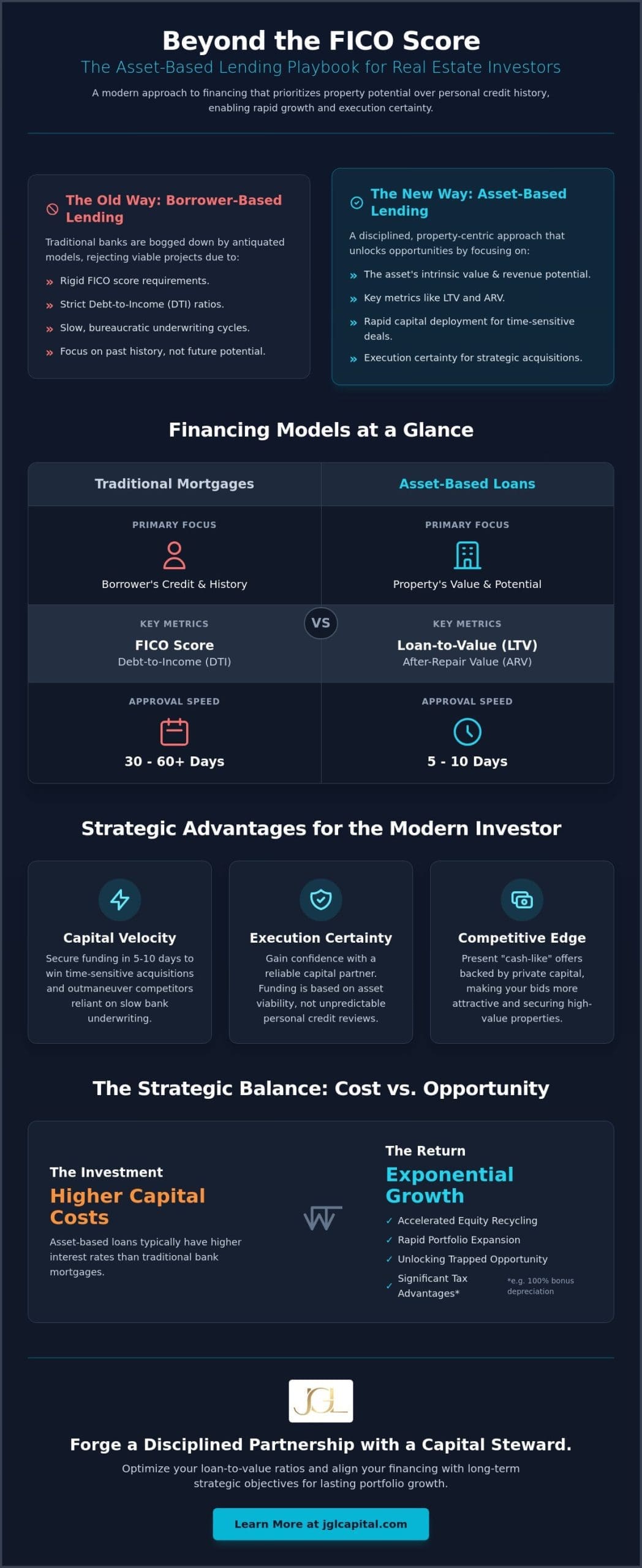
Asset-Based Loans vs. Traditional Mortgages: A Comparative Framework
The selection of a capital structure requires a nuanced understanding of the divergent underwriting philosophies between retail banking and private institutional finance. Traditional mortgages are designed for long-term stability, yet they rely on a bureaucratic “full-doc” process that prioritizes tax returns and personal history. This often creates a significant barrier for those investigating how to get a real estate investment loan with bad credit. In contrast, asset-based lending operates through streamlined processing that focuses on property revenue potential. This focus on tangible security mirrors the model used by a pawn shop dover de, where capital is deployed based on the immediate value of an asset rather than extensive personal documentation. While a bank may take forty-five to sixty days to navigate internal compliance committees, private capital can be deployed within five to ten days, providing the strategic agility necessary for high-stakes acquisitions.
When to Prioritize Speed over Cost of Debt
Strategic capital allocation often necessitates prioritizing execution certainty over the lowest possible interest rate. In competitive markets, hard money lenders offer superior utility by allowing investors to secure properties that require immediate action. Professional real estate investing frequently utilizes a hybrid approach. This involves using bridge capital to stabilize a distressed or vacant asset, thereby creating the necessary seasoning and value-add to qualify for a long-term institutional refinance later. This transition from private to traditional debt ensures that the project is never stalled by the slow underwriting cycles of conventional lenders.
Scalability for Professional Portfolios
Institutional banks frequently impose arbitrary caps on the number of active loans a single investor may hold, regardless of the investor’s track record or the project’s profitability. This restriction can severely limit the growth of a diversified portfolio. Asset-based lending removes these personal constraints by underwriting each deal as a standalone business entity. This flexibility allows for the simultaneous management of multiple fix and flip loans, ensuring a continuous project pipeline. By shifting the focus to the asset’s intrinsic worth, investors can scale their operations without being penalized for their success or their personal credit history.
If you are prepared to move beyond the limitations of traditional banking and require a capital partner that values property potential over personal FICO scores, we invite you to consult with our institutional lending experts to align your financing with your long-term growth objectives.
Executing Your Strategy: Aligning Capital Allocation with Project Objectives
The successful conclusion of a real estate acquisition depends upon the precise alignment of capital with the specific operational objectives of the project. While the initial challenge for many investors involves understanding how to get a real estate investment loan with bad credit, the ultimate viability of the venture is determined by the selection of a partner who possesses the institutional depth to navigate complex market conditions. A rigorous evaluation of a private money broker’s track record is essential, as the expertise of the intermediary often dictates the execution certainty of the transaction. Investors must also determine the optimal loan-to-value ratio to mitigate personal exposure, recognizing that a disciplined approach to leverage serves as a primary safeguard against unforeseen market fluctuations.
Before the deployment of capital, the articulation of a definitive exit strategy remains a non-negotiable requirement for any professional engagement. Whether the objective involves a strategic sale upon the completion of property improvements or a transition into long-term institutional financing, the path to capital return must be clearly defined and supported by current market data. This foresight ensures that the investor is not caught in a liquidity crisis when the short-term debt reaches its maturity wall. By establishing these parameters early, partners can protect the integrity of the project and ensure that the generation of worth remains the primary focus throughout the investment lifecycle.
Identifying the Optimal Financing Structure
The choice between short-term bridge capital and long-term rental property financing should be dictated by the asset’s stabilization timeline and the investor’s broader portfolio objectives. Professional developers often require interest-only periods to preserve liquidity during the initial phases of a project, or flexible draw schedules that align with specific construction milestones. These customized, individual solutions provide a level of utility that standardized retail products simply cannot match. By tailoring the financing to the project’s specific cash flow requirements, sophisticated partners ensure that debt remains a supportive mechanism for growth rather than a source of structural friction.
The JGL Capital Approach to Disciplined Stewardship
JGL Capital’s thirty-year legacy is built upon a foundation of stability and a meticulous approach to the preservation of partner value. We act as a strategic ally, prioritizing the alignment of objectives and the long-term growth of our stakeholders over the simple provision of transactional services. In an environment where traditional banks frequently focus on historical credit blemishes, our firm maintains a disciplined focus on the intrinsic value of the asset and the strategic viability of the deal. This commitment to stewardship ensures that those navigating the complexities of how to get a real estate investment loan with bad credit can secure the capital necessary to build lasting legacies through careful, deliberate action.
For investors seeking a collaborative relationship grounded in analytical rigor and institutional expertise, the choice of a capital partner is the most critical decision in the acquisition process. We invite you to Secure Fast, Asset-Backed Capital for Your Next Deal and experience the execution certainty that comes from three decades of dedicated capital management.
Forging a Path to Institutional Growth through Asset-Backed Capital
The evolution of the real estate market in 2026 demands a departure from restrictive, borrower-centric financing models. By prioritizing the intrinsic value and revenue potential of the property, investors can effectively bypass the limitations of traditional credit scoring. This structural shift isn’t merely a tactical adjustment; it’s a strategic imperative for those seeking to maintain capital velocity in a competitive landscape. Understanding how to get a real estate investment loan with bad credit enables you to focus on the disciplined selection of assets that generate long-term worth.
While the cost of private debt reflects a higher risk premium, the execution certainty and speed of funding provided by a seasoned partner often outweigh the interest premiums. Success in this environment requires a clearly articulated exit strategy and a commitment to rigorous analytical evaluation. With over 30 years of institutional-grade industry expertise and a national reach, JGL Capital provides property-focused underwriting that prioritizes your project’s potential over your personal history. Our streamlined process is designed to support your growth and the preservation of value. We invite you to Secure Fast, Asset-Backed Capital for Your Next Deal and begin building your legacy today.
Frequently Asked Questions
How can I get a real estate investment loan with bad credit in 2026?
Securing a loan depends on transitioning from borrower-centric underwriting to a collateral-focused model that prioritizes the asset’s economic viability. This transition is essential for understanding how to get a real estate investment loan with bad credit by presenting a property with robust revenue potential. Institutional lenders in this space evaluate the project’s intrinsic worth rather than personal FICO history, providing a disciplined and stable pathway for significant capital allocation.
What is the minimum credit score required for an asset-based loan?
While asset-based lending emphasizes property value, some institutional providers in 2026 maintain a minimum credit threshold between 620 and 680 to ensure a baseline of financial responsibility. It’s possible to secure funding with scores below 600 if the underlying collateral is exceptionally strong. Borrowers should anticipate that lower scores typically result in higher interest premiums or more conservative loan-to-value requirements to offset the perceived risk assume by the lender.
Do asset-based lenders require personal income verification or tax returns?
Asset-based lenders typically utilize a streamlined documentation process that does not require the exhaustive personal tax returns or income verification found in retail banking. This methodology is fundamental for how to get a real estate investment loan with bad credit, as the underwriting focus shifts toward the property’s debt service coverage ratio. This allows for an efficient assessment of the project’s specific risk profile, facilitating execution certainty for time-sensitive acquisitions without personal financial scrutiny.
What types of properties are accepted as collateral for asset-backed loans?
Collateral eligibility encompasses a broad spectrum of professional real estate assets, including multi-family complexes, commercial developments, and new construction projects. Land loans and residential properties intended for fix and flip or long-term rental use are also standard in this sector. This diversity allows investors to align their capital needs with specific project objectives across various asset classes, ensuring a versatile and scalable funding partnership that supports long-term growth.
How quickly can a private money loan be funded compared to a bank?
Private capital can be deployed significantly faster than traditional bank financing, with funding cycles typically ranging from five to ten business days. This compares to the standard forty-five to sixty-day cycles observed in conventional banking institutions. This accelerated capital velocity is a critical advantage for investors who must act decisively on distressed assets or competitive acquisitions where speed and execution certainty are primary factors in successful deal completion.
What are the typical interest rates for asset-based real estate loans?
Interest rates for asset-based real estate loans in June 2026 are generally 1% to 2.5% higher than those of conventional mortgage products. Hard money instruments often range between 8% and 15% annually, depending on the property type and the borrower’s specific strategic requirements. While the cost of capital is elevated, the flexibility and execution certainty provided by these loans often justify the premium for sophisticated investors managing complex portfolios.
Do asset-based loans require a personal guarantee from the borrower?
Most asset-based loans in the current market require a personal guarantee, although the primary security remains the underlying real estate asset. This structure ensures a collaborative alignment of interests between the lender and the investor, reinforcing a disciplined approach to project management. While the asset is the primary focus of the underwriting, the personal guarantee serves as a secondary layer of accountability for the preservation and creation of value.
What happens if the property value declines during the term of a bridge loan?
A decline in property value during the term of a bridge loan can create complications for the planned exit strategy, particularly when transitioning to long-term institutional debt. If the loan-to-value ratio exceeds the lender’s threshold, the investor may be required to provide additional capital to pay down the balance before refinancing. This risk underscores the necessity of a rigorous initial feasibility study and a conservative approach to capital allocation throughout the term.