

The pursuit of the lowest possible interest rate often acts as a strategic anchor that inadvertently stalls the expansion of a sophisticated real estate portfolio. While the instinctual drive toward cost minimization is understandable, it’s a perspective that frequently overlooks the intrinsic value of capital velocity and the high cost of missed opportunities. You’ve likely experienced the frustration of watching a high-yield distressed property slip away while awaiting the exhaustive deliberations of a traditional bank’s underwriting committee. Understanding the nuance of hard money vs conventional loan for investment isn’t merely a matter of comparing interest rates; it’s a fundamental exercise in strategic capital allocation and disciplined asset stewardship.
This comparative analysis provides a clear framework for selecting the appropriate financing vehicle to optimize your portfolio’s liquidity and growth. We’ll examine the critical distinctions between institutional conventional financing and private asset-backed capital, focusing on how speed and flexibility impact your ultimate return on investment. By the conclusion of this study, you’ll possess a disciplined methodology for scaling your acquisitions beyond the limitations of personal credit and stringent debt-to-income requirements, ensuring a steady alignment with your long-term wealth preservation goals.
Key Takeaways
- Identify the fundamental operational differences between institutional debt governed by rigid bank mandates and private, asset-backed capital tailored for strategic agility.
- Conduct a rigorous cost-benefit analysis of hard money vs conventional loan for investment to determine whether to prioritize capital velocity or the preservation of interest margins.
- Navigate the underwriting disparity by shifting the focus from restrictive personal credit metrics toward a disciplined evaluation of collateral value and asset potential.
- Execute a sophisticated portfolio growth model that leverages high-velocity private capital for acquisition and transitions to low-cost institutional debt for long-term stabilization.
- Overcome scalability barriers inherent in traditional banking by utilizing asset-centric financing to acquire distressed properties that fall outside standard institutional eligibility.
The Core Distinction Between Hard Money and Conventional Financing
The strategic selection of a capital source establishes the operational boundaries and growth trajectory of any sophisticated real estate enterprise. Conventional financing represents the institutional sector of the credit market, where debt instruments are governed by the rigid guidelines of Government-Sponsored Enterprises (GSEs) or specific internal bank mandates. In contrast, private asset-backed capital is provided by non-bank entities and professional brokerage firms that operate outside these standardized frameworks. This fundamental divergence creates a distinct landscape for investors evaluating hard money vs conventional loan for investment. While conventional lenders focus on the minimization of interest expense through standardized long-term debt, private lenders prioritize deal execution and capital velocity through bespoke, asset-specific terms.
The regulatory environment for conventional loans is characterized by high levels of standardization, ensuring predictability for institutional secondary markets. Private capital remains highly flexible, allowing for the negotiation of terms that align with the specific requirements of a complex transaction. Success in conventional lending is measured by the preservation of interest margins over decades. Success in the private sector is measured by the ability to secure and stabilize an asset that might otherwise be lost to a more agile competitor. By prioritizing the intrinsic value of the collateral over the historical credit performance of the individual, private lenders facilitate a level of agility that traditional institutions cannot replicate within their current regulatory constraints.
Defining Conventional Institutional Lending
Underwriting in the institutional sphere is inherently borrower-centric, requiring an exhaustive analysis of personal financial health. Lenders demand high credit scores, low debt-to-income (DTI) ratios, and comprehensive tax returns to mitigate risk. These instruments are typically structured as 15- or 30-year fully amortizing debt, providing a stable cost of capital over a long-term horizon. The typical borrower is a low-risk individual who values long-term stability and the lowest possible interest expense above the speed of acquisition.
Defining Private Asset-Backed Capital
Private capital utilizes the physical property as the primary security for the debt. This Hard Money Loan Definition highlights that these are short-term, interest-only bridge loans designed for rapid deployment. Underwriting is asset-centric, focusing on the After-Repair Value (ARV) and the overall viability of the project rather than the borrower’s personal financial history. This approach enables the funding of distressed properties or complex fix-and-flip projects that fail to meet the stringent property condition requirements of conventional institutional lenders.
Comparative Analysis of Capital Costs and Execution Timelines
The financial efficacy of a real estate transaction is frequently determined by the delicate balance between the nominal cost of debt and the speed of capital deployment. Conventional financing structures are fundamentally market-linked, providing interest rates that reflect broader economic conditions and institutional risk appetites. In contrast, the pricing for private capital is risk-adjusted and asset-specific, reflecting the immediate liquidity requirements of the borrower. This distinction is paramount when analyzing hard money vs conventional loan for investment, as the choice dictates whether an investor is optimizing for the lowest possible interest expense or the highest possible acquisition certainty.
Interest Rates and the Total Cost of Capital
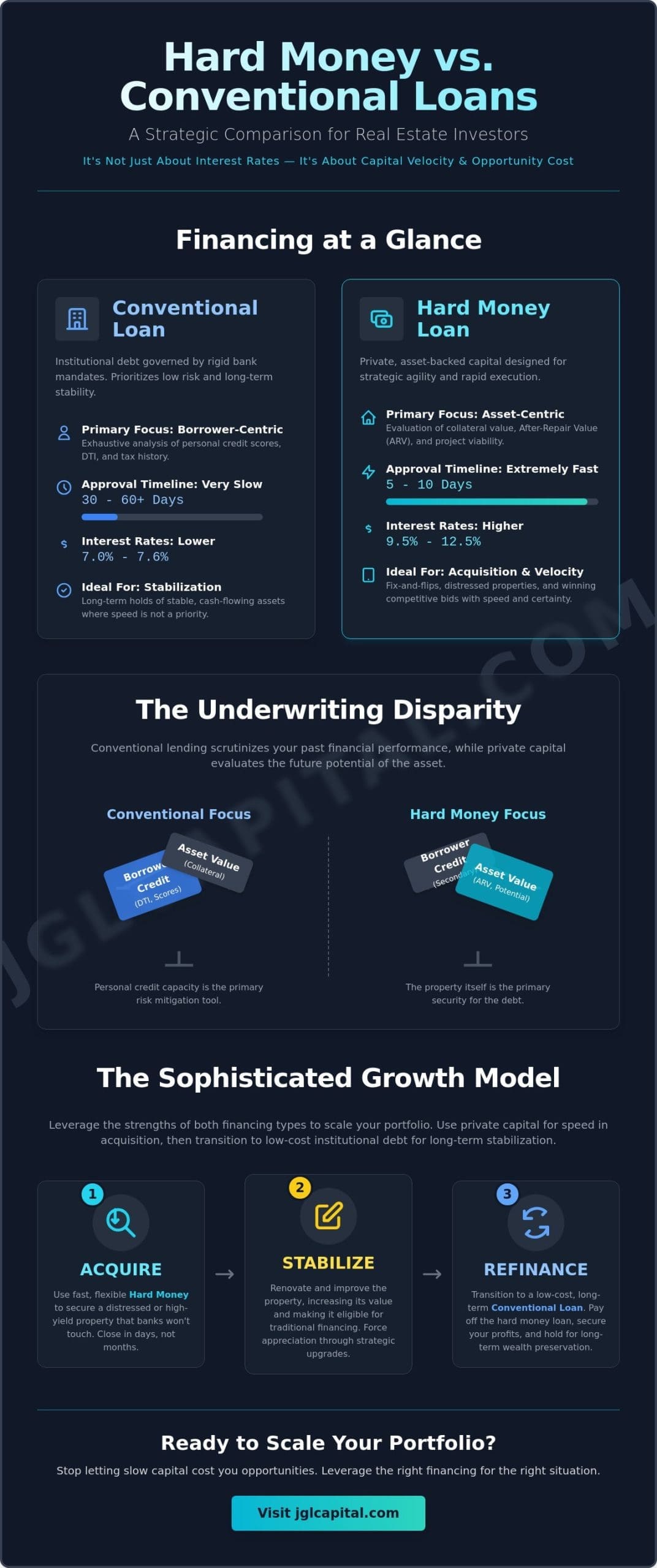
In the mid-2026 fiscal environment, the spread between institutional and private debt remains a defining metric for strategic decision-making. Conventional 30-year fixed rates for investment properties currently fluctuate between 7.084% and 7.584%, while private capital rates generally reside between 9.5% and 12.5%. While the institutional option presents a lower recurring expense, it often carries hidden costs such as Private Mortgage Insurance (PMI) and restrictive reserve requirements that can reach up to 2.0% of the loan amount annually. When examining Hard Money for Real Estate Investors, the higher interest rate is frequently viewed as a secondary consideration compared to the potential return on investment of a time-sensitive acquisition. Upfront costs also diverge significantly, with conventional loans requiring standard origination fees, whereas private loans typically involve 1.5 to 3 points in exchange for immediate capital access.
Velocity of Execution: Approval and Funding Cycles
The administrative inertia inherent in conventional lending often results in funding cycles that exceed 45 days, a timeline that’s frequently incompatible with the demands of distressed property auctions or competitive multi-family acquisitions. These delays are exacerbated by rigorous appraisal requirements that demand exhaustive documentation and multiple layers of institutional review. Private money brokers utilize streamlined internal protocols to assess project viability, allowing for a 5-day close that ensures deal execution in volatile markets. Funding velocity is the primary competitive advantage for the modern real estate developer. By aligning with a disciplined partner like JGL Capital LLC, investors can secure the necessary leverage to capitalize on opportunities that traditional banks would inevitably overlook due to their protracted underwriting cycles.
Strategic Allocation: When to Prioritize Asset-Based Leverage
The determination of an optimal capital source is a strategic decision that must align with the specific lifecycle of the investment and the intended exit strategy. While institutional financing is well-suited for stabilized, cash-flowing assets, it remains fundamentally incompatible with transitional real estate. The discourse surrounding hard money vs conventional loan for investment often centers on nominal interest rates; however, this narrow focus ignores the structural eligibility of the property itself. Traditional institutions typically refuse to fund assets that lack basic habitability or require extensive structural remediation, leaving a critical gap that only private, asset-based capital can fill. In this context, the use of bridge loans serves as a necessary mechanism for securing a property while permanent, low-cost financing is arranged.
A common objection to private capital is that it’s too expensive for the average developer. A disciplined analysis reveals that the opportunity cost of a forfeited high-yield acquisition far outweighs the incremental interest expense of private debt. For example, when a property is priced at a significant discount but requires a 5-day close, the 2% to 5% spread in interest is negligible compared to the total profit margin. These Hard Facts about Hard Money illustrate that speed and flexibility are often more valuable than the cost of capital in a competitive acquisition environment. This is especially true in 2026, as Florida and other high-growth markets witness tighter underwriting standards and more detailed documentation requirements from traditional banks.
Fix-and-Flip and Value-Add Opportunities
Private capital is a necessity for properties that do not meet the “habitable” standards required by conventional underwriting. Specialized fix and flip loans allow for the inclusion of renovation costs in the total loan amount, providing the leverage needed for high-yield restorations. By lending against the After-Repair Value (ARV) rather than the current purchase price, private lenders enable investors to maximize their cash-on-cash returns while transforming distressed assets into premium inventory.
Bridging the Gap in New Construction and Development
Traditional banks are often hesitant to fund ground-up builds due to the inherent risks of construction delays and cost overruns. Sophisticated new construction loans provide the flexibility required for multi-family projects and commercial developments that require staged funding. Private capital also facilitates the acquisition of raw land through land loans, serving as a vital precursor to development-specific financing and ensuring that the project remains viable through its most volatile phases.
The Underwriting Disparity: Credit Capacity vs. Collateral Value
The divergence in underwriting criteria represents perhaps the most significant operational barrier for the ambitious investor seeking to scale a portfolio beyond the limitations of personal credit. Conventional lending is fundamentally borrower-centric, predicated on the assumption that the individual’s personal financial history is the most reliable predictor of loan performance. This philosophy necessitates an exhaustive review of debt-to-income (DTI) ratios and personal liquidity, which often creates an artificial ceiling for even the most successful developers. In the context of hard money vs conventional loan for investment, the transition from institutional to private capital is often driven by the need to decouple acquisition power from personal credit capacity. By shifting the focus toward the physical collateral, asset-based lending facilitates a degree of scalability that traditional bank mandates simply cannot accommodate.
Institutional Focus on Borrower Solvency
Banks view the professional real estate investor through a lens of heightened risk, primarily due to the variable nature of rental income and the high existing debt loads required to maintain a portfolio. The rigid application of qualified mortgage (QM) rules often disqualifies sophisticated borrowers who utilize complex tax strategies to manage their liabilities. Credit capacity is the finite limit placed on investors by traditional institutional guidelines. This institutional inertia requires the submission of at least two years of comprehensive tax returns and personal financial statements, a process that prioritizes historical solvency over the future potential of the specific real estate asset.
Private Focus on Real Estate Intrinsic Worth
Private capital providers employ an asset-centric underwriting model that prioritizes the property’s current intrinsic worth and its projected income-producing potential. A critical component of this evaluation is the DSCR (Debt Service Coverage Ratio), which measures the asset’s ability to cover its own debt obligations without relying on the borrower’s personal income. This analytical rigor allows for the funding of LLCs and other corporate entities, providing a layer of professional distance and liability protection that conventional lenders often resist. Rather than obsessing over historical tax returns, private underwriters focus on a comprehensive project pro-forma and the viability of the exit strategy. If you’re prepared to move beyond the constraints of personal credit limits, you can explore customized asset-based solutions with JGL Capital LLC that align with your strategic growth objectives.
Structuring Your Investment Portfolio for Long-Term Appreciation
The creation of a resilient real estate enterprise requires a capital structure that supports both rapid acquisition and the long-term preservation of value. A sophisticated approach to hard money vs conventional loan for investment recognizes that these debt instruments aren’t mutually exclusive; instead, they’re complementary components of a tiered financing strategy. By utilizing high-velocity private capital for the initial acquisition and renovation phases, investors can secure distressed or complex assets that traditional banks would inevitably reject. Once the property’s stabilized and its market value enhanced, the transition to low-cost institutional debt through a refinance exit strategy ensures the long-term viability of the investment. This methodical progression allows for the efficient recycling of capital, enabling the investor to scale their portfolio without the constraints of personal liquidity limits or restrictive bank mandates.
Balancing the Capital Stack
Optimizing the weighted average cost of capital (WACC) requires a meticulous blend of short-term leverage and permanent financing. While private money serves as the vital catalyst for growth, commercial real estate loans provide the structural stability necessary for the holding period. This dual-track approach ensures that the investor maintains sufficient liquidity to capitalize on emerging opportunities while minimizing the aggregate interest expense across the entire portfolio. In the 2026 market, where interest rate volatility remains a persistent factor, the ability to pivot between these debt instruments is a hallmark of a seasoned developer. Maintaining a disciplined balance between asset-based leverage and institutional debt is essential for the generation of lasting worth and the mitigation of systemic risk.
Selecting a Strategic Private Money Partner
Navigating the private capital markets requires a partner who offers more than just transactional funding. The ideal collaborator provides deep-seated expertise, transparent terms, and a commitment to the alignment of strategic objectives. A strategic partner understands that the choice of hard money vs conventional loan for investment is a nuanced decision based on the specific risk profile of the asset and the intended timeline. JGL Capital LLC brings over 30 years of intellectual capital to every transaction, offering a level of stability and analytical rigor that’s rare in the private sector. Their ability to deliver customized solutions for complex real estate investing scenarios distinguishes them as a disciplined steward of their partners’ growth. As the regulatory landscape continues to evolve, the value of a discreet and knowledgeable ally becomes increasingly paramount for the preservation of wealth. Inquire about your next investment project with JGL Capital LLC.
Optimizing Capital Allocation for Future Growth
The strategic orchestration of debt remains a fundamental pillar of sophisticated real estate management. A disciplined approach to hard money vs conventional loan for investment ensures that capital is deployed with maximum efficiency and tactical precision. By prioritizing capital velocity during the acquisition phase and transitioning to institutional debt for stabilization, investors can effectively maximize their weighted average cost of capital while maintaining a competitive edge in volatile markets. This methodology requires a shift from borrower-centric constraints toward an asset-centric philosophy that recognizes the intrinsic worth of the collateral as the primary driver of project viability.
Navigating the complexities of the modern lending environment necessitates a partner with the intellectual capital to execute bespoke solutions. JGL Capital maintains national funding capabilities for both residential and commercial projects, leveraging over 30 years of industry expertise to facilitate your portfolio’s expansion. Their asset-based lending model focuses on property value rather than personal credit limitations, ensuring that your strategic objectives are met with stability and professional rigor. Secure your next investment with a strategic capital partner. Apply at JGL Capital today. We remain committed to the preservation and growth of your investment legacy.
Frequently Asked Questions
Is hard money more expensive than a conventional loan?
Nominal interest rates and origination points are inherently higher for private capital than for institutional debt. This disparity reflects the risk-adjusted nature of asset-backed lending and the premium placed on execution speed. While the cost of capital is elevated, the strategic value lies in the ability to secure assets that are ineligible for traditional bank programs. A disciplined analysis often reveals that the profit generated from a rapid acquisition outweighs the incremental interest expense.
Can I use a hard money loan to buy a rental property?
Private capital is frequently utilized for the acquisition of rental properties that require immediate stabilization or structural remediation. While hard money serves as an excellent vehicle for securing the asset, most investors implement a refinance strategy to transition into low-cost institutional debt once the property reaches occupancy. Engaging with a professional consultancy like Opolskie Centrum Kredytowe can be instrumental in identifying the most favorable credit terms for this transition. This approach allows for the preservation of liquidity during the volatile acquisition phase while ensuring long-term profitability through conventional amortization schedules.
How fast can a hard money loan close compared to a bank loan?
Private capital providers can typically facilitate a closing within five to ten business days, whereas institutional banks require forty-five to sixty days for comprehensive underwriting. This discrepancy is a result of the streamlined, asset-centric review process employed by private brokerage firms. By focusing on the intrinsic value of the collateral rather than exhaustive borrower documentation, private lenders provide the agility necessary to compete in high-stakes acquisition environments where timing is the primary determinant of success.
Do hard money lenders check credit scores and income?
Professional private lenders conduct a holistic review that includes credit history and financial capacity, though these factors are secondary to the property’s value. Unlike the rigid debt-to-income requirements of traditional banks, private underwriting prioritizes the project’s viability and the borrower’s experience. This flexibility allows sophisticated investors to secure funding based on the strength of the deal rather than being restricted by the arbitrary credit capacity limits of institutional frameworks.
What happens if I cannot refinance a hard money loan into a conventional loan?
Failure to execute a refinance exit strategy requires a proactive approach to asset management, which may include negotiating a loan extension or initiating a strategic sale. Sophisticated investors mitigate this risk by ensuring the property meets the stabilized appraisal requirements of conventional lenders before the private loan matures. In some scenarios, a secondary bridge loan may be utilized to provide additional time for the asset to achieve the necessary performance metrics for institutional takeout.
Are hard money loans only for fix-and-flip investors?
Private capital serves a broad spectrum of real estate scenarios beyond the fix-and-flip archetype, including multi-family acquisitions, commercial developments, and new construction projects. It’s a versatile tool for any transaction where the velocity of capital or property condition precludes traditional financing. The debate of hard money vs conventional loan for investment is relevant for any sophisticated developer who values acquisition certainty and structural flexibility over the long-term cost of debt.
What is the typical down payment required for a private money loan in 2026?
Private lenders generally require a down payment ranging from 20% to 35% of the purchase price or the After-Repair Value, depending on the specific risk profile of the asset. This equity requirement ensures a disciplined alignment of interests between the borrower and the capital provider. While this is higher than some institutional programs, it reflects the asset-based nature of the loan and the lender’s focus on maintaining a secure loan-to-value ratio in volatile markets.
Can I get a hard money loan for a new construction project?
Private capital is an essential resource for ground-up developments where traditional banks are hesitant to provide the necessary leverage. New construction loans from private sources offer staged funding through a series of draws, allowing for the continuous progression of the build without the administrative delays of institutional oversight. This flexibility is particularly valuable for developers managing complex timelines and multi-phase commercial projects that require a high degree of operational agility.