

While conventional banking institutions often prioritize a borrower’s personal credit history over the intrinsic value of an asset, the most successful developers recognize that securing institutional-grade funding depends almost entirely on the technical feasibility and entitlement status of the project. You likely find the opaque underwriting processes and rigid credit mandates of traditional lenders to be a significant barrier to time-sensitive acquisitions. Mastering the specific land development loan requirements of the private sector is no longer just a tactical advantage; it’s a strategic necessity for those managing complex projects that require disciplined capital allocation.
This guide provides a rigorous examination of the financial and technical criteria necessary to align your development objectives with the expectations of sophisticated private capital partners. We’ll explore how to navigate the shift toward asset-centric underwriting, where project-specific factors like infrastructure readiness and zoning compliance take precedence over simple credit metrics. By understanding these institutional benchmarks, you’ll establish a clear roadmap for approval and secure a partnership that understands the nuances of entitlement risk. We’ll also detail the precise documentation required to optimize your capital stack and preserve the long-term integrity of your investment.
Key Takeaways
- Differentiate between the acquisition of raw acreage and the specialized transitional financing required to facilitate the installation of essential horizontal infrastructure.
- Master the specific land development loan requirements concerning Loan-to-Cost (LTC) and Loan-to-Value (LTV) ratios to ensure your project aligns with 2026 institutional underwriting standards.
- Navigate the complexities of financial covenants, focusing on the strategic management of interest reserves and the structuring of capital terms ranging from twelve to thirty-six months.
- Evaluate the critical role of technical due diligence, specifically the verification of entitlement status and the rigorous requirements of a Phase I Environmental Site Assessment.
- Establish a strategic alliance with a disciplined capital partner that leverages thirty years of expertise in asset-backed underwriting to generate and preserve long-term value.
Understanding Land Development Loans vs. Land Acquisition
Distinguishing between the acquisition of acreage and the financing of horizontal infrastructure is a fundamental requirement for any sophisticated developer. A land development loan serves as specialized transitional financing. It’s specifically engineered to fund the installation of roads, utilities, and grading. While a simple land loan facilitates the purchase of the physical property, development capital focuses on the value-add process of transforming raw land into improved, utility-ready sites. This distinction is critical because the primary objective of these funds is to prepare a site for vertical construction or for sale to a merchant builder. By converting non-entitled acreage into shovel-ready lots, developers mitigate the risks that often deter long-term institutional investors.
The strategic deployment of bridge capital during this pre-construction phase allows for a more efficient allocation of resources. It ensures that the project moves through the Real estate development process without the delays common in traditional banking. Unlike standard mortgages, these loans are often structured with draw schedules that align with the completion of specific horizontal milestones. This disciplined approach ensures that capital is only deployed as value is tangibly created on the site. Understanding the specific land development loan requirements is essential for sponsors who wish to optimize their capital stack and avoid the pitfalls of over-leveraging during the highly sensitive entitlement phase.
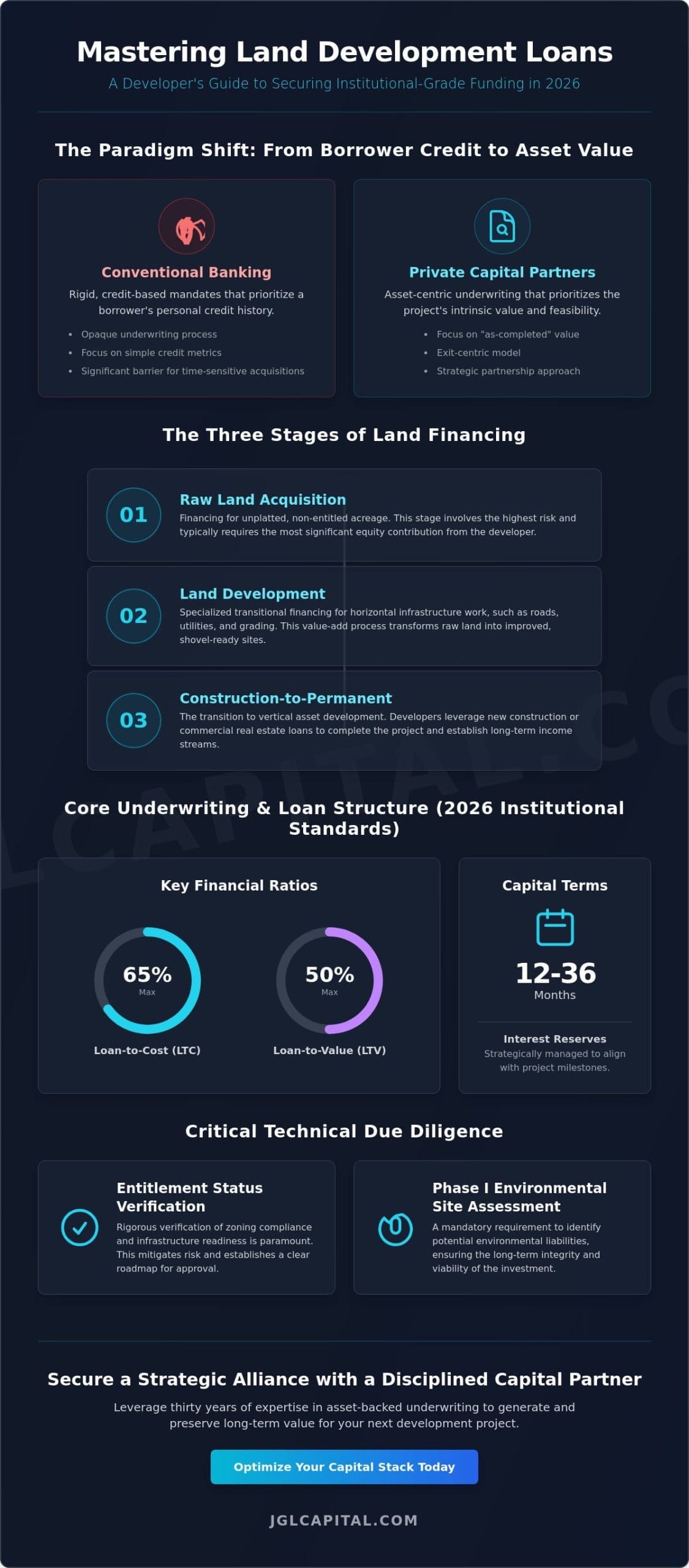
The Three Stages of Land Financing
Securing capital for land requires a nuanced understanding of the project’s current lifecycle stage. This progression typically follows a structured path:
- Raw Land Acquisition: This involves unplatted, non-entitled acreage. It carries the highest risk and typically requires the highest equity contribution because the land lacks the services necessary for immediate use.
- Land Development: This phase focuses on horizontal work. It’s where the most critical land development loan requirements are tested, particularly regarding the costs of roads, sewers, and utility infrastructure.
- Construction-to-Permanent: This stage marks the transition into vertical asset development. At this point, developers often leverage New Construction Loans or Commercial Real Estate Loans to complete the project and establish a long-term income stream.
Why Private Capital Favors Development Feasibility
Private capital providers often exhibit a level of flexibility that traditional depository institutions lack. While banks remain tethered to rigid credit-based mandates that often ignore the specific merits of a deal, private lenders prioritize the project’s feasibility and its “as-completed” value. This exit-centric underwriting model focuses on the sponsor’s ability to execute a clear disposition strategy or transition into a vertical construction loan. By focusing on the intrinsic worth of the entitled site, private capital allows for more nuanced loan-to-cost ratios. This approach recognizes that the successful navigation of land development loan requirements creates substantial equity, which serves as the primary security for the debt. This sophisticated perspective treats the developer as a strategic partner rather than a mere borrower, valuing the preservation of capital through analytical rigor.
Core Underwriting Requirements for Development Projects
The underwriting of complex development projects requires a departure from the elementary credit-based metrics utilized by retail banks. In the current 2026 fiscal environment, institutional private lenders prioritize the intrinsic viability of the site and the precision of the sponsor’s pro forma. While conventional SBA 7(a) loans for real estate provide a benchmark for government-backed financing, private capital allocation often demands more rigorous analytical proof of value. Specifically, land development loan requirements for 2026 typically mandate a Loan-to-Cost (LTC) ratio capped between 80% and 85%, while the Loan-to-Value (LTV) for finished lots generally remains at a disciplined 75%. These ratios ensure that the capital stack is sufficiently insulated against market volatility, requiring a clear and documented exit strategy that demonstrates how the bridge capital will be retired, whether through a sale of the improved lots or a transition into permanent financing.
A comprehensive Project Feasibility Study is no longer an optional attachment; it’s the cornerstone of the underwriting process. This document must articulate the market demand, projected absorption rates, and a detailed sensitivity analysis that accounts for potential cost overruns. Lenders evaluate the “as-completed” value with a focus on Debt Service Coverage Ratios (DSCR), which commonly range between 1.15x and 1.35x. For those seeking to navigate these requirements with a partner who values strategic alignment, engaging with an experienced firm like JGL Capital LLC ensures that your capital structure is optimized for both growth and stability.
Equity and Capital Stack Expectations
Institutional capital providers expect a significant equity contribution, commonly referred to as “skin in the game.” This commitment typically manifests as a 20% to 30% down payment, although unimproved land may require as much as 35% to 50% depending on the lack of existing infrastructure. This equity serves as a primary risk mitigation tool, ensuring the sponsor’s interests remain perfectly aligned with those of the lender. In certain sophisticated structures, existing land equity may be utilized to cross-collateralize other assets, providing a flexible path for well-capitalized developers to expand their portfolios without exhausting liquidity.
The Developer Résumé and Experience
The professional pedigree of the development team is a critical component of the underwriting narrative. Lenders scrutinize the track record of not only the sponsor but also the primary architects, engineers, and contractors involved in the project. A seasoned team with a history of successful exits reduces the perceived risk associated with the entitlement phase, where regulatory and environmental hurdles can often derail timelines. Documenting past performance with analytical rigor instills a sense of security in stakeholders, proving that the team possesses the requisite intellectual capital to handle the complex nuances of site transformation.
Financial Covenants and Loan Structure for 2026
The architecture of transitional development capital is defined by its brevity and its precision. Unlike permanent financing, which often spans decades, land development loan requirements for 2026 typically dictate a term of 12 to 36 months. This window provides the necessary duration to execute horizontal improvements while maintaining the urgency required for a successful exit. As of May 2026, the Federal Reserve has maintained the federal funds rate between 3.50% and 3.75%, influencing a bifurcated lending environment. Land loan rates currently fluctuate between 4% and 10%, while hard money construction rates may reach as high as 12%. These figures necessitate a disciplined approach to capital management, as the cost of carry directly impacts the project’s ultimate internal rate of return.
Central to this structure is the interest reserve. Since horizontal development generates no immediate cash flow, lenders require a pre-funded account to service the debt throughout the construction lifecycle. This ensures that interest payments are met without straining the developer’s liquidity, preserving the project’s financial stability. It’s a mechanism that aligns the interests of the capital provider and the sponsor, ensuring the preservation of value even if unforeseen delays occur during the entitlement or infrastructure phases.
Managing the Draw Process
The disbursement of funds follows a rigorous, milestone-based draw schedule. Capital isn’t released in a single lump sum; instead, it’s allocated as specific infrastructure goals are met. Institutional lenders require third-party inspections to verify that work on roads, sewers, and utilities has been completed to specification before any capital is deployed. The collection of lien waivers from subcontractors is a non-negotiable requirement to protect the capital provider from encumbrances. This methodical oversight ensures the budget remains “in balance,” meaning the remaining loan proceeds are always sufficient to complete the remaining scope of work.
Interest Reserves and Carrying Costs
Calculating the “carry” for a complex project requires meticulous analytical rigor. The interest reserve is typically calculated based on the projected average outstanding balance over the loan term, adjusted for the timing of draws. Private lenders favor pre-funded interest accounts because they eliminate the risk of payment default during the most volatile stages of development. By strategically allocating capital to these reserves, developers maintain project liquidity and demonstrate a sophisticated understanding of resource management. This disciplined stewardship of capital is what distinguishes professional developers from speculative actors in the 2026 market.
Technical Due Diligence: Entitlements and Infrastructure
Technical due diligence represents the investigative bridge between conceptual planning and site actualization. While previous sections addressed financial structuring and draw schedules, the physical and legal integrity of the acreage determines the project’s ultimate viability. Within the context of land development loan requirements, the verification of “Entitlement Status” is a non-negotiable prerequisite. This evaluation encompasses a rigorous review of zoning designations, required variances, and the status of municipal permits. Lenders prioritize assets where the legal right to build has been established, as non-entitled land carries a risk profile that often exceeds institutional comfort levels. Consequently, the mitigation of entitlement risk is paramount to securing favorable terms from private credit sources.
A certified Boundary and Topographic Survey, supported by detailed civil engineering plans, provides the precision necessary for infrastructure approval. These documents allow capital providers to evaluate the complexity of horizontal work, such as storm water management and utility extensions. Institutional partners often require “Will-Serve” letters from utility providers to confirm that the project will have adequate access to water, sewer, and electrical services upon completion. For developers seeking to align these technical specifications with the expectations of private credit providers, the expertise offered by JGL Capital LLC facilitates a more disciplined path toward funding and resource management.
Zoning and Municipal Approvals
Verifying alignment with the local Comprehensive Plan is a fundamental component of the underwriting narrative. Lenders scrutinize entitlement risk to determine its impact on the loan-to-value calculation, which generally caps at 75% for finished lots under current 2026 standards. If a project requires significant rezoning or complex variances, the capital provider may adjust the loan-to-cost to reflect the increased uncertainty. Successfully navigating these municipal approvals transforms speculative land into a strategic resource, significantly enhancing its as-completed valuation and its attractiveness to follow-on vertical lenders.
Environmental and Physical Reports
Identifying latent liabilities is essential for the preservation of capital and the mitigation of environmental risk. A Phase I Environmental Site Assessment (ESA) is a standard requirement to ensure the property is free from contamination that could lead to significant remediation costs. Geotechnical reports are utilized to verify that the soil composition can support the intended infrastructure without excessive stabilization expenses. Wetland delineation is equally vital, as it dictates the buildable acreage and can profoundly impact the project’s density and financial performance. Addressing these physical realities with analytical rigor ensures the long-term integrity of the development.
Securing the Allocation: The JGL Capital Advantage
Successfully navigating the intricate landscape of land development loan requirements requires more than a mere checklist; it demands a strategic alliance with an entity that possesses deep-seated expertise in asset-backed underwriting. JGL Capital LLC serves as a disciplined bridge to institutional-grade private capital, leveraging a 30-year history of stewardship to facilitate the actualization of complex development projects. By prioritizing analytical rigor over marketing hyperbole, the firm provides sophisticated partners with the stability and security necessary to manage high-stakes acquisitions. This established history allows for a nuanced understanding of project feasibility that transcends the rigid, credit-centric mandates often encountered in traditional banking environments.
The firm’s streamlined process for new construction loans ensures that capital is deployed with precision, respecting the critical nature of horizontal infrastructure milestones discussed in previous sections. For developers managing sophisticated portfolios, personalized consultation regarding commercial real estate loans provides the clarity needed to optimize the capital stack and preserve the long-term integrity of the investment. This commitment to the generation of worth distinguishes JGL Capital LLC as a collaborative ally rather than a simple transactional service provider.
Customized Capital Solutions
JGL Capital LLC aligns funding structures with specific project timelines, ensuring that resource management remains steady throughout the development cycle. Working with a partner who prioritizes asset value allows developers to leverage the intrinsic worth of their entitled sites, creating a more flexible and responsive capital allocation than conventional lenders allow. The efficiency of the vetting process is grounded in a rejection of speculative trends, focusing instead on timeless principles of value preservation and meticulous risk assessment. This approach ensures that every solution is highly customized to meet the individual needs of the project and its stakeholders.
Initiating the Strategic Alliance
Beginning the preliminary review process requires a methodical presentation of the project’s core philosophies and strategic objectives. Developers should provide a comprehensive Executive Summary that includes detailed pro formas, entitlement status verification, and a clear articulation of the exit strategy. This initial documentation serves as the foundation for a thorough analysis, allowing the firm to conduct the necessary due diligence with precision. For high-stakes real estate developers ready to secure institutional-grade funding, initiating this alliance with JGL Capital LLC marks the transition from speculative planning to disciplined execution. Establishing this connection ensures your project is backed by the intellectual capital required to build lasting legacies.
Strategic Alignment for Long-Term Value Creation
The successful actualization of horizontal infrastructure depends on a meticulous adherence to technical due diligence and a disciplined approach to capital allocation. The principles detailed here suggest that mastering the specific land development loan requirements for 2026 involves more than simple compliance; it requires the alignment of project feasibility with the expectations of sophisticated capital partners. By prioritizing entitlement status and precise financial covenants, developers establish a foundation for stable, long-term growth. This analytical rigor ensures that the capital stack remains resilient against market volatility while preserving the intrinsic worth of the asset.
JGL Capital brings over 30 years of industry expertise in capital markets to every strategic alliance, offering a national reach with institutional-grade private funding sources. Our asset-backed underwriting model prioritizes project feasibility, providing a sense of security for high-net-worth stakeholders and professional developers alike. We invite you to Secure Strategic Capital for Your Next Development Project and leverage our history of disciplined stewardship. It’s a path that begins with a partner who understands the gravity of your objectives.
Frequently Asked Questions
What is the typical down payment required for a land development loan?
Under standard land development loan requirements, a down payment of 20% to 30% is typically required for improved land projects. Raw land acquisitions often necessitate a higher equity contribution, ranging from 30% to 50%, to account for the lack of existing infrastructure. These thresholds ensure the capital stack remains insulated against market fluctuations and aligns the sponsor’s interests with the long-term preservation of value.
Can I use the land itself as collateral if I already own it outright?
Yes, land owned outright can serve as the primary collateral and fulfill a significant portion of the equity requirement. This land equity is appraised based on its current market value, which often reflects appreciation achieved through the entitlement process. Utilizing existing property in this manner allows developers to preserve liquidity while meeting institutional land development loan requirements for 2026.
How does an interest reserve work in land development financing?
An interest reserve is a pre-funded account established at the closing of the loan to service interest payments during the development lifecycle. Since horizontal infrastructure projects don’t generate immediate cash flow, this reserve ensures that the debt remains current without requiring additional capital injections from the sponsor. It’s a disciplined mechanism that protects project liquidity and provides security for the capital partner.
Do private lenders require a personal guarantee for development loans?
While traditional banks almost universally mandate personal guarantees, private institutional lenders may offer limited recourse or non-recourse structures for highly qualified projects. These determinations depend on the project’s loan-to-value ratio, the strength of the exit strategy, and the sponsor’s professional track record. Sophisticated developers often seek these structures to manage their personal liability across a diverse and complex portfolio.
What is the difference between a land loan and a construction loan?
A land loan is utilized for the acquisition of the physical property, whereas a construction loan funds the vertical development of structures. Land development financing serves as the transitional bridge that covers horizontal costs like grading, roads, and utilities. Each product has distinct underwriting criteria that reflect the varying levels of risk and value creation associated with each phase of the real estate lifecycle.
How long does the approval process take for private development capital?
Private capital providers typically execute the approval and funding process within a window of two to four weeks. This efficiency stands in stark contrast to the lengthy timelines associated with traditional banking, which can often exceed ninety days. This accelerated pace is a strategic advantage for developers who must act quickly to secure time-sensitive acquisitions or meet municipal infrastructure deadlines.
What happens if my project entitlements are not yet fully approved?
Projects without full entitlements are viewed as higher risk and generally receive lower loan-to-value ratios, often capped at 65% for raw land. Some capital providers may structure the loan to fund in stages, releasing additional capital only as specific zoning or permit milestones are achieved. This approach ensures that the capital allocation remains commensurate with the diminishing risk profile of the site.
Are land development loans interest-only or amortizing?
Land development loans are almost exclusively structured as interest-only instruments during the transitional development phase. This structure minimizes the monthly carrying costs for the sponsor, allowing capital to be directed toward the horizontal improvements that generate intrinsic value. Amortization is typically reserved for permanent financing once the asset has reached stabilization and is generating consistent, measurable cash flow.