

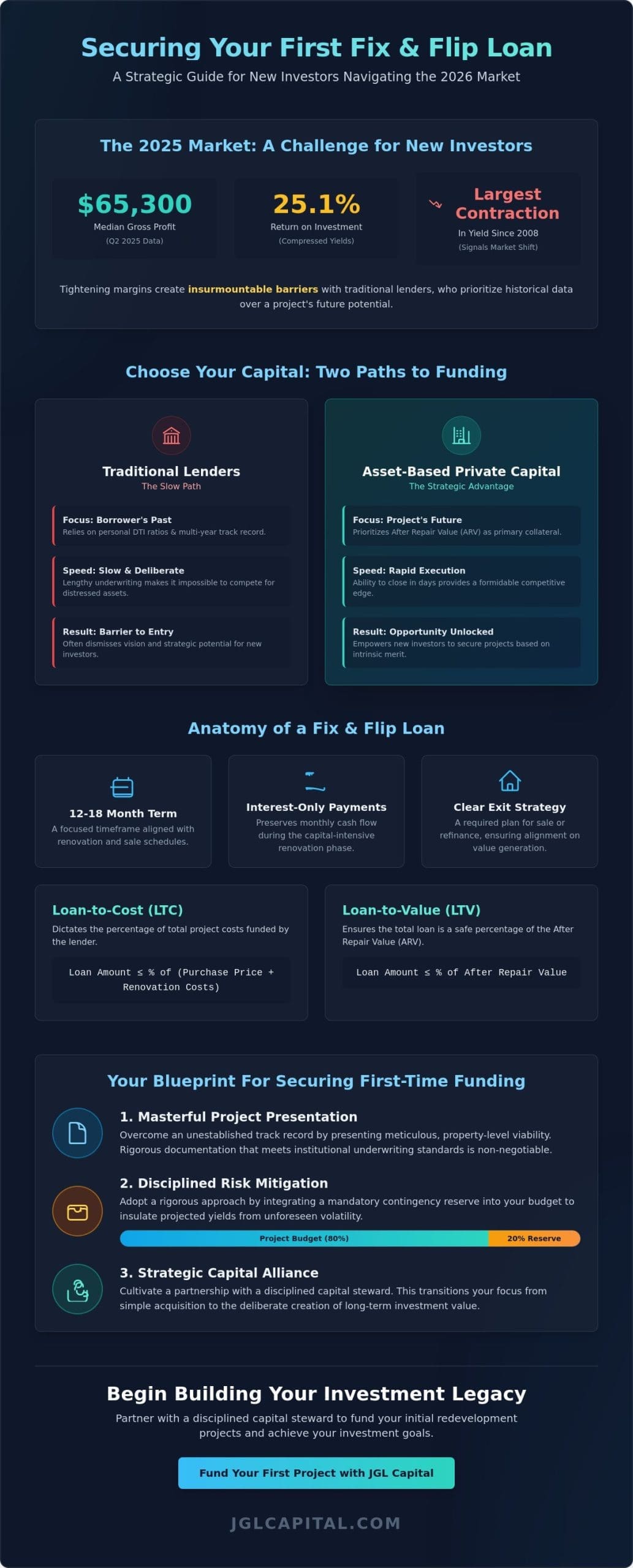
While the median gross profit for residential redevelopment reached $65,300 in the second quarter of 2025, the corresponding return on investment compressed to 25.1 percent, representing the most significant contraction in yield since 2008. You likely recognize that traditional financial institutions often interpret these tightening margins and a lack of established exit history as insurmountable barriers to entry. It’s a common challenge to find that your strategic vision is dismissed by legacy lenders who prioritize historical data over current asset potential. This analysis explores how a fix and flip loan for first time investor can be successfully secured through the utilization of institutional-grade private capital, shifting the focus from the borrower’s past to the project’s intrinsic value. We provide a comprehensive framework for managing complex renovation draws and meeting rigorous underwriting standards in the 2026 market. You’ll gain a precise understanding of how to align with disciplined capital partners to fund your initial redevelopment projects and begin the process of building a lasting investment legacy.
Key Takeaways
- Analyze the fundamental distinctions between conventional retail mortgages and asset-backed transitional capital to ensure that your chosen financing structure maintains strict alignment with the unique demands of residential redevelopment.
- Understand the sophisticated mechanisms through which a fix and flip loan for first time investor utilizes both Loan-to-Cost and Loan-to-Value frameworks to achieve optimal capital efficiency throughout the project lifecycle.
- Overcome the challenges of an unestablished track record by masterfully presenting property-level viability through the rigorous documentation required to satisfy institutional underwriting standards.
- Adopt a disciplined approach to risk mitigation by integrating a mandatory 20 percent contingency reserve into your renovation budget, thereby insulating your projected yields from unforeseen operational volatility.
- Cultivate a strategic alliance with a disciplined capital steward, such as JGL Capital LLC, to facilitate a transition from simple property acquisition to the deliberate creation of long-term investment value.
The Strategic Role of Fix and Flip Financing for the Emergent Investor
In the context of sophisticated residential redevelopment, fix and flip financing serves as a specialized form of transitional capital designed to facilitate the rapid transformation of undervalued assets. Unlike conventional long-term debt, which is structured for the steady amortization of a primary residence, these instruments provide the necessary liquidity to execute a real estate flipping strategy with precision. For those entering the market, a fix and flip loan for first time investor functions as a critical bridge; it allows the emergent principal to acquire, renovate, and divest properties without the constraints of traditional institutional delays. This capital is not merely a debt obligation but a strategic tool that enables investors to compete in high-velocity markets where speed of execution often dictates the viability of a project.
Defining Transitional Capital in Real Estate
Defining the lifecycle of this capital is essential for maintaining fiscal discipline throughout the redevelopment process. These loans typically operate within a 12 to 18 month window, providing a focused timeframe that aligns with the physical renovation schedule and the subsequent market disposition. Most institutional-grade private lenders utilize interest-only payment structures, a choice that prioritizes the preservation of monthly cash flow during the intensive capital-expenditure phase. A clearly articulated exit strategy, whether through the sale of the improved asset or a transition into long-term rental financing, remains the fundamental requirement for any initial capital request. It ensures that both the investor and the capital partner are aligned on the ultimate generation of worth.
Asset-Based Lending vs. Traditional Credit Underwriting
The primary distinction between private capital and retail banking lies in the underlying underwriting philosophy. Traditional credit underwriting relies heavily on personal debt-to-income ratios and historical earnings, which often creates an insurmountable barrier for those without an established portfolio. In contrast, asset-based lending prioritizes the After Repair Value (ARV) as the primary collateral. This shift in focus is particularly advantageous when securing a fix and flip loan for first time investor, as it allows the lender to evaluate the project’s intrinsic worth and future potential rather than the investor’s lack of a multi-year track record. Speed is another definitive factor. In competitive environments where distressed assets are often sold in days, the ability of private capital to close quickly provides a formidable competitive advantage. It allows the disciplined investor to secure opportunities that would otherwise be lost to cash-ready institutional competitors.
The Mechanics of Asset-Based Capital Allocation
Asset-based capital allocation requires a meticulous progression from the initial property valuation to the final satisfaction of the debt obligation. This process isn’t merely a series of administrative hurdles; it’s a disciplined methodology for preserving capital while maximizing project liquidity. When securing a fix and flip loan for first time investor, the lender evaluates the project through two primary lenses: Loan-to-Cost (LTC) and Loan-to-Value (LTV). LTC typically dictates the percentage of the total project costs, including acquisition and renovation, that the lender will fund. LTV, conversely, focuses on the After Repair Value (ARV), ensuring the total loan amount doesn’t exceed a safe threshold of the completed asset’s worth. Establishing a strategic framework for capital allocation is essential to ensure that the project remains liquid throughout its development cycle.
The Underwriting and Valuation Process
The underwriting phase hinges on the critical delta between the ‘as-is’ value and the projected ARV. While the current condition of the property provides the baseline for the acquisition, the projected value after comprehensive redevelopment serves as the primary collateral for the transaction. Third-party appraisals play a vital role here, as they provide an objective validation of the investor’s redevelopment thesis. These professionals analyze comparable sales data to confirm that the proposed improvements will indeed generate the anticipated market value. In periods of heightened market volatility, lenders often adopt more conservative leverage ratios to insulate the capital stack from potential fluctuations in terminal value. Understanding these nuances is a key part of preparing a successful application for fix and flip loans.
Managing the Renovation Draw Schedule
Once the loan is originated, the deployment of renovation capital occurs through a structured draw schedule. Funds aren’t released in a single lump sum; instead, they’re disbursed based on the completion of specific construction milestones, such as foundation repair, framing, or mechanical installations. Each draw request typically triggers a site inspection to verify that the work has been performed to professional standards. This rigorous oversight maintains the integrity of the capital stack and prevents the premature exhaustion of funds. For the emergent investor, this structure provides an inherent safeguard against scope creep and contractor mismanagement. By adhering to a predefined budget and inspection routine, the project maintains its trajectory toward a successful exit and the eventual payoff of the underlying debt.
Navigating Underwriting Standards for First-Time Entrants
Institutional capital providers recognize that every seasoned developer once initiated their career with a single, foundational transaction. While the absence of a historical portfolio may appear as a significant hurdle, it’s often mitigated through the presentation of exhaustive, property-level documentation. To successfully secure a fix and flip loan for first time investor, you must shift the underwriting focus from your personal track record to the project’s intrinsic viability. This transition requires a disciplined approach to data presentation, ensuring that every claim regarding the asset’s potential is supported by empirical market evidence. Lenders prioritize the alignment of interests; they seek to confirm that the principal has sufficient liquidity to weather unforeseen operational challenges, often referred to as ‘skin in the game.’
Compensating for a Lack of Historical Track Record
Operational credibility is frequently established through strategic partnerships rather than individual history. For the emergent investor, aligning with a licensed general contractor who possesses a verifiable record of successful residential redevelopments serves as a powerful signal of stability to a capital partner. This collaborative structure assures the lender that the physical transformation of the asset will be managed with professional rigor. Furthermore, the utilization of sophisticated bridge financing strategies enables you to secure distressed assets with the speed required in competitive markets. By providing detailed market comparables that justify the projected After Repair Value, you demonstrate an analytical depth that compensates for a lack of prior exits. It’s about proving that your redevelopment thesis is grounded in current market realities rather than speculative optimism.
The Essential Documentation for New Investors
The capital application process is an exercise in professional transparency. A robust proposal for a fix and flip loan for first time investor includes a comprehensive checklist of essential documentation, starting with entity-level records such as LLC operating agreements or corporate bylaws. You must provide a meticulously itemized scope of work that details every planned improvement alongside a timeline for completion. It’s a common misconception that ‘No-Doc’ lending implies a lack of due diligence. In the professional sphere, this term typically refers to the absence of traditional personal income verification, yet the lender will still perform a rigorous review of the asset and the borrower’s credit profile as a secondary security measure. Preparing these documents with precision signals to your capital partner that you’re a disciplined steward of investment growth, valuing long-term integrity and the meticulous preservation of value.
Operational Rigour: Mitigating Risk in the First Redevelopment
Operational success in residential redevelopment necessitates a transition from speculative optimism to a disciplined framework of professional risk management. When a principal utilizes a fix and flip loan for first time investor, the primary threats to the preservation of capital are typically found in the accumulation of soft costs and the emergence of unforeseen structural deficiencies post-acquisition. A mandatory 20 percent contingency reserve must be integrated into every renovation budget; this serves as a critical strategic reserve that maintains project liquidity when material costs or labor timelines deviate from the initial pro forma. It’s also imperative to avoid the trap of over-improvement, where the capital invested in aesthetic enhancements exceeds the market’s willingness to pay for a specific asset class. If the terminal market value doesn’t meet the initial redevelopment thesis, investors often transition their strategy toward long-term rental financing, effectively converting a transitional flip into a stable, yield-generating component of a broader portfolio.
Risk Mitigation Through Comprehensive Budgeting
Comprehensive budgeting demands a granular analysis of both direct material expenditures and the cumulative impact of carrying costs. Interest payments, property taxes, and insurance premiums represent a continuous drain on the projected net profit, necessitating a rapid execution timeline to preserve the intended yield. Experience suggests that the first 30 days of a project are the most critical for long-term success. Delays in permitting or contractor mobilization during this initial phase often compound, leading to significant yield compression by the project’s conclusion. A disciplined steward of capital monitors these metrics daily, ensuring that the project remains within the parameters of the initial underwriting.
Building a Professional Redevelopment Team
Building a professional redevelopment team serves as an external safeguard for the investor’s capital and project integrity. Selecting contractors who possess a history of working within the rigid draw schedules of institutional lenders ensures that construction milestones are met with professional precision and documented accordingly. Real estate attorneys provide an additional layer of security by ensuring clear title and the execution of compliant contracts that protect the principal’s interests from legal volatility. Finally, viewing your lender as a strategic ally allows you to leverage their internal expertise; their review of your scope of work provides a secondary perspective that can identify potential operational flaws before capital is deployed. To begin this collaborative process, you can apply for a fix and flip loan through our streamlined institutional platform.
Establishing a Strategic Alliance with JGL Capital LLC
JGL Capital LLC operates on the foundational principle that capital is most effective when it’s aligned with long-term strategic objectives and disciplined management. We’ve spent 30 years refining a philosophy that positions our firm as a steward of investment growth rather than a mere facilitator of high-interest transactions. For those seeking a fix and flip loan for first time investor, our national platform offers a definitive advantage by prioritizing the underlying property value and the project’s intrinsic potential over a borrower’s historical portfolio. This institutional-grade approach provides a level of stability and analytical rigor that more transactional lenders often lack. We view every funding event as the commencement of a collaborative partnership designed to generate lasting worth and preserve the integrity of the capital stack.
A Personalized Approach to Capital Solutions
We’ve observed that the most successful redevelopments are supported by loan structures that reflect the specific nuances of the asset and the local market. JGL Capital LLC rejects the “one-size-fits-all” mentality that dominates much of the retail lending space; instead, we focus on delivering highly customized solutions. This commitment to individualization ensures that your capital structure supports, rather than hinders, your operational objectives. Transparency remains a cornerstone of our engagement. You won’t encounter hidden administrative hurdles or ambiguous terms that complicate your fiscal planning during the renovation phase. By focusing on fix and flip capital allocation that’s both flexible and rigorous, we help emergent investors build the foundations of a professional legacy. Our goal is to foster long-term relationships where our success is directly tied to the generation of value within your portfolio.
The Path to Institutional-Grade Funding
Initiating the capital allocation process begins with a formal inquiry through our streamlined institutional platform. We’ve optimized our application procedure to match the high-velocity requirements of the 2026 real estate market, ensuring you can act decisively on distressed assets without the delays typical of traditional banks. Beyond the provision of debt, JGL Capital LLC provides the “intellectual capital” necessary to refine your redevelopment thesis. Our internal review process serves as an analytical filter, helping you confirm that your project meets the stringent standards required for institutional-grade funding. To secure your first fix and flip loan for first time investor, you’ll submit a comprehensive redevelopment proposal for a formal review. This initial step allows our team to conduct the thorough analysis required to align our resources with your strategic vision, transforming a single project into the first milestone of a lasting investment career.
Advancing Toward Institutional-Grade Redevelopment
Success in the 2026 residential redevelopment market requires a departure from speculative tactics in favor of a disciplined, asset-centric strategy. You’ve seen that securing a fix and flip loan for first time investor is entirely achievable when the project’s intrinsic merit is presented with professional rigor. By prioritizing property-level viability and maintaining a 20 percent contingency reserve, you insulate your capital from the volatility of tightening margins. JGL Capital LLC serves as a seasoned partner in this process, leveraging over 30 years of industry expertise to provide a national lending platform focused on property value. Our asset-based approach ensures that your vision isn’t constrained by a lack of historical track record but is instead supported by institutional-grade intellectual capital. It’s time to transition from simple acquisition to the deliberate creation of worth through a sophisticated strategic alliance.
Secure Your Strategic Capital Allocation with JGL Capital LLC Today. We look forward to supporting your path toward building a lasting investment legacy.
Frequently Asked Questions
Can I really secure a fix and flip loan with no prior experience?
Principals can indeed secure a fix and flip loan for first time investor by demonstrating the intrinsic value of the asset and the viability of the redevelopment thesis. While traditional institutions prioritize historical track records, asset-based lenders focus on the After Repair Value and the professional caliber of the project team. Aligning with an experienced licensed contractor often serves as the necessary catalyst to establish operational credibility during the underwriting process.
What is the typical down payment required for a first-time investor?
Capital requirements for emergent investors typically involve a contribution of 10 to 20 percent of the total project cost. This “skin in the game” serves as a primary risk mitigation factor, ensuring an alignment of interests between the borrower and the capital steward. While leverage ratios vary, you should be prepared to fund the initial acquisition gap and maintaining sufficient liquidity for the project’s early carrying costs.
How do renovation draws work for a first-time flipper?
Renovation funds are disbursed through a structured reimbursement process tied to specific construction milestones. Once a phase of work is verified by a professional third-party inspector, the lender releases the corresponding capital from the escrowed renovation budget. This disciplined mechanism prevents the premature exhaustion of funds and ensures the project maintains its physical and financial integrity throughout the development lifecycle without risking capital on uncompleted work.
Do I need a high credit score to qualify for asset-based financing?
While a credit review is conducted as a secondary security measure, asset-based financing prioritizes the collateral’s viability over the principal’s personal credit history. Minimum scores typically range from 620 to 660, though higher scores may facilitate more favorable leverage or pricing. The primary objective remains the assessment of the property’s potential to generate the projected worth, making it a viable fix and flip loan for first time investor candidates.
What property types are eligible for fix and flip loans?
Eligible assets primarily include non-owner-occupied residential properties, ranging from single-family detached homes to four-unit multi-family structures. Institutional-grade lenders also extend capital for larger multi-family complexes and commercial assets intended for redevelopment. It’s essential to recognize that these instruments are strictly for investment purposes; they cannot be utilized for primary residences or any owner-occupied dwellings due to regulatory constraints.
How long does the approval and funding process take?
The transition from initial inquiry to project funding is considerably more efficient than traditional mortgage processes, often concluding within 10 to 14 business days. This speed of execution allows investors to act decisively on distressed assets in high-velocity markets. The timeline remains dependent on the prompt submission of entity documentation, a detailed scope of work, and the completion of a professional third-party appraisal to validate the asset’s value.
Are there prepayment penalties on fix and flip loans?
Many fix and flip loan products are structured without prepayment penalties, allowing the investor to divest the asset as soon as the redevelopment is finalized. Some structures may include a minimum interest requirement, typically covering the first three to six months of the loan term. This flexibility is designed to support the rapid capital rotation inherent in successful residential redevelopment strategies, allowing for the preservation of net profit upon exit.
What happens if the renovation takes longer than the 12-month loan term?
If unforeseen operational delays extend the project beyond the initial term, lenders may offer loan extensions subject to a formal review and additional fees. Alternatively, if the renovation is complete but the asset hasn’t yet sold, the principal might transition into a long-term rental property loan to stabilize the investment. Proactive communication with your capital partner is vital for maintaining stability when project timelines deviate from the initial pro forma.