

The conventional perception of transitional capital as a mere stopgap measure often obscures its true utility as a sophisticated instrument for capital preservation and institutional scaling. In a market where cash buyers represent nearly one-third of all transactions, securing a bridge loan for investment property requires more than just speed; it demands a disciplined alignment of short-term debt with long-term strategic objectives. You likely recognize that bureaucratic delays in traditional banking and the inherent risks of market volatility can compromise even the most robust acquisition strategies.
We understand the frustration of capital lock-up during property stabilization phases and the necessity for institutional-grade financing structures that protect your equity. This guide provides the analytical framework needed to master the transition from transitional capital to permanent debt, allowing you to maximize liquidity while mitigating refinancing exposure. You’ll gain a comprehensive understanding of how to navigate the shift from SOFR-based bridge pricing to long-term permanent structures, ensuring your portfolio’s growth is both sustainable and meticulously managed.
Key Takeaways
- Analyze the strategic necessity of prioritizing execution velocity over nominal interest rates when securing a bridge loan for investment property Florida to capitalize on time-sensitive market opportunities.
- Delineate the critical transition from asset-backed underwriting to Debt Service Coverage Ratio (DSCR) models upon reaching the specific stabilization threshold required for permanent debt.
- Implement sophisticated risk-mitigation protocols to neutralize refinancing exposure and prevent the erosion of equity during periods of heightened market transition.
- Structure a cohesive financing lifecycle that ensures the seamless migration from transitional capital to highly structured, institutional-grade permanent debt.
- Evaluate the role of disciplined stewardship and extensive industry relationships in maintaining portfolio liquidity and ensuring the long-term preservation of capital value.
The Strategic Role of Transitional Capital in Real Estate Portfolios
Transitional capital serves as the foundational architecture for professional real estate scaling, moving beyond the simplistic notion of gap financing. For the sophisticated investor, the acquisition of a bridge loan for investment property Florida is a deliberate first step in a multi-stage capital lifecycle designed to capture value in high-demand markets. While retail borrowers often focus on nominal interest rates, institutional-grade participants prioritize speed of execution and certainty of closing. In the 2026 market environment, where inventory levels for condo-townhouse properties suggest a buyer’s market with over nine months of supply, the ability to deploy capital rapidly allows investors to negotiate from a position of strength. This strategic deployment facilitates the Buy, Rehab, Rent, Refinance model at scale, transforming distressed or underperforming assets into stabilized, cash-flowing entities ready for long-term debt.
Understanding the Bridge-to-Perm Lifecycle
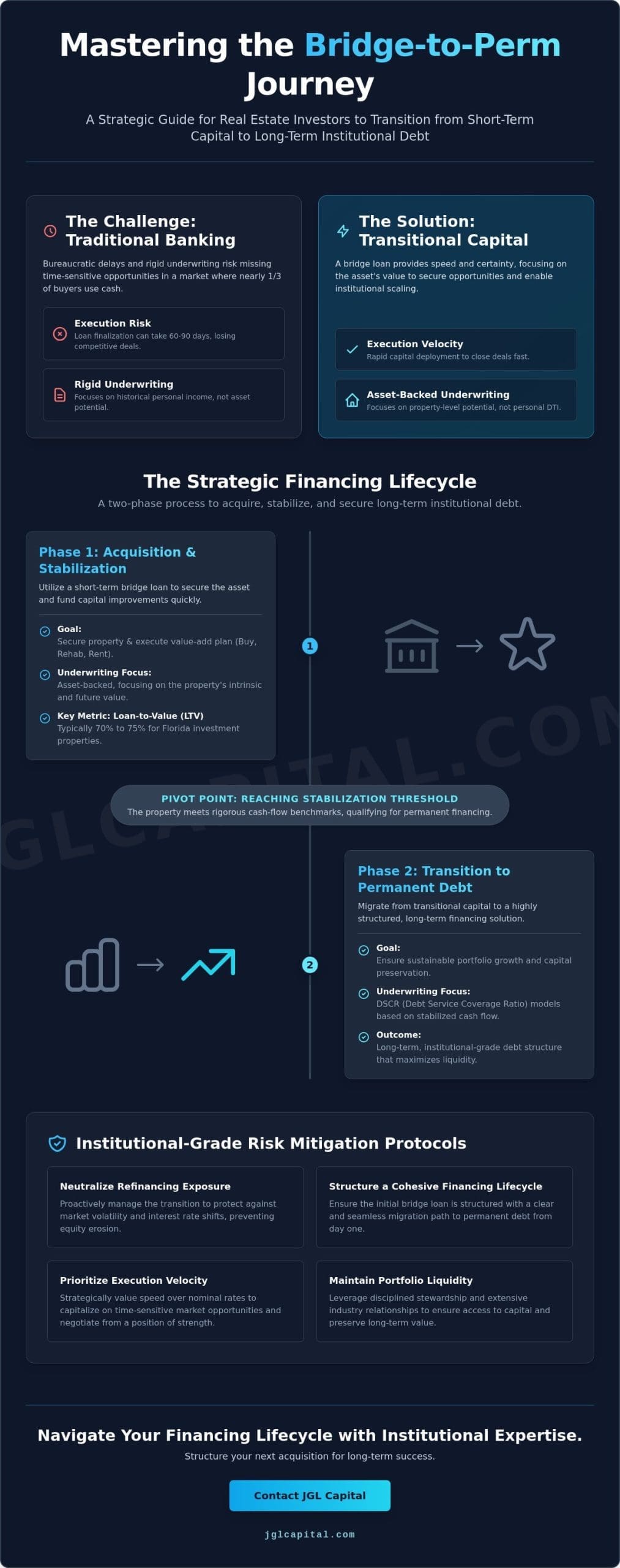
The financing trajectory begins with Phase 1: Acquisition and Stabilization. During this period, short-term bridge capital provides the necessary liquidity to secure the asset and fund essential capital improvements without the constraints of traditional debt-service coverage requirements. As the property reaches operational maturity, the strategy shifts to Phase 2: the pivot to permanent financing. This transition requires a disciplined approach to asset management, ensuring the property meets the rigorous cash-flow benchmarks of institutional lenders. A private money broker acts as a strategic ally throughout this process, aligning the initial debt structure with the eventual exit into long-term permanent capital.
Why Traditional Banking Fails the Professional Investor
Traditional institutional underwriting often relies on rigid, bureaucratic processes that are incompatible with the pace of professional real estate acquisition. While a conventional bank may require 60 to 90 days to finalize a loan, the window for securing a competitive asset in Florida’s primary markets is frequently much tighter. This delay creates an unacceptable level of execution risk. Investors must understand the fundamental mechanics of these instruments to avoid such pitfalls. To clarify the technical utility of these tools, one might ask, What is a bridge loan? In its most professional application, it is an asset-backed facility that bypasses personal income verification in favor of property-level potential. For those seeking a deeper technical analysis of how these structures function in high-stakes environments, our comprehensive resource on what is a bridge loan provides the necessary strategic depth. By utilizing a bridge loan for investment property Florida, investors can bypass the lethargy of traditional banks and maintain their competitive edge in a market characterized by rapid in-migration and evolving inventory dynamics.
Mechanics of the Bridge Loan Phase: Securing the Asset
The efficacy of a bridge loan for investment property Florida resides in its departure from the exhaustive personal underwriting common in retail banking. While traditional institutions prioritize a borrower’s historical debt-to-income ratios, institutional bridge debt focuses on the intrinsic value and future potential of the real estate asset itself. This asset-backed philosophy allows for a more analytical and efficient allocation of capital, particularly in markets where speed determines the success of an acquisition. By prioritizing property-level metrics, investors can secure high-value opportunities that would otherwise be lost to the bureaucratic delays of conventional financing. This approach remains consistent with the broader regulatory framework for temporary financing, which distinguishes these short-term instruments from permanent residential mortgages.
Capital structures for these loans have standardized around specific risk-mitigation benchmarks. For investment assets in Florida, lenders typically maintain a maximum loan-to-value (LTV) ratio of 70% to 75%. These structures often incorporate interest reserves, which are set aside at closing to ensure debt service coverage during the initial months of stabilization. Such a disciplined approach protects the portfolio’s liquidity while providing the borrower with the necessary runway to execute a value-add strategy. When evaluating these high-stakes transitions, aligning with a disciplined capital partner ensures that the debt structure supports, rather than hinders, the preservation of equity.
Institutional Bridge Debt Characteristics
Professional bridge facilities are characterized by their tactical brevity and flexibility. Terms typically span 12 to 24 months, frequently including optional extension periods to account for unforeseen construction or permitting delays. These loans almost exclusively utilize interest-only payment structures, which are now predominantly indexed to the Secured Overnight Financing Rate (SOFR) rather than the discontinued LIBOR. This structure is designed to maximize monthly cash flow during the critical stabilization phase. Additionally, sophisticated lenders offer non-recourse options for qualified assets, shielding the investor’s broader portfolio from localized project risks.
Underwriting the Opportunity, Not Just the Borrower
In asset-based lending, the After-Repair Value (ARV) serves as the primary metric for capital allocation. The underwriting process evaluates the property’s current state against its projected performance following the implementation of a strategic renovation or repositioning plan. A professional executive summary is essential here; it must articulate the exit strategy with precision, whether that involves a sale or a transition to permanent debt. Because the bridge loan for investment property Florida relies on the asset’s potential, the clarity of the stabilization plan dictates the leverage available. This focus on property-level performance allows for more creative and effective financing solutions than those available through traditional credit-based channels.
The Transition: Qualifying for Permanent Financing
The deliberate migration from transitional debt to permanent, long-term capital represents a pivotal moment of value realization within a real estate portfolio. This transition is predicated on reaching a definitive stabilization point, a technical threshold where the asset’s operational cash flow is sufficient to support institutional-grade debt. For those utilizing a bridge loan for investment property Florida, the primary objective is to qualify for permanent debt before the short-term facility reaches its maturity date. This requires a disciplined approach to managing seasoning requirements, which often dictate that an investor must hold an asset for six to twelve months before a cash-out refinance becomes viable. Professional stewardship involves transitioning from bridge loan to permanent financing as soon as the asset demonstrates a consistent Debt Service Coverage Ratio (DSCR), thereby neutralizing maturity pressure and securing the property’s long-term equity.
Bridge vs. Permanent Financing: A Comparative Analysis
The shift to permanent debt is characterized by significant interest rate compression and a fundamental change in amortization. While bridge facilities in the Florida market typically carry interest rates ranging from 10% to 12% as of early 2026, permanent financing allows investors to lock in lower, market-standard rates for up to thirty years. This transition moves the portfolio from interest-only payments, which prioritize short-term liquidity, to fully amortizing schedules that facilitate long-term wealth accumulation. The requirement shift is equally stark; lenders move away from evaluating acquisition potential and instead scrutinize historical performance and the stability of the tenant base.
The DSCR Threshold for Permanent Loans
Qualifying for permanent financing relies heavily on the Debt Service Coverage Ratio (DSCR), a metric that measures the property’s ability to cover its debt obligations through its net operating income. With Florida’s median rent reaching $2,500 as of April 2026, lenders demand a rigorous analysis of the rent roll to ensure that income is both stable and verifiable. A DSCR of 1.20x or higher is generally required to secure favorable pricing and leverage. Preparing for this stage requires meticulous record-keeping during the bridge phase, as institutional-grade scrutiny will extend to every lease agreement and expense line item. Optimizing the timing for a bridge loan for investment property Florida exit ensures that the investor capitalizes on the property’s peak operational efficiency to secure the most competitive long-term terms available.
Risk Mitigation and Exit Strategy Management
A disciplined approach to risk mitigation distinguishes the sophisticated investor from the speculative participant, particularly when utilizing a bridge loan for investment property Florida. Within the current market environment, characterized by a transition toward balanced inventory levels of approximately 5.1 to 5.3 months for single-family homes, the margin for operational error has narrowed. Professional management requires the proactive neutralization of refinancing risk to ensure that capital remains fluid and protected. Refinancing risk is defined as the inability to secure long-term debt before bridge maturity. To avoid the precarious ‘bridge to nowhere,’ where an asset remains unstabilized as debt matures, investors must align their renovation timelines with the specific liquidity cycles of the secondary lending market.
Securing the Exit: A Disciplined Approach
Institutional-grade strategy necessitates the establishment of multiple, viable exit paths long before the initial capital is deployed. While a transition to permanent debt is often the primary objective, a seasoned partner also evaluates the feasibility of an outright sale or a structured bridge extension. This level of contingency planning is essential in a climate where 77.0% of home sales in Florida are currently transacted below list price, suggesting that exit valuations must be grounded in conservative, data-driven analysis rather than optimistic projections. Monitoring lender appetite for permanent debt instruments ensures that the investor can pivot their strategy should interest rate volatility compress available leverage. If you require a partner to help structure these high-stakes transitions, our team provides the institutional stewardship necessary to safeguard your portfolio’s liquidity.
Operational Excellence as a Financing Tool
Operational efficiency serves as a primary driver of successful refinancing outcomes. Meticulous property management and the strategic execution of capital improvements do more than enhance the asset’s aesthetic; they directly influence the final institutional appraisal and the resulting Debt Service Coverage Ratio. When an investor maintains a strategic alliance with their lender during the rehabilitation phase, they ensure that the eventual transition to permanent financing is a seamless progression rather than a frantic scramble. High-register asset management involves documenting every improvement and lease renewal, creating a transparent record of value creation that institutional underwriters require for long-term debt placement. By treating the rehab phase as a prelude to permanent debt, investors minimize equity requirements and secure their legacy through disciplined action.
JGL Capital: Institutional Stewardship for Your Bridge-to-Perm Journey
JGL Capital LLC defines its role not merely as a lender but as a disciplined steward of capital for sophisticated real estate developers and investors. Our institutional approach prioritizes the long-term preservation of worth over transactional volume, ensuring that every bridge loan for investment property Florida is structured to withstand the complexities of a transitioning market. While traditional banks often struggle with the speed required for modern acquisitions, we provide a streamlined alternative that balances rapid execution with the analytical rigor required for high-stakes portfolio management. This commitment to stability is grounded in our ability to deliver customized individual solutions for complex multi-family and commercial projects that require a higher register of strategic oversight. By securing a bridge loan for investment property Florida through our firm, you gain access to a national network of liquidity that remains resilient even as local conditions shift.
A Strategic Alliance for Real Estate Growth
We function as a strategic ally, bridging the gap between an initial acquisition opportunity and the realization of long-term operational stability. By leveraging our 30-year history of industry relationships, we assist partners in navigating the market volatility of 2026, where shifting inventory levels and interest rate benchmarks demand a patient yet decisive approach to capital allocation. This steady hand is particularly vital for developers who utilize our new construction loans to initiate the transformation of raw land into stabilized, institutional-grade assets. Our philosophy emphasizes the alignment of objectives, ensuring that the debt structure we provide today serves as a solid foundation for the equity you intend to build for decades to come.
Executing Your Next Transaction
Our intake process reflects a commitment to transparency and meticulous property analysis, moving from initial underwriting to a funded institutional loan with a focus on certainty of closing. We reject speculative trends in favor of timeless principles; it’s our priority to ensure that each asset-based deal is backed by a thorough assessment of its intrinsic value and exit potential. For those seeking to scale their operations beyond single assets, our approach to commercial real estate loans offers the necessary structure for sophisticated capital deployment. By aligning our objectives with those of our partners, we foster collaborative relationships that prioritize the creation of lasting legacies through deliberate and well-researched action.
Optimizing Capital Structures for Long-Term Portfolio Resilience
The strategic migration from short-term transitional debt to permanent, institutional-grade financing represents a critical evolution in professional asset management. By prioritizing property potential during the acquisition phase and transitioning to cash-flow-driven models once stabilized, you ensure the preservation of equity and the expansion of your legacy. Mastering the nuances of a bridge loan for investment property Florida requires a partner capable of navigating complex regulatory environments and market shifts with analytical precision. It’s this disciplined approach to the capital lifecycle that distinguishes high-stakes stewardship from simple transactional lending.
JGL Capital provides the stability and expertise required to navigate these high-stakes transitions. With over 30 years of industry history and national lending capabilities across the United States, we offer asset-based underwriting that focuses on the intrinsic worth of your property. We invite you to Secure Your Transitional Capital with JGL Capital to ensure your next acquisition is backed by institutional rigor and a commitment to long-term growth. We look forward to building a lasting strategic alliance as you scale your portfolio with confidence.
Frequently Asked Questions
What is the typical interest rate for an investment property bridge loan in 2026?
Interest rates for a bridge loan for investment property Florida in 2026 generally range from 8% to 14.5%, though a corridor between 10% and 12% is most prevalent for standard investment assets. These rates are typically indexed to the Secured Overnight Financing Rate (SOFR), reflecting the current cost of capital in a stabilizing market. Final pricing depends on the specific loan-to-value ratio and the borrower’s historical experience with similar asset classes.
How long does it take to transition from a bridge loan to permanent financing?
The transition typically occurs once the asset reaches a stabilization point, which often requires six to twelve months of operational history to satisfy lender seasoning requirements. Once the property demonstrates consistent rental income, the refinancing process into permanent debt generally takes between 30 and 45 days. It’s essential to initiate this process well before the bridge maturity date to avoid unnecessary capital pressure.
Can I get a bridge loan if I have a low credit score but a high-value property?
Asset-based lenders prioritize the property’s value and its after-repair potential over the borrower’s personal credit history. While a higher credit score may facilitate more favorable terms, a bridge loan for investment property Florida remains accessible to those with lower scores provided the asset maintains a conservative loan-to-value ratio, typically capped at 70% to 75%. This underwriting philosophy focuses on the security of the real estate itself rather than individual consumer debt metrics.
What happens if my property is not stabilized when my bridge loan expires?
If stabilization isn’t achieved by the maturity date, the investor faces significant refinancing risk, which may necessitate a loan extension or a bridge-to-bridge refinance. Extension options are frequently negotiated at the outset but often involve additional fees or a slight increase in the interest rate. Disciplined developers maintain clear contingency plans to ensure that capital remains protected even if construction or leasing schedules encounter delays.
Are bridge loans available for new construction projects as a transitional tool?
Bridge loans serve as a vital transitional tool for new construction projects, providing the necessary liquidity to move from the vertical construction phase to a stabilized rental or sale scenario. These facilities allow developers to retire high-cost construction debt once the certificate of occupancy is issued but before the property has reached full occupancy. This strategic gap-filling ensures that the project remains viable during the critical initial lease-up period.
What are the common fees associated with bridge-to-permanent loan sequences?
Borrowers should expect origination fees ranging from 1% to 3% of the total loan amount, alongside secondary costs for appraisal and underwriting. Appraisal fees typically range from $300 to $700, while institutional underwriting and processing fees generally fall between $500 and $2,000. Additional costs for title insurance and recording fees are also standard components of the financing sequence.
Is a DSCR loan considered permanent financing for an investment property?
A Debt Service Coverage Ratio (DSCR) loan is a standard form of permanent financing for rental properties, focusing on the asset’s ability to cover its own debt obligations through its net operating income. Unlike bridge debt, DSCR loans offer long-term, fully amortizing structures, often with 30-year terms. They represent the primary exit strategy for investors who have completed the stabilization phase and wish to lock in a lower interest rate for the duration of the hold period.
Do bridge lenders require a personal guarantee on institutional investment property loans?
While many private money lenders require a personal guarantee, non-recourse options are available for institutional-grade assets and experienced sponsorship groups. A personal guarantee provides the lender with an additional layer of security, whereas non-recourse debt limits the lender’s recovery to the property itself in the event of default. The final structure depends on the complexity of the deal and the overall risk profile established during the analytical underwriting phase.