

With an estimated $936 billion in commercial real estate loans reaching a critical maturity wall in 2026, the margin for strategic error regarding a bridge loan exit strategy has effectively vanished. You’ve likely recognized that while the agility of private capital provides a vital edge in time-sensitive acquisitions, the looming reality of a short-term maturity date introduces a profound layer of risk. This apprehension is often compounded by market volatility and the intricate technicalities required to transition from private debt to permanent institutional financing without compromising your equity. Precision is paramount.
By refining these frameworks, you transform a potential liability into a disciplined tool for long-term capital preservation. This article provides the sophisticated methodologies necessary to master repayment structures, ensuring you secure optimal terms while shielding your investment legacy from unnecessary erosion. We’ll examine the analytical rigor required to navigate the Secured Overnight Financing Rate environment and the alignment of objectives needed to execute a seamless transition to permanent debt or a profitable divestiture.
Key Takeaways
- Define a clear roadmap for capital recapture to instill institutional underwriting confidence and ensure the long-term preservation of equity.
- Evaluate the strategic trade-offs between asset divestiture for maximum gain and the transition into stabilized, permanent debt structures.
- Learn to protect your portfolio by stress-testing your bridge loan exit strategy against 2026 interest rate forecasts and unforeseen market volatility.
- Synchronize renovation or construction milestones with financing windows to mitigate the high cost of capital erosion caused by operational delays.
- Discover how disciplined, institutional-grade alliances provide the customized financing solutions necessary to support complex exit requirements.
The Strategic Imperative of a Bridge Loan Exit Strategy
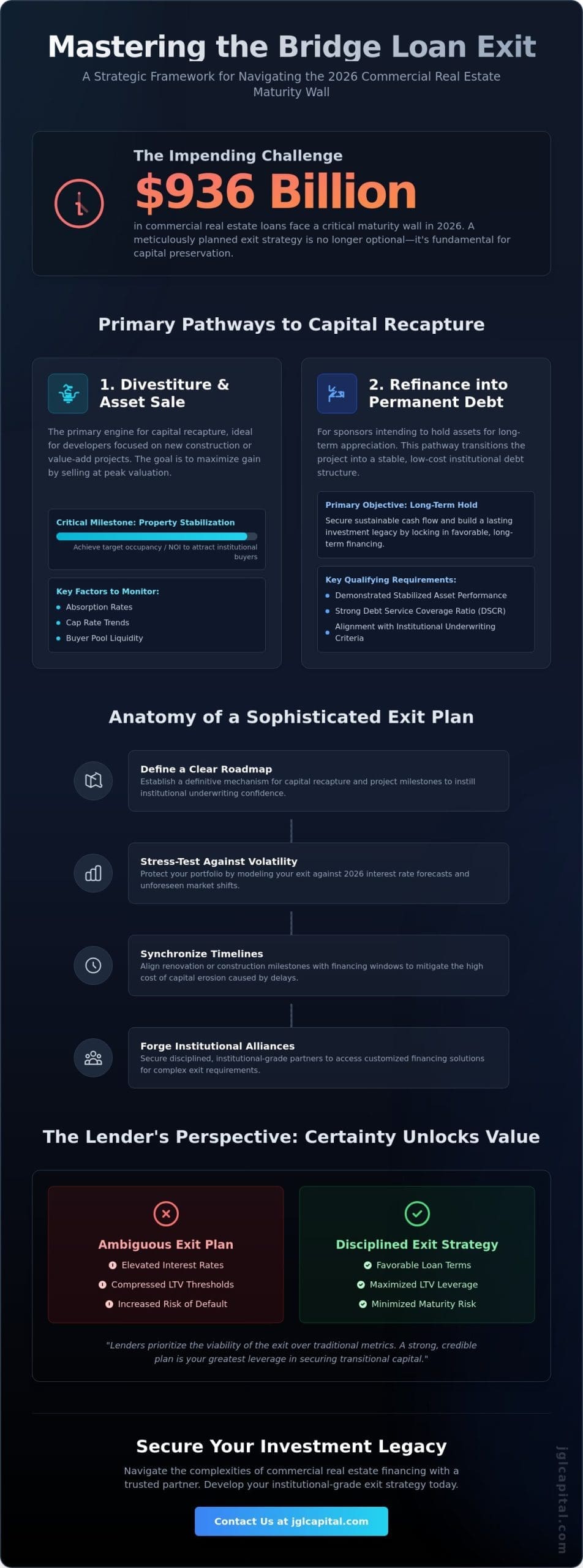
In the current financial environment, characterized by an unprecedented maturity wall of nearly $936 billion in maturing debt in 2026, the formulation of a bridge loan exit strategy transcends basic operational planning to become a fundamental requirement for capital preservation. This roadmap serves as the definitive mechanism for capital recapture, providing a structured pathway for the retirement of short-term obligations through either asset divestiture or the transition to permanent financing. Without a meticulously articulated plan, investors face the dual threats of high-interest default penalties and the erosion of equity during volatile market shifts. Precision is non-negotiable.
Institutional underwriting confidence is directly proportional to the transparency and feasibility of the proposed exit. While a bridge loan provides the necessary speed to capture time-sensitive opportunities, the cost of this transitional capital is significantly influenced by the borrower’s ability to demonstrate a credible path to repayment. A highly detailed exit strategy often results in more favorable loan-to-value (LTV) thresholds, as lenders are willing to extend greater leverage when the risk of maturity default is minimized through analytical rigor. Conversely, ambiguity regarding the exit window can lead to compressed LTVs and elevated interest rates; it’s a direct reflection of the lender’s need to price in the uncertainty of the recapture timeline.
The Anatomy of a Sophisticated Exit Plan
A sophisticated plan identifies the primary mechanism for total debt retirement while establishing a rigorous timeline for project milestones and capital events. This process involves a granular assessment of the cost of delay and the synchronization of operational goals with financing windows. Stakeholders must ensure that portfolio liquidity remains intact, even if primary divestiture timelines are disrupted by macroeconomic shifts. A bridge loan exit strategy is a formal risk-mitigation document required for asset-backed funding.
Institutional Perspectives on Repayment Certainty
Private money lenders prioritize the viability of the exit over traditional metrics like personal credit scores because the underlying real estate asset serves as the primary security for the capital. The focus shifts from the borrower’s historical income to the future value of the asset and the certainty of the repayment event. Aligning investor objectives with these lender risk tolerance frameworks requires a disciplined approach to asset management. When repayment certainty is high, the cost of transitional capital decreases, creating a more efficient capital structure that supports the generation of long-term worth.
Primary Modalities for Capital Recapture and Repayment
The execution of a bridge loan exit strategy relies on selecting a modality that aligns with the asset’s specific lifecycle and the sponsor’s broader investment objectives. Most sophisticated frameworks prioritize either the divestiture of the stabilized asset or the transition into a long-term debt facility. While the choice depends on the underlying investment thesis, every pathway requires a rigorous analysis of market liquidity and the cost of capital. A well-defined exit strategy provides the necessary clarity to navigate these choices without sacrificing equity to predatory terms or forced liquidations.
Divestiture and Asset Sale Strategies
For developers focused on new construction or value-add multi-family projects, the divestiture model serves as the primary engine for capital recapture. This approach necessitates a precise alignment with peak valuation windows, requiring the sponsor to monitor absorption rates and cap rate trends with analytical discipline. Property stabilization is the critical milestone here; achieving a target occupancy or net operating income (NOI) expands the pool of potential buyers to include institutional REITs and pension funds. Managing this sales cycle within the typical 6 to 36-month bridge term requires proactive brokerage engagement and a realistic assessment of the time needed for due diligence.
Refinancing into Permanent Debt Structures
Sponsors intending to hold assets for long-term appreciation prioritize transitioning into permanent, low-cost debt structures. Qualifying for institutional commercial real estate loans typically requires the asset to reach a stabilized Debt Service Coverage Ratio (DSCR), often exceeding 1.25x. Preparing the necessary documentation for this take-out financing should begin early in the bridge cycle to ensure a seamless handoff. This transition is particularly effective for rental property portfolios where the goal is to replace expensive transitional capital with stable, long-term leverage.
The choice between these modalities also carries significant tax implications and ROI variations. While an asset sale may maximize immediate capital gains, it often triggers substantial tax liabilities that can be deferred through a refinancing event. Refinancing allows the sponsor to pull out initial equity while maintaining ownership, effectively increasing the internal rate of return (IRR) on the remaining capital. For those seeking a partner to help structure these complex transitions, exploring tailored multi-family financing can provide the necessary flexibility to execute a sophisticated plan. Whether utilizing cash reserves or seeking external capital injections, the objective remains the same: a disciplined retirement of debt that preserves the sponsor’s investment legacy.
Mitigating Market Volatility with Contingency Frameworks
Market volatility is an inherent variable in transitional financing, requiring a disciplined approach to risk mitigation that extends beyond a singular objective. A singular bridge loan exit strategy is rarely sufficient for the sophisticated sponsor. Instead, professional frameworks utilize multi-layered contingencies that account for shifting interest rate benchmarks like the Secured Overnight Financing Rate (SOFR). Stress-testing these plans against 2026 interest rate forecasts ensures that even if the cost of permanent debt remains elevated, the project’s viability isn’t compromised. This analytical rigor transforms speculative ventures into stable, institutional-grade investments.
Addressing the primary concern of maturity default involves integrating structural safeguards directly into the loan agreement. Interest reserves provide a crucial buffer, ensuring that debt service is maintained even if stabilization takes longer than anticipated. Extension options, while often carrying additional fees, offer a controlled pathway to navigate temporary market illiquidity without the pressure of a forced divestiture. These mechanisms are essential for maintaining portfolio stability when the property doesn’t sell or refinance within the initial term. They provide the gift of time, which is the most valuable asset in a transitional market.
The Necessity of a Robust Plan B
Institutional partners recognize that a fallback position is essential for capital preservation. If a fix-and-flip project encounters a cooling sales market, the ability to pivot to a long-term rental model preserves equity while generating cash flow. This shift requires identifying alternative capital partners for secondary bridge extensions early in the lifecycle. Maintaining a dedicated liquidity buffer allows the sponsor to service debt during these extended hold periods, preventing the erosion of worth that accompanies default penalties. By preparing for a secondary exit modality, the sponsor remains in control of the asset’s destiny.
Addressing Valuation Fluctuations
Valuation fluctuations represent a significant risk when transitioning to permanent financing, particularly as the market adjusts to new pricing realities. If an appraisal for refinancing arrives lower than the initial projections, a shortfall occurs that can stall the exit event. Professionals address this through bridge-to-bridge refinancing or by preparing for a partial capital injection to bridge the gap in leverage. A contingency plan is not a sign of weakness but a hallmark of professional capital management. These frameworks ensure that the sponsor remains a disciplined steward of value, regardless of external market conditions or temporary valuation dips.
Optimizing the Transition Timeline for Maximum ROI
The temporal alignment of operational milestones with financing maturity is a hallmark of sophisticated asset management. When utilizing new construction loans or renovation facilities, the sponsor must synchronize physical completion with the opening of the exit window to avoid the prohibitive “Cost of Delay.” In a high-leverage environment where interest rates for transitional assets often range from 8% to 15%, even a minor slippage in the construction schedule can result in significant capital erosion. Calculating this cost requires a disciplined assessment of daily interest carry against the projected internal rate of return, ensuring that every operational decision serves the ultimate objective of debt retirement.
Monitoring the take-out market is equally critical; locking in permanent financing requires a proactive stance rather than a reactive response to looming maturity. Strategic use of prepayment clauses allows sponsors to exit the bridge facility as soon as stabilization is achieved, thereby maximizing the internal rate of return by reducing the total interest expense. This agility is vital in a market where the Secured Overnight Financing Rate (SOFR) directly influences the pricing of the eventual permanent debt structure. By maintaining a constant dialogue with institutional lenders, sponsors can identify the optimal moment to transition from transitional capital to long-term security.
Alignment of Project Milestones with Maturity Dates
A rigorous bridge loan exit strategy necessitates a critical path that integrates permitting, construction, and leasing milestones into a cohesive timeline. We advocate for the 90-day rule: initiating the formal exit process at least three months prior to the initial maturity date to accommodate the complexities of institutional due diligence. Providing lenders with data-driven updates on these milestones fosters a collaborative relationship, which is essential if a modification or extension becomes necessary. This transparency ensures that all stakeholders are aligned on the progress toward capital recapture.
Managing Extension Options and Prepayment Terms
Negotiating flexibility at the inception of the loan is a primary risk-mitigation tactic. The inclusion of 6-month extension riders provides a necessary safety net, though sponsors must weigh the cost of these options against the potential benefits of lower prepayment penalties. Coordinating with hard money lenders for seamless payoffs requires precise documentation and a clear understanding of the payoff hurdles. For sponsors seeking to refine their capital structures, securing a customized financing consultation can ensure your debt is perfectly aligned with your project’s specific lifecycle.
Institutional Partnership: Aligning Capital with Long-Term Vision
JGL Capital operates on the fundamental principle that transitional financing is not merely a transaction but a high-level strategic alliance designed to generate worth through disciplined management. By integrating a sponsor’s specific bridge loan exit strategy into the initial underwriting phase, we ensure that the capital structure is resilient and perfectly aligned with the asset’s lifecycle. This collaborative approach allows for the articulation of highly customized solutions that address the technical nuances of complex real estate portfolios. This analytical validation often allows for the optimization of loan-to-value thresholds and the compression of capital costs, as the certainty of the repayment event reduces the inherent risk premium. Leveraging over 30 years of intellectual capital, we provide the stability and expertise required to validate even the most ambitious frameworks, ensuring that every claim is grounded in analytical rigor rather than speculation.
Asset-based lending, when executed with this level of precision, facilitates rapid scaling for sophisticated developers who require speed without sacrificing structural integrity. Unlike transactional competitors who prioritize volume, our philosophy centers on the alignment of objectives and the delivery of individual solutions. We view ourselves as a seasoned, strategic, and discreet partner, valuing the generation of worth and the integrity of the capital stack above all else. This persona of a quiet expert is defined by an established history of helping partners navigate the transition from private money to permanent institutional debt with a sense of security and exclusivity.
Bespoke Financing for Complex Transitions
Structuring what is a bridge loan around specific project exit points requires a comprehensive understanding of the full real estate investing lifecycle. Whether the objective involves a multi-family stabilization or the completion of a new construction project, the financing must be flexible enough to accommodate the natural ebbs and flows of the development process. Our focus remains on the preservation of investor equity through meticulous risk mitigation and disciplined stewardship. This institutional-grade approach ensures that your bridge loan exit strategy remains viable even when market conditions shift, providing a sense of stability that is rare in transitional financing.
Securing Your Next Transaction
The successful execution of a repayment plan is the cornerstone of a lasting borrowing relationship, serving as a linguistic signature of a sponsor’s competence. It strengthens the case for future capital allocations and allows for a seamless transition from bridge to permanent capital. JGL Capital supports this progression by offering a suite of products, including multi-family and commercial real estate loans, that accommodate the diverse needs of a growing portfolio. By framing our activities as a form of high-level strategic alliance, we help our partners build lasting legacies through careful, deliberate action. We invite you to partner with an institutional-grade steward for your next transitional project to ensure your capital is managed with the gravity and expertise it deserves.
Securing the Future of Your Capital Through Disciplined Execution
The preservation of capital in transitional real estate requires a fundamental shift from transactional thinking to institutional-grade strategic planning. A robust bridge loan exit strategy serves as the foundational architecture for maintaining equity through market volatility and shifting interest rate benchmarks. By synchronizing project milestones with financing windows and establishing rigorous contingency frameworks, sophisticated sponsors ensure their portfolios remain resilient against unforeseen maturity walls. This disciplined approach distinguishes a mere property owner from a strategic steward of value who prioritizes long-term integrity over speculative gains.
JGL Capital provides the stability and analytical rigor necessary to navigate these complex transitions. With over 30 years of industry expertise and a commitment to institutional-grade asset-based underwriting, we offer nationwide capital allocation for sophisticated investors. We invite you to Consult with JGL Capital to structure your next strategic bridge loan exit. Aligning your vision with a partner who values long-term growth and integrity ensures that your investment legacy is not just protected, but positioned for sustained success. Your commitment to rigorous planning today will define the strength of your portfolio tomorrow.
Frequently Asked Questions
What is the most common bridge loan exit strategy for investors?
The most prevalent methods for capital recapture include the divestiture of the stabilized asset or a transition into a long-term debt facility. For developers specializing in multi-family assets, the objective is often a refinance into permanent debt once the property reaches a target occupancy. Conversely, fix-and-flip sponsors typically rely on an outright sale to realize gains. Your bridge loan exit strategy must align with these lifecycle milestones to ensure institutional confidence and repayment certainty.
Can I change my exit strategy during the term of the bridge loan?
Sponsors maintain the flexibility to pivot their repayment frameworks if market conditions necessitate a shift in strategic objectives. While the initial underwriting focuses on a specific pathway, lenders generally accommodate a transition from sale to refinance if the asset demonstrates sufficient cash flow to support long-term debt. This adaptability is essential for maintaining portfolio liquidity when the sales market experiences temporary contraction or volatility.
How does a lender verify the feasibility of an exit strategy?
Lenders verify feasibility through a meticulous analysis of the asset’s projected Net Operating Income and the sponsor’s operational track record. The underwriting process scrutinizes market absorption rates and comparable sales data to ensure the exit window is realistic. Repayment certainty is established by validating that the property can either support a permanent Debt Service Coverage Ratio or attract institutional buyers within the specified timeframe.
What happens if I cannot execute my exit strategy before the loan matures?
Failure to retire debt by the maturity date increases the risk of default penalties or the initiation of foreclosure proceedings. To mitigate this risk, professional sponsors engage their capital partners at least 90 days prior to maturity to negotiate extension options or modifications. Proactive communication is vital for securing a bridge-to-bridge refinance that protects the underlying equity from erosion during extended hold periods.
Is a refinance always better than a sale for a bridge loan exit?
The superiority of a refinance versus a sale is determined by the sponsor’s specific tax liabilities and internal rate of return targets. Divestiture offers immediate liquidity and total capital recapture, which is ideal for recycling equity into new projects. Refinancing, however, allows for the preservation of a stabilized asset while potentially facilitating a tax-deferred return of initial capital through long-term leverage.
How do interest rate changes in 2026 affect my bridge loan exit plan?
Interest rate volatility in 2026, particularly shifts in the Secured Overnight Financing Rate, directly impacts the feasibility of take-out financing. Higher rates can increase the required Debt Service Coverage Ratio, potentially leading to a funding gap during the refinance event. Sponsors must stress-test their bridge loan exit strategy against these forecasts to ensure they possess adequate cash reserves for potential equity injections if valuations shift.
Do I need a signed contract for sale to qualify for a bridge loan?
A signed contract for sale isn’t a prerequisite for securing transitional capital, although a well-articulated marketing or stabilization plan is mandatory. Lenders prioritize the inherent value of the real estate asset and the sponsor’s ability to execute a value-add program. While a contract provides the highest level of certainty, institutional underwriters focus on the asset’s capability to reach a liquidity event within the loan term.
What role does a DSCR loan play in a bridge loan exit strategy?
A DSCR loan serves as the definitive exit mechanism for stabilized rental portfolios by replacing short-term capital with long-term, cash-flow-based debt. This transition occurs once the property generates sufficient income to satisfy institutional leverage requirements. By utilizing this pathway, sponsors can retire expensive bridge financing and lock in stable rates that support the generation of long-term worth and investment stability.