

What if the success of your next ground-up development depended less on the pursuit of the lowest nominal interest rate and more on the surgical precision of your capital allocation? In the fiscal environment of May 2026, you’ve likely observed that while the aggressive rate spikes of previous cycles have flattened, the persistent volatility in multi-family construction loan rates 2026 continues to challenge the underlying viability of institutional pro forma projections. Traditional bank requirements remain opaque, and capital stack inefficiencies often erode the potential for superior risk-adjusted returns.
JGL Capital LLC provides this institutional-grade examination of multi-family construction financing benchmarks, rate forecasts, and strategic capital structures for the 2026 fiscal year. You’ll gain a comprehensive understanding of the 2026 spreads over SOFR and Treasuries, alongside a strategic framework for identifying a partner capable of delivering bespoke, high-leverage construction capital. We’ll analyze how disciplined stewardship and analytical rigor can transform financing from a transactional hurdle into a distinct competitive advantage for your portfolio.
Key Takeaways
- Gain an institutional perspective on the current “high-but-stable” rate epoch and its implications for long-term capital allocation strategies within the multi-family sector.
- Identify the prevailing benchmarks for multi-family construction loan rates 2026 by examining the relationship between 30-day SOFR spreads and the 10-year Treasury yields that govern permanent exit financing.
- Assess the critical balance between institutional cost and private capital agility to minimize the “cost of delay” throughout the development lifecycle of ground-up projects.
- Refine multi-year development models through the integration of 2026 rate forecasts and a disciplined focus on Debt Service Coverage Ratio requirements for successful takeout planning.
- Discover how a strategic partnership with a seasoned steward provides the bespoke, asset-based financing solutions required to navigate complex capital markets with precision.
The Institutional Landscape of Multi-Family Construction Financing in 2026
The multi-family construction loan operates as a specialized, short-term facility designed to fund the vertical development of residential assets through a disciplined, draw-based mechanism. In May 2026, the market has settled into a “high-but-stable” interest rate epoch, a distinct departure from the erratic shifts and extreme volatility that characterized the 2023 to 2025 period. This newfound equilibrium allows for more precise underwriting and long-term planning, even as multi-family construction loan rates 2026 remain elevated relative to the previous decade. Developers must now navigate a landscape where capital allocation is driven by analytical rigor rather than speculative momentum, ensuring that every project’s pro forma is resilient against persistent financing costs.
Professional developers now prioritize capital certainty and execution speed over the pursuit of the lowest nominal cost of funds. While a traditional Commercial mortgage remains the foundational instrument for stabilized assets and long-term debt, the construction phase requires a more agile and responsive approach. This shift toward specialized new construction loans reflects a strategic pivot away from the rigid, often prohibitive requirements of traditional bank debt. By aligning with partners like JGL Capital LLC who understand the nuances of ground-up development, sponsors ensure their projects remain insulated from the inefficiencies of legacy lending institutions that have tightened their credit boxes in response to regulatory pressure.
Current Rate Ranges and Market Benchmarks
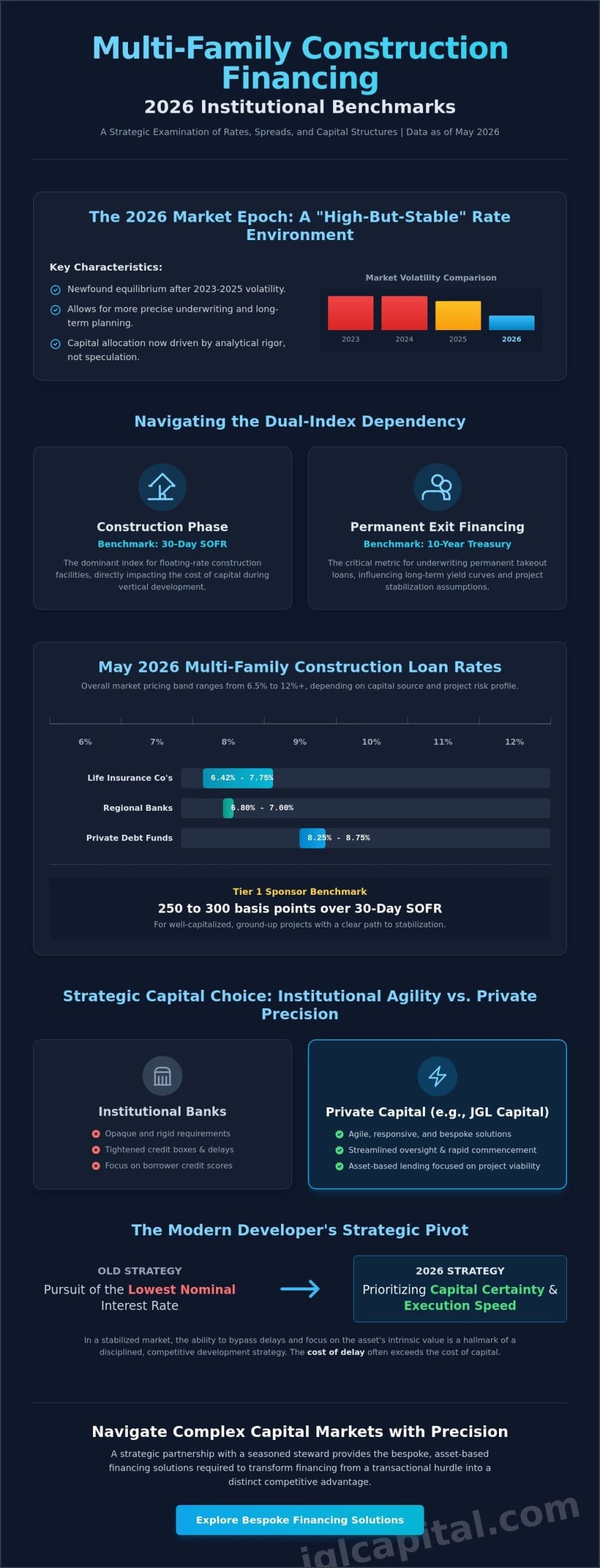
Current industry standards for May 2026 establish a pricing band between 6.5% and 12%+, depending on the capital source and the specific risk profile of the development. Regional banks typically hover around 6.80% to 7.00% based on the 30-day SOFR; meanwhile, private debt funds offer greater leverage and flexibility at rates between 8.25% and 8.75%. For Tier 1 sponsors, the 2026 benchmark for a well-capitalized, ground-up project is currently established at approximately 250 to 300 basis points over the 30-day SOFR. Project scale and the sponsor’s track record significantly influence these basis point spreads, as lenders increasingly reward “clean” projects that demonstrate high levels of capitalization and clear paths to stabilization.
The Role of Asset-Based Lending in Development
Asset-based lending has emerged as the primary vehicle for sophisticated developers who value project viability and collateral quality over individual borrower credit scores. By centering the underwriting process on the property’s anticipated value and its projected net operating income, private capital providers facilitate rapid project commencement without the delays common in traditional banking. This streamlined oversight provides a critical advantage in a stabilized market where the cost of delay often exceeds the cost of capital. In 2026, the ability to bypass traditional credit committees and focus on the asset’s intrinsic value is a hallmark of a disciplined development strategy, allowing JGL Capital LLC to facilitate a more efficient alignment of interests between the steward of capital and the developer.
Key Determinants of Multi-Family Interest Rates and Capital Spreads
The determination of multi-family construction loan rates 2026 relies upon a disciplined analysis of underlying benchmarks and the risk-adjusted spreads applied by institutional credit committees. In the current fiscal landscape, the 30-day Secured Overnight Financing Rate (SOFR) has solidified its position as the dominant index for floating-rate construction facilities, directly impacting the 6.42% to 7.75% ranges typically offered by life insurance companies as of May 8, 2026. While SOFR dictates the cost of capital during the vertical phase, the 10-year Treasury yield remains the critical metric for underwriting permanent exit financing. This dual-index dependency requires developers to maintain a sophisticated understanding of how short-term volatility interacts with long-term yield curves to ensure project feasibility through stabilization.
Capital allocation is further refined by the Loan-to-Cost (LTC) ratio, where higher leverage levels naturally trigger incremental interest rate premiums. Institutional lenders in 2026 frequently utilize a sliding scale for basis point spreads, rewarding sponsors who contribute higher equity percentages with more favorable pricing. The “Sponsor Strength” variable remains a cornerstone of the underwriting process, as a developer’s track record and liquidity position can lead to a significant reduction in the spread over SOFR. For those seeking specialized financing structures, programs such as Multifamily Housing Direct Loans provide a clear example of how government-backed initiatives offer alternative terms for specific asset classes, emphasizing the need for a diverse capital strategy.
Macroeconomic Drivers of 2026 Capital Costs
The Federal Reserve’s commitment to maintaining a stable, albeit elevated, rate environment through May 2026 has created a predictable floor for construction lending. Although the aggressive rate hikes of previous years have subsided, inflationary pressures on construction material indices continue to influence lender sentiment regarding contingency reserves. Global capital flows also play a pivotal role, as international institutional investors seek the relative safety of domestic multi-family assets, providing the liquidity necessary to support high-leverage starts. A disciplined approach to bespoke capital allocation strategies with JGL Capital LLC allows sponsors to capitalize on these global trends while insulating their portfolios from localized market fluctuations.
Project-Specific Risk Premiums
Geographic demand-supply equilibrium analysis is essential for determining the specific risk premium applied to a project’s interest rate. Markets exhibiting a surplus of units in the pipeline may face wider spreads as lenders mitigate the risk of extended lease-up periods. The “Entitlement Premium” also remains a significant factor; projects that’ve secured all necessary zoning and environmental approvals typically command more competitive rates than those in the pre-development phase. Higher leverage ratios inherently command elevated interest rate premiums to offset the increased risk of capital impairment. By focusing on these granular determinants, developers can better position their projects to secure the most advantageous financing terms available in the 2026 market.
Comparing Institutional Banks and Private Capital Structures
Sophisticated developers recognize that the nominal interest rate is merely one component of a broader capital allocation strategy. While institutional banks offer lower headline figures, the inherent bureaucratic friction often creates a “cost of delay” that far exceeds the spread between bank debt and private capital. As indicated by the Mortgage Bankers Association 2026 forecast, multi-family lending has led the commercial finance rebound, yet the distribution of this capital is increasingly bifurcated between traditional depositories and private debt funds. High-level sponsors are moving toward private commercial real estate loans because the speed of execution and flexibility in draw processing often preserve more project value than a lower interest rate can provide. In the context of multi-family construction loan rates 2026, the spread between a regional bank at 6.80% and a private debt fund at 8.25% is often mitigated by the fund’s ability to provide non-recourse structures and higher loan-to-cost thresholds.
Traditional Bank Financing: Constraints and Requirements
In May 2026, traditional bank financing remains tethered to stringent depository requirements and full-recourse obligations. National banks typically offer rates between 6.67% and 6.75% based on the 30-day SOFR, yet these competitive figures often come with the mandate to maintain significant “compensating balances” in low-yield accounts. This effectively increases the “all-in” cost of the capital. Furthermore, the bureaucratic nature of bank-led draw processing can lead to significant delays in subcontractor payments, potentially disrupting construction timelines and eroding the pro forma’s viability. Many banks have also capped their LTC limits at 60% to 65% in 2026, creating a substantial equity gap that sponsors must fill with more expensive mezzanine debt or preferred equity.
Private Money and Hard Money: The Strategic Alternative
Private debt funds and hard money lenders provide a strategic alternative for qualified projects that require higher leverage or non-recourse options. As of May 8, 2026, private debt fund rates range from 8.25% to 8.75%, while hard money multi-family construction debt typically falls between 9.99% and 12.00%. The primary advantage of these structures is the speed of execution; while a bank may take 90 to 120 days to close, a private partner can often fund within 30 days. This agility allows developers to secure subcontractors in a competitive labor market and lock in material pricing before further inflationary shifts occur. For sponsors prioritizing project velocity and capital flexibility, the premium paid for private debt is a calculated investment in the project’s overall success.
Optimizing the Pro Forma for 2026 Development Pipelines
The optimization of a development pro forma requires more than static projections; it demands a disciplined integration of multi-family construction loan rates 2026 into a multi-year model that accounts for both vertical funding and the eventual permanent take-out. In May 2026, developers must look beyond the initial draw and prioritize the Debt Service Coverage Ratio (DSCR) as the primary determinant for successful exit financing. With FHA 223(f) rates starting as low as 5.50% for stabilized assets as of May 4, 2026, the transition from high-interest construction debt to permanent capital must be meticulously choreographed. Mitigating the risk of floating-rate SOFR structures through interest rate caps or hedging instruments isn’t just a recommendation for institutional sponsors; it’s a fundamental requirement of risk-adjusted portfolio management. For projects facing complex entitlement delays or requiring rapid acquisition, strategic alignment with hard money lenders provides the necessary bridge capital to reach the construction commencement phase without exhausting equity reserves.
Sensitivity Analysis for Construction Interest
A rigorous sensitivity analysis serves as the foundation of a resilient pro forma. Sponsors should stress-test their models against 100 to 200 basis point fluctuations in the underlying SOFR or Treasury indices to ensure that interest reserves remain sufficient throughout the construction lifecycle. Maintaining robust interest reserves is essential for project liquidity, preventing capital calls during the critical lease-up phase. To reduce the weighted average cost of capital (WACC), developers should explore bifurcated capital stacks that blend lower-cost institutional debt with targeted private equity, ensuring that the overall financing structure remains competitive even if multi-family construction loan rates 2026 remain elevated throughout the fiscal year.
Sponsorship and Track Record Presentation
Securing favorable terms in a disciplined credit environment requires a compelling narrative that emphasizes the sponsor’s track record and operational depth. Institutional capital providers in 2026 prioritize developers who can demonstrate a history of delivering ground-up projects on time and within budget, especially during periods of material cost inflation. A robust resume, detailed site-specific due diligence, and a clear alignment of interests between the borrower and lender are the hallmarks of a successful capital request. Transparency in borrower-lender partnerships fosters the trust necessary to secure bespoke financing solutions that go beyond the limitations of standard retail products. For developers ready to elevate their capital strategy, engaging in a disciplined partnership for capital allocation ensures that every project is positioned for long-term legacy creation.
JGL Capital: Bespoke Capital Solutions for Multi-Family Developers
JGL Capital LLC stands as a distinguished steward of capital, possessing a legacy of over 30 years dedicated to navigating the intricate complexities of real estate capital markets. While the broader market grapples with the fluctuations of multi-family construction loan rates 2026, our firm provides a sense of stability grounded in analytical rigor and deep-seated expertise. We recognize that every ground-up development requires a unique approach; therefore, we move beyond the rigid constraints of traditional lending to deliver customized capital stacks that align with the specific requirements of the 2026 fiscal year. Our commitment to partnership and stewardship ensures that every project is treated as a collaborative endeavor, prioritizing long-term value creation and the preservation of institutional wealth.
Our methodology centers on streamlined asset-based underwriting, a process that prioritizes the intrinsic value and projected viability of the property over the restrictive credit metrics favored by traditional depositories. This approach allows for rapid project commencement, ensuring that developers can capitalize on market windows without the bureaucratic delays that often erode a pro forma’s resilience. By acting as a disciplined partner rather than a mere service provider, we foster an environment where strategic objectives are clearly defined and meticulously executed. It’s this focus on the alignment of interests that distinguishes our firm from transactional competitors who lack the depth of our strategic oversight.
The Strategic Advantage of JGL Partnership
Partnering with JGL Capital LLC provides developers with direct access to private capital pools that operate with fewer regulatory hurdles than traditional banking institutions. Our expertise in real estate investing spans diverse asset classes, allowing us to provide nuanced insights into portfolio optimization and risk-adjusted returns. We maintain a steady and measured communication rhythm, ensuring that every claim is qualified and every strategy is rooted in timeless principles of finance. This disciplined oversight is particularly vital in 2026, as sponsors navigate the transition from construction to stabilization amidst a landscape of persistent, though predictable, capital costs.
Commencing Your 2026 Development Journey
Initiating a partnership with JGL Capital LLC begins with a methodical due diligence process led by our senior analysts. During the initial intake and property evaluation phase, we conduct a thorough assessment of the project’s feasibility, market position, and sponsorship strength. We value precision over speed, taking the time to conduct thorough due diligence to ensure a perfect alignment of interests between all stakeholders. For institutional partners and high-net-worth individuals seeking a seasoned ally, the path to securing competitive multi-family construction loan rates 2026 is defined by careful, deliberate action. We invite you to engage with our team to explore how our intellectual capital can help build your lasting legacy through sophisticated financial management.
Executing Institutional Development Strategies in a Stabilized Epoch
Success in the current fiscal year depends on a sponsor’s ability to transcend nominal interest rate comparisons and embrace a holistic approach to capital allocation. The prevailing multi-family construction loan rates 2026, currently established within the 6.5% to 12% pricing band, reflect a market equilibrium where the 30-day SOFR dictates short-term costs while 10-year Treasury yields govern the critical permanent exit. By prioritizing the Debt Service Coverage Ratio and utilizing asset-based lending to bypass traditional bank bureaucracy, professional developers can insulate their pro formas against localized volatility and ensure rapid project commencement.
JGL Capital remains a disciplined steward of your vision, offering over 30 years of specialized expertise and national service coverage for high-stakes multi-family starts. Our focus on bespoke, asset-backed solutions ensures that your capital stack is optimized for superior risk-adjusted returns and long-term legacy creation. We invite you to consult with our strategic capital partners to secure your 2026 multi-family financing and begin the next phase of your development journey with institutional confidence. Your commitment to excellence deserves a partner who values analytical rigor and the alignment of interests above all else.
Frequently Asked Questions
What is the average multi-family construction loan rate in 2026?
The prevailing multi-family construction loan rates 2026 currently span a spectrum from 5.75% for HUD-backed facilities to over 12% for opportunistic hard money structures. These figures are primarily governed by the 30-day SOFR, which as of May 8, 2026, serves as the benchmark for the majority of floating-rate construction debt. Institutional bank pricing typically clusters between 6.67% and 7.00% for Tier 1 sponsors with significant liquidity.
How does a multi-family construction loan differ from a traditional mortgage?
A multi-family construction loan functions as a short-term, draw-based facility specifically designed to fund the vertical development phase, whereas a traditional mortgage is a long-term, amortized instrument for stabilized assets. Unlike permanent financing, construction debt typically features interest-only payments on disbursed funds, requiring a clear take-out strategy upon project completion. The underwriting focus shifts from historical income to future project viability and collateral value.
What LTV and LTC ratios are common for multi-family projects in 2026?
Common Loan-to-Cost (LTC) ratios for multi-family projects in 2026 range from 60% to 65% for traditional national banks, while private capital providers often extend leverage to 75% or higher for qualified sponsors. Loan-to-Value (LTV) considerations are secondary during the development phase, as lenders prioritize the project’s ability to achieve a minimum 1.20x Debt Service Coverage Ratio at stabilization. These ratios reflect a disciplined approach to capital allocation and risk management.
Can I secure a non-recourse construction loan for a multi-family project?
Non-recourse construction loans are available in 2026, primarily through HUD/FHA 221(d)(4) programs or specialized private debt funds that prioritize asset quality over personal guarantees. While these structures mitigate individual liability, they often require more stringent property standards and higher capitalization levels to offset the lender’s risk. It’s a strategic choice for developers looking to preserve personal balance sheet flexibility during the high-risk vertical phase.
What are the primary indices used to price multi-family construction debt?
The 30-day Secured Overnight Financing Rate (SOFR) and the 10-year U.S. Treasury yield are the primary indices used to price multi-family construction debt in the current fiscal year. SOFR typically dictates the variable cost of construction draws, while Treasury yields serve as the benchmark for the permanent, fixed-rate financing that replaces the construction facility upon stabilization. Understanding the interaction between these indices is vital for precise pro forma modeling.
How long does the underwriting process take for a private money construction loan?
The underwriting process for a private money construction loan typically spans 30 days, offering a significant speed advantage over the 90 to 120 days required by traditional institutional banks. This accelerated timeline allows developers to secure critical subcontractors and lock in material pricing, which is essential in a market where the cost of delay often impacts project viability. Our firm prioritizes analytical rigor to ensure that speed doesn’t compromise due diligence.
Are interest rate caps required for multi-family construction financing?
Interest rate caps are standard requirements for floating-rate multi-family construction financing in 2026 to protect against unforeseen volatility in the SOFR index. Lenders mandate these hedging instruments to ensure that the project’s interest reserve remains sufficient to cover debt service throughout the anticipated development and lease-up period. This requirement serves as a safeguard for both the steward of capital and the development partner, maintaining project integrity.
Does JGL Capital offer bridge-to-construction financing options?
JGL Capital provides bespoke bridge-to-construction financing options designed to facilitate land acquisition and pre-development activities before transitioning into a vertical construction facility. This integrated approach allows sponsors to maintain continuity in their capital stack, ensuring that the alignment of interests remains consistent from the initial site acquisition through project stabilization. It’s a collaborative solution that values long-term growth and the delivery of tailored, institutional-grade capital structures.