

The reliance on traditional, consumer-grade mortgages often serves as the primary bottleneck for sophisticated portfolios, as the 25.1% return on investment for house flipping in the second quarter of 2025 demonstrates that narrow margins demand more precise financial instruments. You likely recognize that the rigid underwriting and protracted funding cycles of conventional banks are increasingly incompatible with the agility required in the current rebalancing market. This guide provides the analytical framework necessary to evaluate specialized real estate investor loan programs, ensuring you can identify the optimal capital structure to enhance your risk-adjusted returns while managing the transparency requirements of the FinCEN reporting rule that took effect on March 1, 2026.
We will examine the strategic advantages of DSCR and bridge financing to help you secure a reliable lending partnership that prioritizes long-term value creation. By shifting from transactional debt to a model of disciplined capital stewardship, you’ll be able to optimize your capital stack for maximum ROI and secure the high-leverage financing necessary for new construction or distressed asset acquisition. This transition allows for the precise articulation of your investment philosophy through tailored solutions that align with your long-term legacy objectives and provide the speed of execution your portfolio requires.
Key Takeaways
- Understand the 2026 transition from borrower-centric income verification to asset-centric underwriting for sophisticated, non-owner-occupied real estate developments.
- Learn how to utilize specialized real estate investor loan programs to decouple personal credit from property potential through a rigorous analysis of After Repair Value.
- Evaluate the distinct operational mechanics of DSCR, fix-and-flip, and new construction programs to align your capital allocation with the asset’s specific lifecycle stage.
- Apply a disciplined evaluation framework to select optimal capital structures based on your intended investment horizon and the necessity of renovation capital.
- Identify the strategic advantages of a long-term partnership that offers bespoke financial engineering and an institutional approach to portfolio optimization.
The Evolving Landscape of Real Estate Investor Loan Programs in 2026
The landscape of real estate investor loan programs in 2026 is defined by a fundamental shift toward asset-centric underwriting; this is a transition necessitated by the increasing complexity of global capital markets. These specialized financing vehicles are strictly designed for the acquisition and development of non-owner-occupied properties, prioritizing the income-generating potential of the asset over the borrower’s personal debt-to-income ratio. This evolution reflects a broader rebalancing of the market, where the ability to articulate a property’s value proposition is more critical than traditional credit metrics. While conventional lenders remain tethered to rigid, borrower-centric protocols, the 2026 environment demands a more sophisticated approach to capital allocation that values intellectual capital and strategic due diligence.
Traditional Mortgages vs. Private Money Programs
Conforming loans often lack the requisite agility for professional portfolios, particularly when federal interest rate shifts impact bank liquidity and tighten lending standards. In May 2026, while Freddie Mac’s 30-year fixed-rate average hovered around 6.30%, the constraints of traditional underwriting often led to missed opportunities in high-growth sectors. Professional investors frequently utilize a Hard money loan or bridge financing as tactical instruments for rapid acquisition, accepting higher interest rates for the benefit of accelerated capital deployment. This trade-off is often justified by the need to secure assets before competitors can finalize bank-led financing, especially when the median gross profit for house flipping reached $65,300 in the second quarter of 2025. It’s a matter of prioritizing the capital stack’s responsiveness over the nominal cost of debt.
Institutional Capital vs. Individual Hard Money Lenders
The source of investment capital significantly influences the stability and reliability of a lending partnership. Institutional backing provides a level of strategic oversight and operational depth that individual lenders cannot replicate, ensuring that funding remains consistent even during periods of market volatility. With over 30 years of industry expertise, JGL Capital emphasizes the importance of a disciplined partner who understands the nuances of the March 1, 2026 FinCEN reporting rule. This regulation, which requires the disclosure of beneficial ownership for acquisitions made through LLCs or trusts, has shifted private capital allocation toward more transparent, institutional structures. In 2026, there’s a noticeable concentration of capital within multi-family and new construction sectors, where institutional-grade real estate investor loan programs provide the necessary scale for portfolio optimization. Partnering with a seasoned steward of capital ensures that your growth is supported by analytical rigor and a commitment to long-term value creation.
Asset-Based Financing: The Mechanics of Private Capital
At the core of sophisticated real estate investor loan programs lies the decoupling of personal credit history from the intrinsic potential of the underlying asset. Unlike traditional bank underwriting that prioritizes a borrower’s debt-to-income ratio, asset-based lending focuses on the property’s ability to generate value or income. This methodology allows for a more precise allocation of capital toward projects that might otherwise be overlooked by conventional institutions. Lenders evaluate the After Repair Value (ARV) through a lens of analytical rigor, comparing the current market state against the projected valuation post-renovation. This foresight is critical; as of the second quarter of 2025, the median gross profit for house flipping reached $65,300, a figure that underscores the importance of accurate valuation in a rebalancing market.
Institutional lenders maintain a distinct preference for ‘skin in the game’, requiring investors to maintain significant equity in the deal to align interests. This structure ensures that both the lender and the developer share a disciplined commitment to the project’s success. Within the professional capital stack, private financing often serves as the senior debt, providing the foundation for more complex property developments. By focusing on the asset’s performance rather than personal financial minutiae, investors can scale their portfolios with greater efficiency. For those seeking to refine their strategic approach, exploring bespoke capital solutions can provide the clarity needed for long-term growth.
Bridge Financing for Transitional Assets
Sophisticated investors utilize bridge loans to effectively close the temporal gap between initial acquisition and the securing of permanent financing. These instruments are particularly effective for transitional assets that require immediate capital to stabilize or renovate. The mechanics of these loans typically involve interest-only payments, which is a strategic choice that preserves cash flow during the critical renovation phase. By minimizing monthly debt service, developers can reinvest liquidity back into the asset to maximize its eventual market value. A clearly defined exit strategy, whether through refinancing into a 30-year DSCR loan or the final disposition of the asset, remains the hallmark of a disciplined investment philosophy.
Hard Money: Speed as a Competitive Advantage
In the high-stakes environment of 2026, the speed of capital deployment is often more valuable than the nominal cost of debt. Investors focused on Fix and Flip Loans prioritize rapid execution to secure distressed assets in competitive markets. Streamlined underwriting processes in private capital markets allow for closings in as little as 5 to 10 days, a pace that traditional banks simply cannot match. This agility is supported by the asset-backed nature of the security, where the property itself provides the primary collateral. While interest rates for these programs typically range from 9% to 13% as of May 2026, the ability to capture a high-ROI opportunity often outweighs the higher origination fees of 1.5 to 3 points. Speed isn’t just a convenience; it’s a strategic necessity for portfolio preservation and growth.
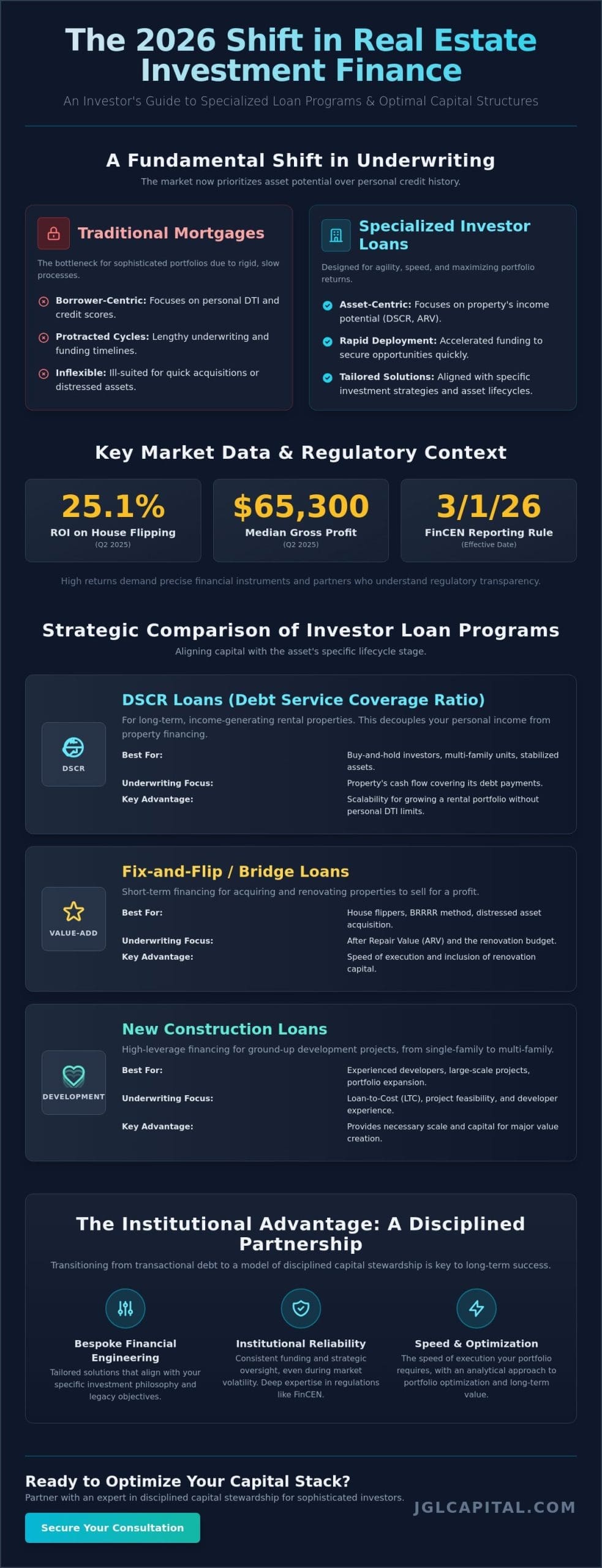
Strategic Comparison: DSCR, Fix-and-Flip, and New Construction Programs
The selection of a specific financial vehicle must be predicated on the asset’s current position within the investment lifecycle, as the efficacy of capital allocation depends on the alignment of the loan structure with project objectives. While many retail banks offer generic products with rigid constraints, the breadth of real estate investor loan programs available through private capital markets allows for a more nuanced approach to portfolio optimization. In 2026, we’ve observed a significant pivot toward new construction loans as a response to persistent supply constraints in primary and secondary markets. This shift is accompanied by an evolution in Commercial Real Estate Loans, which now provide the structural flexibility required to support larger institutional multi-family portfolios through sophisticated debt-service modeling.
The DSCR Loan: Long-Term Rental Strategy
The Debt Service Coverage Ratio (DSCR) loan represents the definitive tool for long-term rental appreciation because it prioritizes property performance over personal income metrics. By utilizing a formula that divides the property’s gross rental income by its annual debt service, lenders can assess the asset’s self-sufficiency with analytical rigor. As of May 2026, residential DSCR rates range from 6.12% to 8.75%, with the most competitive pricing reserved for ratios of 1.25 or higher. Professional investors prefer these real estate investor loan programs because they bypass the onerous, borrower-centric underwriting that often stalls conventional bank cycles. It’s a disciplined method for optimizing cash flow even in a stabilized interest rate environment, ensuring that the capital stack remains resilient against market fluctuations.
Fix-and-Flip and New Construction: The Growth Engine
For those focused on high-velocity growth and value creation, fix and flip loans provide the necessary leverage for residential redevelopment. These short-term, interest-only programs typically feature rates between 9% and 13% and allow for closings within 10 to 18 days, which is a critical advantage in competitive acquisition environments. Conversely, ground-up construction requires a more complex oversight structure involving staged draws and rigorous inspections to ensure project integrity. Managing risk-adjusted returns in 2026 necessitates a lending partner who provides both the capital and the strategic oversight to navigate volatile material costs and labor markets. Each program serves as a distinct pillar, supporting a balanced strategy that values long-term stewardship and the delivery of bespoke financial engineering.
Evaluation Framework: Selecting the Optimal Loan Program
The selection process for real estate investor loan programs must be a methodical exercise in financial engineering, where the chosen debt structure aligns precisely with the asset’s projected performance. It’s not merely a matter of securing capital; it’s about optimizing the capital stack to ensure that leverage enhances rather than encumbers your risk-adjusted returns. A disciplined framework begins with a clear definition of the investment horizon, distinguishing between the 6 to 18-month cycles of a residential redevelopment and the multi-decade stabilization of a rental portfolio. This temporal clarity dictates whether the focus should remain on the speed of acquisition or the sustainability of the interest rate.
Defining the asset’s physical condition is the subsequent priority, as the necessity for renovation capital significantly alters the underwriting requirements. For aggressive redevelopment projects, lenders may finance up to 95% of the loan-to-cost (LTC), providing the liquidity needed for extensive structural improvements. Conversely, for stabilized assets, the focus shifts to loan-to-value (LTV) metrics, where the most competitive pricing in 2026 is typically achieved at 65% to 70% LTV. You must also quantify the impact of prepayment penalties and exit fees, which can erode equity if the project’s timeline deviates from the initial pro forma. A thorough analysis of these variables allows for a more precise articulation of your strategic objectives. To begin this process with expert guidance, you can request a portfolio capital analysis to identify your optimal leverage points.
Risk Management and Due Diligence
Risk management in the 2026 market requires a lending partner who conducts rigorous internal underwriting to anticipate potential market shifts. It’s essential to work with a steward of capital who understands the nuances of the March 1, 2026 FinCEN reporting requirements, ensuring that your legal entities remain compliant throughout the transaction. Mitigating interest rate risk often involves a strategic bridge-to-permanent transition, where a short-term instrument provides the initial acquisition speed before refinancing into a long-term DSCR program once the asset is stabilized. Identifying red flags, such as unusually high exit fees or restrictive cross-collateralization clauses, is a critical component of institutional-grade due diligence that preserves your long-term growth.
Capital Allocation for Multi-Family and Commercial Assets
Scaling a portfolio from single-family units into institutional-grade assets necessitates a shift toward commercial real estate loans. These programs accommodate the complexities of syndication and partnership structures, allowing for the aggregation of capital while maintaining a clear alignment of interests among stakeholders. Portfolio optimization through strategic cross-collateralization can unlock equity from existing holdings to fund new acquisitions, provided the debt service remains within disciplined parameters. This sophisticated approach to capital allocation ensures that every dollar is deployed with strategic oversight, building a lasting legacy through the careful, deliberate management of high-stakes financial resources.
JGL Capital: Bespoke Financial Engineering for Sophisticated Investors
JGL Capital operates as a seasoned steward of capital, leveraging over 30 years of industry expertise to navigate the complexities of modern capital markets. Our approach to real estate investor loan programs is rooted in the timeless principles of analytical rigor and portfolio optimization, ensuring that every allocation of private capital is supported by thorough due diligence. Unlike transactional lenders who prioritize volume over value, we emphasize a disciplined alignment of interests between the firm and the developer. This partnership model is designed to provide the strategic oversight necessary for wealth preservation and growth in a market that has seen a 25.1% return on investment for house flipping as of the second quarter of 2025. By providing tailored, asset-backed solutions, we prioritize the viability of the project above all else, ensuring that our partners have access to the reliable capital required to build lasting legacies.
The firm serves as a discreet partner to institutional entities and high-net-worth individuals who require a sophisticated alternative to the rigid constraints of traditional banking. Our processes are meticulously structured to eliminate the administrative delays that frequently result in missed opportunities. By focusing on the intrinsic value of the real estate and the strategic objectives of the investor, we deliver financial instruments that are as unique as the assets they secure. It’s a commitment to professional excellence that transforms simple lending into a collaborative, high-level partnership.
The JGL Capital Advantage: Expertise and Execution
Institutional partners trust JGL Capital for our ability to provide precise, high-level financial management across the entire capital stack. A dedicated private money broker within our firm acts as a strategic ally, navigating the nuances of the 2026 lending environment to secure competitive points and fees that reflect the quality of the underlying asset. Our national reach allows us to support diverse portfolios across the United States, providing the scale needed for multi-family developments and large-scale commercial acquisitions. We don’t just provide funding; we offer the intellectual capital necessary to optimize risk-adjusted returns in a rebalancing market.
Initiating Your Strategic Partnership
The path toward capital deployment begins with a comprehensive consultation process that evaluates the specific needs of your asset class. Preparing your project for underwriting requires a methodical presentation of documentation, including detailed pro formas and asset valuations that reflect the current market state. This disciplined preparation ensures that our team can conduct the necessary due diligence with precision and speed. We invite you to contact JGL Capital today to discuss your bespoke financing requirements and discover how our intellectual capital can enhance your investment strategy.
Advancing Your Portfolio through Disciplined Capital Stewardship
The rebalancing market of 2026 requires a transition from transactional debt to a model of strategic capital allocation. By prioritizing asset-centric underwriting and optimizing the capital stack for maximum risk-adjusted returns, you’ll ensure your portfolio remains resilient against volatility. Identifying the most effective real estate investor loan programs is no longer a matter of simple rate comparison; it’s an exercise in financial engineering that demands a partner with deep-seated expertise and national reach. This disciplined approach allows for the precise articulation of your investment objectives while maintaining a commitment toTimeless principles of finance.
JGL Capital provides this strategic oversight through 30 years of experience and a commitment to delivering bespoke solutions for both residential and commercial assets. Our asset-based underwriting ensures your growth is supported by analytical rigor rather than administrative delays. It’s time to align your investment philosophy with a steward who values integrity and long-term legacy creation. Secure Institutional-Grade Capital for Your Next Asset Acquisition and position your portfolio for sustainable success in the evolving landscape of private finance. Your commitment to deliberate action today builds the foundation for tomorrow’s wealth preservation.
Frequently Asked Questions
What is the primary difference between a DSCR loan and a traditional investment property mortgage?
The primary distinction lies in the underwriting methodology; DSCR programs prioritize the property’s gross rental income over the borrower’s personal debt-to-income ratio. While traditional mortgages require extensive personal income verification, DSCR loans evaluate the asset’s ability to cover its own debt service, typically requiring a ratio between 1.0 and 1.25. This focus allows for more rapid portfolio expansion without the constraints of personal credit limits.
How do hard money loan interest rates compare to traditional bank rates in 2026?
Hard money interest rates in May 2026 typically range from 9% to 13%, while Freddie Mac’s 30-year fixed-rate average for traditional mortgages was 6.30% during the same period. The higher cost of private capital reflects the increased risk and the accelerated speed of execution provided by the lender. Investors accept these terms to secure assets that traditional banks often refuse to finance due to property condition or timing requirements.
Can I secure a new construction loan if I don’t have a long history of development?
Securing a new construction loan is feasible for investors without an extensive development history, provided the project exhibits strong viability and the borrower maintains sufficient liquidity. Lenders generally require a down payment of at least 20% and a minimum credit score of 680 to mitigate the inherent risks of ground-up development. Partnering with an experienced general contractor can further strengthen the application during the analytical review process.
What are the typical down payment requirements for asset-based investor loan programs?
Asset-based real estate investor loan programs generally require a down payment between 20% and 35% of the property’s value. Achieving the most competitive pricing in 2026 typically necessitates a loan-to-value ratio of 65% to 70%. Higher leverage options up to 80% exist, but these usually result in elevated interest rates to compensate for the lender’s increased capital exposure.
How quickly can a bridge loan be funded for a time-sensitive acquisition?
Bridge financing can be deployed within 10 to 18 days for time-sensitive acquisitions where traditional bank cycles would result in a missed opportunity. This accelerated timeline is made possible by streamlined underwriting that focuses on the asset’s current and projected value. Such agility is a strategic necessity for professional investors competing for distressed assets or transitional properties in high-demand markets.
Is it possible to use a private money loan program for a multi-family property acquisition?
Private money loan programs are frequently utilized for multi-family property acquisitions to provide the flexible capital structures that institutional portfolios require. These programs allow for the acquisition of value-add assets that may not yet qualify for permanent agency financing. By utilizing private capital for the initial purchase and stabilization phase, investors can optimize their capital stack before transitioning to long-term debt.
What does ‘risk-adjusted return’ mean in the context of choosing a loan program?
Risk-adjusted return refers to the profit generated by an investment relative to the amount of risk accepted to achieve that gain. In the context of capital allocation, it means evaluating whether a higher-interest bridge loan is justified by the potential for significant appreciation or rapid project completion. Disciplined investors prioritize real estate investor loan programs that offer the highest return for every unit of risk exposure.
Are there prepayment penalties associated with most private real estate investor loans?
Prepayment penalties are common in long-term real estate investor loan programs, such as 30-year DSCR loans, but are less frequent in short-term bridge or fix-and-flip financing. These penalties protect the lender’s yield by ensuring a minimum interest return over a specified period. It’s essential to review the specific terms of the loan agreement to understand how these fees might impact your eventual exit strategy.