

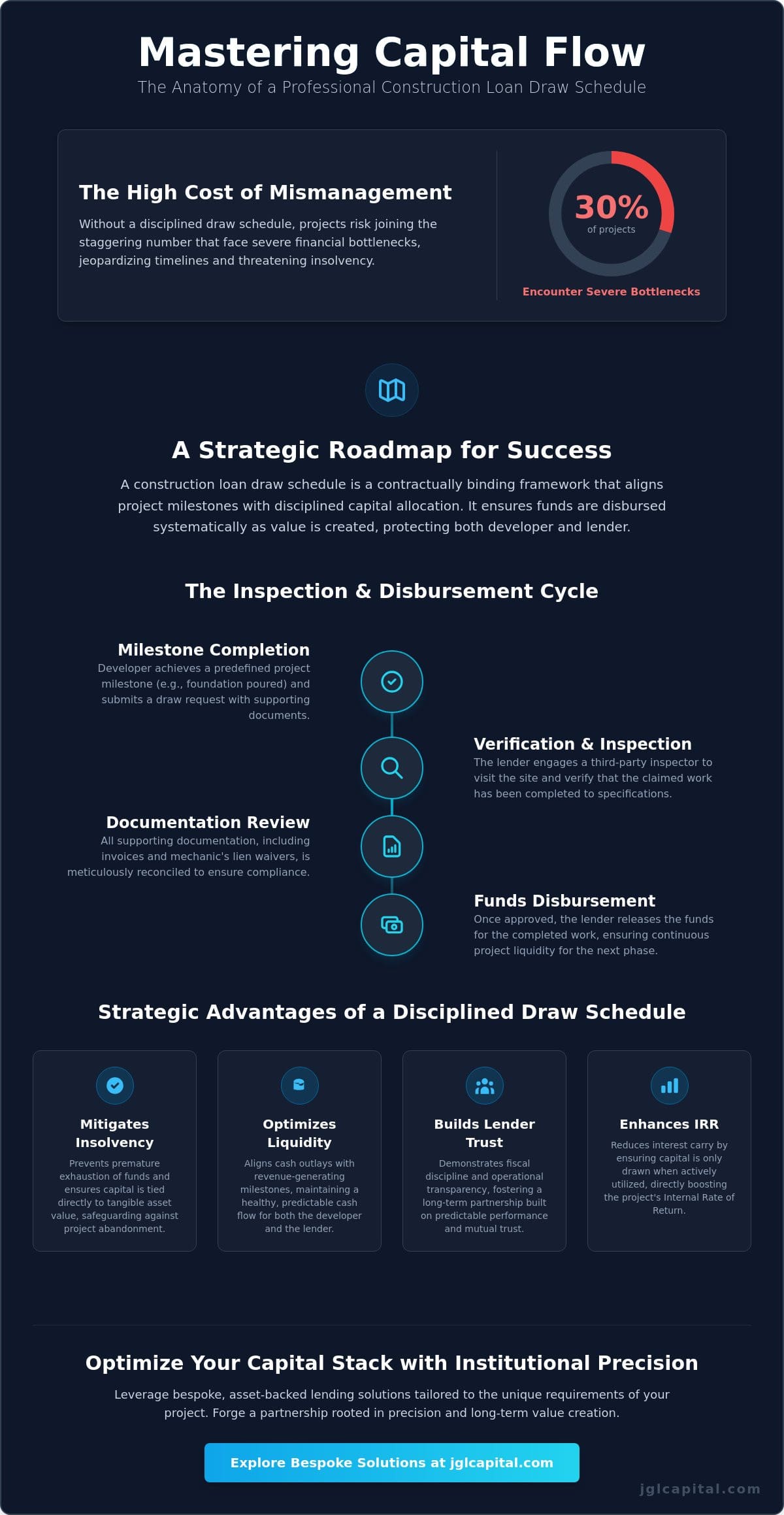
The success of a multi-million dollar development in 2026 is predicated less on the height of the structure and more on the disciplined cadence of its capital flow. When developers fail to implement a rigorous construction loan draw schedule template, they risk joining the 30% of projects that encounter severe bottlenecks due to misaligned disbursement cycles. It’s a reality that institutional partners understand well; the alignment of fund availability with specific project milestones is the cornerstone of effective risk management and strategic oversight.
You’ve likely experienced the friction that occurs when soft costs or retainage requirements aren’t meticulously accounted for within your financial framework. This guide offers a professional structure to master these complexities, providing a roadmap that optimizes liquidity while ensuring your project remains insulated from the volatility of funding delays. We’ll explore how to synchronize physical construction progress with sophisticated capital allocation strategies to reduce friction during the inspection and disbursement phases.
Key Takeaways
- Recognize the strategic function of a draw schedule as a contractually binding framework that aligns project milestones with disciplined capital allocation to ensure superior risk-adjusted returns.
- Utilize a professional construction loan draw schedule template to establish precise line-item breakdowns and milestone-driven trigger events, ensuring transparent fund disbursement throughout the development lifecycle.
- Mitigate project insolvency and development risk by implementing rigorous oversight of milestone allocation, effectively preventing the hazards of front-loading while streamlining mechanic’s lien waiver management.
- Optimize the inspection and disbursement cycle through the meticulous reconciliation of supporting documentation and strategic coordination with lender representatives to maintain consistent project liquidity.
- Discover how bespoke, asset-backed lending solutions can be tailored to the unique requirements of your project’s capital stack, fostering a partnership rooted in institutional precision and long-term value creation.
The Strategic Role of a Construction Loan Draw Schedule in Capital Allocation
A sophisticated construction loan draw schedule template serves as the contractually binding roadmap that governs the orderly disbursement of funds throughout a development’s lifecycle. It operates at the intersection of project management milestones and financial risk-adjusted returns, providing a structured framework for capital deployment. Institutional lenders, particularly those managing portfolios in excess of $500 million, prioritize milestone-based funding over lump-sum allocations to maintain rigorous control over their liquidity positions. This methodical release of capital ensures that interest carry is only incurred on funds actively utilized, which directly enhances the project’s overall internal rate of return (IRR). By adhering to project financing structures that demand proof of progress, developers can demonstrate fiscal discipline and operational transparency. This alignment is essential for securing competitive terms in the 2026 lending environment.
Defining the Draw Schedule Framework
The architecture of a draw schedule requires a precise distinction between hard costs and soft costs. Hard costs encompass the tangible elements of construction, such as foundation work and structural steel; soft costs include the intangible yet vital expenses like architectural fees and municipal permits. Funding is typically released based on the percentage of completion metric, which is verified by an independent third-party inspector to ensure accuracy. The draw schedule acts as the primary mechanism that synchronizes capital deployment with physical value creation. This synchronization prevents the misallocation of resources and ensures that the project’s equity and debt are utilized in the correct sequence.
The Importance of Alignment Between Developer and Lender
Transparency within the draw process is the cornerstone of institutional trust. When a developer utilizes a standardized construction loan draw schedule template, it fosters a long-term partnership built on predictable performance. This disciplined capital release prevents the lender from entering an over-advanced position, where the outstanding loan balance exceeds the current market value of the physical improvements. It’s a safeguard against project abandonment. By releasing funds only after specific milestones are achieved, the lender mitigates the risk of insolvency or contractor default. This strategic oversight ensures that every dollar invested contributes to the appreciation of the asset’s collateral value.
- Risk Mitigation: Prevents the premature exhaustion of contingency funds during the early phases of site work.
- Operational Efficiency: Streamlines the audit trail for tax and accounting purposes, reducing administrative friction.
- Strategic Liquidity: Optimizes cash flow for both the developer and the financial institution by aligning outlays with revenue-generating milestones.
Effective capital allocation is not a passive activity. It requires a rigorous, data-driven approach to ensure that every disbursement is justified by physical progress on the job site. For developers aiming to scale their operations, mastering this financial instrument is a prerequisite for institutional-grade success. It’s the difference between a project that struggles with liquidity and one that maintains a healthy, predictable trajectory toward completion.
Essential Components of a Professional Draw Schedule Template
A meticulously structured construction loan draw schedule template acts as the primary mechanism for maintaining fiscal discipline throughout the project lifecycle. It’s more than a simple spreadsheet; it’s a strategic roadmap that aligns capital disbursement with physical progress. Developers must ensure the template includes comprehensive line-item breakdowns that span from initial site preparation to the final aesthetic finishes. This granularity allows for precise Budget vs. Actual tracking, which is essential for identifying variances before they jeopardize the project’s solvency. Most institutional lenders require a retainage provision, typically set at 10%, to ensure the general contractor fulfills all contractual obligations and maintains quality standards until the final certificate of occupancy is issued.
Hard Cost Categorization and Milestone Mapping
The efficacy of a draw schedule depends on its ability to define clear trigger events for funding. Structural phases, including the foundation, framing, and dried-in stages, must be mapped to specific disbursement percentages to prevent over-leveraging. Integrating Mechanical, Electrical, and Plumbing (MEP) rough-ins into this logic ensures that capital isn’t advanced ahead of verifiable installation. Each request should be substantiated by a third-party inspector who confirms that the work in place matches the requested funds. Understanding the nuances of the construction loan draw request process is vital for developers who wish to avoid liquidity bottlenecks. By establishing these milestones early, developers create a transparent environment that fosters trust with their capital partners.
Soft Cost Allocation and Contingency Management
Soft costs, such as architectural, engineering, and legal fees, require front-loaded allocation within the initial draws to facilitate the pre-development phase. A robust construction loan draw schedule template also incorporates a contingency fund, often ranging from 5% to 15% of the total project cost, to absorb market fluctuations or site-specific surprises. Strategic reallocation of savings is possible, but it must be governed by strict protocols. For instance, if the excavation phase concludes 4% under budget, those funds shouldn’t be spent arbitrarily. Instead, they should be moved to the contingency pool to preserve the capital stack’s integrity. Developers seeking to optimize their project’s financial structure can benefit from the bespoke capital solutions offered by seasoned institutional advisors who prioritize long-term value creation.
- Site Preparation: Clearing, grading, and utility lateral installation.
- Foundation: Excavation, footings, and slab placement.
- Building Envelope: Framing, roofing, and exterior cladding.
- Interior Systems: MEP rough-ins and insulation.
- Finishes: Drywall, cabinetry, and flooring.
Mitigating Risk Through Precise Milestone Allocation
The structural integrity of a project’s capitalization depends heavily on the chronological accuracy of its disbursements. Front-loading, the practice of inflating early-stage draw requests beyond the actual value of installed work, poses a critical threat to project solvency. If a developer permits disbursements to outpace physical progress, they effectively provide unsecured credit to the contractor. This imbalance compromises the lender’s collateral position and leaves the developer vulnerable should a general contractor face liquidity issues. Utilizing a sophisticated construction loan draw schedule template serves as a defensive mechanism, ensuring that capital allocation remains strictly commensurate with verified site inspections.
Strategic oversight requires aligning the disbursement schedule with the procurement of high-value, long-lead components. Recent data from 2024 supply chain indices indicate that specialized HVAC systems and custom millwork often require lead times exceeding 24 weeks. By integrating these procurement milestones into the template, developers can secure necessary materials without prematurely depleting their contingency reserves. This disciplined approach protects the developer’s equity position by maintaining a consistent debt-to-equity ratio throughout the construction lifecycle. It’s a method that ensures the final 20% of the project remains fully funded even if unforeseen site conditions arise.
Lien Waiver Integration and Legal Protection
Legal protection is foundational to capital preservation. Developers must implement a rigorous protocol for collecting both conditional and unconditional lien waivers with every funding cycle. The construction loan draw schedule template should function as a ledger that tracks these documents against specific subcontractor payments to ensure the title remains unencumbered. A draw request is incomplete without a corresponding release of lien for previous funding. This practice prevents the clouding of title and mitigates the risk of costly litigation during the stabilization phase. By maintaining this level of administrative rigor, the developer projects an image of institutional competence to their financial partners.
Managing Retainage for Quality Assurance
Retainage acts as a vital financial lever, typically set at 5% to 10% of each progress payment. This withheld capital provides the necessary leverage to ensure that subcontractors fulfill their contractual obligations through the final punch list. The psychological impact of these funds ensures that quality standards are maintained during the final 15% of the build. Strategic developers schedule the release of retainage only upon the issuance of the Certificate of Occupancy or the achievement of substantial completion as defined by AIA standards. This ensures the project reaches a marketable state before the final capital is deployed; it’s a safeguard that aligns the interests of the contractor with the long-term viability of the asset.
Best Practices for Streamlining the Inspection and Disbursement Cycle
Precision in the disbursement cycle is the hallmark of a disciplined development firm. Developers often face liquidity constraints when the administrative burden of draw requests lags behind physical progress. A well-structured construction loan draw schedule template serves as more than a simple checklist; it acts as a strategic roadmap for capital allocation. Before submitting a request, developers must ensure all invoices, lien waivers, and supporting documentation are reconciled against the total project budget. This rigorous internal audit prevents the delays associated with incomplete submissions and ensures that the request aligns with the current stage of completion.
The inspection phase requires proactive coordination. Lenders typically deploy third-party consultants to verify that the work described in the draw request matches the physical reality on-site. Delays here are often the result of poor communication or restricted site access. By treating the inspector as a partner in the project’s success, developers can facilitate a more efficient verification process. This involves providing clear documentation of any materials stored off-site and ensuring that all work areas are safe and accessible for review.
Optimizing the Third-Party Inspection Process
Site readiness dictates the speed of fund release. When the lender’s representative arrives for verification, every line item on the construction loan draw schedule template must be visible and accessible. In 2026, institutional lenders increasingly rely on high-resolution photographic evidence and drone telemetry to supplement physical walkthroughs. Developers who maintain a daily digital log of progress reduce the need for inspector re-visits by 15% to 20% on average. When discrepancies arise between reported progress and inspector findings, immediate transparency is required. Resolving these variances through detailed cost-to-complete reports maintains the integrity of the lender-developer relationship.
Reducing Friction in Fund Disbursement
The transition from approval to disbursement requires a sophisticated internal accounting framework. Utilizing digital submission portals accelerates the underwriting review, often shortening the window from request to funding to fewer than five business days. Establishing a predictable monthly draw rhythm stabilizes subcontractor cash flow and reinforces the project’s financial health. This consistency is vital for those managing New Construction Loans, where capital timing determines the ultimate risk-adjusted return. Once funds are transferred, internal ledgers must be updated immediately to reflect the new remaining balance of the loan facility.
- Maintain a centralized digital repository for all lien waivers and insurance certificates.
- Schedule inspections at least 72 hours in advance to ensure site personnel are available.
- Review the inspector’s report immediately to address any holdbacks or required corrections.
- Utilize automated wire transfers to minimize the time between lender approval and subcontractor payment.
Optimizing Project Liquidity with JGL Capital’s Bespoke Solutions
JGL Capital operates with a philosophy of institutional precision, providing asset-backed lending solutions that prioritize the structural integrity of a project’s financial lifecycle. While a standard construction loan draw schedule template provides a functional baseline, our firm recognizes that sophisticated development requires more than a static document. We specialize in tailoring draw schedules to the intricate nuances of a project’s capital stack, ensuring that liquidity remains available during critical transitional phases. With a track record spanning thirty years, we provide the analytical rigor necessary to navigate the complexities of modern development. Our approach centers on the delivery of bespoke, tailored solutions that reflect the gravity of high-stakes financial management.
Strategic Partnership vs. Transactional Lending
Traditional banking institutions often impose rigid frameworks that result in detrimental delays for developers. JGL Capital differentiates itself by aligning its interests directly with the project’s success, functioning as a collaborative ally rather than a mere source of capital. Our bespoke underwriting process centers on property value and project potential, utilizing private capital to bypass the bureaucratic friction common in conventional finance. This flexibility offers several distinct advantages for the professional developer:
- Expedited Capital Deployment: Rapid funding cycles ensure that construction milestones are met without the typical friction of institutional bureaucracy.
- Capital Stack Integration: We architect financing solutions that harmonize with the unique equity and debt structures of the development.
- Analytical Underwriting: Our focus remains on the intrinsic value of the real estate and the project’s long-term viability.
This approach allows for the rapid deployment of funds, which is a necessity when managing the tight timelines inherent in residential and multi-family construction. By focusing on risk-adjusted returns and strategic oversight, we ensure that every capital allocation serves the long-term objective of value creation. We reject speculative trends in favor of timeless principles of finance and disciplined stewardship.
Securing Your Next Construction Loan
The path to securing financing for high-stakes projects demands a streamlined application process that respects the developer’s time and expertise. JGL Capital provides a disciplined framework for capital preservation, offering a level of sophistication that transactional lenders can’t replicate. Our team leverages three decades of market experience to identify and mitigate risks before they impact the bottom line. Developers who utilize a construction loan draw schedule template find that our oversight adds a layer of security to their financial planning. This partnership model is designed to build lasting legacies through careful, deliberate action.
We invite you to experience a partnership grounded in integrity and professional excellence. Partner with JGL Capital for your next construction project to secure the funding and strategic guidance your vision requires.
Securing Project Viability Through Precise Capital Deployment
Effective capital allocation in 2026 requires a rigorous framework that aligns project milestones with fiscal reality. By implementing a standardized construction loan draw schedule template, developers mitigate the liquidity risks that often derail large-scale commercial projects. This discipline ensures that every disbursement reflects actual site progress, maintaining the equilibrium between asset-backed security and operational momentum. Professional developers who prioritize these structured frameworks find that they don’t just manage debt; they optimize the entire lifecycle of their investment through analytical precision and strategic oversight.
JGL Capital brings over 30 years of institutional expertise to the specialized field of asset-backed lending. Our national reach provides professional developers with the bespoke financial structures necessary to navigate complex market conditions. We act as a disciplined steward of your capital, ensuring that every draw cycle is executed with the professional rigor your portfolio deserves. We invite you to Explore Strategic Construction Financing with JGL Capital and leverage our deep-seated industry knowledge to secure your next project’s legacy. Your vision deserves the stability and confidence that only a seasoned partner can provide.
Frequently Asked Questions
What is a standard retainage percentage in a construction draw schedule?
A standard retainage percentage typically ranges between 5% and 10% of each progress payment, serving as a fiduciary safeguard for the lender and developer. This capital’s withheld until the project reaches substantial completion to ensure all contractual obligations are satisfied. According to the American Institute of Architects (AIA) Document A201, these funds provide necessary leverage to address punch-list items or potential mechanic’s liens before final disbursement occurs.
How do soft costs differ from hard costs in a loan disbursement?
Hard costs represent the tangible assets of a project, such as lumber, steel, and labor, while soft costs encompass intangible expenses like architectural fees, legal permits, and interest reserves. Within a professional construction loan draw schedule template, these categories remain distinct to facilitate precise capital allocation. Lenders often require a 15% to 20% allocation for soft costs in urban development projects to account for rigorous regulatory compliance and planning phases.
Can I modify my draw schedule once the construction loan has closed?
You can modify a draw schedule after the loan closes, though it requires formal approval through a change order process or a loan amendment. Lenders maintain strict adherence to the original budget to preserve the project’s loan-to-cost ratio, which often sits at 75% for commercial ventures. Developers must provide 100% documentation for any reallocation of funds to ensure the strategic oversight of the portfolio remains intact throughout the construction lifecycle.
What documentation is required to submit a professional draw request?
Submitting a professional draw request requires a detailed AIA G702 or G703 form, accompanied by paid invoices and executed lien waivers from all subcontractors. This documentation ensures that the 12 to 18 month construction timeline remains financially transparent and audited. Lenders typically demand a current schedule of values to verify that the percentage of completion aligns with the requested capital disbursement to mitigate risk.
How does a construction inspection affect the timing of my funding?
A construction inspection directly dictates the funding timeline, as lenders won’t release capital until a third-party consultant verifies the physical progress on-site. This process generally adds 3 to 5 business days to the disbursement cycle after the initial request. By confirming that the work matches the construction loan draw schedule template, the inspector protects the lender’s collateral and ensures that the project’s risk-adjusted returns remain viable.
Is it possible to include a contingency fund in my draw schedule template?
It’s standard practice to include a contingency fund of 5% to 10% within your draw schedule to buffer against unforeseen structural or market fluctuations. This reserve provides a necessary layer of protection for the developer’s equity and the lender’s principal. Institutional partners expect this allocation to be clearly delineated in the budget, ensuring that capital’s available for emergency expenditures without disrupting the primary construction phases or the overall strategic objective.
What happens if a project milestone is delayed due to supply chain issues?
If a project milestone’s delayed by supply chain disruptions, the developer must immediately update the project timeline and notify the lender to avoid a technical default. Delays often lead to increased carrying costs, as interest reserves may deplete faster than the 24 month projections anticipated. Proactive communication and a revised critical path analysis help maintain the partnership’s integrity while the firm manages the logistical challenges of resource procurement.
Why do lenders require lien waivers before releasing subsequent draws?
Lenders require lien waivers to confirm that subcontractors have been paid in full, thereby extinguishing their legal right to claim the property as collateral. This requirement protects the project’s title and ensures that the lender’s first-lien position remains unencumbered. By securing these documents before releasing subsequent draws, the firm maintains a disciplined approach to risk management and prevents the accumulation of 90-day delinquent accounts that could jeopardize the asset’s value.