

If traditional banking institutions retracted 12% of their commercial real estate lending volume by the conclusion of 2024, why do sophisticated investors still treat conventional debt as the primary benchmark for liquidity? You’ve likely experienced the friction of rigid underwriting and the frustration of opaque fee structures that don’t align with institutional standards. While the need for rapid capital is absolute, the inconsistency of smaller, fragmented private hard money lenders can jeopardize the stability of a high-stakes portfolio during periods of market volatility. Such instability necessitates a more disciplined approach to capital allocation that favors transparency and proven track records over mere availability.
This article delivers a sophisticated framework for evaluating and comparing capital sources to ensure your strategic objectives remain uncompromised in the 2026 market. You’ll gain a disciplined methodology for vetting partners based on their risk-adjusted returns and historical liquidity. We’ll outline the precise steps to transition from transactional borrowing to a stable, asset-backed partnership that prioritizes long-term stewardship and portfolio optimization. By the end of this analysis, you’ll possess the tools to secure a reliable capital partner who understands the gravity of high-stakes financial management.
Key Takeaways
- Discern the structural differences between traditional depository institutions and asset-based entities to effectively deploy transitional capital for complex real estate acquisitions.
- Evaluate the strategic utility of private hard money lenders in securing rapid, flexible financing that traditional banking structures often fail to accommodate during time-sensitive market cycles.
- Categorize the primary vehicles of private capital—including brokers, direct lenders, and funds—to determine the most efficient debt structure for your portfolio’s unique risk-return profile.
- Apply a sophisticated due diligence framework to verify a lender’s track record and institutional stability, ensuring a disciplined alignment of interests for high-stakes projects.
- Explore how bespoke financing solutions and expert stewardship can enhance capital preservation while driving long-term value in commercial and new construction ventures.
Defining the Role of Private Hard Money Lenders in Modern Capital Allocation
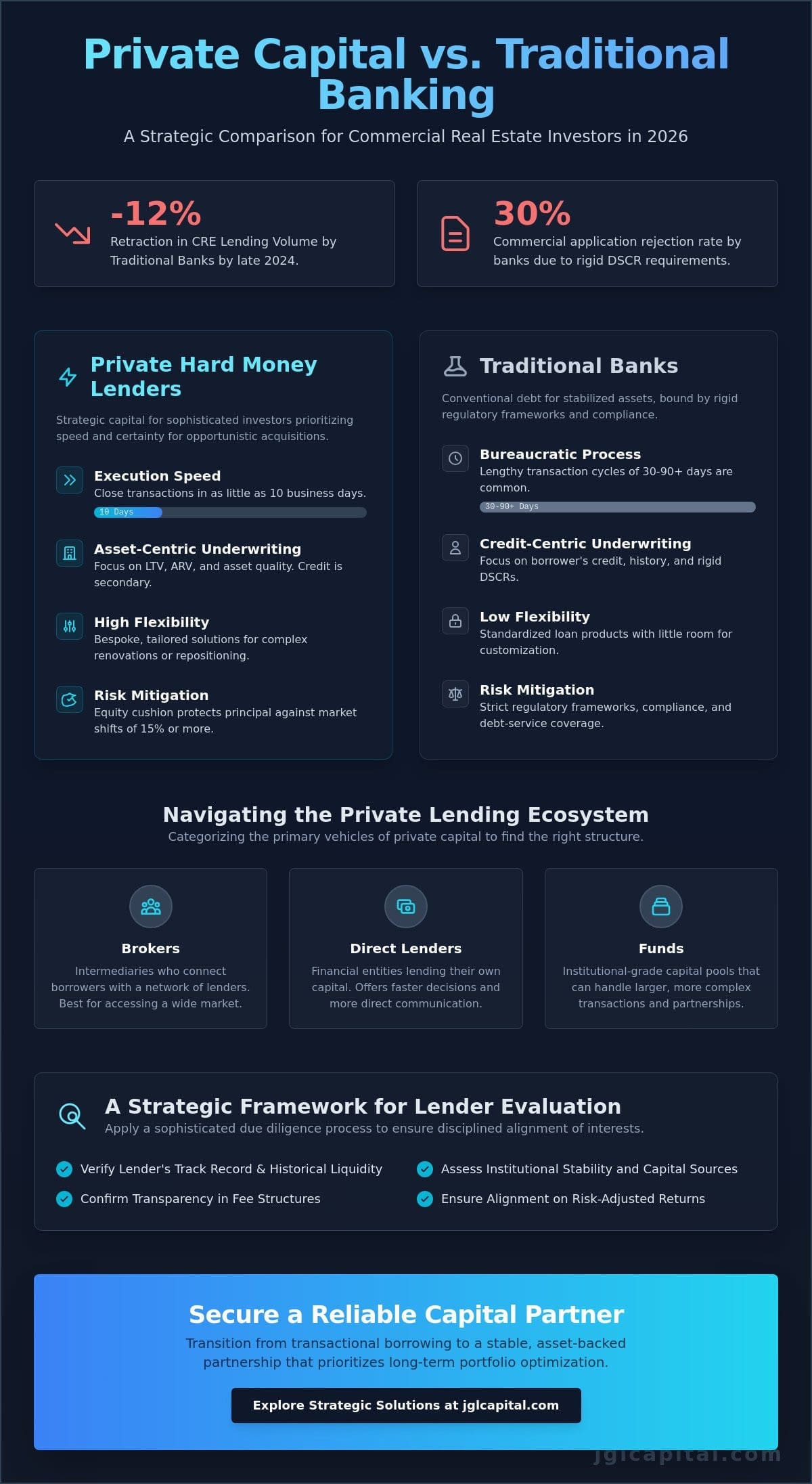
Private hard money lenders operate as specialized, asset-based financial entities that provide transitional capital, serving a function that has matured significantly since the market shifts of 2020. While traditional depository institutions remain tethered to rigid regulatory frameworks and credit-centric underwriting, private capital sources offer a level of flexibility that’s essential for modern portfolio optimization. A Hard money loan traditionally served as a bridge for short-term liquidity; however, by 2026, it’s evolved into a sophisticated instrument for opportunistic acquisition and value creation. This evolution reflects a broader transition in the credit markets where speed and certainty are prioritized over the bureaucratic inertia of conventional banking.
The perception of these loans has transitioned from a “lender of last resort” to a specialized tool for strategic capital allocation. Sophisticated investors, often managing real estate portfolios exceeding $50 million, frequently prioritize execution certainty over the lowest possible interest rate. They recognize that the ability to close a transaction within 10 business days often outweighs the cost of capital, particularly when competing for distressed or high-yield assets in volatile environments. In this context, private hard money lenders act as strategic allies, providing the liquidity necessary to capture market inefficiencies that traditional lenders are structurally unable to address.
The Mechanics of Asset-Backed Private Financing
Underwriting within the private sector follows a collateral-centric logic that stands in stark contrast to the credit-centric models employed by retail banks. Capital access is primarily determined by the following metrics:
- Loan-to-Value (LTV): The ratio of the loan amount to the current appraised value of the asset.
- After-Repair-Value (ARV): The projected valuation of the property following the completion of a specific capital improvement plan.
- Asset Quality: The physical and economic viability of the underlying real estate.
The equity cushion serves as the primary risk-mitigation tool for private lenders, ensuring that the principal remains protected even if market conditions shift by 15% or more during the loan term. This framework allows hard money loans to function as high-leverage solutions for complex renovations or repositioning projects where traditional documentation is insufficient.
Economic Drivers for Private Capital in 2026
Institutional credit tightening, which accelerated in late 2024 following significant regulatory shifts in the banking sector, has created a substantial liquidity gap. Private hard money lenders fill this void by facilitating complex transactions that traditional institutions deem too idiosyncratic or time-sensitive. Statistics from the first quarter of 2026 indicate that 30% of commercial bank applications are now rejected due to rigid debt-service coverage ratio (DSCR) requirements, forcing investors toward more agile alternatives. The shift toward bespoke, tailored financial solutions isn’t merely a trend; it’s a structural response to a market that demands rapid deployment of capital and surgical precision in risk assessment.
Private Hard Money Lenders vs. Traditional Banks: A Comparative Analysis
The divergence between institutional banking and private capital allocation becomes most apparent when evaluating the velocity of transaction cycles. While traditional depository institutions remain anchored to rigid compliance frameworks, private hard money lenders operate with a mandate for agility and precision. This distinction isn’t merely operational; it’s a strategic choice for investors who prioritize the capture of time-sensitive assets. A comprehensive understanding of real estate investing reveals that the higher cost of private capital is often offset by the preservation of equity through rapid execution. Sophisticated partners recognize that while a bank offers lower interest rates, the 60-day delay in funding can result in a total loss of the acquisition opportunity.
Speed of Execution and Decision-Making Latency
Traditional banks typically require a 30 to 60-day window to process commercial or residential investment loans. This latency stems from layered committees and exhaustive document verification. In contrast, the private lending cycle often concludes within 5 to 10 business days. This accelerated timeline transforms the investor’s market position, allowing them to present “all-cash” equivalent offers that carry significant weight in competitive negotiations. By reducing administrative friction, capital stewards can scale portfolios at a pace that traditional debt simply cannot support. The ability to deploy capital with such immediacy is a cornerstone of institutional-grade wealth preservation strategies.
Flexibility in Underwriting and Risk Assessment
The underwriting philosophy of private hard money lenders prioritizes asset performance over the restrictive debt-to-income (DTI) metrics favored by banks. Institutional partners often encounter “broken” properties or non-stabilized assets that fail to meet the standard criteria of conventional lenders. Private capital provides the necessary bridge to stabilize these assets before seeking long-term refinancing.
- Asset-Centric Metrics: Loans are secured based on the collateral’s intrinsic value and projected exit strategy.
- Customized Terms: Repayment structures are tailored to align with the specific milestones of a project.
- Geographic Strategy: Utilizing hard-money lenders Florida allows investors to tap into high-growth corridors where market speed is the primary driver of risk-adjusted returns.
This flexibility ensures that capital remains a tool for growth rather than a bureaucratic hurdle. Investors seeking to optimize their capital stack should consider how a bespoke lending partnership
Navigating the Private Lending Ecosystem: Brokers, Direct Lenders, and Funds
The architecture of private capital is defined by three distinct delivery mechanisms, each serving a specific function within a diversified real estate portfolio. Sophisticated investors distinguish between intermediaries, balance-sheet originators, and structured investment funds to ensure that the chosen vehicle aligns with their specific risk-adjusted return profiles. Identifying the ultimate origin of liquidity is paramount, as the stability of a funding source often dictates the viability of a project during periods of market volatility. Private hard money lenders operate across these varied silos, necessitating a rigorous due diligence process that moves beyond simple interest rate comparisons to examine the underlying capital structure.
The strategic role of hard money loan lenders remains central to sourcing efficient debt structures that prioritize speed and certainty of execution. By categorizing capital into these three primary vehicles, sponsors can better match lender constraints with project requirements. Whether the objective is a rapid bridge for a distressed acquisition or a long-term stabilization of a multi-family asset, the choice of lender structure dictates the level of flexibility and the depth of the partnership throughout the investment lifecycle.
The Strategic Value of Private Money Brokers
Experienced intermediaries act as essential architects of debt, providing institutional partners with access to multiple capital silos through a single, sophisticated point of contact. Brokers provide a layer of strategic oversight that’s particularly valuable when navigating the complex underwriting requirements of multi-family or commercial assets. They don’t just facilitate transactions; they optimize the capital stack by negotiating terms across a broad spectrum of private hard money lenders. This intermediary role is vital for sponsors who require bespoke financing solutions that a single direct lender might lack the mandate to provide.
Direct Lenders and Private Equity Funds
Direct lenders utilize their own balance sheets to deploy capital, a model that frequently results in accelerated timelines and more predictable closing cycles. This contrast is evident when compared to private equity funds, which manage discretionary capital on behalf of limited partners. While funds often provide greater scale for massive developments, the discretionary nature of their capital can introduce variables related to fund life cycles and investor redemptions. Data from the 2024 credit markets indicated that balance-sheet lenders maintained higher funding reliability during mid-year contractions than syndicated vehicles. Evaluating the depth of a lender’s capital reserves is a fundamental component of institutional stewardship, ensuring that the partner possesses the resilience to support the project through every phase of the economic cycle.
A Strategic Framework for Evaluating Private Hard Money Lenders
Selecting a capital partner requires a methodology that transcends superficial rate comparisons. Institutional investors must implement a rigorous due diligence process that prioritizes stability and the preservation of equity over the allure of low-cost, high-leverage offers. This disciplined approach ensures that the chosen financing partner possesses the operational maturity to handle complex real estate transactions without the risk of mid-cycle capital retraction.
Institutional Reliability and Track Record
A lender’s historical performance serves as the primary benchmark for future reliability. Prospective partners should verify the total volume of capital deployed, specifically seeking firms that have successfully funded over 750 transactions or managed upwards of $300 million in debt obligations within the last three fiscal years. Membership in professional bodies, such as the American Association of Private Lenders (AAPL), indicates a commitment to the ethical standards established by the industry’s updated 2024 guidelines. A lender’s behavior during periods of significant market stress, such as the liquidity contraction observed in the third quarter of 2023, represents the ultimate indicator of institutional reliability. Firms that maintained their funding commitments when others retracted demonstrated the operational resilience and balance sheet strength required for long-term strategic oversight.
Transparency and Cost of Capital
The true cost of debt is rarely captured by the nominal interest rate alone. Sophisticated sponsors dissect the “all-in” cost by scrutinizing origination points, processing fees, and the presence of “junk fees” that often inflate the effective annual percentage rate by 150 to 200 basis points. Clear, declarative loan terms are essential for accurate portfolio optimization; any ambiguity in the fine print suggests a fundamental misalignment of interests between the borrower and the lender. When analyzing short-term liquidity options, investors often utilize a what is a bridge loan framework to determine if the capital structure supports the asset’s transitional phase.
Experienced private hard money lenders distinguish themselves by offering partnership value that extends beyond the initial disbursement. This value is found in the lender’s ability to provide bespoke solutions and strategic flexibility during unforeseen project delays. By prioritizing a disciplined approach to capital allocation, sponsors ensure that their financing partners function as strategic allies rather than mere service providers. It’s vital to assess whether the lender’s internal underwriting team understands the specific nuances of the local market, as this expertise often dictates the speed of the closing process.
Optimizing Portfolio Growth through JGL Capital’s Strategic Stewardship
JGL Capital operates as a disciplined steward of capital, distinguishing itself from the broader market through a commitment to analytical rigor and institutional stability. While many private hard money lenders focus on high-volume transactional metrics, this firm prioritizes the long-term health of its partners’ portfolios. This philosophy is rooted in 30 years of market experience, allowing the organization to function as a sophisticated ally rather than a simple source of debt. By aligning interests through a transparent allocation process, the firm ensures that every dollar deployed serves a specific, strategic purpose in the borrower’s wealth preservation strategy.
Bespoke Solutions for Complex Real Estate Projects
Standardized lending models often collapse under the weight of complex, high-stakes developments. JGL Capital addresses this by engineering tailored capital structures specifically designed for new construction and multi-family acquisitions. This process involves more than just providing liquidity; it requires the integration of strategic oversight into the very fabric of loan origination. The firm’s approach ensures that the debt profile remains sustainable throughout the project’s lifecycle, from the initial site preparation to the final stabilization phase.
The efficacy of this methodology is evident in the firm’s recent operational history. Consider these key elements of their bespoke delivery:
- Strategic Liquidity Management: The firm recently resolved a $15 million liquidity constraint for a high-net-worth developer by restructuring bridge financing to align with phased construction milestones.
- Risk-Adjusted Structuring: Every deal undergoes a rigorous stress test to ensure the capital structure can withstand market volatility in 2026.
- Direct Principal Access: Partners communicate directly with decision-makers, eliminating the bureaucratic delays common in traditional institutional environments.
The JGL Capital Commitment to Professionalism
Professionalism in the private lending sector demands a rejection of speculative trends in favor of timeless financial principles. JGL Capital maintains a measured pace of deployment, conducting exhaustive due diligence to protect the integrity of its capital allocations. This disciplined approach provides a sense of security for institutional partners who require certainty of execution in competitive markets. It’s a level of sophistication that goes beyond the capabilities of standard private hard money lenders, offering a foundation for building lasting legacies.
Initiating a partnership begins with a comprehensive evaluation of the project’s fundamentals and the developer’s overarching vision. This initial consultation serves as the basis for a collaborative relationship defined by transparency and mutual respect. For those ready to move from a transactional mindset to a strategic alliance, the path forward is clear. Partner with JGL Capital for your next strategic capital requirement.
Advancing Capital Resilience in the 2026 Credit Environment
The evolution of the credit markets through 2026 demonstrates that securing high-performance liquidity requires a departure from the rigid structures of legacy banking. Investors who prioritize private hard money lenders gain a distinct advantage by accessing flexible, asset-backed solutions. These structures are calibrated for the complexities of commercial and new construction projects. Success depends on a framework of disciplined stewardship and institutional-grade underwriting to ensure every allocation supports long-term portfolio optimization. With over 30 years of specialized expertise, JGL Capital remains a dedicated partner in navigating these sophisticated financial landscapes. We focus on the precise alignment of capital with value-creating opportunities. Our commitment to analytical rigor protects your legacy. It’s through this meticulous approach to risk-adjusted returns that true wealth preservation is achieved. You’re invited to Secure Strategic Capital for Your Next Project with JGL Capital and experience the impact of professional capital allocation. Your vision for growth deserves a foundation built on stability and deep-seated industry knowledge.
Frequently Asked Questions
What is the primary difference between a private hard money lender and a traditional bank?
Private hard money lenders prioritize the intrinsic value of the underlying real estate asset over the borrower’s personal credit history or income. Unlike traditional banks that operate under rigid federal regulations like the Basel III framework, these asset-based financiers offer expedited closing times. This flexibility allows investors to fund non-stabilized commercial assets or fix-and-flip projects that don’t meet conventional lending standards.
How much do private hard money lenders typically charge in interest and fees?
Interest rates from private hard money lenders in 2026 typically range from 8% to 12% based on the risk-adjusted profile of the specific transaction. Lenders also require origination fees, commonly referred to as points, which represent 1% to 3% of the total loan amount. These costs reflect the increased risk and rapid capital deployment required for time-sensitive real estate investments compared to standard mortgage products.
Can I use a hard money loan for a primary residence?
Private hard money lenders don’t provide financing for owner-occupied primary residences because their capital is strictly reserved for business and investment purposes. Using these funds for a personal home is prohibited by federal consumer protection laws, specifically the Dodd-Frank Act and TRID regulations. JGL Capital focuses exclusively on non-owner-occupied projects, such as commercial developments or bridge financing, to support the strategic objectives of institutional investors.
What documentation is required to secure a loan from a private hard money lender?
Securing a loan requires a detailed property summary, a professional appraisal or broker price opinion, and a clearly articulated exit strategy. While banks demand years of tax returns, private lenders prioritize the property’s valuation and the borrower’s track record with similar real estate assets. This streamlined due diligence process focuses on the viability of the project rather than extensive personal financial statements or debt-to-income ratios.
How fast can a private hard money lender fund a deal?
Many private hard money lenders can fund a transaction within 5 to 10 business days, depending on the asset’s complexity and the readiness of the borrower’s documentation. This rapid execution is a critical advantage for investors participating in time-sensitive foreclosure auctions or competitive bidding scenarios. In these high-stakes environments, the ability to close a deal quickly often proves more valuable than securing a lower purchase price through a bank.
Is it better to work with a direct lender or a private money broker?
A direct lender offers a single decision-making point, while a broker like JGL Capital provides access to multiple capital silos for complex project structures. Sophisticated investors often prefer the strategic oversight of a broker because it allows for bespoke capital allocation tailored to a diverse portfolio. This partnership model ensures that the financing structure aligns with long-term wealth preservation goals rather than settling for a single, rigid lending product.