

A 2025 analysis by the Global Real Estate Finance Association revealed that 68% of institutional portfolios experienced yield compression because of capital inconsistencies during mid-cycle market corrections. For the sophisticated investor, the selection of fix and flip lenders isn’t merely a transactional hurdle; it’s a foundational decision that dictates the long-term viability of a risk-adjusted return strategy. You’re likely aware that opaque underwriting and hidden fee structures can erode the precision of even the most disciplined capital allocation model, especially when market shifts demand immediate liquidity. This guide offers a rigorous framework to master the evaluation of high-tier lending partners, ensuring your projects remain insulated from the volatility projected for 2026.
We’ll analyze the essential metrics of transparency and operational stability that transform a simple credit line into a robust strategic alliance. By the conclusion, you’ll possess the analytical tools required to streamline capital deployment across your entire portfolio while securing the stewardship your capital deserves. This systematic approach allows for the preservation of wealth through deliberate, evidence-based partnership selection, moving beyond speculative trends toward a model of enduring fiscal integrity.
Key Takeaways
- Navigate the evolving landscape of asset-backed financing by understanding the critical transition toward institutional private capital within the 2026 market.
- Evaluate the strategic interplay between Loan-to-Cost (LTC) and After-Repair Value (ARV) to enhance capital efficiency and optimize risk-adjusted returns.
- Utilize a comprehensive due diligence checklist to vet fix and flip lenders, focusing specifically on historical fund performance and the stability of their underlying capital structures.
- Scrutinize the transparency of term sheets and final disclosures to ensure a disciplined approach to project underwriting and the mitigation of liquidity risks.
- Position your investment strategy for scalable growth through the application of bespoke financial solutions and rigorous strategic oversight.
The Evolution of Asset-Backed Financing for Sophisticated Property Investors
Fix and flip lending represents a specialized form of short-term, asset-backed bridge financing designed for the rapid acquisition and renovation of distressed residential or commercial assets. As we move through the 2026 fiscal year, the market landscape has shifted decisively toward institutional private capital as the primary source of liquidity for high-velocity projects. This transition reflects a sophisticated maturation of the industry where seasoned investors prioritize lender reliability and certainty of execution over marginal differences in nominal interest rates. In this environment, the most successful practitioners align themselves with institutional fix and flip lenders who offer transparent draw schedules and predictable terms. A strategic lending partner provides the structural support necessary for complex portfolio scaling, whereas a transactional broker often lacks the depth of capital required for sustained growth across multiple markets.
The Role of Private Capital in Modern Real Estate
Private capital serves as the essential engine for liquidity in sectors where traditional banking constraints inhibit rapid deployment. In competitive markets, the ability to close a transaction within 7 to 10 days provides a definitive edge over competitors who are often reliant on 45-day bank cycles. Asset-backed lending is a credit structure that prioritizes the intrinsic value and projected after-repair value of the physical property over the personal credit history of the borrower. This methodology allows Flipping (real estate) professionals to leverage the equity within the asset itself to secure necessary funding without the friction of traditional retail banking. The shift toward institutional-grade private money ensures that capital remains available even when broader debt markets experience volatility.
Why Traditional Bank Financing Fails the Active Investor
Conventional mortgages are governed by rigid regulatory frameworks that prioritize personal debt-to-income ratios, which often restricts an investor’s ability to hold more than 10 financed properties simultaneously. Institutional speed is frequently sacrificed for bureaucratic oversight in these traditional settings, leading to missed opportunities in fast-moving Florida markets. Specialized fix and flip lenders focus on the profitability of the specific project rather than the borrower’s W-2 income. By reducing documentation hurdles, such as the requirement for two years of personal tax returns for every entity owned, these lenders facilitate a more aggressive capital allocation strategy. This streamlined approach is vital for maintaining a competitive posture and ensuring that capital is deployed where it generates the highest risk-adjusted returns. Understanding the strategic myths surrounding home flipping loans becomes essential for investors seeking to optimize their capital deployment in 2026.
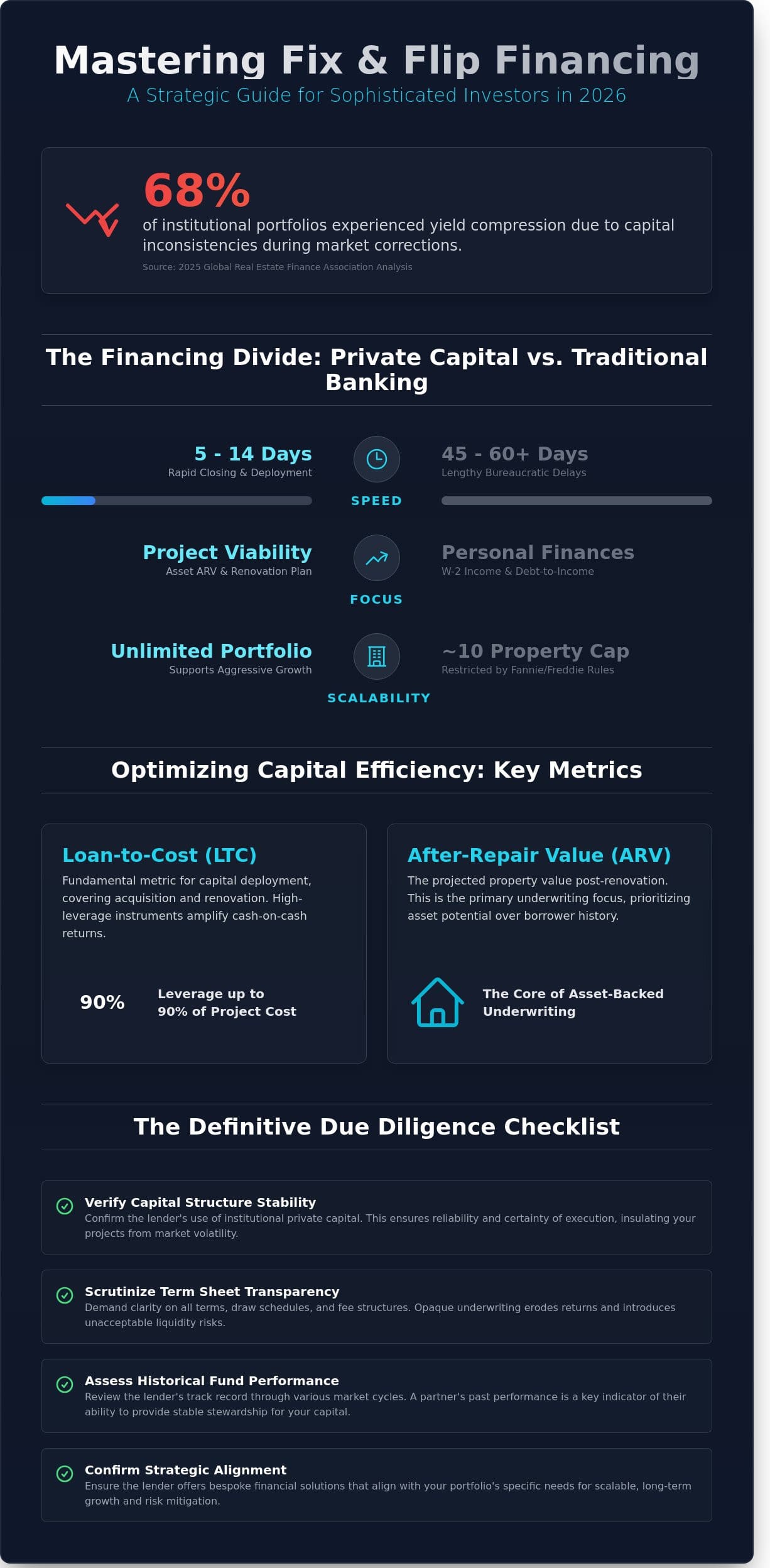
- Speed of Execution: Funding typically occurs in 5 to 14 days compared to 45 to 60 days for banks.
- Underwriting Focus: Emphasis is placed on the After Repair Value (ARV) and renovation feasibility.
- Scalability: Borrowers aren’t limited by the same “number of loans” caps found in Fannie Mae or Freddie Mac guidelines.
Strategic Leverage: Optimizing Capital Efficiency through LTC and ARV
In the 2026 credit environment, sophisticated investors prioritize the optimization of liquidity through precise capital allocation. Professional fix and flip lenders evaluate projects based on the delicate interplay between immediate capital requirements and projected asset appreciation. By utilizing high-leverage instruments, which frequently reach 90% of the acquisition price, developers can significantly amplify their cash-on-cash returns. This strategic use of debt allows for the preservation of internal capital for simultaneous acquisitions; however, it requires a disciplined analysis of risk-adjusted return profiles to ensure that debt service obligations don’t compromise the project’s solvency during the renovation phase.
Mastering Loan-to-Cost (LTC) Ratios
LTC serves as the fundamental metric for initial capital deployment because it quantifies the lender’s exposure relative to the total project investment. Modern structures that include 100% rehab funding accelerate timelines by removing the friction of incremental capital calls, allowing projects to reach the market 15% faster than those relying on staggered draws. To manage a multi-property portfolio with precision, investors utilize the following formula to calculate effective leverage: (Total Debt across all Assets) / (Total Acquisition Costs + Total Renovation Budgets) = Effective Portfolio Leverage. Maintaining an effective leverage of 85% or higher across five or more concurrent projects requires a partner capable of Understanding Fix and Flip Loans and their underlying security requirements within the broader institutional framework.
The Significance of ARV in Portfolio Growth
The After-Repair Value (ARV) represents the terminal value of the asset and dictates the viability of the eventual exit strategy. Professional underwriting in 2026 relies on a combination of granular algorithmic data and local market appraisals to verify these projections with a 98% accuracy rate. This rigorous valuation methodology ensures that the loan remains secured against a realistic market price, protecting both the lender and the investor from market volatility. For a deeper analysis of these dynamics, investors should consult the comprehensive guide on Fix and Flip Loans in Florida. Aligning with fix and flip lenders who prioritize analytical accuracy over speculative trends is essential for long-term wealth preservation. Investors seeking to scale their operations through a disciplined capital partner will find that precision in ARV estimation is the most reliable predictor of portfolio health.
Critical Differentiators: Assessing Lender Reliability and Underwriting Rigor
The primary concern for sophisticated real estate operators involves the inherent volatility of many fix and flip lenders. In a market where timing dictates the internal rate of return, a lender’s failure to fund can jeopardize an entire portfolio’s performance. Discriminating investors must look beyond top-line interest rates to evaluate the underlying structural integrity of their financial partners. This requires a rigorous analysis of capital origins and operational capacity. True partnership requires a commitment that extends past the closing table, ensuring that the lender’s liquidity remains robust even when broader market conditions tighten.
The Stability of Capital Sources
A lender’s reliability is inextricably linked to its capital stack. Many firms rely on warehouse lines of credit, which are subject to the restrictive covenants and liquidity whims of larger banking institutions. During the market disruptions of 2022, several such entities paused originations overnight because their credit lines were frozen or subject to margin calls. Conversely, lenders utilizing discretionary capital or permanent equity vehicles maintain autonomy over their deployment decisions. This distinction is vital for those seeking Regulatory Exemptions for Commercial Loans, as these business-purpose facilities require a level of certainty that retail-oriented platforms cannot provide. The lowest interest rate frequently masks the highest execution risk, as capital that is priced below market equilibrium often lacks the structural resilience to withstand volatility.
Streamlining the Rehab Draw Process
Operational efficiency during the renovation phase determines the project’s ultimate velocity. Identifying the best fix and flip lenders involves assessing their ability to execute 48-hour draw turnarounds. When a lender maintains in-house servicing, they eliminate the friction of third-party intermediaries who don’t share the investor’s sense of urgency. Transparent inspection protocols prevent the administrative bottlenecks that often lead to contractor attrition. Beyond the initial points, investors should demand a comprehensive schedule of fees, including:
- Third-party legal and documentation expenses.
- In-house processing and underwriting fees.
- Draw inspection and wire transfer charges.
Precision in these details ensures that capital allocation remains focused on value creation rather than unexpected soft costs. A disciplined steward of capital provides a clear roadmap for every disbursement, allowing the borrower to manage their workforce with confidence. This level of strategic oversight is what separates institutional-grade partners from mere transactional providers.
The Definitive Due Diligence Checklist for Selecting a Lending Partner
Selecting a capital partner requires a level of analytical rigor that extends far beyond a simple interest rate comparison. Sophisticated investors recognize that the efficacy of fix and flip lenders is measured by their ability to provide reliable strategic oversight and liquidity throughout the 12 to 18-month project lifecycle. You must conduct a granular audit of the lender’s previous 24 months of funding activity to ensure they possess the institutional stability required for high-stakes Florida real estate. A lender’s history of successfully funded deals, particularly those exceeding $1,000,000 in total capitalization, serves as a primary indicator of their operational competence.
Transparency remains the cornerstone of any professional partnership. You’ll need to meticulously reconcile the preliminary term sheet with the final closing disclosures to identify any discrepancies in the capital allocation structure. Professional fix and flip lenders operate with a commitment to clarity, ensuring that interest-only structures and draw schedules are defined with mathematical precision. This disciplined approach eliminates the risk of predatory administrative costs, which can unexpectedly erode 3% to 5% of a project’s projected net margin if left unvetted.
The Institutional Audit: Lender Reputation
A comprehensive background check on the private money brokerage’s leadership is non-negotiable for serious capital preservation. You should examine the executive team’s history for at least 10 years of consistent performance in credit markets. Red flags often manifest as a lack of clarity in commitment letters or a history of re-trading terms 48 hours before a scheduled closing. High-volume institutional investors, specifically those managing portfolios of 15 or more active assets, provide the most reliable references regarding a lender’s ability to maintain stewardship over complex draw processes.
Technical Term Evaluation Checklist
The cost of capital must be analyzed over the full duration of the loan, including any potential extension periods. It’s vital to evaluate the following technical components:
- Prepayment Penalties: Verify if the lender imposes a minimum interest period, which can penalize investors who achieve an early exit within 4 or 5 months.
- Extension Flexibility: Ensure that extension options are codified in the original loan documents; these should typically cost no more than 1% of the principal balance per 90-day period.
- Underwriting Alignment: Confirm that the lender’s valuation methodology aligns with current 2024 market data to prevent a capital shortfall during the acquisition phase.
To secure a partnership grounded in analytical rigor and transparent capital allocation, investors should consult with the strategic advisors at JGL Capital to discuss bespoke financing solutions.
JGL Capital: Facilitating Strategic Growth Through Bespoke Private Lending
JGL Capital LLC operates as a disciplined steward of capital; the firm leverages over 30 years of specialized expertise to provide liquidity in complex real estate markets. While many fix and flip lenders prioritize volume, JGL Capital LLC maintains a focus on strategic oversight and asset-backed lending principles that ensure risk-adjusted returns for all stakeholders. The firm’s approach to loan origination for residential and multi-family projects isn’t transactional; it’s an exercise in analytical precision. Every capital allocation decision reflects a commitment to integrity and the preservation of wealth through rigorous due diligence. This institutional perspective ensures that capital is deployed where it can generate the most significant impact on a developer’s portfolio. By prioritizing the long-term health of an investment over short-term gains, the firm establishes itself as a quiet expert in the field of private credit.
A Legacy of Financial Stewardship
The organization’s commitment to building lasting legacies is evident in its institutional-grade processing capabilities and national reach. This infrastructure allows developers to scale operations with confidence; it’s particularly vital for those seeking new construction loans to expand their portfolios beyond traditional renovations. By aligning interests with institutional partners, JGL Capital LLC ensures that every project receives the strategic depth required for long-term success. The firm has successfully managed diverse portfolios across multiple market cycles, proving its resilience and unwavering focus on portfolio optimization. This track record provides high-net-worth individuals and institutional partners with the security of knowing their capital is managed by a team that values deliberate, calculated action rather than speculative trends.
Initiating a Strategic Partnership
Professional investors benefit from a streamlined application process that respects the urgency of the Florida market. A dedicated loan advisor oversees every phase of the deal; they provide the clarity needed to navigate complex capital structures. This bespoke service model distinguishes JGL Capital LLC from standard fix and flip lenders by offering tailored solutions rather than rigid products. The underwriting team evaluates each asset based on its intrinsic value and potential for appreciation, ensuring that the financing matches the project’s lifecycle. It’s a process defined by transparency and a rejection of fleeting industry buzzwords. Investors ready to discuss capital allocation for their next acquisition should contact the firm’s advisory team to begin the underwriting process and secure a partnership grounded in stability and analytical rigor.
Securing Strategic Advantage in the 2026 Credit Markets
As the 2026 fiscal landscape necessitates higher levels of analytical rigor, the selection of a financing partner dictates the ultimate ceiling of your portfolio’s risk-adjusted returns. Sophisticated investors understand that capital efficiency depends on a lender’s ability to integrate precise LTC and ARV valuations into a seamless underwriting framework. By prioritizing institutional stability and a proven track record of disciplined stewardship, you ensure that your capital allocation remains resilient against market volatility. Identifying the most reliable fix and flip lenders involves more than a cursory review of rates; it requires a deep dive into the underwriting rigor and capital depth that only a seasoned partner provides. JGL Capital offers this level of sophistication, backed by over 30 years of industry expertise and a streamlined asset-based approach that serves a national footprint. We’re dedicated to the alignment of interests and the delivery of bespoke solutions that respect the complexity of your strategic objectives. Secure your next strategic investment with JGL Capital’s bespoke lending solutions. We look forward to facilitating your continued growth and preserving the legacy you’ve built.
Frequently Asked Questions
What are the typical interest rates for fix and flip loans in 2026?
Interest rates for fix and flip loans in 2026 typically range from 9.5% to 13.5% based on the Federal Reserve’s projected 2025 terminal rate of 4.25%. These rates reflect the risk-adjusted returns required by institutional capital in the Florida market. Borrowers with a track record of five or more successful exits often secure rates at the lower end; meanwhile, first-time investors might see points ranging from 1.5% to 3.0%.
How do fix and flip lenders calculate the After-Repair Value (ARV)?
Fix and flip lenders calculate the After-Repair Value (ARV) by conducting a forensic analysis of comparable sales within a 0.5-mile radius that have sold within the last 180 days. This valuation process incorporates the projected cost of improvements, requiring a detailed line-item budget to ensure the finished asset aligns with local market demands. Professional appraisers utilize the sales comparison approach to determine a precise terminal value, ensuring the loan-to-value ratio remains below 75%.
Is a down payment always required for a private money flip loan?
A down payment is standard in private money lending, typically requiring the borrower to contribute 10% to 20% of the purchase price as a demonstration of capital alignment. It’s rare to find 100% financing unless you’re an experienced developer with over 10 successful exits. Most institutional partners mandate this minimum equity stake to ensure that the interests of the borrower and the lender remain synchronized throughout the project’s lifecycle.
Can I get a fix and flip loan with a low credit score?
You can obtain financing with a credit score as low as 620, provided the underlying asset demonstrates substantial equity and a clear path to profitability. Institutional lenders don’t focus exclusively on FICO scores, as they prioritize the property’s intrinsic value and the borrower’s liquidity. If your score falls below the 680 threshold, the lender may adjust the interest rate by 100 to 200 basis points to offset the perceived risk profile.
What is the difference between a hard money lender and a private money broker?
A hard money lender provides capital directly from their own balance sheet, whereas a private money broker acts as an intermediary to facilitate connections between borrowers and various capital sources. Direct fix and flip lenders offer greater certainty of execution and streamlined decision-making processes since they maintain strategic oversight of their own funds. Brokers may provide access to bespoke products, but they often add an additional layer of fees, typically 1% to 2%.
How quickly can a fix and flip lender provide funding for a deal?
A professional fix and flip lender can provide funding in as few as 7 to 10 business days once a clear title and an acceptable appraisal are secured. This expedited timeline is essential for securing distressed assets in competitive markets like Miami or Orlando. By utilizing standardized due diligence protocols, these firms bypass the 45-day processing cycles common in traditional banking, allowing investors to capitalize on immediate market opportunities.
What documents are required to apply for asset-backed real estate financing?
Applying for asset-backed financing requires a detailed renovation budget, a signed purchase contract, two months of corporate bank statements, and a comprehensive entity organizational chart. Lenders also require a professional resume detailing your real estate experience. Providing these documents in a structured digital format allows the underwriting team to conduct a thorough risk assessment and confirm that your capital allocation strategy is viable for the specific Florida submarket.
Do fix and flip lenders provide funding for the renovation costs?
Most fix and flip lenders provide funding for 100% of the renovation costs, which are typically disbursed through a series of structured draws as specific milestones are reached. The lender holds these funds in an escrow account, releasing capital only after a third-party inspector verifies that 100% of the scheduled work is complete. This disciplined approach ensures that the project remains on schedule and that the capital effectively enhances the property’s market value.