

A non-warrantable designation is frequently a reflection of rigid institutional bureaucracy rather than a true assessment of a property’s underlying intrinsic value. For the disciplined investor, a standard mortgage rejection often stems from factors entirely outside their control, such as a condo association’s failure to meet the August 2026 mandate requiring reserve studies to follow the highest recommended funding levels. It’s frustrating to watch a high-yield opportunity vanish because a traditional lender prioritizes rigid debt-to-income ratios over the actual performance of the asset.
This guide serves as a comprehensive resource on how to get a loan for a non-warrantable condo by utilizing private, asset-backed capital that aligns with your strategic growth objectives. You’ll discover how to bypass the constraints of institutional underwriting and secure reliable funding for non-conforming properties when speed is paramount. We will analyze the impact of the recent elimination of the Limited Review process and detail the specific bridge and rental loan structures that allow sophisticated partners to scale their portfolios with precision and confidence.
Key Takeaways
- Understand the technical parameters that classify properties as non-warrantable and why it’s standard for traditional institutions to perceive these assets as high-risk liabilities.
- Identify the specific operational triggers, such as single-entity ownership concentration, that necessitate specialized capital solutions when conventional banks won’t provide liquidity.
- Learn to pivot from borrower-centric underwriting to asset-backed evaluation, utilizing bridge and commercial real estate loans to unlock value in non-conforming developments.
- Master the precise sequence of financial due diligence required to determine how to get a loan for a non-warrantable condo by matching specific property triggers with appropriate private capital sources.
- Recognize the importance of institutional-grade expertise and disciplined underwriting when you’re navigating complex acquisitions that fall outside the purview of conventional banking.
Defining the Non-Warrantable Condo Dilemma in 2026
The concept of warrantability is a cornerstone of the secondary mortgage market, serving as a filter for the risk profile of a condominium project. A unit is classified as warrantable when it adheres to the stringent eligibility requirements established by Government-Sponsored Enterprises (GSEs), primarily Fannie Mae and Freddie Mac. When a development fails to meet these granular standards, it becomes non-warrantable, effectively severing its connection to conventional liquidity. This classification isn’t necessarily an indictment of the property’s physical integrity or market demand. Instead, it’s often a result of administrative or financial non-compliance with institutional mandates. In the current market, this distinction is critical for those determining how to get a loan for a non-warrantable condo without sacrificing their investment timeline.
The Role of Fannie Mae and Freddie Mac
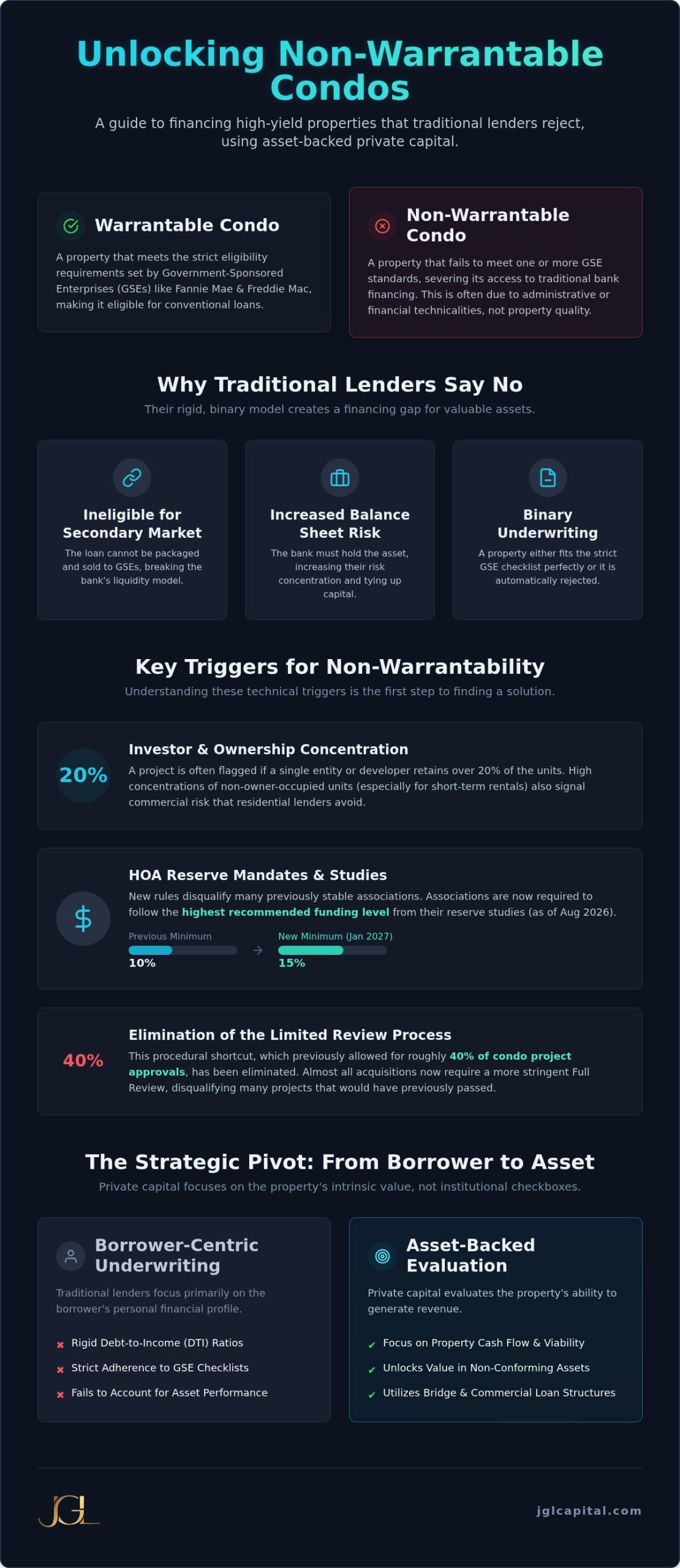
Local banks typically operate as conduits for the secondary market, relying on the ability to package and sell loans to GSEs to maintain their capital reserves. The introduction of the Uniform Appraisal Dataset and recent policy shifts have intensified this dependency. As of August 3, 2026, the elimination of the Limited Review process means that almost all acquisitions now require a Full Review or a specific Waiver of Project Review. This shift removes the procedural shortcuts that previously allowed for roughly 40% of condo project approvals. Additionally, the new requirement for reserve studies to follow the highest recommended funding level, rather than baseline levels, has disqualified many associations that were previously considered stable. For detailed regional guidance, A and N Mortgage Services, Inc. offers a specialized look at building warrantability and loan approval processes in Illinois.
Why Traditional Lenders Decline These Assets
Conventional institutions view non-warrantable units as high-risk liabilities because they cannot be offloaded to the secondary market. If a bank cannot sell the loan, the asset must remain on their balance sheet, which increases their risk concentration and consumes capital that could be deployed elsewhere. This rigidity is compounded by the upcoming January 4, 2027, mandate increasing minimum HOA reserve allocations from 10% to 15%. Traditional underwriting is binary; a property either fits the GSE box or it doesn’t. This lack of flexibility creates a financing gap for sophisticated investors who recognize the value of an asset despite its bureaucratic non-compliance. Private capital bridges this divide by focusing on the underlying worth of the real estate rather than the association’s paperwork. By prioritizing property performance over institutional checkboxes, investors can secure the capital necessary to capitalize on these overlooked opportunities.
Identifying Criteria That Trigger Non-Warrantability
The transition from a warrantable asset to a non-conforming liability is often precipitated by a series of identifiable financial and operational triggers. While the physical property may remain in excellent condition, technical non-compliance with GSE mandates creates a barrier that traditional banks aren’t equipped to cross. Understanding how to get a loan for a non-warrantable condo requires a shift in perspective from credit-based to asset-based evaluation. This is especially true when an association’s financial structure or tenant mix deviates from the rigid standards of conventional institutional underwriting.
Investor Concentration and Rental Ratios
One primary catalyst for a non-warrantable designation is the concentration of ownership within a single development. Although Fannie Mae retired the specific 50% investor concentration limit on March 18, 2026, many local institutions still utilize this benchmark to assess risk. High percentages of non-owner-occupied units, particularly those dominated by short-term rental (STR) activity, signal a commercial nature that traditional residential lenders avoid. When a developer retains over 20% of the units or a single entity acquires a dominant stake, the resulting concentration of risk often triggers an automatic rejection. A portfolio lender that offers non-warrantable condo loans will typically look beyond these binary ratios to evaluate the property’s actual cash flow and market viability.
Structural and Financial Health of the Association
The financial discipline of the condo association is under greater scrutiny than ever before. Associations must now prepare for the January 4, 2027, mandate that increases minimum reserve allocations from 10% to 15% of the annual budgeted assessment income. Failure to meet these thresholds, or the presence of high delinquency rates among unit owners, immediately disqualifies the project from conventional funding. Other common triggers include:
- Commercial Space Allocation: Developments where more than 35% of the total square footage is dedicated to commercial use.
- Condotel Characteristics: Properties that offer daily rentals, check-in desks, or other hotel-like services.
- Ongoing Litigation: Legal disputes involving the association or the developer that create unquantifiable financial exposure.
- Right of First Refusal: Restrictive clauses in the association’s bylaws that impede a lender’s ability to liquidate the asset.
Banks avoid ambiguity. When these complexities arise, investors need a partner capable of conducting deep-level due diligence to find a path forward. For those managing institutional-grade acquisitions, partnering with a private money broker provides the necessary agility to overcome these hurdles and secure capital based on the property’s intrinsic worth.
Strategic Financing Alternatives: Portfolio and Asset-Backed Lending
The transition from institutional rejection to successful acquisition requires a fundamental shift in capital strategy. While traditional banks remain tethered to borrower-centric underwriting, professional investors prioritize asset-backed evaluation to overcome the hurdles of non-conforming properties. This approach focuses on the intrinsic value and income-generating potential of the real estate rather than the rigid debt-to-income metrics that often disqualify sophisticated borrowers. For those determining how to get a loan for a non-warrantable condo, the solution lies in private capital sources that view these assets through a commercial lens.
Utilizing commercial real estate loans allows for a more nuanced assessment of property performance. These vehicles are designed for complexity, accommodating projects with high investor concentration or significant commercial footprints. When an asset requires immediate stabilization, bridge loans provide the necessary liquidity to secure the property while the investor addresses the specific triggers of non-warrantability. This transitional capital is essential for maintaining momentum in a competitive market where institutional delays often result in lost opportunities.
DSCR Loans for Non-Warrantable Condos
Debt Service Coverage Ratio (DSCR) loans have emerged as a primary instrument for financing non-conforming units. In this underwriting model, the property’s ability to cover its own debt obligations via rental income takes precedence over personal tax returns. Private lenders typically require a minimum DSCR of 1.0 to 1.25, ensuring the asset remains self-sustaining. While down payments for non-warrantable condos often range from 20% to 30%, the flexibility in personal credit requirements provides a distinct advantage for investors scaling large portfolios. This focus on cash flow allows for a more accurate reflection of the investment’s viability.
The Advantages of Private Money Brokerage
Navigating the fragmented landscape of non-QM and portfolio lending requires a partner with deep-seated institutional relationships. A private money broker acts as a strategic steward, providing access to a diverse network of capital sources that traditional depository institutions cannot reach. This collaborative model ensures that loan terms are meticulously aligned with the investor’s long-term objectives. By bypassing the bureaucratic red tape of standard banks, investors gain the agility needed to execute complex transactions with precision. Professional brokerage services transform a transactional hurdle into a sophisticated capital alliance, fostering the preservation of value across a diverse real estate portfolio.
The Step-by-Step Path to Securing a Non-Warrantable Loan
Securing capital for non-conforming assets requires a methodical approach that mirrors institutional-grade due diligence. It’s not about finding a loophole. It’s about presenting a case where property performance justifies the risk. Understanding how to get a loan for a non-warrantable condo involves more than a simple application. It demands a strategic alliance with capital partners who prioritize asset value over bureaucratic compliance. Precision is paramount. Speed defines the outcome.
The process begins with a meticulous audit of the association’s financial health. Investors must identify the specific trigger, whether it’s a lack of reserve funding or a high concentration of single-entity ownership, to match the property with the appropriate source of capital. This alignment ensures that the funding solution is tailored to the asset’s unique risk profile. By isolating the reason for the non-warrantable status, you can present a targeted mitigation strategy to private underwriters who value clarity and transparency.
Documenting the Opportunity
A compelling loan package is built on transparency and analytical depth. You’ll need the condo questionnaire, the association’s annual budget, and the master insurance policy to provide a clear picture of the project’s stability. Crafting a sophisticated executive summary is essential for high-stakes real estate investing deals. This document should articulate the property’s cash flow potential and its relative position in the local market. A professional appraisal is equally vital. It must recognize market value based on actual performance rather than the restrictive guidelines of government-backed entities.
Navigating the Underwriting Process
Private underwriters evaluate complexities, such as ongoing litigation or excessive commercial footprints, with a focus on risk mitigation rather than outright avoidance. Their disciplined approach allows for a more nuanced interpretation of financial documents. In an asset-backed lending environment, the approval timeline is significantly compressed compared to traditional institutions. While a bank might take months to review a complex file, private capital can often provide a commitment in a fraction of the time. Finalizing terms requires a clear understanding of interest rates and points, but more importantly, a defined exit strategy. Investors should align with a private money broker to ensure the loan structure supports long-term portfolio growth and the preservation of value.
JGL Capital LLC: Institutional Expertise in Complex Condo Financing
JGL Capital LLC operates as a disciplined steward for investors navigating the technical hurdles of non-conforming assets. With over 30 years of industry expertise, the firm provides the analytical rigor necessary to secure funding when traditional banks decline. Our institutional approach is particularly vital when determining how to get a loan for a non-warrantable condo, as these transactions require a level of sophistication that goes beyond standard retail lending. We specialize in high-stakes capital allocation, focusing on transactions that exceed 10 million dollars, ensuring that every strategic objective is met with precision. This commitment to stability is evident in our handling of complex new construction loans and large-scale multi-family projects.
Customized Capital Solutions
The firm prioritizes the alignment of objectives through highly customized, individual solutions that address the specific needs of sophisticated partners. By emphasizing property value over personal credit scores, JGL Capital LLC empowers investors to leverage the intrinsic worth of their assets rather than relying on rigid institutional metrics. Our bridge loans and rental property loans are structured to provide the liquidity necessary for rapid acquisition and stabilization. This focus on asset-backed lending allows for the generation of worth in markets where traditional financing has become inaccessible. We view our role not merely as a service provider, but as a collaborative ally dedicated to building lasting legacies through strategic real estate financing. Every transaction is treated with the gravity it deserves, ensuring that your portfolio growth remains steady and disciplined.
National Reach with Institutional Standards
As a seasoned private money broker, JGL Capital LLC functions as a strategic ally across the United States, providing a robust alternative to the bureaucratic delays of traditional depository entities. We understand that sophisticated investors require more than just capital; they need a partner who understands the nuances of how to get a loan for a non-warrantable condo in a shifting regulatory environment. Our streamlined underwriting process maintains institutional standards while offering the agility required for complex acquisitions. This national reach, combined with our deep-seated history and intellectual capital, ensures that our partners can execute their strategies with confidence. By framing our activities as a form of high-level strategic alliance, we ensure that every acquisition is supported by a foundation of integrity and long-term vision. It’s time to initiate your high-value acquisition with a partner that values precision and performance above all else.
Advancing Your Portfolio Through Strategic Capital Alliances
JGL Capital LLC stands as a disciplined steward for those managing high-stakes acquisitions. With over 30 years of industry expertise and an asset-backed underwriting philosophy, we specialize in 10 MIL+ strategic loans that traditional lenders simply aren’t equipped to handle. Our role is to provide the stability and analytical rigor necessary to preserve and generate worth across your real estate portfolio. Secure Institutional Capital for Your Next Condo Acquisition with JGL Capital LLC and align your objectives with a partner that values long-term integrity. It’s time to transform complex property hurdles into a foundation for lasting legacy.
Frequently Asked Questions
What exactly makes a condo non-warrantable in the 2026 market?
A property is classified as non-warrantable when it fails to adhere to the technical eligibility requirements established by GSEs. In the 2026 climate, this often results from associations failing to meet the August 3 mandate requiring reserve studies to follow the highest recommended funding levels. Other triggers include single-entity ownership exceeding 20% or commercial space allocations that surpass the standard 35% threshold, effectively disqualifying the asset from conventional secondary market liquidity.
Can I get a DSCR loan for a non-warrantable condo unit?
Yes, utilizing a DSCR loan is a primary strategy for those determining how to get a loan for a non-warrantable condo. This underwriting model prioritizes the property’s rental income potential over the borrower’s personal financial history. Private capital sources typically require a minimum coverage ratio between 1.0 and 1.25, ensuring the asset generates sufficient liquidity to service its own debt obligations independently of the investor’s credit profile or debt-to-income ratio.
How do interest rates for non-warrantable loans compare to traditional mortgages?
Interest rates for non-conforming condo loans are typically higher than those found in the conventional mortgage market. This premium reflects the increased risk concentration that private lenders must maintain on their balance sheets since these loans cannot be sold to Fannie Mae or Freddie Mac. As of August 2026, rates for these specialized products often begin near 6.99%, though final pricing depends on the specific risk triggers and the asset’s overall performance metrics within the current market.
Is it possible to finance a condo that is currently involved in litigation?
Financing remains accessible for properties involved in litigation through specialized asset-backed capital sources. While traditional banks issue automatic rejections for any project with pending legal disputes, private underwriters conduct a granular analysis of the litigation’s financial implications. If the legal exposure is quantifiable and does not threaten the structural integrity of the project, a bridge or rental property loan can be structured to facilitate the acquisition, providing the liquidity necessary for sophisticated investors to move forward.
What is the maximum LTV typical for a private non-warrantable condo loan?
Maximum Loan-to-Value (LTV) ratios for non-warrantable units generally range between 70% and 80%. This requirement necessitates a down payment of 20% to 30%, which serves as a protective equity cushion for the lender. These thresholds ensure that the investor remains deeply committed to the asset’s long-term performance, reflecting the disciplined underwriting standards required for properties that fall outside the purview of government-backed financing programs and institutional depository mandates.
How long does it take to close a bridge loan for a non-warrantable property?
Bridge loans for non-conforming assets typically close within a streamlined timeframe of two to four weeks. This pace is significantly faster than the institutional underwriting cycles of traditional depository banks, which often require months for a full project review. Private money brokers prioritize speed and analytical precision, allowing sophisticated partners to capitalize on time-sensitive opportunities without the delays associated with bureaucratic red tape or the rigid secondary market compliance standards of traditional institutions.
Do I need to provide personal tax returns for an asset-backed condo loan?
Providing personal tax returns is generally not required for asset-backed condo loans. Private capital sources focus their due diligence on the property’s intrinsic value and its capacity to generate consistent cash flow. This shift from borrower-centric to property-centric underwriting allows investors to scale their portfolios without the rigid debt-to-income constraints that often lead to rejections at traditional banks. The asset serves as the primary security for the transaction, emphasizing property performance over personal income.
Can a non-warrantable condo eventually become warrantable again?
A property can regain warrantable status if the condo association rectifies the specific issues that triggered the initial non-conforming designation. This process usually involves increasing HOA reserve allocations to meet the 15% mandate or resolving outstanding litigation that previously deterred traditional lenders. Once the association aligns its financial and operational structures with current GSE requirements, the units may once again qualify for conventional financing, potentially allowing the investor to refinance into traditional debt at lower rates.