

In the current capital environment, the true cost of land acquisition is measured not by the interest rate, but by the opportunity cost of institutional inertia. Many developers find that traditional banking structures, characterized by rigid underwriting and protracted approval cycles, are fundamentally misaligned with the temporal demands of high-stakes development. It’s a common frustration to see a viable project stalled because a lender requires utility access before considering a commitment, or demands down payments that deplete the very liquidity needed for future construction.
This guide provides a rigorous analysis of private capital allocation, demonstrating how sophisticated commercial land development loans can provide the transitional leverage necessary to secure raw or improved parcels. We’ll explore the strategic deployment of asset-backed financing to bridge the gap between acquisition and permanent funding. By examining the disciplined stewardship of capital and the nuances of 2026 market conditions, you’ll gain the clarity required to navigate complex underwriting landscapes and secure the foundational assets of your next legacy project.
Key Takeaways
- Distinguish between consumer-grade lot loans and commercial-grade acquisition capital to ensure your financing structure aligns with high-stakes development objectives.
- Evaluate the specific risk profiles and capital requirements associated with raw, unimproved, and improved land assets to optimize your resource allocation.
- Leverage private capital to navigate the institutional liquidity gap, utilizing commercial land development loans to secure time-sensitive opportunities that traditional banks often overlook.
- Shift the underwriting focus from personal credit metrics toward project viability and comprehensive exit strategies to facilitate more favorable financing terms.
- Discover how a disciplined partnership with a seasoned capital steward can bridge the gap between acquisition and construction while preserving essential liquidity for development costs.
Understanding the Strategic Nuances of Land Acquisition Financing
A land loan represents a specialized category of financing designed to facilitate the acquisition of undeveloped property, serving as the foundational layer of a project’s capital stack. Unlike consumer lot loans, which are tailored for individuals seeking to build primary residences, commercial land development loans are sophisticated financial instruments structured for professional entities focused on value creation through transformation. Within the broader lifecycle of real estate development, these loans provide the essential bridge between initial site identification and the commencement of vertical construction, allowing developers to lock in strategic positions before full entitlements are secured. It’s a method of securing control over a future asset while maintaining the flexibility required for the pre-development phase.
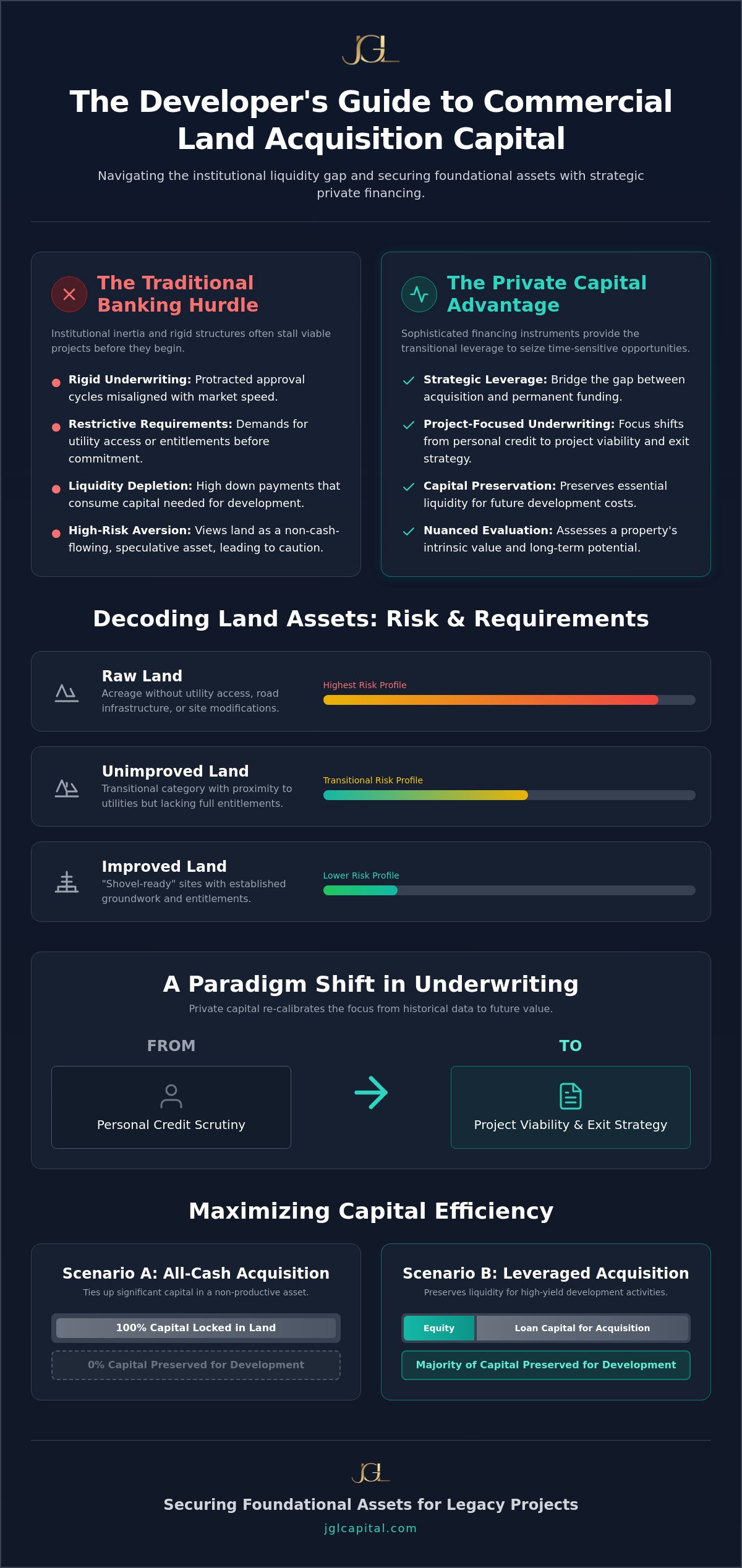
Institutional banks historically view land as a high-risk asset class due to its inherent lack of immediate cash flow and the speculative nature of future market demand. Because raw land doesn’t generate income to service debt, traditional lenders often treat these requests with significant caution, applying conservative underwriting standards that favor stabilized assets. This institutional hesitation creates a liquidity gap that private capital is uniquely positioned to fill, offering a more nuanced evaluation of a property’s intrinsic value and its long-term development potential. By utilizing a commercial mortgage framework tailored for acquisition, developers can navigate these institutional barriers while maintaining the momentum required for high-stakes projects.
The Economic Rationale for Land Financing
The strategic deployment of debt for land acquisition is primarily a function of capital efficiency. By securing commercial land development loans for the initial purchase, developers preserve their liquid capital for high-yield development activities such as site work, engineering, and architectural design. This approach allows for the preservation of internal rates of return by minimizing the equity locked in non-productive assets during the pre-development phase. Establishing land equity early in the process creates a robust foundation to secure future construction tranches, as the appreciated value of the land can often satisfy equity requirements for subsequent financing. Leveraging these assets effectively mitigates the significant opportunity cost associated with all-cash acquisitions, ensuring that capital remains available for unforeseen contingencies or additional acquisitions.
Risk Mitigation and Asset Evaluation
Lenders specializing in land acquisition conduct a rigorous assessment of the property’s intrinsic value, focusing heavily on the path of progress and the current state of entitlements. The impact of zoning and entitlement status on loan viability can’t be overstated, as a property with “by-right” development capabilities represents a significantly lower risk profile than raw acreage requiring a comprehensive rezoning process. The liquidity discount is a reduction in the appraised value of an asset to account for the extended duration and high transaction costs required to convert raw land into cash in an illiquid market. To manage this risk, disciplined stewards of capital evaluate the developer’s track record and the project’s ultimate exit strategy, ensuring that the transition from raw land to a stabilized asset is supported by analytical rigor and market-driven data.
Categorizing Land Assets: Raw, Unimproved, and Improved Property
Precise categorization of land assets is fundamental to determining the risk-adjusted return on any development project. Lenders distinguish between raw, unimproved, and improved property to calibrate their exposure and define the structure of their commitments. Raw land, representing the highest risk profile, consists of acreage without utility access, road infrastructure, or significant site modifications. Unimproved land serves as a transitional category, where properties may have proximity to utilities or partial infrastructure but lack the final entitlements for immediate vertical development. Improved land, conversely, constitutes shovel-ready sites where the groundwork for construction is established, including paved access and utility connections directly to the parcel.
These classifications directly dictate the available leverage and cost of capital for commercial land development loans. As of June 2026, raw land typically requires a down payment of 30% to 50%, reflecting the speculative nature of the asset and the absence of immediate utility. Improved land, benefiting from reduced development risk, often allows for more aggressive leverage, frequently requiring only 20% to 30% down. While government-backed programs like the USDA Business and Industry Loan Guarantees provide structured support for rural commercial projects, private capital remains the primary driver for urban and suburban acquisitions where speed and flexibility are paramount. The choice of category influences not only the loan-to-value ratio but also the interest structure, which is often interest-only during the acquisition phase to preserve borrower liquidity.
Underwriting Raw Land for Long-Term Development
Underwriting raw land demands a rigorous evaluation of the property’s potential for future entitlement and utility extension. A lender must understand the developer’s comprehensive exit strategy, whether it involves selling entitled pads or transitioning into a phased construction plan. Because these assets don’t produce income, the analytical focus shifts toward the borrower’s liquidity and their established history of navigating complex municipal approvals. Typical LTV constraints for non-entitled land assets remain conservative, ensuring that the capital partner is protected against the extended timelines inherent in raw land transformation.
Improved Lots and Construction Readiness
Improved land commands higher leverage because the primary risks of site development have already been mitigated. This status allows for a seamless transition from acquisition financing to new construction loans once final permits are secured. Identifying true shovel-ready status requires thorough due diligence, ensuring that all utility tap fees are paid and environmental clearances are active. For developers seeking to capitalize on these high-velocity opportunities, aligning with a strategic capital partner ensures that the project moves from site control to vertical progress without unnecessary delays. It’s about maintaining momentum when the market is most receptive.
Private Capital vs. Institutional Lending: Navigating the Liquidity Gap
Institutional lenders often exhibit a profound aversion to land assets, primarily because these properties don’t generate the immediate cash flow required to service debt under traditional amortization schedules. This lack of income-producing capability frequently leads banks to classify land as a high-risk exposure, resulting in demands for 50% down payments or higher. For the sophisticated developer, such rigid requirements create a significant liquidity gap, effectively locking up capital that would be better utilized for pre-development milestones or architectural engineering. Private capital providers fill this void by offering a more agile framework for commercial land development loans, prioritizing the asset’s future worth over the borrower’s current debt-to-income ratios.
Speed of execution serves as a vital competitive advantage in high-stakes land acquisition. In markets where prime parcels are scarce, the ability to close a transaction within a compressed timeframe can be the deciding factor in securing a site. While a traditional bank may require ninety days for a committee-driven approval process, private capital partners can often provide a commitment based on a disciplined analysis of the property’s merits. This flexibility allows developers to bridge the gap between initial acquisition and the eventual securing of permanent financing or a project sale, ensuring that momentum is never sacrificed to institutional inertia.
The Asset-Based Underwriting Philosophy
The core of private lending lies in an underwriting philosophy that focuses on the After-Developed Value (ADV) rather than historical cost or the borrower’s personal balance sheet. By evaluating the project’s pro forma and its alignment with market demand, lenders can provide the transitional capital needed for opportunistic buys. This is particularly relevant when engaging with hard money lenders, who specialize in rapid deployment for time-sensitive acquisitions. These partners act as disciplined stewards, ensuring that every claim of value is qualified by analytical rigor and a clear understanding of the project’s exit strategy. For developers navigating these institutional hurdles, aligning with a discreet capital partner provides the stability required to execute on high-conviction opportunities.
Institutional Constraints and Regulatory Hurdles
Traditional banks operate under the heavy weight of regulatory frameworks such as Basel III, which mandate higher capital adequacy ratios for speculative land holdings. These mandates force institutions to require extensive personal guarantees and secondary collateral, often creating an administrative burden that outweighs the benefit of a slightly lower interest rate. The institutional reliance on rigid draw schedules and frequent inspections can disrupt the steady rhythm of a development project. By choosing private commercial land development loans, developers avoid these regulatory bottlenecks, opting instead for a collaborative relationship built on mutual objectives and the generation of long-term worth.
Underwriting Criteria: Transitioning from Personal Credit to Project Viability
The transition from traditional credit-centric lending to asset-based underwriting represents a fundamental shift in how sophisticated capital is allocated for commercial land development loans. While institutional banks often prioritize personal debt-to-income ratios and credit scores, private capital providers place greater emphasis on the intrinsic potential of the project itself. This hierarchy of underwriting begins with the borrower’s established history of successful execution, as past performance serves as the most reliable indicator of future results. It’s not merely about the land’s current state but its capacity for transformation. A disciplined analysis evaluates the alignment between the developer’s vision and the economic realities of the local market, ensuring that the project is grounded in analytical rigor rather than speculative optimism.
Essential Documentation for Developers
Securing a commitment for commercial land development loans requires a meticulous assembly of due diligence materials that validate the project’s feasibility. This package must include zoning verification to confirm the parcel’s intended use and density allowances, alongside environmental impact assessments, specifically Phase I and Phase II reports, to identify any historical liabilities. Topographical surveys and utility availability letters are equally critical, as they define the physical and logistical constraints of the site. Developers should also provide preliminary site plans and comprehensive construction cost estimates, which allow the lender to assess the feasibility of the proposed development timeline. These documents form the basis of a collaborative relationship, providing the transparency necessary for a capital partner to act as a disciplined steward of investment worth.
The Exit Strategy: Ensuring Capital Recapture
The feasibility of the proposed exit strategy remains the ultimate arbiter of a loan’s viability. A well-defined path to capital recapture must be articulated from the outset, whether it involves refinancing the debt into long-term commercial real estate loans or selling the entitled parcel to a merchant builder. In many instances, the successful completion of the horizontal development phase serves as the catalyst for retiring the land acquisition debt, allowing the developer to transition into vertical construction with a stabilized equity position. For those ready to move beyond the constraints of traditional credit-based lending, applying for project-focused financing ensures that the capital structure reflects the true value of the asset. Retiring transitional debt through a disciplined exit is the final step in preserving long-term growth and project integrity.
Executing the Vision: Partnering with JGL Capital for Land Development
JGL Capital LLC operates as a disciplined steward of transitional capital, leveraging over thirty years of industry expertise to facilitate high-stakes acquisitions and development projects nationwide. Our approach to commercial land development loans is characterized by a rejection of institutional bureaucracy in favor of analytical rigor and speed of execution. We recognize that the temporal constraints of land acquisition require a partner who moves with precision, providing customized financial solutions that are meticulously aligned with the specific operational objectives of the developer. This commitment to stability and security ensures that every transaction is grounded in timeless principles of value preservation and project integrity.
The firm provides a streamlined alternative to traditional banking, focusing on the intrinsic merits of the property rather than the personal credit metrics of the borrower. By prioritizing the asset’s value and the developer’s track record, we offer a level of flexibility that is often absent in institutional environments. This specialized focus on commercial land development loans allows developers to secure the foundational assets required for their portfolios while maintaining the liquidity necessary for future vertical construction. It’s a strategic alliance designed to bridge the gap between initial site control and the realization of a project’s full potential.
A Collaborative Approach to Value Creation
The generation of worth in real estate development is predicated on the alignment of objectives between the borrower and the capital partner. JGL Capital LLC frames its activities as a form of high-level strategic alliance, valuing collaborative relationships that extend beyond simple service provision. By maintaining a discreet and professional posture, we ensure that the developer’s proprietary strategies and market positions remain protected throughout the acquisition phase. This focus on responsibility and integrity allows our partners to preserve liquidity for development costs, effectively mitigating the friction of traditional banking delays. Our role is that of a quiet expert, relying on established history and intellectual capital to support the creation of lasting legacies.
Initiating the Capital Allocation Process
The path to securing capital for land acquisition begins with a preliminary review that assesses the core fundamentals of the land asset, focusing on its location, entitlement status, and ultimate project viability. This disciplined evaluation allows for a rapid decision-making process, which is essential in competitive markets where delays often result in lost opportunities. Our fee structures are characterized by transparency, eliminating the administrative ambiguity often found in institutional lending. For developers seeking a tailored land financing proposal, the process moves from initial inquiry to a definitive funding commitment with a steady and measured rhythm. It’s a methodical approach that values precision over speed, ensuring that every capital allocation is supported by thorough analysis and a clear path to capital recapture.
Advancing the Horizon of Strategic Land Acquisition
The successful transformation of raw acreage into a stabilized asset requires more than just a vision; it demands a capital structure that respects the complexities of the development lifecycle. By prioritizing project viability over institutional credit constraints, developers can navigate the liquidity gap that often stalls high-stakes projects. Utilizing sophisticated commercial land development loans allows for the preservation of essential capital while ensuring that site control is maintained during the critical entitlement phase. It’s a disciplined approach to capital allocation that ensures every strategic move is supported by analytical rigor and a clear path toward vertical construction.
As you evaluate your next opportunistic acquisition, consider the benefits of a partnership grounded in over thirty years of capital management expertise. JGL Capital provides a nationwide reach focused on asset-backed project viability, offering the rapid execution necessary for time-sensitive opportunities. We invite you to Secure Your Strategic Land Capital with JGL Capital and experience a level of stewardship that values long-term growth and integrity. Your commitment to building a lasting legacy deserves a capital partner that is equally invested in the generation of worth.
Frequently Asked Questions
What are the typical down payment requirements for a private land loan?
Down payment requirements are determined by the land’s current state and its utility access. For improved land with established infrastructure, developers should anticipate a down payment of 20% to 30%. Raw land carries a higher risk profile and typically requires a 30% to 50% equity position. These ratios ensure that the capital structure remains stable throughout the pre-development phase.
Can I secure a land loan if the property is currently zoned as raw land?
Yes, private capital providers specialize in financing raw land by evaluating the project’s long-term potential and entitlement path. While institutional banks often avoid non-income-producing assets, commercial land development loans from private sources prioritize the property’s intrinsic value. A documented exit strategy and a clear understanding of municipal requirements are essential for securing these commitments.
How does the underwriting process for a land loan differ from a construction loan?
Underwriting for land acquisition focuses on site control and the feasibility of future development rather than active construction tranches. While a construction loan requires detailed vertical build budgets and architectural plans, a land loan emphasizes the property’s current valuation and the developer’s track record. This allows for a more streamlined assessment of the asset’s foundational worth before vertical progress begins.
What is the standard duration for a land acquisition bridge loan?
Land acquisition loans are typically structured with a duration of 12 to 24 months. This timeframe provides developers with the necessary window to complete horizontal site work, secure entitlements, or finalize construction financing. These bridge structures are designed as transitional instruments, allowing for the strategic deployment of capital until a permanent financing solution is established or the asset is sold.
Are personal credit scores the primary factor in JGL Capital’s lending decisions?
No, the primary focus of our underwriting is the asset’s value and the project’s overall viability. While borrower experience is considered, we don’t rely on personal credit scores or income ratios as the definitive metric for approval. This asset-backed approach allows us to provide flexible solutions for sophisticated partners who may have significant liquidity tied up in other high-stakes developments.
What happens to the land loan once I am ready to begin vertical construction?
The land loan is typically retired or refinanced when the project transitions into the vertical construction phase. Developers often utilize the equity created during the entitlement process to satisfy the requirements of a new construction loan. This transition ensures that the capital stack remains optimized for the specific risks and operational demands of active building activities.
Does JGL Capital finance the purchase of improved lots for multi-family projects?
Yes, our lending framework includes the acquisition of improved lots specifically intended for multi-family development. These shovel-ready sites often command more favorable leverage due to their reduced risk profile and proximity to utility infrastructure. By securing commercial land development loans for these parcels, developers can accelerate their timelines and preserve capital for the intensive costs of vertical multi-family construction.
How quickly can a land loan be funded compared to a traditional mortgage?
Private land financing can often be funded within days or weeks, a significant advantage over the months-long process required for traditional mortgages. This speed of execution is a hallmark of our disciplined stewardship, allowing developers to capitalize on time-sensitive opportunities without the delays of institutional committees. Our streamlined underwriting focuses on core fundamentals to ensure a rapid and professional closing process.