

The most expensive capital in a real estate portfolio isn’t the loan carrying the highest interest rate, but the commitment that fails to materialize at the closing table when your equity is most exposed. As global private credit assets are projected to exceed $2 trillion in 2026, the primary challenge for sophisticated investors has shifted from capital access to the verification of capital reliability. Identifying a partner whose operational discipline mirrors your own strategic objectives requires a rigorous set of questions to ask a private money lender to expose potential vulnerabilities in their execution. You understand the profound risk that hidden fees and opaque draw schedules pose to the preservation of value in high-stakes developments.
This article provides a sophisticated framework to evaluate private capital partners with the analytical rigor required for an institutionalized market. We’ll equip you with a definitive due diligence checklist that addresses the 2026 FinCEN Residential Real Estate Rule and asset-backed valuation metrics. By adopting this methodical approach, you’ll ensure your portfolio is supported by a strategic alliance that values long-term growth and integrity, providing the security necessary for the creation of lasting legacies.
Key Takeaways
- Recognize that rigorous due diligence is a non-negotiable prerequisite for maintaining project liquidity and protecting equity within a maturing private credit market.
- Scrutinize the financial architecture of potential loans by requiring precise definitions of interest structures and origination fees to ensure complete capital transparency.
- Identify the most critical questions to ask a private money lender regarding their internal ARV methodologies and draw schedules to mitigate the risk of operational bottlenecks.
- Leverage the strategic expertise of a seasoned broker to navigate the complexities of institutional capital sourcing and verify the historical performance of lending partners.
- Align your long-term investment objectives with partners who demonstrate the capacity for follow-on funding and a disciplined approach to managing unforeseen market shifts.
Establishing the Framework for Private Capital Due Diligence
Private money lending operates as a rigorous, asset-backed alternative to traditional banking institutions, prioritizing the intrinsic value of the real estate over the borrower’s personal credit history. This disciplined approach ensures that capital remains available for complex projects, such as New Construction or Multi-Family acquisitions, where traditional lenders often retreat. By focusing on the asset’s performance metrics, private capital provides a stable foundation for high-stakes management and the preservation of equity.
Due diligence is a non-negotiable prerequisite for maintaining project liquidity throughout the lifecycle of an investment. It’s not merely a procedural formality; rather, it serves as a critical diagnostic tool to distinguish between a transactional lender and a strategic capital partner. The core objective remains the identification of a partner whose specific underwriting philosophy aligns with your intended exit strategy. This alignment ensures that the financing structure supports, rather than hinders, the creation of worth. When considering various questions to ask a private money lender, you’re not just seeking a rate; you’re vetting a long-term ally who understands the gravity of your objectives.
The Evolution of Asset-Based Lending in 2026
The current fiscal year has seen a definitive shift toward property-centric valuation models. This evolution into sophisticated Asset-Backed Finance (ABF) allows developers to access the agility required for competitive national markets where speed of execution is paramount. Capital reliability has emerged as the primary metric for investor success. A lender’s capacity to fund consistently, regardless of broader market fluctuations, often outweighs the benefits of a marginally lower interest rate. This shift reflects a maturing industry that values intellectual capital and analytical rigor over speculative trends.
Defining the Scope of Your Inquiry
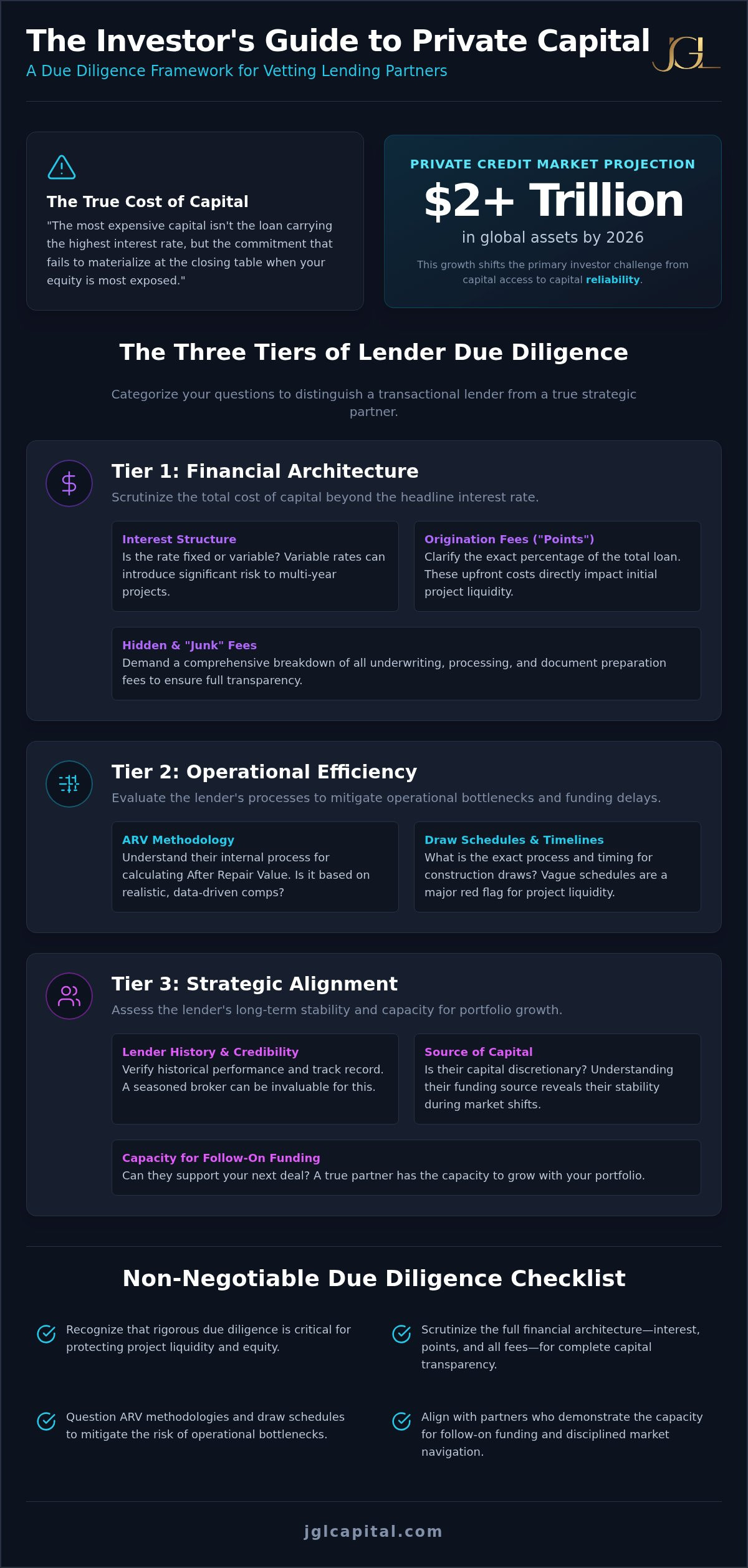
To conduct a thorough evaluation, investors must categorize their questions to ask a private money lender into three distinct tiers: financial architecture, operational efficiency, and strategic alignment. Transparency during the initial consultation phase acts as a litmus test for the lender’s institutional maturity and commitment to integrity. Private money is a flexible, speed-oriented capital solution for sophisticated developers that bridges the gap between immediate opportunity and long-term institutional stability.
- Financial Tiers: Scrutinizing the total cost of capital beyond the headline interest rate, including points and back-end fees.
- Operational Tiers: Evaluating the precision of draw schedules and the methodology for calculating After Repair Value (ARV).
- Strategic Tiers: Assessing the lender’s history, their source of capital, and their capacity for follow-on funding in high-value portfolios.
Evaluating the Financial Architecture: Rates, Points, and Fee Structures
The financial architecture of a private loan dictates the ultimate viability of a real estate development. Sophisticated investors don’t merely look at the interest rate; they conduct a forensic analysis of the entire fee structure to prevent the erosion of projected margins. When formulating questions to ask a private money lender, you must demand clarity on whether the interest rate is fixed or variable for the duration of the term. While fixed rates offer stability, variable structures can introduce volatility into multi-year construction projects that your modeling might not account for initially.
It’s equally vital to scrutinize origination fees, commonly referred to as “points,” as a percentage of the total capital allocation. These upfront costs significantly impact the initial liquidity of the project. A comprehensive breakdown of underwriting, processing, and document preparation fees is necessary to verify the absence of unexpected administrative charges at the closing table. These “junk fees” often signal a transactional rather than a strategic approach to lending, undermining the trust required for high-stakes management.
Understanding the Total Cost of Capital
Calculating the effective APR is the only way to compare disparate funding offers with analytical rigor. This calculation must include all brokerage, origination, and recurring fees over the life of the loan. When assessing the competitive landscape of Hard Money Lenders, investors must prioritize lenders who offer transparent cost structures that withstand scrutiny. Interest-only payments are a common feature in private credit, providing vital relief to project cash flow during the intensive construction phase. However, the lack of principal reduction means the exit strategy must be executed with precision to avoid a capital shortfall at maturity.
Prepayment Penalties and Exit Fees
Exit strategies often require flexibility, yet many lenders impose minimum interest requirements or “yield maintenance” clauses. These provisions ensure the lender receives a guaranteed return even if the loan is repaid ahead of schedule. It’s critical to ask how a rapid flip or a quick refinance affects the total loan cost. If the project timeline exceeds the initial term, you’ll also need to understand the structure of potential extension fees. These costs can be prohibitive if they aren’t negotiated during the initial underwriting phase. Engaging a disciplined capital partner allows you to secure terms that align with your portfolio’s growth trajectory without encountering hidden financial friction.
Analyzing Operational Efficiency: ARV, Draw Schedules, and Funding Timelines
Operational excellence is the invisible force that determines the success of high-stakes real estate developments. While financial terms dominate initial discussions, the mechanics of capital deployment often present the greatest risk to project timelines. You must determine the lender’s specific methodology for calculating After Repair Value (ARV) and Loan-to-Value (LTV) ratios, as these metrics dictate the depth of your equity requirement. Institutional-grade lenders utilize forensic appraisal standards to ensure valuations are grounded in market reality rather than speculative optimism.
The Mechanics of Construction Draws
Construction momentum relies entirely on the predictable flow of capital. One of the most vital questions to ask a private money lender concerns their specific inspection and draw process for new construction loans. You need to know if fund disbursements are strictly paid in arrears or if the lender provides an initial mobilization advance to secure materials and labor. A delay of even a few days in processing a draw can stall a multi-million dollar site, leading to contractor attrition and compounding carry costs. Ask about the frequency of inspections and the typical turnaround time from the site visit to fund availability to maintain a steady operational rhythm.
Speed to Close and Capital Readiness
In the 2026 regulatory environment, capital readiness is often defined by the lender’s ability to navigate increased compliance without sacrificing speed. Ask for a realistic “clear to close” timeline that accounts for modern Bank Secrecy Act (BSA) reporting guidelines and FinCEN compliance. Sophisticated partners prioritize property viability during underwriting, allowing them to issue firm commitments while others remain mired in bureaucratic delays. It’s essential to verify the internal steps required before a loan is fully committed to ensure the lender has the liquidity and infrastructure to handle complex, eight-figure capital requirements. These operational questions to ask a private money lender reveal whether an organization possesses the disciplined framework necessary to support your most ambitious portfolio expansions.
Assessing Credibility and the Strategic Broker Advantage
Credibility in the private credit sector is forged through historical performance and the successful navigation of multiple market cycles. When you’re evaluating potential partners, you should prioritize organizations with 30+ years of industry expertise. This longevity indicates a disciplined approach that survives macroeconomic volatility. Essential questions to ask a private money lender include a deep inquiry into their primary source of capital. You need to know if you’re engaging with a single, closed-end fund or a network of institutional partners, as the latter often provides greater resilience against localized liquidity crunches.
The choice between a direct lender and a strategic broker is frequently misunderstood by less experienced investors. While some suggest avoiding intermediaries to minimize fees, this perspective ignores the sophisticated architecture of modern capital markets. A direct lender is limited by their specific fund mandates. In contrast, a strategic broker provides a broader platform, matching your project’s unique risk profile to the most favorable capital pool available. Requesting case studies involving specific asset classes, such as multi-family loans, allows you to verify that the lender’s history aligns with your current development objectives.
The Value of a Strategic Brokerage
A professional brokerage acts as an essential strategic filter in the financing process. By managing the complexities of underwriting and sourcing, a broker allows the developer to maintain their focus on the execution of the project rather than the minutiae of capital acquisition. JGL Capital LLC serves as a seasoned partner in this capacity, functioning as a strategic bridge to institutional capital for sophisticated developers. We handle the heavy lifting of aligning diverse capital stacks, ensuring that your financing is both reliable and optimized for long-term growth. To secure a partner who prioritizes your legacy over simple transactions, consider engaging with the private money broker service at JGL Capital LLC, which offers national coverage and specialized expertise.
Verifying Institutional Integrity
Institutional integrity is revealed through a firm’s conduct during market downturns. You should ask potential partners about their track record during previous volatile cycles to gauge their stability. Inquire about the professional backgrounds of the firm’s principals to ensure their expertise is grounded in analytical rigor rather than aggressive marketing. A reputable partner understands that the creation of value is a collaborative, long-term endeavor. They’ll prioritize the alignment of objectives over short-term gains, providing the security that high-net-worth stakeholders require. These questions to ask a private money lender are fundamental to establishing a relationship based on mutual responsibility and strategic worth.
Strategic Alignment: Selecting a Lender for Long-Term Portfolio Growth
Selecting a lender for a multi-million dollar portfolio requires looking far beyond the immediate transaction to the long-term viability of the partnership. One of the most telling questions to ask a private money lender is how they manage unforeseen market shifts or unavoidable project delays. A partner who understands the cyclical nature of real estate will offer the flexibility required to preserve your equity during transitional phases. You need a partner who provides strategic insights rather than acting as a simple capital conduit. This is especially true for developers managing 10 MIL+ loans, where the margin for error is slim and the need for institutional-grade stability is paramount.
Customization remains the hallmark of sophisticated capital allocation. You should inquire about the specific flexibility of bridge loans to meet transitional needs, such as stabilizing an asset before securing permanent financing. A lender’s willingness to provide follow-on funding for future acquisitions serves as a key indicator of their commitment to your portfolio’s growth trajectory. A disciplined steward of capital prioritizes the alignment of objectives, ensuring that every financial structure serves the broader goal of building lasting legacies.
Partnership Beyond the Transaction
True partnership is defined by discreet expertise and a commitment to professional stewardship. It’s not merely about the provision of funds; it’s about the alignment of strategic goals. A lender who acts as a collaborative ally in wealth preservation will help you navigate the complexities of high-stakes management with analytical rigor. Their ability to remain steady when market dynamics fluctuate is a testament to their historical expertise and institutional maturity. When you’re finalizing your questions to ask a private money lender, focus on their capacity to act as a disciplined ally who values integrity above short-term transactional gains.
Finalizing the Selection Process
This due diligence checklist serves as a rigorous framework for institutional-grade evaluation, designed to instill trust and security in sophisticated partners. By moving from financial architecture to operational efficiency and strategic alignment, you ensure that your real estate portfolio is backed by reliable capital. We invite you to engage with our team for a sophisticated analysis of your next high-value project, leveraging our 30+ years of industry expertise to secure your investment future. Consult with the principals at JGL Capital LLC to align your capital needs with our strategic lending platforms.
Securing the Future of Your Real Estate Portfolio
The successful preservation of capital in a maturing real estate market requires more than just access to funds; it demands a disciplined approach to partnership and a rigorous vetting process. By internalizing the sophisticated framework of questions to ask a private money lender established in this guide, you’ve equipped yourself to distinguish between simple capital conduits and true strategic allies. You now possess the analytical tools to scrutinize financial architecture, verify operational draw mechanics, and align your long-term objectives with institutional-grade integrity. This methodical due diligence ensures that every commitment within your portfolio is backed by the reliability required for the creation of a lasting legacy.
JGL Capital LLC stands as a seasoned steward in this landscape, offering the intellectual capital and stability that high-stakes developments demand. With over 30 years of industry leadership and a specialization in complex 10 MIL+ transactions, our national reach is supported by a commitment to analytical rigor and institutional-grade underwriting. Secure Strategic Capital for Your Next Project with JGL Capital LLC and benefit from a partnership grounded in stability and expertise. Your pursuit of excellence in real estate deserves a financing partner whose discipline mirrors your own strategic vision.
Frequently Asked Questions
How does a private money loan differ from a traditional bank loan in 2026?
Private money loans differ from traditional banking through their emphasis on asset-based valuation and execution speed, often closing within 14 days. While banks focus on personal financials and debt-to-income ratios, private capital prioritizes the property’s intrinsic worth. This distinction is critical in 2026 as traditional institutions face increased regulatory constraints, making private credit the primary source of agility for sophisticated real estate developers.
Why should I ask about the lender’s experience with my specific asset class?
Lenders with specific asset class experience bring a nuanced understanding of market dynamics and valuation benchmarks, such as multi-family density or commercial zoning. This expertise allows for more accurate risk assessment and tailored loan structures. Partnering with a firm that has 30 years of history ensures that your project is evaluated with analytical rigor rather than surface-level metrics.
What is the most critical question to ask regarding construction draw schedules?
You must ask about the specific turnaround time from the initial inspection to the disbursement of funds. A streamlined draw process is the lifeblood of any development, preventing contractor attrition and costly project delays. Verify if the lender utilizes third-party inspectors and if they permit an initial mobilization draw to cover the immediate material costs of the project.
Can a private money broker help me secure better terms than going direct?
A strategic broker acts as a professional filter, matching your project with the capital source most aligned with your objectives. By leveraging a national network of institutional partners, brokers often secure more competitive rates and higher leverage than a single direct lender could offer. This remains a central component of the questions to ask a private money lender for large-scale developments.
What happens if my project timeline exceeds the initial loan term?
If a project exceeds its term, lenders typically utilize extension options that involve a fee and a potential rate increase. It’s essential to define these parameters during the initial negotiation to avoid liquidity crises. A collaborative partner values long-term growth and will work to restructure the debt in a way that protects the project’s ultimate equity and exit strategy.
How does After Repair Value (ARV) affect my total borrowing capacity?
ARV determines the total capital you can access by projecting the property’s value upon completion of the renovation or construction. Lenders use this figure to establish the Loan-to-Value (LTV) ratio, often funding a significant portion of the total project cost. This property-centric approach allows investors to maximize their leverage by focusing on the generation of future worth.
Are there specific questions I should ask about multi-family or commercial bridge loans?
Investors should inquire about the lender’s experience with 10 MIL+ transactions and their specific requirements for debt service coverage ratios. Commercial bridge loans are often transitional, so you must understand the lender’s flexibility regarding tenant improvements and leasing commissions. These inquiries are fundamental questions to ask a private money lender when managing the complexity of a commercial real estate strategy.
Is a personal credit score relevant when asking for an asset-backed private loan?
Asset-backed lenders prioritize the property’s value, yet they may review personal credit to assess the borrower’s history of financial stewardship. A lower score is rarely a disqualifier if the asset demonstrates significant worth and a clear exit strategy exists. This focus on the property rather than the individual provides sophisticated investors with the flexibility required to execute complex, high-value acquisitions.