

What if the most significant threat to your project’s internal rate of return isn’t a shift in market cycles, but the subtle ambiguities hidden within your construction documentation? Sophisticated investors recognize that creating a scope of work for a renovation serves as the definitive bridge between high-level investment strategy and the granular realities of physical execution. It’s a common frustration to encounter unforeseen budget escalations or to find your capital deployment stalled because a private money lender requires more rigorous technical substantiation than your current documents provide.
This article offers a disciplined methodology to master the art of drafting professional-grade specifications that ensure transparency and mitigate financial risk. You’ll learn to construct a repeatable framework that aligns your project objectives with precise budgetary constraints, ultimately facilitating faster approval from institutional partners. We will explore the essential components of a strategic scope, the nuances of resource management, and the analytical rigor necessary to secure your legacy in a competitive environment.
Key Takeaways
- Establish institutional-grade accountability by distinguishing a professional Scope of Work from a rudimentary punch list to ensure project transparency.
- Master the technical process of creating a scope of work for a renovation through forensic site assessments and the alignment of physical improvements with investment exit strategies.
- Protect project margins by eliminating vague terminology and implementing a structured protocol for addressing unforeseen conditions during the discovery phase.
- Streamline the capital acquisition process by providing private money lenders with the detailed documentation necessary to validate project viability and facilitate efficient draw schedules.
- Implement a repeatable, disciplined framework that minimizes operational risk and reinforces your position as a sophisticated partner in high-stakes real estate management.
The Strategic Significance of a Renovation Scope of Work
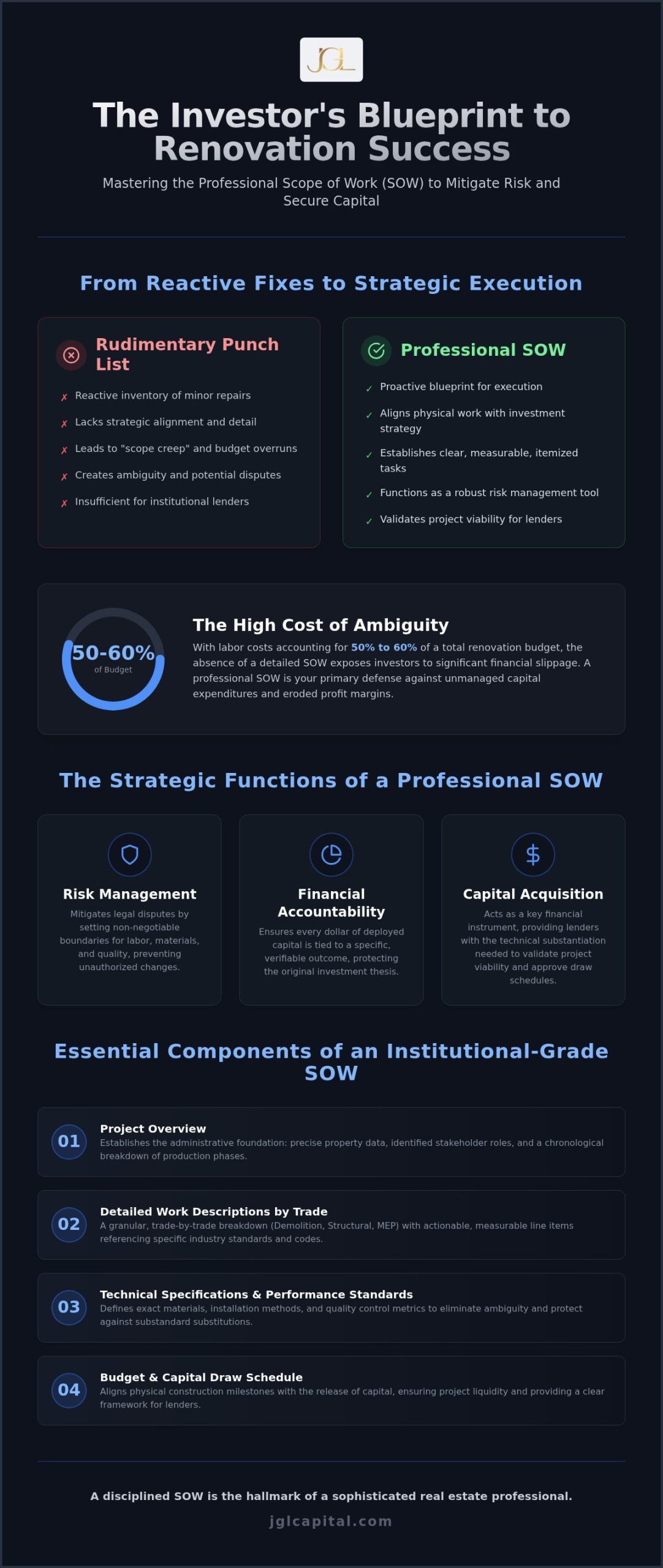
A professional Statement of Work (SOW) represents far more than a mere technical requirement; it is the foundational blueprint for project execution and financial accountability. For the sophisticated investor, this document serves as a comprehensive articulation of the project’s physical and fiscal parameters. It translates abstract investment goals into a sequence of actionable, itemized tasks that govern the relationship between the owner and the general contractor. By establishing a rigorous baseline for performance, the SOW ensures that every dollar of deployed capital is tied to a specific, verifiable outcome.
Distinguishing between a rudimentary “punch list” and an institutional-grade SOW is critical for long-term value preservation. While a punch list is typically a reactive inventory of minor repairs, the process of creating a scope of work for a renovation is a proactive exercise in strategic alignment. This document acts as the primary defense against “scope creep,” which is the gradual, unallocated expansion of project requirements that erodes profit margins. Given that labor costs can account for 50% to 60% of a total renovation budget, the absence of a detailed SOW leaves the investor vulnerable to significant financial slippage and unmanaged capital expenditures.
Beyond the To-Do List: A Risk Management Tool
A meticulously drafted SOW functions as a robust risk management instrument that protects the integrity of the original investment thesis. It mitigates the potential for legal disputes by setting clear, non-negotiable boundaries for labor, materials, and delivery expectations. When expectations are codified with analytical rigor, the likelihood of mechanics liens or contractual conflicts diminishes. This clarity ensures that the contractor’s execution remains strictly aligned with the investor’s strategic objectives, preventing the dilution of project value through unauthorized modifications or substandard material substitutions.
The SOW as a Financial Instrument
In the context of asset-backed lending, the SOW is treated as a vital financial instrument rather than just a construction guide. Private money brokers and institutional lenders utilize this documentation to evaluate the underlying viability of fix and flip loans and other high-leverage products. By aligning physical construction milestones with the release of capital, the SOW provides a structured framework for the loan draw schedule. This ensures liquidity throughout the project lifecycle and reinforces the borrower’s credibility, as a well-documented plan signals a disciplined and professional approach to resource management. Ultimately, creating a scope of work for a renovation that is grounded in itemized reality rather than speculative estimates is the hallmark of a seasoned real estate professional.
Essential Components of a Professional-Grade Scope of Work
The architecture of a professional-grade document begins with a rigorous Project Overview, establishing the administrative foundation that governs all subsequent activity. This includes precise property data, identified stakeholder roles, and a chronological breakdown of production stages into logical, phased work descriptions. Budget precision is paramount. When creating a scope of work for a renovation, the objective is to eliminate the subtle ambiguities that often lead to catastrophic budget overruns. By defining the technical specifications and performance standards at the outset, you provide a clear metric for quality control that protects your equity. A disciplined SOW ensures that every participant operates within a unified strategic framework.
Detailed Work Descriptions by Trade
Effective documentation requires a trade-by-trade breakdown, categorizing tasks into demolition, structural, and mechanical, electrical, and plumbing (MEP) segments. Each line item must be actionable and measurable, referencing specific industry standards such as the International Building Code (IBC) or relevant local equivalents. This level of granularity ensures that subcontractors understand the exact parameters of their responsibility, leaving no room for the “extra” work claims that frequently derail a project’s financial trajectory. By incorporating forensic-level detail into these descriptions, you establish a defensible baseline for inspections and draw approvals, reinforcing the stability of the project’s timeline.
Materials and Finish Schedules
Sophisticated investors avoid the peril of vague “allowances” by insisting on SKU-level detail for all materials and finishes. This precision is particularly vital in high-stakes projects where the level of finish must align perfectly with the targeted market segment’s expectations. Explicitly documenting owner-supplied versus contractor-supplied materials prevents double-billing and ensures that procurement timelines are synchronized with the construction schedule. This disciplined approach to material management is a hallmark of investors who successfully secure fix and flip loans for high-leverage projects. It ensures that the aesthetic execution reflects the underlying investment thesis without variance.
Perhaps most importantly, a professional SOW must explicitly state what is NOT included. Defining exclusions and limitations is a strategic necessity to prevent financial ambiguity and mitigate the risk of unallocated expenditures. When creating a scope of work for a renovation, failing to outline these boundaries leaves the project vulnerable to disputes over unforeseen site conditions or ancillary tasks. By clearly outlining the limits of the contractor’s responsibility, you preserve the integrity of your budget and ensure that all parties are aligned on the project’s physical and fiscal constraints. This clarity is essential for maintaining the trust of high-net-worth stakeholders and institutional partners alike.
A Methodical Step-by-Step Guide to Creating Your SOW
The development of an institutional-grade document requires a systematic approach that transcends simple template completion. It’s a cumulative process of discovery, analysis, and refinement designed to eliminate operational friction. By following a disciplined, five-step sequence, investors can transform a conceptual vision into a rigorous, bid-ready instrument that withstands the scrutiny of institutional partners and general contractors alike. This methodical progression ensures that the process of creating a scope of work for a renovation remains grounded in physical reality and fiscal responsibility.
- Step 1: Conduct a comprehensive site audit and forensic assessment of existing conditions to identify latent defects.
- Step 2: Define the project objectives based on the exit strategy, ensuring the finish level aligns with the target market.
- Step 3: Draft the initial narrative scope in collaboration with key technical advisors to establish the project’s intent.
- Step 4: Refine the document into an itemized, bid-ready format that allows for precise contractor comparisons.
- Step 5: Perform a final comprehensive review and integrate the SOW into the master construction contract as a primary exhibit.
Conducting the Site Audit
The foundation of a reliable SOW is a forensic assessment that identifies “hidden” issues within the building envelope and mechanical systems. Relying on superficial observations often leads to the discovery of structural decay or outdated electrical systems mid-project, which necessitates costly change orders. Utilizing third-party inspections provides an objective validation of the proposed scope, ensuring that the baseline for the renovation is accurate. Capturing high-resolution photographic evidence during this phase establishes a definitive record of pre-existing conditions, serving as a critical reference point for quality control and dispute resolution throughout the construction lifecycle.
Collaborating with Professionals
Sophisticated investors don’t work in isolation; they leverage the expertise of architects, structural engineers, and specialized consultants to ensure technical accuracy. This collaboration is vital when creating a scope of work for a renovation that involves structural modifications or complex MEP upgrades. These professionals ensure that the SOW aligns with current municipal regulations and permit requirements, preventing the operational delays associated with non-compliance. Synthesizing this expert input into a cohesive, non-contradictory document prevents the friction that occurs when technical specifications conflict with architectural plans. This alignment is essential for securing faster approval from private money lenders who prioritize project viability and regulatory adherence.
Mitigating Risk: Avoiding Common SOW Mistakes
The integrity of a capital deployment strategy depends on the precision of its underlying documentation. When creating a scope of work for a renovation, the most common failure point is the use of non-specific, subjective terminology that invites interpretation. Phrases such as “replace as needed” or “repair to match existing” introduce significant financial liability, as they delegate the definition of project completion to the contractor rather than the investor. This lack of specificity often results in unallocated costs and friction during the final inspection phase, ultimately undermining the investor’s ability to maintain a disciplined budget and protect project margins.
The Danger of Ambiguity
Imprecise wording serves as a primary catalyst for budget inflation and protracted project delays. For instance, failing to explicitly define site management expectations, such as the requirement for a “broom clean” environment at the conclusion of each production phase, can lead to disputes regarding labor costs for site remediation. Standardizing a technical vocabulary across all project documentation ensures that every stakeholder shares a unified understanding of performance standards. By eliminating ambiguity, investors preserve the fiscal integrity of the asset and ensure that the renovation proceeds without the operational friction caused by misaligned expectations.
Managing Unforeseen Conditions
No site audit, regardless of its forensic depth, can fully account for the complexities hidden within older structures. Managing the “Discovery Phase” requires a structured framework that incorporates contingency clauses to define how unforeseen conditions are priced and approved. Utilizing “unit pricing” for common unknowns, such as the replacement of rotted subflooring or outdated electrical wiring, allows for cost control even when the exact volume of work is initially unknown. It is recommended to maintain a contingency fund of 15% to 20% of the total project cost to accommodate these variables while demonstrating to lenders that the project remains financially robust despite the process of creating a scope of work for a renovation involving significant unknowns.
A formal change order protocol must be established to manage any deviations from the original scope with institutional-grade discipline. This protocol ensures that every modification is documented, priced, and approved in writing before the work commences, preventing the accumulation of unallocated charges that often appear at the project’s conclusion. Integrating the SOW as a primary exhibit within the broader construction agreement provides the legal foundation necessary to enforce these standards. For investors seeking to leverage these professional standards into capital, ensuring your documentation aligns with the requirements for fix and flip loans is a critical step in securing the necessary funding for high-stakes projects.
Aligning Your Scope of Work with Private Capital Requirements
In the context of high-stakes real estate management, the Statement of Work functions as a critical underwriting instrument that bridges the gap between physical construction and financial risk assessment. Private money brokers and institutional partners don’t merely view the SOW as a project guide; they utilize it to evaluate the underlying viability of fix and flip loans. By providing a granular breakdown of intended improvements, the investor allows the lender to validate the projected After Repair Value (ARV) with analytical rigor. A professional SOW demonstrates “pattern recognition” and deep-seated expertise, signaling to capital partners that the borrower is a disciplined steward of investment value. This level of documentation often influences the final credit decision, as hard money lenders prioritize projects where the execution plan is transparent and itemized.
The SOW as an Underwriting Requirement
Lenders require absolute alignment between the SOW and the appraisal report to ensure that the proposed renovation justifies the requested capital. If the scope fails to substantiate the finish level required for the target ARV, the funding request may face significant delays or downward adjustments. For those pursuing new construction loans, a clear scope facilitates faster funding by providing the technical substantiation necessary for institutional-grade risk assessment. Creating a scope of work for a renovation that mirrors the appraiser’s assumptions is essential for maintaining the integrity of the loan-to-value ratio and securing favorable terms. Precision here isn’t optional.
Streamlining the Draw Process
The relationship between the SOW and the loan draw schedule is fundamental to maintaining liquidity throughout the project lifecycle. By mapping specific SOW line items to funding milestones, investors ensure a steady flow of capital as construction progresses. Lenders typically release funds based on “percentage complete” reporting, which relies entirely on the documented scope to verify that physical milestones have been achieved. This methodical approach minimizes the risk of capital being deployed for incomplete or substandard work. It protects the lender and the investor simultaneously.
When creating a scope of work for a renovation, partnering with a strategic ally like JGL Capital LLC ensures that your documentation meets the rigorous standards of sophisticated lenders. With over 30 years of industry expertise, JGL Capital LLC understands the technical nuances required to align a project’s physical execution with its financial objectives. This alignment facilitates a seamless draw process from inception to exit. By framing the SOW as a high-level strategic alliance document, you position your project for success with partners who value long-term growth and integrity above all else.
Mastering the Blueprint for Institutional Capital Deployment
Mastering the discipline of creating a scope of work for a renovation transforms a mere construction project into a sophisticated investment vehicle. By transitioning from vague task lists to itemized, institutional-grade documentation, you effectively mitigate the risk of unallocated capital expenditures and operational slippage. This rigorous approach ensures that every physical milestone is perfectly synchronized with your financial objectives and capital draw schedules, providing a transparent baseline for performance that satisfies the most demanding private money lenders. Precision in documentation is the hallmark of a seasoned investor who values the preservation of equity over speculative trends.
Securing a strategic ally who understands these technical nuances is the final step in ensuring project viability. Partner with JGL Capital LLC for your next high-stakes investment project to leverage over 30 years of combined industry expertise and specialized brokerage access to private capital networks. Our disciplined approach to asset-backed real estate finance provides the stability and analytical expertise required to navigate complex market cycles. JGL Capital LLC looks forward to supporting your next legacy-building endeavor with the meticulous attention your vision deserves.
Frequently Asked Questions
What is the difference between a Scope of Work and a Statement of Work?
While industry professionals often use the acronym SOW interchangeably, a technical distinction exists between the two terms. The Scope of Work refers specifically to the granular list of tasks and materials required for a project. In contrast, a Statement of Work is the comprehensive contractual document that encompasses the scope, alongside payment terms, schedules, and legal protections. Both are essential for maintaining institutional-grade transparency during a high-stakes renovation.
How detailed should a renovation scope of work actually be?
Precision is the primary metric for project success. A professional document must provide SKU-level detail for materials and specific, trade-by-trade instructions for all labor. Vague descriptions are a significant liability that lead to unallocated costs and project friction. When creating a scope of work for a renovation, the objective is to eliminate ambiguity so that contractors and lenders share a unified understanding of the finished asset.
Can I change the scope of work after the project has started?
Modification is possible only through a formal change order protocol. Any deviation from the original agreement must be documented, priced, and approved in writing by all stakeholders to preserve the integrity of the contract. Unauthorized changes often disrupt the loan draw schedule and create legal vulnerabilities. Disciplined investors treat the SOW as a living document that requires rigorous version control and analytical oversight throughout the construction lifecycle.
Does a private lender require a professional scope of work for a fix-and-flip loan?
Institutional private lenders mandate a professional SOW to validate the After Repair Value and overall project viability. This documentation is central to the underwriting process, as it allows the lender to assess risk with clinical accuracy. Providing a detailed plan demonstrates the borrower’s sophisticated approach to resource management. It often facilitates faster approval for fix and flip loans by ensuring the lender’s appraisal aligns with the investor’s execution strategy.
How do I handle materials in the scope of work if I haven’t picked them yet?
Investors should utilize specific allowances based on documented market-rate benchmarks for the target demographic. While SKU-level detail is the preferred standard, setting a fixed dollar amount for finishes allows the project to move into the underwriting phase without delay. These selections must be finalized before the commencement of the relevant production phase to avoid procurement bottlenecks. This approach maintains the project’s momentum while preserving necessary aesthetic flexibility.
Who should be responsible for drafting the final scope of work?
The investor must act as the primary steward of the drafting process, synthesizing input from the general contractor and technical advisors. While the contractor provides essential labor estimates, the investor ensures the document remains aligned with the exit strategy and capital requirements. Creating a scope of work for a renovation is a collaborative effort that requires the investor to maintain final authority over the project’s physical and fiscal parameters.
What are “allowances” in a scope of work, and should I use them?
Allowances are budgetary placeholders for materials or services that have not been finalized, such as cabinetry or flooring. They offer essential flexibility during the early stages of a project but introduce a degree of financial ambiguity. Sophisticated investors minimize the use of allowances to ensure the budget remains grounded in itemized reality. Relying on speculative estimates rather than firm quotes can erode profit margins and complicate the capital draw process.
How does a scope of work prevent project delays?
A comprehensive SOW eliminates the need for mid-project decision-making by establishing a definitive sequence of production. By defining all technical specifications and material requirements at the outset, you prevent the operational friction that occurs when contractors wait for owner approvals. This clarity is essential for maintaining a steady communication rhythm and ensuring that capital is deployed efficiently. A well-drafted scope serves as the definitive roadmap for timely project completion.