

The successful execution of high-scale residential development in 2026 hinges less on the pursuit of interest rate arbitrage and more on the strategic alignment of capital velocity with project-specific risk. While traditional banking institutions continue to prioritize rigid debt-to-income metrics and exhaustive bureaucratic protocols, sophisticated developers understand that these constraints often lead to deleterious project delays. Securing multi-family construction loans through private capital channels offers a necessary alternative, providing the flexibility required for complex assets that demand a more analytical underwriting approach.
You likely recognize that institutional red tape frequently stifles momentum, failing to account for the inherent feasibility of a well-conceived project. This guide serves as a disciplined framework to help you master the intricacies of large-scale financing through high-velocity private capital and expert brokerage strategies. We’ll explore how to achieve superior Loan-to-Cost ratios and ensure the fast execution required to meet critical construction timelines. By the conclusion of this analysis, you’ll possess the strategic insight necessary to identify a partner who values long-term growth and the generation of worth over simple transactional service.
Key Takeaways
- Analyze the 2026 market shift where private capital has emerged as the primary vehicle for sophisticated developers seeking to avoid institutional bureaucratic delays.
- Differentiate between Loan-to-Cost (LTC) and Loan-to-Value (LTV) metrics to ensure your capital stack remains resilient throughout the ground-up build phase.
- Discover how to leverage multi-family construction loans through private brokerage channels to achieve rapid execution and meet aggressive development timelines.
- Evaluate the essential elements of sponsor capacity, focusing on how professional underwriting prioritizes project feasibility and historical pattern recognition over rigid personal credit scores.
- Formulate a precise exit strategy that facilitates a seamless transition from construction financing to permanent Agency or DSCR debt solutions.
The Landscape of Multi-Family Construction Financing in 2026
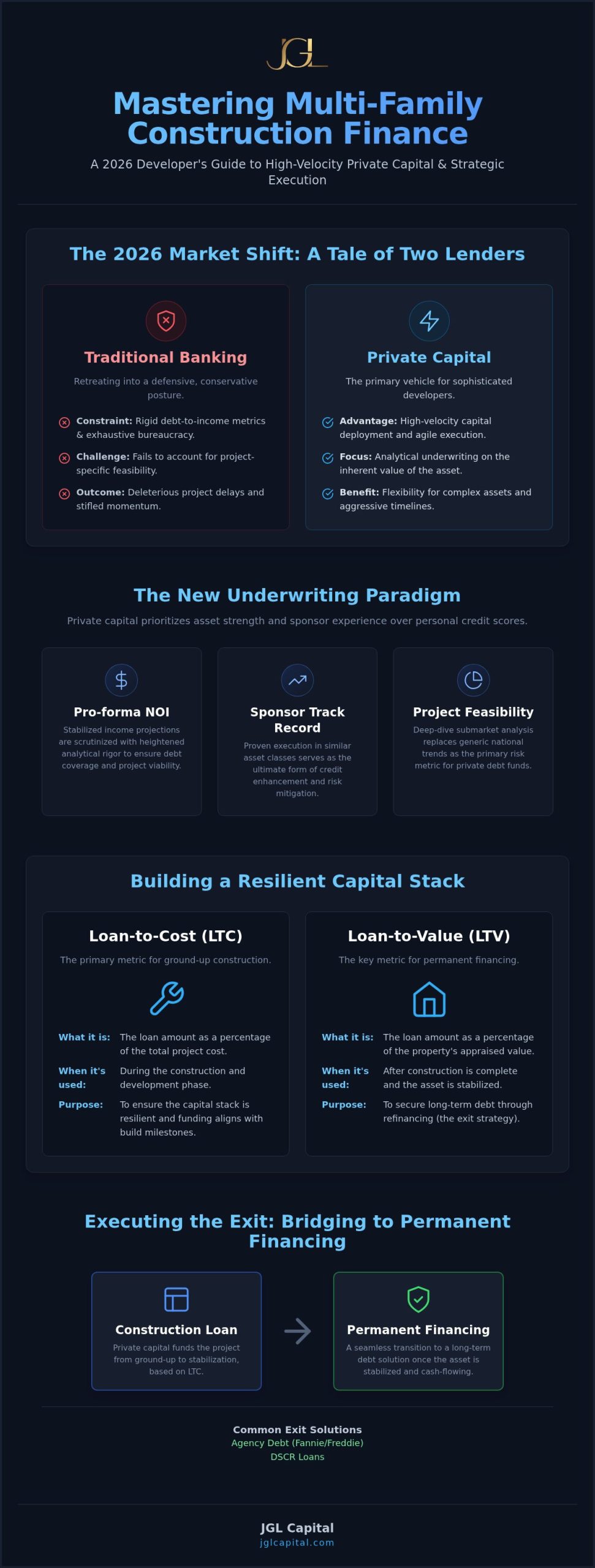
The 2026 fiscal environment has necessitated a fundamental recalibration of how developers secure multi-family construction loans. While traditional depository institutions have historically anchored the sector, their recent retreat into a more defensive, conservative posture has created a strategic void now filled by sophisticated private debt funds. These institutional-grade entities operate with a high degree of capital velocity, prioritizing the inherent value of the asset over the cumbersome regulatory frameworks that often impede traditional bank lending. Because these arrangements are structured strictly as business-purpose transactions, they remain exempt from the consumer-grade regulatory friction that typically slows residential mortgage processing. It’s this specific exemption that allows for a more agile deployment of resources, provided the borrower engages in a process defined by analytical rigor and disciplined risk management.
Current Market Dynamics and Capital Velocity
Interest rate stabilization throughout 2026 has revitalized multi-family starts, particularly within the middle-market apartment segment where supply remains notably constrained. In this high-stakes environment, the speed of execution has transitioned from a secondary advantage to a primary competitive differentiator. Developers who can secure funding within a truncated window gain a significant advantage in securing labor and materials at fixed costs before inflationary pressures shift. Understanding the mechanics of construction financing is essential during this phase, as the phased release of capital must align precisely with the project’s operational milestones to maintain forward momentum. It’s no longer enough to have a viable project; you must have a capital partner who can move at the pace of the market.
The Shift Toward Asset-Backed Underwriting
The most profound evolution in the current market is the definitive move away from personal income-based credit evaluation toward asset-backed underwriting. Modern private capital sources focus primarily on Pro-forma Net Operating Income (NOI) and the project’s long-term feasibility within its specific submarket. This shift recognizes that for large-scale developments, the strength of the asset and the historical pattern recognition of the sponsor are more reliable indicators of success than personal debt-to-income ratios. This analytical approach provides the necessary flexibility for complex or transitional assets that traditional banks often find too unconventional to finance. Key metrics in this new underwriting paradigm include:
- Pro-forma NOI: Lenders now scrutinize stabilized income projections with heightened analytical rigor to ensure debt coverage.
- Sponsor Track Record: Proven execution in similar asset classes serves as the ultimate form of credit enhancement in 2026.
- Project Feasibility: Deep-dive submarket analysis replaces generic national trends as the primary risk metric for private debt funds.
By prioritizing these metrics, private capital provides a level of customization that’s simply unavailable through traditional institutional channels. This allows for the creation of worth through careful, deliberate action rather than being subject to the whims of rigid bank committees.
Evaluating the Mechanics of Multi-Family Construction Capital
The transition from high-level market theory to the granular mechanics of multi-family construction loans requires a disciplined understanding of how debt is structured against project costs. While the broader multifamily construction market analysis highlights the macro-economic pressures of 2026, the individual sponsor’s success depends on optimizing the capital stack. This process begins with a precise calculation of leverage ratios and the strategic selection of debt characteristics that protect the sponsor’s broader portfolio and long-term liquidity.
LTC and Leverage Thresholds
Loan-to-Cost (LTC) functions as the primary metric for multi-family construction loans, representing the percentage of total hard and soft costs covered by the lender. In 2026, while traditional banks often retreat to 60% or 65% LTC, private debt funds frequently provide up to 75% leverage for well-capitalized projects. This higher leverage allows developers to preserve liquidity for other opportunities or to manage the 39% increase in construction costs observed since 2020. To bridge the remaining gap, sophisticated developers often layer mezzanine debt or preferred equity, ensuring that the primary equity requirement remains manageable without diluting the project’s internal rate of return (IRR).
Non-Recourse vs. Recourse Debt Structures
Non-recourse debt remains the gold standard for institutional-grade sponsors, as it limits the lender’s recovery to the underlying asset rather than the sponsor’s personal balance sheet. This protection is vital when managing high-stakes, ground-up builds where unforeseen environmental or labor disruptions can occur. Even with the inclusion of standard “bad boy” carve-outs, which trigger recourse in the event of fraud, misapplication of funds, or gross negligence, the exclusion of personal liability is a strategic priority that justifies the slightly higher interest rates associated with private capital. Experienced developers prioritize these terms to safeguard their legacy and ensure that a single project’s volatility doesn’t jeopardize their entire enterprise.
Capital efficiency is further influenced by the interplay between origination points and the overall project IRR. In 2026, many private lenders require 1 to 2 points at closing, which can initially seem burdensome to the uninitiated. However, when weighted against the opportunity cost of an 18-month institutional delay, these fees are often negligible. Meticulously structured interest reserves serve as a critical liquidity buffer, ensuring that the project remains current on debt service throughout the construction and lease-up phases. This disciplined approach to liquidity management prevents the need for distressed capital calls during the transition to permanent financing. For those seeking to optimize these complex structures, engaging with an experienced private money broker can provide access to the institutional-grade capital your project requires.
Institutional Rigidity vs. Private Capital Brokerage
The selection of a capital partner in 2026 is often a choice between the low-rate promise of government-backed programs and the high-velocity execution of private debt funds. While programs like the HUD 221(d)(4) offer attractive long-term rates, they frequently require a lead time of 12 to 18 months for approval. In a market where construction costs have risen approximately 39% since 2020, such a delay is often untenable. Carrying costs, property taxes, and the potential for shifting submarket demand can quickly erode the thin margins of a large-scale development. Private multi-family construction loans, conversely, can often reach a definitive close within 30 days, allowing developers to lock in material costs and labor contracts before inflationary pressures escalate further.
The Strategic Advantage of Private Money Brokerage
Utilizing a brokerage model to source multi-family construction loans provides a level of market coverage that a single depository institution cannot replicate. JGL Capital leverages 30 years of industry pattern-recognition to identify “off-market” capital sources that align with the specific risk profile of a project. As a disciplined steward of your capital stack, the firm ensures that every strategic objective is articulated with precision. This collaborative approach to capital allocation is further explored in our Commercial Real Estate Loans: A Strategic Guide, which outlines the necessity of aligning debt structures with long-term value creation. By bypassing the saturated queues of traditional banks, sponsors can maintain the momentum essential for institutional-grade builds.
Overcoming Institutional Underwriting Barriers
Traditional banking institutions frequently struggle with projects that deviate from standard residential metrics, such as mixed-use developments or those located in transitional urban cores. Their reliance on rigid FICO scores and personal debt-to-income ratios often ignores the primary indicator of success: the sponsor’s track record. Private capital underwriting prioritizes project feasibility and historical execution over personal credit nuances. If a developer has successfully delivered high-density assets in the past, that experience serves as the ultimate form of credit enhancement. This flexibility extends to the operational phase, where streamlined draw processes ensure that subcontractors are paid promptly, preventing the labor disruptions that often plague projects mired in bank bureaucracy.
The premium paid for private capital is rarely about the interest rate alone; it’s an investment in certainty. When you calculate the opportunity cost of a stalled project and the risk of missing a critical lease-up window, the agility of private money often proves to be the more economical path. It’s a strategic alliance that values the generation of worth through deliberate, timely action.
Underwriting the Asset: Risk Mitigation and Project Feasibility
The underwriting phase for multi-family construction loans represents the most critical juncture in the capital allocation lifecycle. In 2026, lenders have moved beyond surface-level credit checks, instead employing a disciplined approach to project feasibility that mirrors institutional investment standards. A comprehensive feasibility study is no longer an optional attachment; it’s the primary document used to verify market absorption rates and local supply-demand equilibrium. By analyzing projected multifamily deliveries, which are expected to decrease by 36% in 2026, sponsors can demonstrate a clear path to stabilization. This analytical rigor ensures that the project isn’t merely a speculative build but a strategic response to a documented housing deficit.
Sponsor capacity remains the defining metric for private debt funds. Lenders prioritize historical pattern recognition, scrutinizing a developer’s track record of delivering similar high-density assets within budget. Liquidity and net worth are evaluated not as personal credit metrics, but as indicators of a sponsor’s ability to navigate the 39% increase in construction costs seen since 2020. This focus on experience allows for a more nuanced risk mitigation strategy, where the strength of the developer offsets traditional banking rigidities. It’s a collaborative assessment that values the preservation of capital through proven execution.
Essential Documentation for Multi-Family Financing
To secure favorable terms, sponsors must provide a meticulously balanced “Sources and Uses” statement that accounts for every dollar of the capital stack. Pro-forma financial modeling must utilize conservative Cap Rate assumptions and stabilized NOI projections that reflect the current 8.6% national apartment vacancy rate. For a deeper analysis of these requirements, consult our New Construction Loans: A Strategic Guide. These documents serve as the blueprint for the project’s financial integrity, allowing the lender to audit the schedule and budget with precision before a single shovel enters the ground.
Managing the Construction Draw Process
Maintaining project momentum requires a professionalized construction draw process. Draw schedules must be aligned with verified project milestones, with third-party inspectors providing the objective data needed to release funds. This disciplined oversight builds lender trust and ensures that the standard budget contingency remains intact for unforeseen site conditions. Successful developers use these audits as a form of risk management, preventing cost overruns from diluting the final IRR. If you’re prepared to capitalize on a high-leverage opportunity with a partner who understands these complexities, you should apply for a multi-family construction loan through our expert brokerage network today.
Executing the Exit Strategy: Bridging to Permanent Financing
The vertical completion of a project marks the commencement of the most delicate phase in the fiscal lifecycle. While multi-family construction loans provide the essential fuel for ground-up development, they aren’t structured for long-term holding. A disciplined exit strategy must be formulated long before the certificate of occupancy is issued. This transition often utilizes a “Bridge-to-Permanent” model, designed to minimize interest rate exposure during the critical lease-up period. By aligning the short-term debt with a clear path toward Agency financing, such as Fannie Mae or Freddie Mac, sponsors can protect their equity and ensure a seamless handoff between capital providers. It’s a process that requires meticulous timing and an unwavering focus on the stabilization threshold.
The Role of DSCR Loans in Stabilization
The Debt Service Coverage Ratio (DSCR) serves as the primary metric for lenders evaluating a stabilized asset. It measures the project’s ability to cover its debt obligations through its net operating income alone. Optimizing rent rolls during the initial lease-up is essential to maximize permanent loan proceeds, as even minor fluctuations in vacancy can impact the final valuation. For broader context on managing these assets in a volatile market, our guide on Real Estate Investing: Strategies for 2026 provides the necessary framework for long-term value creation. Achieving a DSCR of 1.25x or higher is typically the benchmark required to transition from high-velocity construction debt to lower-cost, 30-year permanent financing solutions.
Strategic Planning for Capital Recycling
Sophisticated developers view each project as a vehicle for capital recycling rather than a static end-point. A cash-out refinance allows sponsors to extract their initial equity and a portion of the created worth, which can then be deployed into the next development. This cycle of growth requires that the exit plan be integrated into the initial underwriting of the multi-family construction loans. It’s this level of foresight that distinguishes a disciplined steward of capital from a transactional developer. JGL Capital acts as a persistent ally throughout this journey, ensuring that your capital stack remains optimized from the first shovel to the final refinance. If you’re ready to secure a partner who understands the gravity of your legacy and the importance of long-term stability, you should engage JGL Capital for your next multi-family project.
Navigating the Next Phase of Capital Allocation
The 2026 landscape for residential development necessitates a definitive departure from the institutional rigidity of traditional depository institutions. Success in this environment requires a disciplined alignment between capital velocity and project feasibility, ensuring that every allocation of debt serves the long-term preservation of worth. By prioritizing asset-backed underwriting and rigorous feasibility analysis, sophisticated sponsors can bypass the bureaucratic friction that often results in deleterious project delays. It’s no longer sufficient to secure a loan; one must secure a strategic alliance that values the generation of value over simple transactional metrics.
Executing high-leverage multi-family construction loans is a sophisticated process that demands a seasoned partner who understands the intricacies of the entire capital lifecycle. JGL Capital offers 30+ years of industry pattern-recognition expertise, specializing in $10M+ private capital brokerage with a comprehensive national reach. Our commitment to analytical rigor and asset-focused underwriting provides the stability required for high-stakes management. We invite you to Secure Strategic Capital for Your Multi-Family Development and begin building a lasting legacy through careful, deliberate action. Your vision for institutional-grade growth deserves a partner who values integrity and excellence above all else.
Frequently Asked Questions
What is the typical leverage (LTC) for a private multi-family construction loan?
Private debt funds typically offer leverage up to 75% Loan-to-Cost (LTC) for well-capitalized projects in 2026. This threshold allows sponsors to optimize their capital stack while preserving liquidity for operational contingencies. While traditional banks often retreat to 60% or 65% LTC, private capital provides the necessary flexibility to account for the 39% increase in construction costs observed since 2020. This higher leverage is essential for maintaining project momentum in a volatile market.
Do multi-family construction loans require a personal guarantee?
Many private multi-family construction loans are structured as non-recourse debt, specifically for institutional-grade sponsors with proven track records. This structure limits the lender’s recovery to the underlying asset, although standard “bad boy” carve-outs remain a fundamental requirement to mitigate risks associated with fraud or gross negligence. Such arrangements protect a developer’s broader portfolio from the volatility of a single ground-up project, ensuring that personal assets remain shielded from construction-specific risks.
How long does it take to fund a large-scale apartment construction project?
Large-scale apartment construction projects funded through private capital channels can often reach a definitive close within 30 days. This accelerated timeline is a primary differentiator compared to government-backed programs, which frequently require 12 to 18 months for final approval. Rapid execution allows developers to secure labor and material contracts before inflationary pressures or submarket shifts erode project margins. It’s a strategic advantage that prioritizes capital velocity over institutional bureaucracy.
Can I use a bridge loan to acquire the land before the construction loan closes?
Utilizing a bridge loan for land acquisition is a standard strategic maneuver to secure a site while the final construction drawings and permits are finalized. This short-term capital provides the necessary velocity to close on a high-value parcel without waiting for the more exhaustive underwriting process of a full construction facility. It’s a disciplined approach to site control that ensures the project remains viable during the pre-development phase, preventing competitors from acquiring prime locations.
What is the minimum loan amount JGL Capital considers for multi-family projects?
JGL Capital specializes in sourcing and structuring private capital for projects requiring a minimum of $10 million in debt. This threshold ensures that our resources are focused on high-stakes, institutional-grade developments where our 30 years of pattern-recognition expertise can provide the greatest strategic advantage. By concentrating on the middle-market and large-scale segments, we maintain the analytical rigor necessary to manage complex capital stacks and deliver worth to our sophisticated partners.
How does asset-based lending differ from traditional bank construction loans?
Asset-based lending prioritizes the inherent value and pro-forma Net Operating Income (NOI) of the project over the personal debt-to-income ratios of the sponsor. While traditional banks often rely on rigid FICO-based underwriting, private debt funds evaluate the feasibility study and historical execution as the primary indicators of risk. This shift allows for more flexible financing solutions for transitional assets or mixed-use developments that don’t fit the standard, conservative profiles of depository institutions.
What are the primary exit strategies for a construction loan?
The primary exit strategy for a construction facility involves transitioning to long-term permanent financing once the asset reaches stabilization. This is typically achieved through Agency debt, such as Fannie Mae or Freddie Mac, or through a DSCR-based permanent loan. Another viable path is a cash-out refinance, which allows sponsors to recycle their initial equity into subsequent developments. This strategic planning ensures the long-term preservation of capital while facilitating the creation of new high-density assets.
Are there specific requirements for “green” or sustainable multi-family builds in 2026?
In 2026, sustainable build standards are increasingly scrutinized as a component of long-term asset viability rather than a mere regulatory hurdle. While specific “green” requirements vary by capital source, many institutional lenders offer enhanced proceeds for projects that meet rigorous environmental certifications. These sustainable features are viewed as risk mitigation tools that ensure the asset remains competitive and compliant as energy regulations evolve. Incorporating these standards is a disciplined approach to future-proofing high-value real estate investments.