

The traditional banking sector’s systematic retreat from raw land exposure has transformed horizontal infrastructure from a routine development phase into a formidable financing bottleneck. For the sophisticated developer, securing land development loans in 2026 demands a departure from conventional institutional channels that are currently characterized by restrictive loan-to-cost ratios and protracted underwriting cycles. You’ve likely experienced the frustration of stalled timelines as banks prioritize liquidity over project potential, leaving essential road and utility work without adequate capital. This article serves as a strategic roadmap to mastering the complexities of private capital, offering a disciplined approach to bridging the gap between raw acreage and vertical construction. By leveraging asset-backed underwriting, you can secure the necessary funding for acquisition while establishing a clear trajectory for future site improvements. We will explore the nuances of current market conditions, including the impact of evolving regulatory landscapes, and examine how customized private money solutions can minimize personal liability and maximize the long-term value of your portfolio.
Key Takeaways
- Understand the critical distinctions between acquisition and horizontal infrastructure to ensure a seamless transition toward vertical construction phases.
- Analyze how ‘As-Completed’ appraisals and Loan-to-Cost (LTC) metrics dictate the leverage available for land development loans in a conservative credit environment.
- Leverage the speed and flexibility of asset-backed private capital to overcome the low LTV ratios and protracted underwriting cycles of traditional institutional lenders.
- Establish project viability through a comprehensive checklist that prioritizes detailed feasibility studies and rigorous environmental site assessments to mitigate underwriting friction.
- Secure a strategic alliance with experienced brokers to access customized, high-leverage financing solutions that minimize personal liability through disciplined asset-based lending.
What Are Land Development Loans and Why Are They Essential?
In the sophisticated ecosystem of real estate finance, land development loans represent a specialized instrument designed to facilitate the transition from speculative acreage to institutional-grade assets. These loans provide the necessary capital for both the initial acquisition of raw land and the subsequent horizontal improvements required to support future structures. Understanding What is Land Development is fundamental to this process; it involves the physical alteration of the landscape through the installation of roads, sewers, and essential utilities. Traditional institutional lenders often categorize this phase as the highest risk in the development cycle, primarily because raw land lacks immediate cash flow and its valuation is deeply contingent upon the successful attainment of entitlements and zoning approvals. Without these legal permissions, the land’s utility remains theoretical, making the role of the developer as a disciplined steward of the entitlement process vital for establishing the underlying value required for asset-backed financing.
The Lifecycle of Land Financing
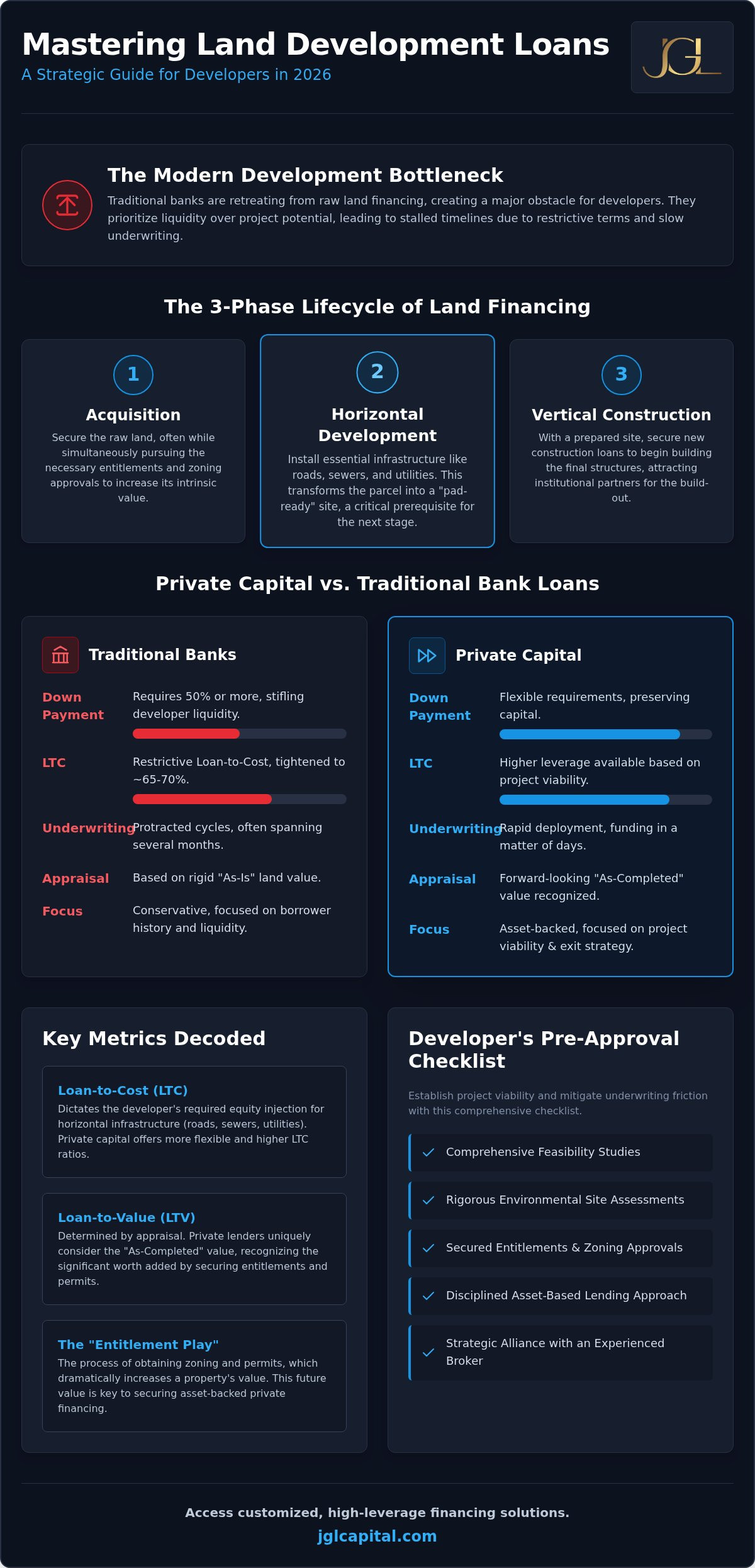
The progression of a project through the capital stack occurs in distinct, sequential phases, each requiring a tailored financial approach to ensure stability. Acquisition financing typically secures the property, often while the developer pursues the necessary entitlements to increase the land’s intrinsic worth. Once permits are secured, horizontal development funding covers the intensive infrastructure costs that transform a parcel into a buildable site. This phase is the critical precursor to securing new construction loans, as vertical lenders generally require a “pad-ready” site before committing to a project’s vertical integration. Successful execution during these early stages builds the intellectual capital necessary to attract institutional partners for the final build-out.
Private Capital vs. Traditional Bank Land Loans
Institutional banks maintain a conservative posture toward undeveloped land, frequently mandating down payments of 50% or more to mitigate potential volatility. This capital-intensive requirement can stifle a developer’s liquidity and stall project momentum. In contrast, customized land development loans through private money brokers prioritize the underlying project viability and the strength of the exit strategy over traditional credit metrics. While banks may struggle with underwriting cycles that span several months, private capital can be deployed in a matter of days. This speed allows developers to capitalize on time-sensitive opportunities without the constraints of rigid institutional mandates. Asset-backed underwriting focuses on the disciplined creation of value, ensuring that the financing aligns with the project’s strategic objectives rather than solely relying on a borrower’s personal financial history.
Key Metrics in Land Development Financing: LTV and LTC
The successful capitalization of horizontal projects rests upon the meticulous calibration of two primary financial metrics: Loan-to-Value (LTV) and Loan-to-Cost (LTC). While traditional Bank Financing for Land Development often adheres to rigid “As-Is” appraisals, private land development loans frequently incorporate the “As-Completed” value. This forward-looking perspective recognizes the ‘entitlement play’, which is the significant appreciation in worth that occurs once a parcel is zoned and permitted for its highest and best use. For multi-family projects, sophisticated lenders also evaluate the potential debt service coverage ratio (DSCR) of the future vertical asset to ensure the horizontal investment remains a bankable precursor to permanent financing.
Current market data indicates that while traditional banks have tightened their construction LTC from 80% down to approximately 65% or 70%, private capital remains more flexible. This flexibility is essential for funding the exhaustive costs of horizontal infrastructure, where the LTC ratio dictates the developer’s required equity injection for roads, sewers, and utility grids. Managing these ratios requires a disciplined approach to capital allocation to maintain project liquidity throughout the entitlement cycle.
Appraisal Methodologies for Raw and Developed Land
Appraisal accuracy serves as the fundamental cornerstone for securing commercial real estate loans. For initial acquisition, the Sales Comparison Approach provides a baseline by analyzing recent transactions of similar acreage. However, complex projects require the Subdivision Development Method, also known as Residual Land Value analysis. This technique subtracts the total development costs and expected profit from the projected gross sales of finished lots to determine the present value of the raw land. This analytical rigor ensures that the capital stack is rooted in realistic performance metrics rather than speculative optimism.
Structuring the Draw Schedule for Horizontal Work
Managing the disbursement of funds for horizontal improvements requires a disciplined draw schedule that aligns with physical site progress. Capital is injected in stages to cover specific milestones, such as clearing and grading, or the installation of deep utilities. Each draw request is typically verified by a third-party inspector to confirm that the work completed matches the funds requested. To preserve project integrity, developers should maintain a disciplined contingency plan to mitigate unforeseen cost overruns during the civil engineering phase. If you’re seeking a partner to help structure these complex capital requirements, engaging with an experienced broker can provide the necessary market intelligence to optimize your capital stack.
Strategic Advantages of Private Money for Land Projects
Private capital offers a distinct alternative to the rigid frameworks of traditional banking, particularly as institutional lenders maintain conservative postures toward undeveloped acreage. Unlike conventional lenders that prioritize borrower liquidity and personal income, private land development loans utilize asset-backed underwriting. This methodology places the intrinsic value and future potential of the property at the forefront of the credit decision, allowing the land’s utility to serve as the primary security. While government-backed programs such as USDA Rural Housing Site Loans provide essential support for specific rural residential initiatives, private money offers a broader, more flexible scope for commercial and high-density residential developments. By leveraging over 30 years of industry pattern recognition, a seasoned partner can identify latent project risks that conventional algorithms might overlook, ensuring that the loan structure remains resilient throughout the entitlement process.
Flexibility in maturity dates is another hallmark of private debt, providing a necessary buffer against unpredictable municipal approval timelines. Utilizing bridge loans allows developers to seize acquisition opportunities immediately, providing a transitional capital layer that remains in place until permanent financing or vertical construction loans are secured. This strategic use of transitional capital ensures that the developer maintains control of the site while finalizing the horizontal infrastructure plans required for institutional take-out.
Speed as a Competitive Moat
In the volatile market of 2026, the speed of execution has become a primary competitive moat for sophisticated developers. While traditional bank committees may take 30 to 45 days to reach a formal decision, private money brokers often finalize approvals within 3 to 5 days. This rapid deployment of capital enables developers to win competitive bids on prime parcels that would otherwise be lost to cash buyers. Bypassing the bureaucratic delays of institutional underwriting eliminates the significant opportunity cost associated with stalled project timelines, allowing site work to commence without the friction of conventional financing cycles.
Customized Capital Solutions
Sophisticated institutional sponsors often require non-recourse options to preserve their balance sheet integrity and minimize personal liability. Private capital solutions can be structured with interest-only periods during the horizontal phase, effectively preserving cash flow for critical site improvements like grading and utility installation. This alignment ensures that the debt service remains manageable while the developer executes on their broader real estate investing goals. By framing the relationship as a strategic alliance rather than a mere transaction, private lenders provide the agility necessary to navigate the complexities of modern land development.
The Developer’s Checklist: Preparing for Loan Approval
The systematic preparation of a project dossier is the definitive factor in compressing underwriting timelines for land development loans. Sophisticated lenders require a comprehensive site plan and a rigorous feasibility study to validate the project’s economic assumptions and long-term viability. This analytical rigor ensures that every claim regarding the land’s potential is grounded in market data rather than speculative optimism. Beyond the physical plan, developers must secure all necessary environmental reports, specifically Phase I and Phase II Environmental Site Assessments (ESA). These documents serve as essential risk-management tools, ensuring the parcel is free of liabilities that could impede future vertical development or institutional take-out.
A granular budget for horizontal infrastructure costs is equally vital, detailing every expenditure from site grading and clearing to the installation of deep utilities. This budget must be accompanied by proof of zoning and entitlement status, as these legal permissions establish the project’s “shovel-ready” value. By presenting a disciplined and well-documented proposal, you demonstrate the professional stewardship required to manage complex capital allocations effectively.
The Importance of the Exit Strategy
The exit strategy is the most critical component of a successful loan application. Because undeveloped land does not produce immediate cash flow, private capital partners and hard money lenders prioritize the exit over the entry to ensure a clear path to repayment. Common strategies include refinancing into a traditional construction loan once horizontal work is complete or selling “finished lots” to national homebuilders who seek pad-ready sites. A credible exit strategy provides the security necessary for lenders to commit high-leverage capital, as it outlines a logical transition from a speculative asset to a bankable institutional product.
Documentation Requirements for Asset-Based Loans
Professional borrowing requires a formal entity structure, typically an LLC or corporation, to ensure the loan is treated as a commercial transaction. Lenders will require title reports and ALTA surveys to confirm a clean path to ownership, free of undisclosed liens or easements that might restrict development. Additionally, fully executed Purchase and Sale Agreements (PSA) with clear assignment clauses are necessary to define the terms of the acquisition. If you’re ready to advance your project from raw land to a shovel-ready asset, consult with our strategic advisory team to review your documentation and optimize your capital stack for rapid execution.
JGL Capital: Your Strategic Partner in Land Development
JGL Capital LLC operates as a specialized private money broker, providing sophisticated developers with a strategic gateway to a vast network of private capital. By utilizing a brokerage model, the firm transcends the limitations of single-source lending, offering a highly customized approach to land development loans that aligns with the specific lifecycle of each project. This model is particularly effective for large-scale residential, multi-family, and commercial land projects where the complexity of horizontal infrastructure requires a disciplined and nuanced understanding of capital allocation. While the firm maintains a national reach, it retains the agility and discretion of a boutique private money entity, ensuring that high-stakes transactions receive the individual attention and analytical rigor they deserve.
The firm’s commitment to excellence is reflected in its focus on asset-backed underwriting, a process that emphasizes property value over traditional credit metrics. This approach is essential for developers who require rapid execution to maintain project momentum in a competitive landscape. By positioning itself as a strategic ally rather than a mere service provider, JGL Capital LLC ensures that every capital allocation is designed to bridge the gap between speculative acreage and shovel-ready vertical construction.
Why Sophisticated Developers Choose JGL Capital LLC
The firm’s value proposition is rooted in over 30 years of combined industry expertise, a history that provides the pattern recognition necessary to navigate volatile market cycles. This deep-seated knowledge allows for the precise articulation of strategic objectives, particularly for projects requiring capital in excess of $10 million. Sophisticated partners choose to align with JGL Capital LLC because the firm prioritizes the creation and preservation of value, viewing every transaction as an opportunity to build a lasting legacy through a strategic alliance. The focus remains on asset-backed underwriting, where the property’s intrinsic worth and development potential are evaluated with the gravity that high-stakes management demands.
Initiating Your Land Development Project
Securing capital for horizontal infrastructure begins with a consultative evaluation of the project’s core philosophies and strategic milestones. JGL Capital LLC employs a methodical approach to project review, ensuring that your development goals are perfectly synchronized with the most appropriate private capital sources. This steady, measured pace of analysis ensures that every claim is qualified and every strategy is clearly defined before deployment. If you’re managing a significant land acquisition and require a partner who values integrity and long-term growth, contacting JGL Capital LLC for a professional review is the first step toward securing a disciplined capital solution. By framing this engagement as a high-level strategic alliance, the firm ensures that your project is positioned for a successful transition from raw land to a bankable vertical asset.
Advancing Your Horizontal Vision through Disciplined Capital Allocation
The transformation of raw land into a bankable institutional asset requires more than just a vision; it demands a disciplined approach to capital structure and risk mitigation. By mastering the technical nuances of land development loans, you can bridge the critical gap between acquisition and vertical construction with precision. This strategic guide has detailed the essential role of asset-backed underwriting and the importance of ‘As-Completed’ appraisals in establishing project viability. JGL Capital LLC serves as a seasoned steward in this complex landscape. We leverage 30+ years of private money expertise to facilitate high-value transactions that traditional banks often overlook. Through our extensive national brokerage network, we provide the stability and analytical rigor necessary to optimize terms for even the most intricate horizontal projects. If you’re prepared to elevate your next venture through a collaborative partnership, we invite you to Secure Strategic Capital for Your Next Land Development Project. We look forward to helping you build a lasting legacy through careful, deliberate action.
Frequently Asked Questions
What is the difference between a land loan and a land development loan?
A land loan primarily facilitates the acquisition of a specific parcel, whereas land development loans encompass both the purchase and the subsequent horizontal infrastructure improvements. These improvements include the installation of roads, sewer systems, and essential utilities necessary to transform raw land into a buildable site. While the former secures the physical asset, the latter provides the capital required for the civil engineering phase that precedes vertical construction.
Can I get a land development loan with no money down?
Securing financing for horizontal projects with zero equity is generally not feasible within a disciplined credit environment. Lenders typically require a significant capital commitment to align interests and mitigate risk, with raw land often requiring down payments between 30% and 50% in the current 2026 market. Improved land may qualify for lower requirements, ranging from 20% to 30%, though 100% financing is reserved for specific government-backed programs rather than private asset-based lending.
How long does it typically take to close on a private land loan in 2026?
Private money brokers can often finalize approvals and close transactions within 3 to 5 business days, providing a vital speed advantage over traditional institutions. In contrast, conventional banks typically require 30 to 45 days for their protracted underwriting cycles. This rapid deployment of capital is essential for developers seeking to secure prime parcels before competitors can navigate the bureaucratic delays of traditional loan committees.
Does JGL Capital LLC require a minimum credit score for land financing?
JGL Capital LLC prioritizes the underlying property value and the credibility of the exit strategy over traditional credit metrics such as FICO scores. While institutional lenders often mandate a minimum score of 680 for land-related financing, our asset-backed underwriting focuses on the project’s intrinsic potential. This approach allows us to serve as a strategic ally for experienced developers who possess substantial intellectual capital but seek flexible financing solutions.
What are the typical interest rates for land development loans?
Current market data for 2026 indicates that traditional lenders offer rates between 6.5% and 10.0%, while private money options generally range from 8.5% to 14% on an interest-only basis. These rates reflect the inherent risk of undeveloped acreage and the premium for rapid execution. Additionally, private land development loans may involve 4 to 6 points, whereas traditional bank financing for improved lots often requires a lower initial cost at the expense of speed.
How does the draw process work for horizontal infrastructure?
The draw process is structured around specific civil engineering milestones, ensuring that capital is released in alignment with physical site progress. Funds are typically disbursed for clearing, grading, and utility installation after a third-party inspector verifies the completion of each phase. This disciplined methodology preserves project liquidity while ensuring that the lender’s exposure remains balanced against the increasing value of the improved land.
Can land development loans be used for multi-family projects?
These loans are frequently utilized to prepare sites for high-density multi-family developments, particularly under new regulations like Florida’s HB 1389. Horizontal financing allows developers to install the necessary infrastructure to create pad-ready sites, which are essential for securing future vertical construction loans. By bridging the gap to vertical integration, these loans serve as a critical component in the lifecycle of institutional residential projects.
What happens if my entitlement process takes longer than the loan term?
If municipal approval cycles exceed the initial loan term, developers can often negotiate extensions or transition into short-term bridge capital. Maintaining transparent communication regarding permit status and site progress is vital for securing these extensions with private lenders. Because private capital is more agile than traditional bank debt, it can be customized to accommodate the unpredictable nature of zoning and entitlement timelines without triggering default.