

The traditional reliance on personal credit capacity as the primary engine for portfolio growth is no longer a viable strategy for the sophisticated investor in 2026. As the market matures, the constraints of debt-to-income ratios and the sluggish pace of conventional banking institutions often result in missed opportunities within high-velocity markets. Securing the right financing for short-term rental properties now requires a transition toward institutional-grade capital structures that prioritize the intrinsic value of the asset over the personal financial history of the borrower.
It’s likely you recognize that qualifying properties based on projected Airbnb or Vrbo revenue is the only logical path toward meaningful expansion, yet traditional lenders remain tethered to archaic lease-based underwriting. This comprehensive analysis provides a disciplined framework for leveraging asset-based debt, such as DSCR and bridge loans, to facilitate rapid but secure portfolio growth. We will examine the current 2026 landscape of non-recourse solutions, the impact of localized regulatory shifts across diverse markets, and the strategic advantages of aligning with JGL Capital LLC, a capital partner that values long-term stability over transactional speed.
Key Takeaways
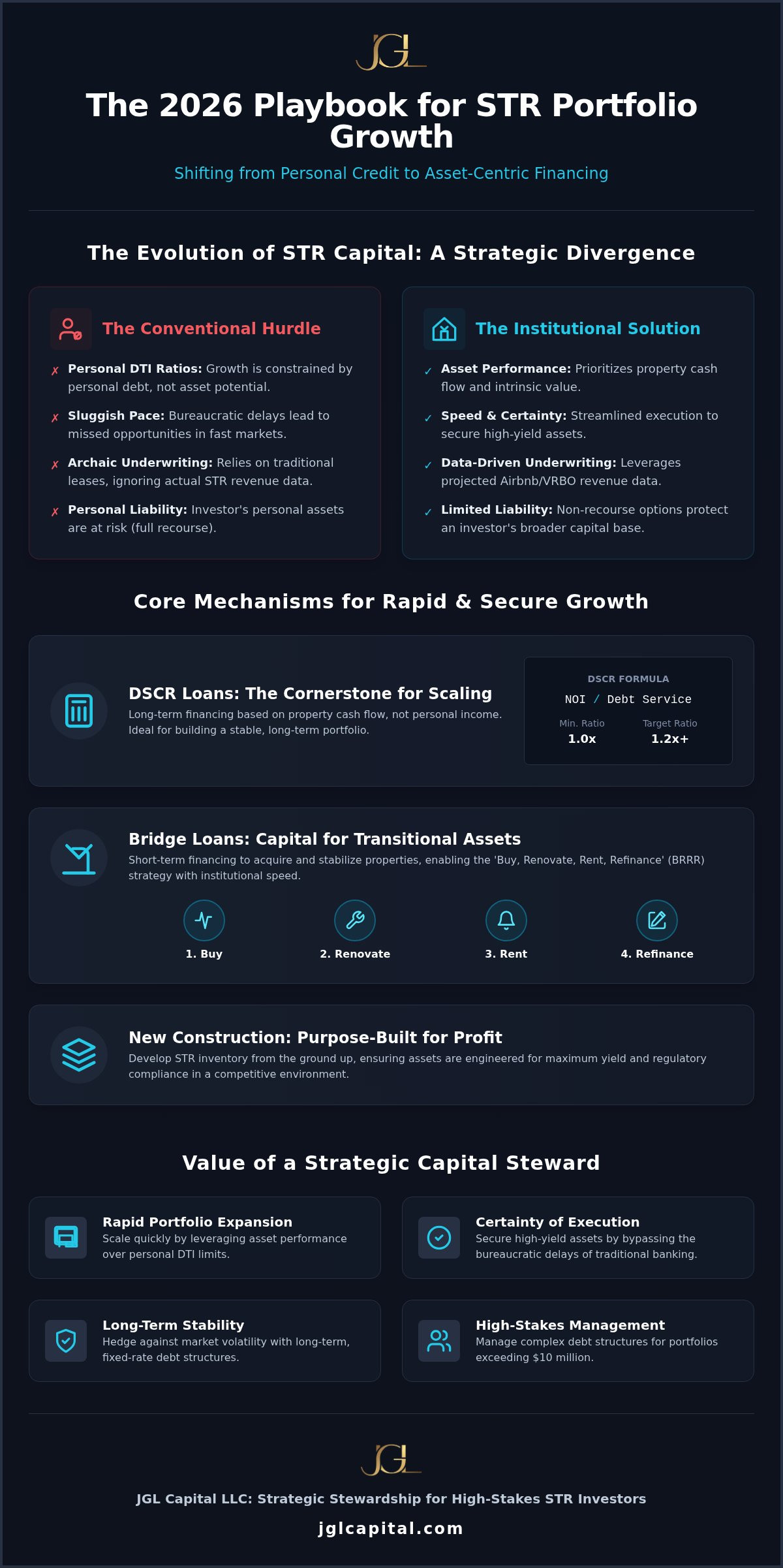
- Understand the institutional shift toward asset-centric underwriting, which prioritizes property performance over personal debt-to-income ratios to facilitate rapid portfolio expansion.
- Discover how to optimize financing for short-term rental properties by leveraging 2026 DSCR metrics that utilize projected platform revenue rather than traditional long-term lease data.
- Identify the strategic role of bridge loans in managing transitional assets, allowing investors to execute the ‘Buy, Renovate, Rent, Refinance’ strategy with speed and certainty.
- Explore the advantages of utilizing new construction financing to develop purpose-built inventory, ensuring assets are engineered for maximum yield in a competitive regulatory environment.
- Learn the value of establishing a long-term alliance with a strategic capital steward capable of managing complex, high-stakes debt structures exceeding $10 million.
The Evolution of Short-Term Rental Financing: Beyond Conventional Constraints
The landscape of short-term rentals (STR) has undergone a profound transformation. What was once considered a fragmented, secondary market for individual property owners has matured into a sophisticated institutional asset class. By 2026, the influx of professional management and purpose-built developments has necessitated a parallel evolution in capital deployment strategies. Traditional banking models, which rely heavily on personal debt-to-income (DTI) ratios, often fail to recognize the significant yield potential inherent in high-performance vacation properties. This mismatch between asset performance and archaic underwriting criteria creates a strategic gap that only specialized financing for short-term rental properties can effectively bridge.
The Institutionalization of the STR Market
The current market environment is defined by a decisive shift toward data-driven validation. Institutional underwriters now utilize granular performance metrics from third-party data aggregators to verify revenue projections, replacing the conservative, often inaccurate estimates used in years past. This transition has paved the way for purpose-built STR assets; these are properties designed specifically for high-turnover hospitality rather than long-term residential occupancy. Such assets demand a nuanced understanding of market volatility and seasonal cash flows. Conventional residential lenders aren’t equipped to manage these complexities, as their models are built for stability rather than the dynamic performance of a hospitality-driven real estate portfolio.
Conventional vs. Private Capital: A Strategic Divergence
Professional developers frequently encounter significant friction when they attempt to scale portfolios through traditional retail banks. The primary obstacle remains the rigid adherence to personal DTI requirements. These constraints effectively penalize the investor for their existing leverage, regardless of whether that debt is supported by robust, self-sustaining cash flows. Asset-backed lending offers a disciplined alternative. By prioritizing the property’s performance and its specific Debt Service Coverage Ratio, private capital provides the speed and certainty of execution required to secure high-yield assets. In a market where closing times can dictate the success of an acquisition, the ability to bypass the bureaucratic delays of traditional mortgages is a critical advantage. This strategic shift toward specialized financing for short-term rental properties allows for the creation of durable, long-term value that isn’t tethered to personal liability or personal income constraints.
DSCR Loans: The Core Mechanism for Short-Term Rental Growth
Debt Service Coverage Ratio (DSCR) loans represent the primary vehicle for scaling a short-term rental enterprise without the friction of personal income verification. In the 2026 credit environment, lenders have refined their underwriting to accommodate the inherent volatility of the hospitality sector. By evaluating the asset’s specific cash flow against its debt obligations, these loans empower investors to secure financing for short-term rental properties based on real-world performance. This shift toward asset-centric underwriting allows for the utilization of 30-year fixed-rate products, which provide a hedge against interest rate volatility and serve as a cornerstone for long-term wealth preservation. Furthermore, the inclusion of non-recourse features in many institutional DSCR products ensures that an investor’s broader capital base remains insulated from property-specific liabilities.
Calculating DSCR for Vacation Rental Assets
The fundamental calculation for DSCR involves dividing the property’s annual Net Operating Income (NOI) by its total annual debt service. For short-term rental assets, underwriters typically require a minimum ratio of 1.0, though higher-leverage opportunities often demand a ratio of 1.2 or greater. Unlike traditional real estate financing options, 2026 underwriting standards heavily weight projected gross revenue from platforms such as Airbnb and VRBO, often validated by third-party data providers. It’s essential to account for professional management fees, which can range from 15% to 30% of gross revenue, as these significantly impact the final coverage ratio. Seasonal fluctuations are also meticulously modeled to ensure the property remains solvent during off-peak months.
Strategic Portfolio Expansion via DSCR
One of the most compelling advantages of the DSCR model is the ability to facilitate simultaneous acquisitions across diverse geographic markets. Since the debt is tied to the asset rather than the individual’s debt-to-income ratio, sophisticated investors can maintain a high velocity of growth. Many of these rental property loans feature non-recourse or limited-recourse provisions, which effectively insulate the borrower’s broader capital base from property-specific risks. This structural protection is vital for high-net-worth stakeholders focused on building a resilient, diversified footprint. Aligning with an experienced partner can help you optimize your debt stack to maximize cash-on-cash returns while preserving institutional-grade stability.
Bridge Loans and Transitional Capital for STR Acquisitions
Transitional capital serves as a vital instrument for investors who identify high-potential assets that currently lack the stabilization required for long-term debt. Within the lifecycle of a portfolio, bridge loans provide the immediate liquidity necessary to secure properties that may require renovation or lack a documented history of short-term rental performance. This short-term debt is particularly effective for executing the ‘Buy, Renovate, Rent, Refinance’ (BRRRR) strategy, where the objective is to force appreciation and stabilize the asset before transitioning to permanent financing. While the interest rates for bridge capital are naturally higher than those of stabilized products, the cost must be measured against the opportunity cost of a lost acquisition in a competitive market. Utilizing creative financing strategies allows sophisticated developers to maintain momentum without being hindered by the lengthy approval processes of conventional institutions.
Bridge to DSCR: The Refinance Exit Strategy
The efficacy of bridge debt is entirely dependent on a clearly articulated exit strategy. Investors must structure their transitional capital with a focus on future institutional-grade financing for short-term rental properties. Managing interest rate risk during this phase is paramount; this often involves utilizing interest-only structures to maximize cash flow during the renovation period. A seasoned capital steward ensures that the initial bridge loan is perfectly aligned with the requirements of the ultimate DSCR take-out loan. This foresight prevents the common pitfall of securing entry capital that complicates the transition to long-term stability. It’s a disciplined approach that prioritizes the preservation of capital across the entire project lifecycle.
Commercial Bridge Loans for Multi-Unit STR Projects
Scale often leads investors toward larger, multi-family assets that are operated exclusively as vacation rental complexes. These projects require specialized commercial real estate loans that account for the unique underwriting nuances of multi-unit STR operations. For high-stakes projects exceeding $10 million, bridge solutions offer the flexibility to reposition underperforming apartments into high-yield hospitality assets. Underwriters in this space focus on the aggregate performance of the units and the strength of the management team rather than the credit profile of the individual sponsor. Partnering with a firm that specializes in high-value, complex projects ensures that your capital structure remains robust throughout the entire transitional period.
New Construction Financing for Purpose-Built STR Assets
The emergence of purpose-built inventory signifies a decisive maturation within the hospitality real estate sector. By 2026, sophisticated developers have increasingly favored ground-up projects to ensure that every square foot is meticulously engineered for maximum yield and operational efficiency. Utilizing specialized new construction loans provides the institutional leverage required to create high-performance inventory that meets the expectations of modern travelers. This strategic approach to financing for short-term rental properties allows sponsors to bypass the cumbersome requirements of traditional banks, which frequently lack the analytical tools to underwrite non-stabilized developments. Private capital facilitates a more disciplined management of draw schedules and interest-only periods, ensuring that necessary liquidity is preserved throughout the duration of the build phase.
Underwriting the Future Value of STR Developments
Institutional underwriters assess these developments based on their projected “as-completed” value, a process that demands a high degree of analytical rigor. This evaluation relies heavily on detailed pro-formas that incorporate local market saturation data and projected occupancy rates validated by specialized platforms. By focusing on the intrinsic value of the completed asset rather than the sponsor’s personal debt-to-income ratio, private lenders can provide higher loan-to-cost (LTC) ratios. It’s this level of scrutiny that ensures the capital structure remains resilient against market fluctuations during the development lifecycle. Mitigating the inherent risks of construction is often achieved through strategic alliances with experienced developers who have a proven history of delivering complex projects on schedule.
Ground-Up Development vs. Major Renovations
Selecting the optimal capital path involves a careful analysis of the project’s scale and the specific demands of the local market. While ground-up development allows for the creation of bespoke hospitality assets, major renovations often require a more agile form of capital. Investors who don’t want to lose a competitive edge frequently utilize hard money lenders for rapid-deployment renovation capital. This is particularly effective when speed of execution is the primary competitive advantage. For projects involving land acquisition or horizontal development, highly customized financing for short-term rental properties is necessary to maintain momentum. To ensure your next project is backed by institutional-grade capital, you should engage with a strategic capital steward who understands the nuances of high-stakes development.
JGL Capital LLC: Strategic Stewardship for High-Stakes STR Investors
JGL Capital LLC operates on a foundational principle of strategic stewardship, recognizing that the deployment of high-stakes capital requires more than simple transactional facilitation. With a history spanning over 30 years, our firm provides the analytical rigor and disciplined approach necessary to navigate the complexities of financing for short-term rental properties at scale. We specialize in securing bespoke capital for transactions exceeding $10 million, ensuring that sophisticated investors can bypass the structural limitations of traditional banking. By prioritizing the alignment of institutional expertise with specific investor objectives, JGL Capital LLC streamlines the progression from initial analysis to funded asset, removing the bureaucratic delays that often impede portfolio expansion.
Customized Solutions for Sophisticated Portfolios
The preservation of liquidity is as vital as the acquisition of the asset itself. Our debt structures are meticulously engineered to enhance overall portfolio resilience, allowing high-net-worth stakeholders to maintain a robust capital position while leveraging asset-based debt. Through our extensive national reach, JGL Capital LLC facilitates growth across diverse vacation rental markets, providing a consistent standard of excellence regardless of the geographic location. This deliberate approach to capital allocation ensures the creation of lasting legacies, grounded in the timeless principles of value preservation and strategic growth. We act as a quiet expert, relying on our established history and intellectual capital to deliver results that transactional competitors cannot replicate.
Initiating the Strategic Alliance
The path toward a successful acquisition begins with a collaborative evaluation of your next high-value project. Our process is defined by a thorough assessment of the asset’s performance potential and its integration into your broader strategic goals. During the institutional-grade underwriting phase, investors can expect a level of precision and transparency that reflects our commitment to integrity. JGL Capital LLC maintains a measured pace that values accuracy over haste, ensuring that every claim is qualified and every risk is clearly defined before closing. By framing our activities as a strategic alliance, we provide the stability required for sophisticated financing for short-term rental properties. Consult with JGL Capital LLC to optimize your short-term rental debt structure.
Strategic Capital Alignment for the Next Era of Hospitality
The transition from personal liability to institutional-grade capital structures is the defining shift for successful investors in 2026. By prioritizing asset performance through DSCR metrics and utilizing transitional bridge capital for complex acquisitions, you ensure your portfolio is built on a foundation of analytical rigor rather than individual credit constraints. Purpose-built developments and high-value renovations require a disciplined approach that traditional institutions often fail to provide. Lenders often lack flexibility. Those who don’t understand the nuances of the hospitality sector typically cannot accommodate rapid expansion or complex debt stacks.
Optimizing your approach to financing for short-term rental properties involves more than securing a loan; it requires a strategic alliance with a partner that understands the gravity of high-stakes management. JGL Capital LLC provides over 30 years of strategic lending expertise, specializing in high-value transactions exceeding $10 million with national asset-backed lending capabilities. Our commitment to value preservation ensures that your capital structure remains resilient as the market matures and regulations evolve. We act as a disciplined steward for your vision, providing the stability and intellectual capital necessary for lasting success.
Secure Institutional Capital for Your STR Portfolio with JGL Capital LLC. We look forward to facilitating your long-term expansion through a shared vision of excellence and strategic growth.
Frequently Asked Questions
What is a DSCR loan for a short-term rental property?
A DSCR loan is a debt instrument where qualification is based on the property’s ability to cover its debt service rather than the borrower’s personal income. It’s the standard for financing for short-term rental properties in 2026. Lenders calculate the ratio by dividing net operating income by total annual debt. A ratio of 1.0 or higher is typically required to ensure the asset is self-sustaining and capable of supporting its own leverage.
Can I use projected Airbnb income to qualify for a rental property loan?
Yes, sophisticated lenders now utilize projected revenue from platforms like Airbnb and Vrbo to underwrite rental property loans. This process involves validating data through third-party aggregators to ensure projections are grounded in local market performance. It’s a significant shift from traditional models that required signed leases. This approach allows investors to secure higher loan amounts based on the actual earning potential of a vacation rental asset rather than conservative long-term averages.
How do bridge loans differ from traditional mortgages for vacation rentals?
Bridge loans are short-term, interest-only facilities typically lasting 12 to 36 months, whereas traditional mortgages are long-term, amortizing products. They serve as transitional capital for properties that don’t yet meet stabilized DSCR requirements, such as those undergoing renovation. While traditional mortgages focus on permanent stability, bridge debt prioritizes flexibility and speed. This allows investors to secure an asset and force appreciation before transitioning into a more permanent, institutional-grade debt structure.
Are there financing options for new construction STR projects?
Specialized financing for short-term rental properties includes construction-to-permanent loan programs specifically for purpose-built assets. These projects usually follow a two-loan process: a short-term construction loan followed by a refinance into a long-term DSCR loan once the certificate of occupancy is issued. This structure allows developers to manage the build phase with interest-only payments. It ensures that the capital stack remains optimized as the project moves from ground-up development to operational status.
What are the typical down payment requirements for an institutional STR loan?
Typical down payment requirements for institutional-grade STR loans range between 20% and 25% for high-credit borrowers. For investors with lower credit scores or those seeking higher leverage on complex assets, a 30% down payment may be required to mitigate risk. These thresholds ensure that there is sufficient equity in the deal to withstand market fluctuations. Maintaining this equity cushion is a standard practice among disciplined lenders focused on long-term value preservation.
Is personal income verification required for asset-backed STR financing?
Personal income verification and debt-to-income (DTI) requirements are generally omitted in asset-backed STR financing. The underwriting process focuses almost exclusively on the property’s debt service coverage and the borrower’s experience in the hospitality sector. This allows sophisticated partners to expand their portfolios without being limited by their personal tax returns or existing personal debt. It’s a more logical approach for professional developers who manage real estate as a distinct business entity.
How quickly can a private money loan close for a competitive STR deal?
Private money loans can often close in significantly less time than traditional bank financing, sometimes within a matter of days. This speed of execution is vital for securing assets in competitive markets where delays can lead to lost opportunities. By utilizing a streamlined underwriting process that ignores personal DTI constraints, private capital providers offer a level of certainty that conventional lenders cannot match. It’s a strategic advantage for investors who need to deploy capital quickly.
What is the minimum loan amount JGL Capital LLC typically handles for STR portfolios?
JGL Capital LLC specializes in high-value transactions, typically handling loan amounts of $10 million and greater for short-term rental portfolios. Our firm’s focus is on serving high-net-worth stakeholders and institutional partners who require sophisticated, bespoke debt solutions for large-scale acquisitions. By maintaining this minimum threshold, we ensure that every project receives the analytical rigor and dedicated stewardship necessary for high-stakes management. We prioritize building lasting legacies through careful, deliberate capital allocation.