

The distinction between a successful real estate acquisition and a catastrophic capital failure often rests not on the headline interest rate, but on the institutional integrity of the chosen financing partner. You likely recognize that the private lending market, while offering essential liquidity for complex projects, remains a landscape where the burden of due diligence falls squarely upon the borrower’s shoulders. Identifying specific hard money lender red flags is a prerequisite for protecting your project’s solvency and ensuring that your capital partner possesses the actual reserves necessary to reach the closing table without unnecessary delays or hidden complications.
This analysis provides a rigorous framework to help you distinguish between professional, institutional-grade lenders and predatory entities that utilize vague term sheets or demand significant upfront fees before a loan is even approved. By the conclusion of this guide, you’ll possess a comprehensive checklist for lender verification that aligns with the disciplined standards of asset-backed finance. We will examine the critical indicators of lender instability, clarify the difference between standard industry costs and deceptive practices, and establish a methodology for securing a strategic alliance that prioritizes long-term value and the preservation of equity over mere transactional gain.
Key Takeaways
- Differentiate between institutional-grade private capital and predatory lending through a rigorous assessment of contractual transparency and operational history.
- Identify critical hard money lender red flags, such as the solicitation of non-refundable fees or significant deposits prior to the execution of a formal term sheet.
- Mitigate capital uncertainty by verifying direct access to liquidity and avoiding “Daisy Chain” scenarios where intermediaries lack the authority to commit funds.
- Utilize a structured due diligence framework that prioritizes executive background checks and the verification of successfully funded projects within your specific asset class.
- Secure a strategic alliance with a disciplined capital steward to ensure the alignment of long-term objectives and the preservation of property value.
The Private Capital Landscape: Why Identifying Hard Money Lender Red Flags is Essential
The allocation of private capital represents a fundamental pillar within modern real estate development, particularly as traditional banking institutions continue to tighten their credit facilities. While the agility of non-bank financing is a significant advantage, the absence of stringent federal oversight necessitates a heightened level of vigilance from sophisticated investors. Recognizing hard money lender red flags isn’t merely an exercise in risk mitigation; it’s a critical component of professional fiduciary responsibility. A failure to distinguish between a disciplined capital steward and a predatory operator can jeopardize the solvency of high-stakes construction projects, leading to terminal delays and the erosion of equity. Professional capital providers prioritize the preservation of value through analytical rigor, whereas unregulated entities often obscure their lack of liquidity with aggressive marketing or opaque terms.
The Evolution of Private Money in 2026
As of August 2026, the U.S. asset-based lending market has expanded to exceed $465 billion, reflecting a systemic shift toward property-value-centric underwriting models. This growth has attracted a diverse array of market participants, some of whom lack the institutional history or capital reserves required for large-scale execution. Sophisticated partners prioritize capital certainty over the nominal interest rate, understanding that a lower quote is irrelevant if the lender fails to fund at the closing table. The current environment demands a meticulous review of a lender’s operational track record to ensure they possess the stability to support multi-family or commercial developments throughout the entire project lifecycle. Speed of execution is a valuable commodity, but it must never serve as a justification for reduced contractual transparency.
Defining the Professional Standard in Asset-Backed Loans
A disciplined approach to private financing is characterized by absolute transparency and a commitment to strategic alignment. For those seeking a Hard money loan overview, it’s clear that these instruments are designed for short-term, asset-centric needs rather than long-term residential occupancy. Professional firms act as quiet experts, relying on intellectual capital rather than high-pressure tactics to secure partnerships. They provide clear, balanced term sheets that define every metric of performance and responsibility. Identifying hard money lender red flags early in the negotiation phase allows for a strategic pivot before capital is committed. By framing the relationship as a strategic alliance rather than a simple transaction, a legitimate lender ensures that their objectives are perfectly synchronized with the borrower’s vision for value generation. This level of professional maturity is often the product of decades of industry experience, ensuring that every claim is qualified and every strategy is clearly defined.
The Proliferation of Upfront Fee Schemes and Predatory Deposits
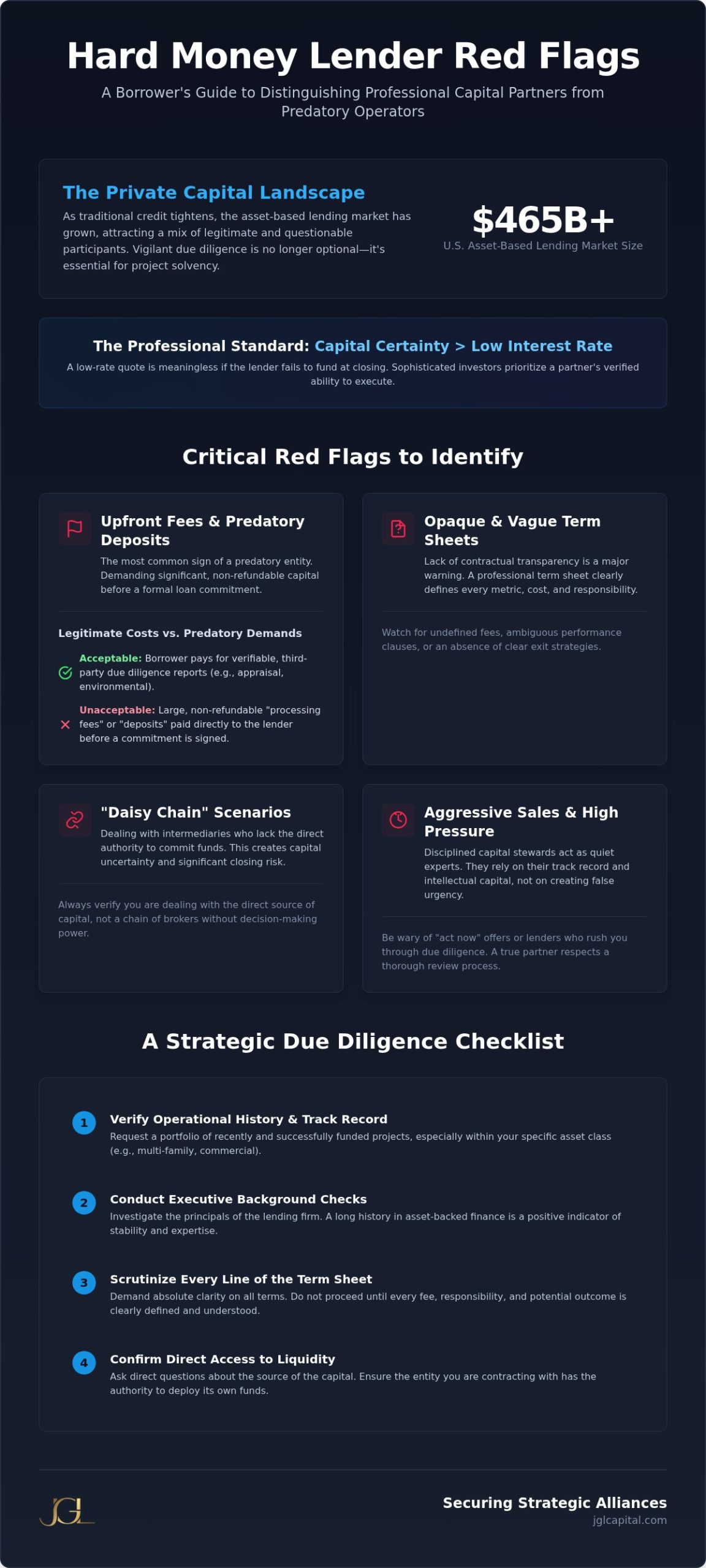
The mobilization of private capital necessitates a clear distinction between necessary transactional costs and predatory fee structures. Sophisticated borrowers must remain vigilant, as the request for capital prior to the formalization of a debt facility is one of the most prevalent hard money lender red flags. While the underwriting of complex commercial or multi-family assets requires legitimate third-party expenditures, these costs should never be used as a veil for non-refundable retainers that provide no guarantee of funding. A disciplined capital partner operates with a transparency that ensures every dollar requested is tied to a specific, verifiable service that advances the due diligence process.
Legitimate Underwriting Costs vs. Predatory Demands
In professional asset-backed lending, the borrower typically carries the cost of third-party reports, including appraisals, environmental assessments, and site inspections. These expenditures are necessary to establish the underlying value of the collateral and are a standard part of the risk assessment lifecycle. A significant warning sign arises when a lender demands “commitment fees” or “application retainers” before providing a definitive term sheet. Legitimate firms operate with a level of institutional maturity that precludes the need for such speculative deposits. If a lender requests “upfront insurance fees” or “processing retainers” that aren’t credited toward closing costs, it’s a clear signal of an undisciplined, or potentially fraudulent, operation. You should always demand a line-item breakdown of every anticipated pre-closing expense to ensure the alignment of financial interests and the preservation of your project’s liquidity.
The Risks of Unverified Wire Transfers
The security of capital during the pre-closing phase is a non-negotiable aspect of high-stakes management. Predatory entities often pressure borrowers to wire funds directly to corporate or personal accounts for “due diligence purposes.” This practice bypasses the essential protections provided by reputable, third-party title companies or escrow agents. A disciplined steward of capital will always utilize established escrow protocols to manage third-party service payments, ensuring that funds are only released upon the completion of specific milestones. Verifying the legitimacy of a capital partner involves assessing their institutional history and their adherence to standardized financial safeguards. For those prioritizing the preservation of value, aligning with a disciplined private money broker with a decades-long track record provides the necessary security to move forward with confidence. Analytical rigor must extend to the very mechanics of how funds are transferred and held, ensuring that your equity remains protected from unauthorized depletion throughout the underwriting process.
Assessing Operational Transparency and Capital Certainty
Capital certainty serves as the fundamental bedrock of successful real estate development. Without it, even the most sophisticated project remains vulnerable to market shifts and operational paralysis. One of the most insidious hard money lender red flags involves the “Daisy Chain” phenomenon, where a purported lender is actually a broker without direct access to capital. These intermediaries often lack the authority to commit funds, leading to a precarious situation where a deal may collapse at the final hour because the ultimate source of liquidity declined the risk. A professional capital partner must demonstrate a clear, direct path to their reserves and provide transparent insight into their decision-making hierarchy. Analytical rigor requires you to verify the lender’s institutional track record and the physical presence of their operations before committing your equity to a partnership.
Verifying the Source of Capital
Determining whether you’re engaging with a direct lender or a multi-layered broker is a critical step in your due diligence. You must ask pointed questions regarding the origin of their funds and the specific individual who holds final approval authority. Broker-heavy structures often result in compounded fees and significant closing delays, as each layer of the transaction introduces new variables and potential points of failure. This reliability is especially vital for new construction loans, which require a consistent and predictable funding schedule for monthly construction draws. If a lender cannot provide a verifiable institutional history or documented proof of recently funded projects, it’s highly likely they lack the operational infrastructure to support high-stakes management.
Analyzing Term Sheet Ambiguity
The presentation of a term sheet serves as a primary indicator of a firm’s institutional maturity. Vague or overly complex loan documents that obscure the true cost of capital are significant hard money lender red flags. A disciplined steward of capital provides a methodical breakdown of all origination fees, leaving no room for “junk fees” that can quietly erode project margins. Industry standards for origination fees typically range between 1.5 and 3 points; any deviation from this range should be accompanied by a clear, asset-backed justification. Transparency is a metric of professional integrity. Any attempt to hide costs within dense legalese suggests a lack of alignment with your long-term objectives. This disciplined approach distinguishes a quiet expert from a transactional competitor who relies on ambiguity to secure a commitment.
A Strategic Due Diligence Checklist for Private Money Partnerships
Professional capital allocation requires a proactive rather than reactive stance. While the preceding sections identified specific hard money lender red flags, this checklist provides a methodical path toward verification. It’s essential to move beyond the surface-level attraction of quick liquidity to evaluate the structural integrity of the lending firm itself. A disciplined borrower recognizes that a lender’s internal processes are just as important as the capital they provide. This rigorous approach ensures that your project is supported by a partner capable of navigating the complexities of high-stakes asset management.
- Step 1: Executive Leadership Review. Conduct a thorough background check on the firm’s executive leadership to ensure a history of ethical management and financial stability.
- Step 2: Proof of Performance. Request documented proof of recently funded projects that are similar in both scope and asset class to your current project.
- Step 3: Underwriting Evaluation. Analyze the responsiveness and technical proficiency of the underwriting team; a lack of technical depth often signals a lack of actual capital control.
- Step 4: Objective Alignment. Review the proposed term sheet to ensure that the lender’s exit requirements and interest structures align with your project’s pro forma.
- Step 5: Specialized Expertise. Verify the lender’s specific experience in commercial real estate loans to ensure they understand the nuances of institutional-grade underwriting.
Evaluating Intellectual Capital and Industry Expertise
The distinction between a transactional broker and a disciplined capital steward often lies in their intellectual capital. Thirty years of industry expertise provides a necessary buffer during volatile market cycles, allowing for a more nuanced approach to risk than a newer firm might offer. Sophisticated partners should look for a “quiet expert” whose reputation is built on a history of successful execution rather than aggressive marketing hyperbole. This depth of knowledge is particularly critical when implementing complex real estate investing strategies that require a partner capable of understanding intricate capital stacks. A lack of industry-specific terminology or a failure to grasp project-specific hurdles are significant hard money lender red flags that suggest a lack of institutional maturity.
The Professional Reference Audit
A rigorous due diligence process must include a direct audit of a lender’s professional references. Contacting previous institutional partners allows you to verify the consistency of the funding process across various asset classes. It’s particularly useful to inquire about the lender’s conduct during project challenges or requested extensions. A reliable partner remains steady and collaborative when variables change, whereas an undisciplined lender may resort to high-pressure tactics or predatory adjustments. If you’re ready to align with a partner that values analytical rigor and the preservation of equity, you can begin your strategic consultation with JGL Capital to ensure your project receives the institutional support it deserves. This audit ensures that your chosen partner possesses the stability and integrity necessary for a long-term strategic alliance.
Establishing Strategic Alliances with Disciplined Capital Stewards
The JGL Capital Philosophy: Analytical Rigor and Stability
JGL Capital LLC operates as a disciplined steward of capital, leveraging over thirty years of industry expertise to provide a streamlined alternative to traditional banking. Our model prioritizes the intrinsic value of the asset, which allows us to bypass the bureaucratic delays and personal credit constraints that often hinder conventional financing. Whether you’re researching hard money lenders in Florida or seeking a partner for a national multi-family project, our approach remains rooted in timeless principles. We specialize in sophisticated debt facilities, often exceeding $10 million, ensuring that every loan is meticulously structured to support the long-term legacy of our partners. This focus on property value over speculative trends further solidifies our position as a knowledgeable entity in the private capital landscape.
Initiating the Partnership: Precision in Underwriting
A professional partnership begins with a precise exchange of data and a mutual understanding of strategic objectives. To initiate a formal review, you should prepare a comprehensive data package that includes project pro formas, site plans, and a clear articulation of the exit strategy. This level of preparation reflects a sophisticated management style that seasoned lenders respect. We view our activities as a form of high-level strategic alliance, where the generation of worth is a collaborative effort between the developer and the capital provider. It’s this commitment to responsibility and mutual success that distinguishes a quiet expert from a transactional competitor. You’re invited to engage JGL Capital for a sophisticated review of your capital requirements to ensure your next acquisition is supported by a foundation of institutional strength and analytical rigor.
Securing the Future of Your Capital Allocation Strategy
The successful execution of high-stakes real estate projects requires more than just capital; it demands a partnership rooted in transparency and institutional integrity. By remaining vigilant against common hard money lender red flags, such as opaque fee structures or unverified capital reserves, you protect your project’s solvency and ensure a predictable path to closing. A disciplined approach to due diligence transforms a simple transaction into a strategic alliance that prioritizes the long-term preservation of value. This analytical rigor is the hallmark of a sophisticated investor who understands that the quality of the capital partner is as critical as the terms of the debt facility itself.
JGL Capital LLC brings over 30 years of industry expertise to every partnership, specializing in asset-backed underwriting for loans exceeding $10 million. We invite you to secure institutional-grade capital with JGL Capital LLC to experience a level of professional stewardship that aligns perfectly with your sophisticated objectives. With a methodical focus on property value and a rejection of speculative trends, we provide the stability necessary to build lasting legacies in the built environment. We’re committed to supporting your next major acquisition with the analytical rigor your vision deserves.
Frequently Asked Questions
What is the most common red flag when dealing with a new hard money lender?
The most prevalent indicator of predatory intent is the solicitation of substantial, non-refundable “commitment” or “due diligence” fees prior to the issuance of a formal term sheet. Legitimate institutional partners prioritize the alignment of objectives and only request funds for verifiable third-party costs. This practice is among the primary hard money lender red flags that sophisticated investors should identify early to preserve their project’s liquidity and avoid fraudulent schemes.
Are upfront fees ever legitimate in private real estate lending?
Upfront expenditures are legitimate only when they are directly tied to third-party reports necessary for asset-backed underwriting, such as appraisals or environmental assessments. A disciplined steward of capital will provide a transparent breakdown of these costs and utilize reputable escrow agents to manage the funds. Any request for “insurance fees” or “processing retainers” that aren’t credited toward closing costs should be viewed with extreme skepticism.
How can I verify if a hard money lender actually has the capital to fund my deal?
Verifying capital certainty requires a meticulous review of a lender’s institutional track record and their specific source of liquidity. You should request a list of recently funded projects that match your asset’s scale and inquire whether the firm utilizes its own balance sheet or relies on external syndication. A professional partner will demonstrate a clear, direct path to their reserves and provide evidence of consistent execution in complex market environments.
Why is a lender’s physical location or institutional history important?
A verifiable physical presence and a documented institutional history serve as essential metrics of accountability and operational maturity. These factors distinguish a seasoned capital partner from ephemeral entities that lack the infrastructure to support high-stakes construction or multi-family projects. A firm with decades of expertise possesses the intellectual capital necessary to navigate project-specific hurdles, ensuring that your strategic alliance is built on a foundation of stability and trust.
What should I look for in a hard money loan term sheet to avoid hidden costs?
A professional term sheet must present a methodical and unambiguous breakdown of all points, origination fees, and potential exit penalties. You should scrutinize the document for “junk fees” or overly complex clauses that could erode your project’s margins during the repayment phase. Identifying these hard money lender red flags within the contractual language allows for a strategic pivot before your equity is legally committed to an undisciplined partner.
Can a hard money lender change the terms of the loan right before closing?
While predatory lenders may utilize “bait and switch” tactics to alter terms immediately prior to closing, a disciplined capital steward maintains the integrity of the original term sheet. Terms should only be adjusted if the underlying project data or asset valuation changes significantly during the due diligence process. Professionalism in lending is defined by the delivery of highly customized solutions that remain steady, mirroring a patient approach to long-term objectives.
How do I distinguish between a direct lender and a broker ‘daisy chain’?
Distinguishing between a direct lender and a “daisy chain” of brokers involves asking pointed questions about the final credit approval authority. You must determine if the entity you are engaging with possesses the direct power to fund the deal or if they’re merely intermediaries seeking to place the risk with a third party. Brokers who lack direct access to capital often introduce unnecessary delays and compounded fee structures that jeopardize project timelines.
What are the risks of using a lender who does not require an appraisal?
Utilizing a lender that bypasses the appraisal process introduces significant risks regarding the stability of the capital and the true cost of the debt. Professional asset-backed underwriting relies on precise valuations to protect the interests of both the borrower and the lender. The absence of a formal appraisal often signals that the lender is compensating for unverified risk with predatory interest rates or hidden contractual traps that threaten your equity.