

The strategic bridge between property acquisition and full stabilization is often obstructed by the inherent inertia of traditional lending institutions. While the demand for premium, high-quality commercial space continues to intensify, the conventional process for securing a loan for tenant improvements remains fraught with administrative delays and rigid underwriting criteria that fail to account for the nuances of complex renovations. You recognize that every day a space remains un-tenanted represents a dilution of potential yield; however, the capital requirements for bespoke build-outs often exceed standard lease allowances, necessitating a more sophisticated approach to resource management.
This guide provides a comprehensive analysis of how private capital can be leveraged to accelerate construction timelines and optimize property value without the constraints of personal credit-heavy mandates. You’ll discover the advantages of asset-backed bridge structures that prioritize project viability and speed of execution. We will explore the methodologies for aligning your financing strategy with lease commencement obligations, ensuring your capital remains deployed where it generates the highest possible worth.
Key Takeaways
- Understand the strategic role of interior renovation capital as a catalyst for property stabilization and the preservation of long-term asset value.
- Learn how sophisticated private lenders utilize “as-stabilized” appraisals and pro-forma valuations to provide higher leverage than traditional institutional sources.
- Discover the logistical advantages of securing an expedited loan for tenant improvements to ensure strict adherence to lease commencement dates and tenant retention.
- Identify the essential components of a disciplined financing request, including a comprehensive Scope of Work and executed Letters of Intent.
- Explore how professional bridge loan structures allow real estate investors to minimize personal capital outlay while maximizing the performance of their commercial portfolios.
The Strategic Role of Tenant Improvement (TI) Capital in Commercial Real Estate
The deployment of capital for tenant improvements represents a critical phase in the life cycle of a commercial asset. A loan for tenant improvements functions as a specialized credit facility, meticulously structured to facilitate the transformation of raw shells into productive, revenue-generating environments. This form of structured debt is not merely a provision for aesthetic upgrades; it is a fundamental strategic tool used to align the physical utility of a property with the specific operational requirements of high-value tenants. By securing dedicated financing for interior renovations, investors can preserve their liquidity while ensuring that the asset meets the exacting standards of the modern market.
Sophisticated real estate professionals perceive TI capital as a direct investment in the property’s Net Operating Income (NOI). Securing a loan for tenant improvements allows for the precise articulation of a property’s potential, turning a speculative space into a realized asset. The relationship between high-quality build-outs and long-term asset performance is well-documented, as bespoke environments—often elevated by curated fine art from Art Fusion Galleries—tend to command higher rental premiums and foster significantly greater tenant retention rates. When a property is stabilized through disciplined capital allocation, the risk profile of the asset is fundamentally altered, facilitating a more favorable transition to permanent financing. In this context, the strategic use of TI funding serves as a catalyst for value creation, bridging the inherent gap between a vacant acquisition and a fully stabilized, income-producing entity.
Bridging the Gap Between Acquisition and Occupancy
The transitional period following the acquisition of a commercial property is often the most precarious for an investor’s internal rate of return (IRR). During this phase, raw space remains a non-performing asset, incurring carry costs without generating offsetting revenue. Utilizing bridge loans to fund necessary renovations allows sponsors to move with the requisite speed to meet lease commencement dates. This speed-to-market is vital. Every month saved in the construction schedule directly enhances the project’s cumulative yield, as it accelerates the timeline for the first rental payment.
The Intersection of Lease Obligations and Capital Expenditure
Modern commercial leasing often necessitates a delicate balance between landlord-controlled build-outs and tenant-led improvements. Providing a robust TI allowance is frequently the deciding factor in securing a creditworthy tenant in a competitive landscape. TI financing empowers landlords to offer these essential concessions without depleting their primary cash reserves. This approach is particularly effective in mitigating vacancy risks, as customized, high-specification interior upgrades create a “sticky” environment that tenants are reluctant to vacate. By framing these expenditures as a form of high-level strategic alliance, the property owner solidifies the long-term viability of the lease agreement.
The Mechanics of Asset-Backed Tenant Improvement Loans
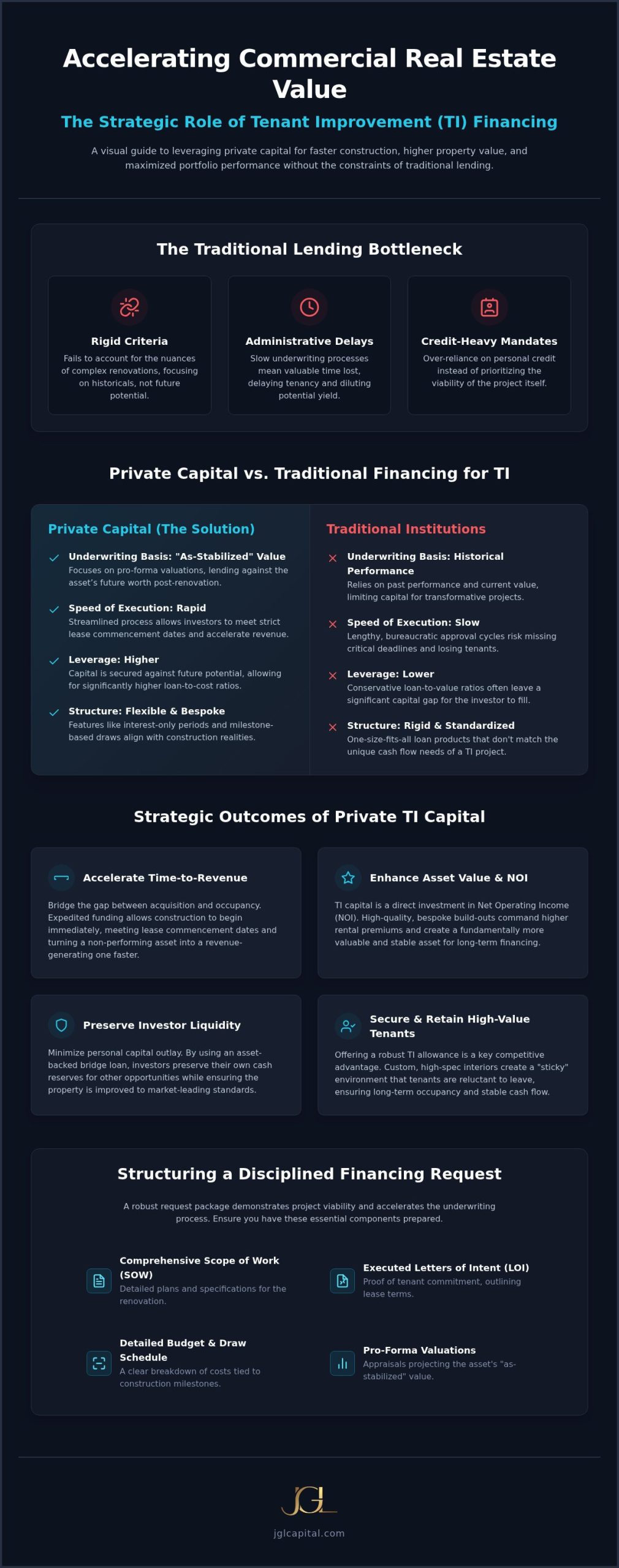
The underwriting of a loan for tenant improvements involves a sophisticated evaluation of pro-forma value rather than historical performance. Private lenders prioritize the “as-stabilized” appraisal, which projects the asset’s worth following the completion of renovations and the commencement of the lease. This methodology allows for significantly higher leverage, as the capital is secured against the future utility and income-generating potential of the improved space. Unlike traditional banking models that focus heavily on the borrower’s personal credit, private capital providers analyze the interplay between the asset’s physical quality and the underlying tenant’s creditworthiness.
Structural nuances such as interest-only periods and meticulously managed draw schedules are standard in these facilities. Interest-only periods provide the necessary breathing room during the construction phase, ensuring that debt service doesn’t prematurely erode the project’s liquidity. Draw schedules are typically tied to specific construction milestones, requiring professional inspections to verify that work is proceeding according to the approved scope. This disciplined approach ensures that funds are deployed efficiently and that the project remains on track for its scheduled occupancy date.
Defining Eligible Hard and Soft Costs
A comprehensive request for a loan for tenant improvements must distinguish between hard and soft costs to ensure full transparency during the capital allocation process. Hard costs encompass the physical components of the renovation, including structural partitions, specialized HVAC systems, and flooring installations. These are the tangible assets that directly contribute to the property’s physical value.
Soft costs are equally vital but often underfunded in standard bank products. These include architectural fees, engineering reports, permitting costs, and legal documentation. A disciplined budget also incorporates a contingency fund, typically ranging from 5% to 10%, to manage unforeseen construction overruns without disrupting the project’s financial stability. Identifying these costs upfront allows for a more accurate loan-to-cost (LTC) calculation and reduces the likelihood of capital shortfalls mid-project.
Leveraging Commercial Bridge Financing for TI Projects
Many commercial real estate loans are structured as bridge debt specifically to accommodate the transitional nature of TI projects. This bridge financing serves as the primary vehicle for funding renovations before the asset is seasoned enough for long-term permanent debt. For instance, a $10M+ acquisition of an underperforming office building utilizes TI capital to secure a Tier-1 medical tenant, whose long-term lease then facilitates a favorable exit into a permanent CMBS or life company loan. If you’re managing a high-stakes renovation, consulting with a private money specialist at JGL Capital LLC can help align your capital structure with these strategic objectives.
Private Capital vs. Traditional Institutional TI Financing
The distinction between traditional institutional lending and private capital allocation is most pronounced when examining the temporal constraints of modern commercial transactions. While conventional banks often necessitate an exhaustive 90-day underwriting cycle, private capital provides the agility required to secure a loan for tenant improvements within a significantly compressed timeframe. This disparity in execution speed is not merely a matter of convenience; it represents a strategic imperative in high-stakes environments where tenant attrition remains a persistent threat. Traditional lenders frequently prioritize historical credit performance and rigid debt-coverage ratios, often failing to account for the transformative potential of a well-executed renovation project.
Private capital providers adopt a more analytical approach, focusing on the future stabilized value of the asset and the strategic alignment of the proposed build-out. This flexibility allows for the financing of value-add or distressed properties that institutional mandates would summarily reject. While the nominal interest rate on private debt may exceed that of a conventional mortgage, the true measure of cost is found in the opportunity loss associated with a vacant building. Sophisticated practitioners of real estate investing recognize that the premium paid for private capital is frequently offset by the accelerated commencement of rental income and the preservation of the landlord-tenant relationship.
Speed of Execution as a Competitive Advantage
Rapid funding serves as a critical buffer against the erosion of trust that often occurs during protracted negotiations. When a prospective tenant signs a Letter of Intent, their operational timeline begins immediately. Delays in construction funding can lead to missed commencement dates, which may trigger penalty clauses or lease termination. Private capital ensures that a loan for tenant improvements is deployed with the precision necessary to meet these strict deadlines. By eliminating the administrative friction inherent in institutional banking, investors can trigger rent payments earlier, effectively enhancing the project’s cumulative internal rate of return.
Occupancy and Credit Flexibility
Institutional lenders frequently exhibit a systemic bias toward national credit tenants, which creates a significant capital gap for non-rated entities or emerging startups. Private money underwriting evaluates the underlying business logic and the physical utility of the space rather than relying solely on credit ratings. This enables the financing of both pre-leased spaces and speculative build-outs, allowing landlords to create high-specification environments that attract high-growth occupants. By aligning capital allocation with the specific risk profile of the asset, private lenders provide a level of customization that traditional banks simply cannot replicate.
Structuring a Robust Request for Tenant Improvement Financing
Securing a loan for tenant improvements requires a level of documentation that transcends simple application forms. It’s a methodical presentation of the asset’s future economic viability, requiring a comprehensive Scope of Work (SOW) that details every structural modification and aesthetic enhancement. This document must be supported by a granular budget, vetted by professionals, to ensure that the capital allocation is sufficient to meet the project’s objectives without mid-cycle shortfalls. The inclusion of executed lease agreements or binding Letters of Intent (LOI) is essential, as these documents provide the contractual proof of the asset’s income-generating potential.
Lenders also scrutinize the execution team. Identifying a general contractor with a verifiable track record in similar commercial sectors is non-negotiable. This expertise mitigates operational risk. Simultaneously, the sponsor must present the “After-Repair Value” (ARV) through professional pro-forma projections. These projections serve as the analytical foundation for the loan, demonstrating how the improvements will drive Net Operating Income and long-term asset appreciation. Precision in these early stages ensures that the funding process remains disciplined and aligned with the property’s overarching strategic goals.
The Importance of the Tenant Profile
The creditworthiness of the incoming occupant is a primary determinant of the loan-to-cost (LTC) ratio. Providing detailed financials for the tenant allows the lender to assess the stability of the future cash flow. Lease duration plays a pivotal role here; for instance, the presence of a 10-year NNN lease significantly improves the likelihood of funding and may allow for more aggressive leverage. Such long-term commitments provide the security that private capital partners require for large-scale allocations, as they guarantee a steady stream of revenue to service the debt.
Aligning Loan Maturity with Property Stabilization
The structural alignment of a loan for tenant improvements must account for both the construction timeline and a subsequent “burn-in” period. This period ensures the tenant is fully operational and paying rent before the sponsor seeks an exit. A well-conceived exit strategy often involves refinancing into a permanent new construction loan or a stabilized commercial mortgage. Coordinating with the permanent lender during the TI phase ensures that the final build-out meets the underwriting requirements for long-term debt. To discuss the specific requirements for your next high-stakes renovation, you may consult with the strategic advisors at JGL Capital LLC.
JGL Capital LLC: Bespoke Financing for High-Stakes TI Projects
JGL Capital LLC operates at the intersection of analytical rigor and strategic execution, providing a level of capital sophistication that traditional retail banks often fail to match. Our firm specializes in facilitating a loan for tenant improvements for large-scale projects, typically exceeding the $10 million threshold, where the complexity of the renovation requires more than a simple credit line. With over 30 years of industry expertise, we’ve refined a disciplined approach to asset-backed capital allocation that prioritizes the inherent worth of the commercial asset over the restrictive historical credit metrics favored by institutional lenders. This focus allows us to provide the liquidity necessary to transform underperforming properties into high-yield, stabilized assets.
Every allocation we manage is underpinned by a commitment to the preservation of value. We focus on the as-stabilized potential of the property. This empowers investors to execute ambitious build-outs that attract Tier-1 tenants. Our role transcends that of a mere service provider; JGL Capital LLC acts as a strategic ally, ensuring that the structured debt we provide aligns perfectly with your long-term portfolio objectives. By framing our activities as a high-level strategic alliance, we ensure that every dollar deployed serves the broader mission of property stabilization.
A Collaborative Approach to Value Creation
We function as a discreet partner for sophisticated investors who require a national footprint without the parochial constraints of regional banking institutions. Our reach across the United States ensures that regardless of the asset’s location, the underwriting remains consistent, professional, and grounded in institutional-grade analysis. This national perspective is particularly beneficial for sponsors managing multi-market portfolios where speed and reliability are the primary drivers of success. When securing a loan for tenant improvements through our firm, you gain access to a seasoned team that understands the nuances of complex draw schedules and lease commencement obligations. Requesting a customized consultation for your next TI-heavy acquisition is the first step toward optimizing your capital stack.
Preserving Capital and Building Legacies
Our philosophy is rooted in the belief that the alignment of objectives is the only sustainable foundation for a lending relationship. We don’t merely provide capital; JGL Capital LLC provides a framework for the creation and preservation of worth. By utilizing precise performance metrics and a patient approach to long-term growth, we help our partners build lasting legacies in the commercial real estate sector. It’s this disciplined stewardship that distinguishes our firm in a transactional market. To discuss your specific requirements and explore how we can support your property stabilization goals, engage JGL Capital LLC for your commercial tenant improvement financing needs.
Optimizing Asset Performance Through Strategic Capital Allocation
The transition from a vacant shell to a stabilized, income-producing asset requires more than just capital; it demands a disciplined alignment between your financing structure and your property’s operational goals. By prioritizing the future utility of a commercial property, sophisticated investors can bypass the administrative friction of institutional banking and secure a loan for tenant improvements that meets the urgent demands of high-value occupants. This strategic flexibility ensures that construction milestones are reached and rent commencement is triggered without unnecessary delay.
JGL Capital brings over 30 years of strategic lending experience to this process, specializing in commercial loans exceeding $10 million for high-stakes projects nationwide. Our asset-backed focus ensures that the inherent worth of your property remains the primary driver of the underwriting process, allowing you to preserve personal liquidity while building a lasting legacy. We invite you to contact JGL Capital to discuss your strategic TI financing requirements and discover how a disciplined partnership can accelerate your property stabilization. Your next successful build-out is within reach.
Frequently Asked Questions
What is a loan for tenant improvements?
A loan for tenant improvements is a structured debt instrument designed to facilitate the interior modification of a commercial asset. It allows property owners to customize a space to meet the specific operational requirements of an incoming tenant without depleting their primary liquidity. These facilities are essential for bridging the gap between property acquisition and full stabilization, ensuring the asset reaches its maximum income-generating potential.
Can I use a bridge loan to fund tenant improvements?
Bridge financing serves as the quintessential vehicle for funding tenant improvements during the transitional phase of an asset’s life cycle. These loans provide the necessary speed and flexibility to complete renovations before the property is seasoned enough to secure long-term permanent debt. This approach is particularly effective for value-add projects where the current occupancy doesn’t yet meet institutional underwriting requirements.
What are hard vs. soft costs in TI financing?
Hard costs encompass the physical construction elements of a project, such as plumbing, electrical systems, and structural modifications. Soft costs involve the intellectual and administrative capital required for the renovation, including architectural design, engineering reports, and municipal permitting fees. A comprehensive loan for tenant improvements should ideally account for both categories to ensure the sponsor isn’t forced to utilize personal capital for essential non-construction expenses.
How long does it take to secure private money for TI build-outs?
Private capital execution typically occurs within a significantly compressed timeframe compared to institutional banking. While conventional banks may require a 90-day cycle for underwriting and approval, private money allocations can often be finalized in a fraction of that time. This rapid deployment is critical for ensuring strict adherence to lease commencement deadlines and preventing the attrition of prospective tenants.
Does JGL Capital require a high credit score for TI loans?
JGL Capital adopts an asset-centric underwriting philosophy that de-emphasizes personal credit scores in favor of property-level analysis. Our evaluation focuses on the property’s pro-forma performance and the as-stabilized value created through the renovation. This methodology provides a sophisticated alternative to rigid institutional mandates, allowing us to fund projects based on their intrinsic merit and future revenue potential.
What is the maximum loan amount available for commercial tenant improvements?
We specialize in large-scale capital deployments, with a primary focus on commercial loans exceeding $10 million. The specific maximum is determined by the asset’s projected Net Operating Income and the overall strength of the project’s strategic business case. This specialization allows us to support significant renovations for medical offices, industrial facilities, and premium retail spaces across the United States.
How do draw schedules work for tenant improvement projects?
Draw schedules are structured to release funds in disciplined tranches as specific construction milestones are achieved. This process involve regular site inspections by third-party professionals to verify that the work remains in alignment with the approved scope and budget. This disciplined management of capital ensures that funds are deployed efficiently and that the project remains on track for its scheduled occupancy date.
Can TI loans be used for speculative commercial space?
Speculative build-outs can be financed through private capital when the pro-forma projections demonstrate a clear market demand for high-specification space. These allocations are evaluated based on the physical utility of the improvements and their potential to attract creditworthy tenants in a competitive landscape. While more complex than pre-leased projects, speculative TI funding is a viable strategy for sponsors looking to modernize aging assets.