

In the high-stakes environment of institutional real estate, the speed of capital allocation is often dictated not by the strength of the underlying asset, but by the meticulous precision of the borrower’s administrative preparation. Understanding exactly what documents are needed for a hard money loan represents the critical threshold between a missed opportunity and a successfully secured acquisition. You likely recognize that traditional lending institutions frequently prioritize exhaustive personal histories over the intrinsic value of the collateral, creating a bureaucratic environment that leads to sluggish closing times and significant frustration. This reliance on legacy paperwork often obscures the true potential of a deal, yet the necessity for rigorous documentation remains a cornerstone of professional risk management.
This comprehensive 2026 guide is designed to empower you with a master checklist for asset-backed financing, ensuring your next project receives the reliable capital it demands without the friction of unexpected administrative gaps. We will explore the specific requirements for complex entity structures and property-level data, providing the clarity needed to align your objectives with institutional standards. You will gain a streamlined path to capital, grounded in a disciplined understanding of why these specific records are essential for the preservation and generation of value in a competitive market.
Key Takeaways
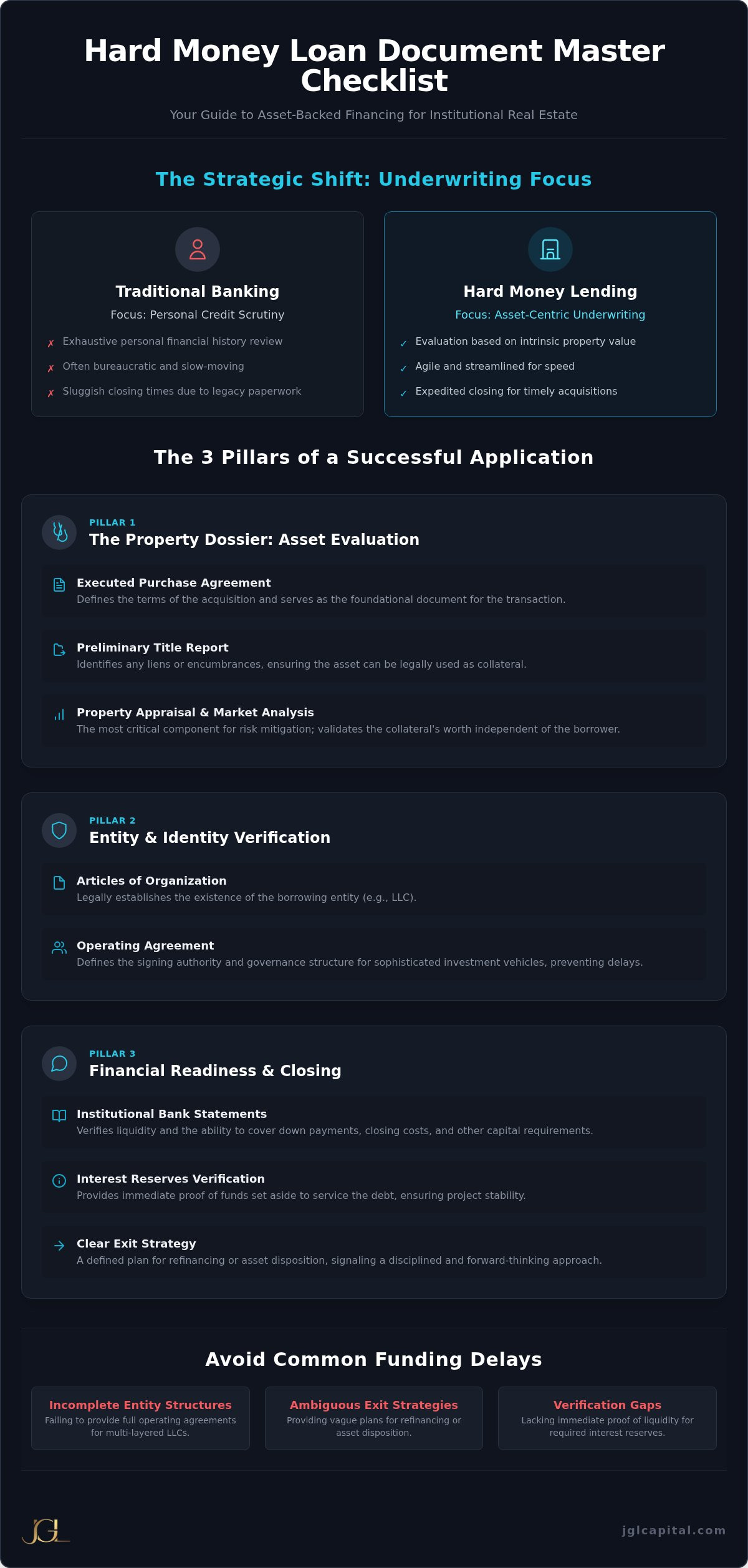
- Understand the fundamental transition from traditional credit-based scrutiny to asset-centric underwriting, ensuring your project is evaluated on its intrinsic potential rather than personal financial history.
- Gain a definitive understanding of exactly what documents are needed for a hard money loan, including executed purchase agreements and preliminary title reports, to facilitate an expedited closing process.
- Address the complexities of corporate entity verification, including the specific requirements for Articles of Organization and Operating Agreements that define signing authority for sophisticated investment vehicles.
- Master the final requirements for financial readiness, such as verifying liquidity through institutional bank statements and securing the necessary interest reserves to maintain project stability.
- Discover how leveraging three decades of industry expertise and a national brokerage network can streamline capital allocation for large-scale commercial and multi-family developments.
Understanding the Strategic Shift: Why Hard Money Documentation Differs from Traditional Banking
The transition from conventional depository lending to private, asset-backed capital requires a fundamental reorientation of an investor’s administrative approach. While traditional banks operate within a framework of exhaustive personal financial scrutiny, private lenders focus on the intrinsic value and income-generating potential of the real estate itself. This distinction isn’t merely academic; it dictates the entire lifecycle of the transaction. Understanding exactly what documents are needed for a hard money loan is the first step in aligning with this institutional mindset. By prioritizing the asset, lenders offer a level of agility that’s simply unattainable through standard mortgage channels, provided the borrower can substantiate the property’s viability through rigorous data.
The regulatory landscape further necessitates this shift in documentation strategy. Because these instruments are specifically designed for non-owner-occupied investment purposes, they fall outside the consumer protection mandates that often slow down residential lending. This exemption allows for greater structural flexibility but demands a higher register of professional disclosure. Sophisticated investors recognize that their documentation serves as a proxy for their expertise. A well-organized submission package doesn’t just satisfy a requirement; it functions as a persuasive argument for the project’s success, signaling to institutional partners that the borrower possesses the discipline required for high-stakes management.
The Primacy of Asset Value Over Personal Credit
In this specialized sector, the property appraisal and comprehensive market analysis represent the most critical components of the dossier. These documents serve as the primary instruments for risk mitigation, allowing the lender to validate the collateral’s worth independent of the borrower’s personal balance sheet. Although a review of credit history remains a standard component of the due diligence process, it rarely serves as the definitive factor in the approval decision. Instead, the focus remains on the debt service coverage ratio and the projected exit strategy. This shift in priority enables investors to expand portfolios rapidly, as the constraints of personal debt-to-income ratios are effectively removed from the equation.
Speed of Execution: How Documentation Impacts Funding Timelines
The primary advantage of private capital is the velocity of deployment, yet this speed is often compromised by administrative oversights. Common bottlenecks, such as incomplete entity disclosures or outdated title reports, can stall a closing for weeks. There’s a direct, measurable correlation between the accuracy of initial submissions and the speed at which capital is allocated. Utilizing a standardized checklist ensures that every claim is qualified and every strategy is clearly defined. This methodical preparation avoids the following common delays:
- Incomplete Entity Structures: Failing to provide full operating agreements for multi-layered LLCs.
- Ambiguous Exit Strategies: Providing vague plans for refinancing or asset disposition.
- Verification Gaps: Lacking immediate proof of liquidity for required interest reserves.
By treating the application process as a form of high-level strategic alliance, you ensure that the path to capital remains unobstructed. Professional document preparation reflects a commitment to timeless principles of resource management, positioning you as a disciplined steward of value rather than a mere transactional participant.
The Property Dossier: Essential Documentation for Asset Evaluation
The evaluation of the physical asset represents the most rigorous phase of the underwriting process. Since private capital providers prioritize collateral over personal credit, the property dossier must be exhaustive and analytically sound. When determining what documents are needed for a hard money loan, the focus shifts to the property’s current state, its potential for value creation, and any legal encumbrances that might compromise the lender’s position. This documentation acts as the primary validation for the loan-to-value (LTV) ratio, which serves as the bedrock of the financing structure. Accurate data at this stage prevents the erosion of trust and ensures that the capital allocation remains aligned with the project’s scope. For those undertaking significant renovations, partnering with a full-service construction firm like Laptiva can provide the analytical detail required to substantiate the project’s potential and ensure all technical documentation meets institutional standards.
Purchase Agreements and Preliminary Title Reports
A fully executed Purchase and Sale Agreement (PSA) is the essential catalyst for any transaction. This document must include all addenda and counter-offers to provide a transparent view of the acquisition terms. Without a complete PSA, the underwriting process cannot accurately gauge the leverage requirements or the timeline for funding. Parallel to the contract, a preliminary title report is required to identify liens, easements, or encumbrances early in the cycle. Clarity of title is non-negotiable. For investors engaged in transitional real estate, understanding what is a bridge loan provides necessary context on how these documents support short-term financing strategies.
Lenders also require a comprehensive property appraisal or a Broker Price Opinion (BPO) to establish a baseline value. This valuation must be accompanied by evidence of property insurance, specifically naming the lender as the loss payee to protect the institutional interest. For those managing stabilized assets or multi-family projects, the dossier must also include current rent rolls and existing lease agreements. These records allow for a precise calculation of the Debt Service Coverage Ratio (DSCR), ensuring the asset generates sufficient cash flow to meet its obligations throughout the loan term.
Construction Budgets and Scopes of Work (SOW)
For projects involving revitalization or ground-up development, the documentation requirements become significantly more granular. A detailed Scope of Work (SOW) and a line-item construction budget are mandatory for fix-and-flip or renovation projects. These documents provide the lender with a roadmap for the deployment of construction draws and the eventual realization of the after-repair value (ARV). In the context of new construction loans, developers must provide approved permits, architectural blueprints, and environmental reports to satisfy risk management protocols.
Institutional-grade budget approvals require a level of detail that accounts for both hard and soft costs. This transparency allows for a disciplined assessment of the project’s feasibility and ensures that the capital remains protected against unforeseen site conditions. Aligning with a strategic capital partner who understands these complexities ensures that your property dossier is positioned for rapid approval and reliable funding.
Entity and Identity Verification: Documenting the Borrower’s Legal Structure
The identification of the borrowing entity’s legal architecture is a prerequisite for institutional capital allocation, as it ensures the alignment of responsibility and the enforceability of the debt obligation. When evaluating what documents are needed for a hard money loan, the focus naturally expands from the property itself to the corporate vehicle utilized for the acquisition. It’s essential to recognize that this administrative rigor serves to mitigate the risks associated with complex ownership structures, providing a stable foundation for the creation and preservation of value throughout the lifecycle of the loan.
Lenders mandate the submission of the Articles of Organization or Incorporation, which function as the foundational record of the entity’s existence. This is complemented by the Employer Identification Number (EIN) confirmation from the IRS and a current Certificate of Good Standing from the Secretary of State. These records verify that the entity is properly formed and remains in active compliance with jurisdictional regulations. Government-issued identification for all principal members or shareholders remains a standard requirement to satisfy Know Your Customer (KYC) protocols, ensuring that all parties to the transaction are clearly identified and their roles defined.
Corporate Governance Documents for Real Estate Entities
Lenders must verify the internal hierarchy of the borrowing structure to confirm who possesses the legal authority to execute the transaction. The Operating Agreement or Corporate Bylaws are meticulously scrutinized to identify the individuals who maintain signing authority. In multi-member LLCs, this clarity is paramount to avoid future litigation or challenges to the validity of the debt obligation. For sophisticated commercial real estate loans, these documents often include formal resolutions that specifically authorize the transaction, thereby reinforcing the brand’s commitment to disciplined risk management and long-term stability.
The Investor Profile: Documenting Experience and Track Record
While the asset serves as the primary security for the capital, the investor’s history of execution informs the lender’s risk appetite and strategic objectives. A comprehensive understanding of what documents are needed for a hard money loan includes the preparation of a detailed track record sheet, which documents previous successful exits and managed properties. This evidence of past performance often influences Loan-to-Value (LTV) ratios by demonstrating a seasoned approach to market volatility and project management. When applying for fix and flip loans, the inclusion of a professional investor bio highlighting specific project management milestones serves as a linguistic signature of competence, distinguishing the borrower from more transactional competitors through a demonstrated commitment to professional excellence.
Financial Readiness and Closing Requirements: The Final Checklist
The final phase of the capital allocation process focuses on the verification of financial readiness and the formalization of closing protocols. While previous documentation establishes the asset’s value and the borrower’s legal structure, this terminal checklist confirms the availability of the necessary capital to sustain the project. Determining what documents are needed for a hard money loan at this stage requires a meticulous review of liquid assets and insurance protections. Institutional lenders demand a transparent view of the borrower’s liquidity to ensure the project remains capitalized through potential market fluctuations or unforeseen operational delays. This alignment is essential.
Proof of Liquidity and Capital Reserves
Lenders define acceptable liquidity as cash or cash equivalents that can be deployed immediately to satisfy the down payment and required interest reserves. This “skin in the game” serves as a primary protective covenant, aligning the interests of the borrower with the preservation of the lender’s capital. Standard requirements typically include the last two months of institutional bank statements to verify the source and stability of these funds. Lenders don’t just look for cash; they look for stability. For those executing complex real estate investing strategies, such as 1031 exchanges, the submission of a HUD-1 or Closing Disclosure from the relinquished property is essential to validate the tax-deferred capital stack.
Insurance Coverage and Protective Covenants
The preservation of asset value is inextricably linked to comprehensive insurance coverage. Lenders mandate specific endorsements, including Hazard, General Liability, and, where applicable, Builder’s Risk for development projects. A critical requirement is the “Lender’s Loss Payable” endorsement, which ensures that the institution’s financial interest is prioritized in the event of a total or partial loss. A clear, verified insurance binder must be delivered well in advance of the closing date to avoid administrative friction. Precision here is non-negotiable.
To conclude the documentation process, the following items must be finalized to facilitate the secure transfer of capital:
- Personal Financial Statement (PFS): A comprehensive outline of the broader financial position for all major guarantors.
- Wire Instructions: Verified banking details provided on institutional letterhead to ensure the secure movement of funds.
- Closing Disclosure: A final review of all transaction costs to ensure alignment with the initial term sheet.
By maintaining a disciplined approach to these final requirements, you ensure a seamless transition from underwriting to funding. If you are prepared to move forward with a high-stakes acquisition, you should consult with a strategic capital ally to ensure your financial dossier meets the highest institutional standards and avoids common closing delays.
Optimizing Your Capital Strategy with JGL Capital’s Institutional Approach
The successful acquisition of high-stakes real estate assets requires more than just a list of records; it necessitates a sophisticated alignment between the borrower’s objectives and the lender’s risk parameters. Understanding exactly what documents are needed for a hard money loan is merely the baseline of a much broader capital strategy. At JGL Capital LLC, we leverage over 30 years of industry expertise to transform the documentation process from a bureaucratic hurdle into a streamlined path for capital allocation. By operating as a national private money broker, we provide our partners with access to a diverse array of institutional capital sources, ensuring that each solution is as unique as the project it funds.
Our institutional approach is grounded in the principle that the intrinsic value of the property and the viability of the project should always take precedence over personal credit scores. This philosophy is particularly critical for large-scale commercial developments and multi-family projects where loan amounts frequently exceed $10 million. In these high-register transactions, the precision of the underwriting process is paramount. We focus on analytical rigor to ensure that every claim is qualified and every strategy is clearly defined, allowing for the preservation of value even in complex market environments. We prioritize the following elements to ensure your project remains on a steady trajectory toward funding:
- Asset Validation: Rigorous analysis of current and projected property values to maximize leverage.
- Entity Expertise: Expert navigation of multi-layered corporate structures and signing authorities.
- Risk Mitigation: Proactive identification of title encumbrances or liquidity gaps before they delay closing.
The Role of a Strategic Broker in Document Management
A strategic broker serves as a vital advocate, bridging the gap between the investor’s vision and the capital provider’s requirements. JGL Capital provides a comprehensive pre-underwriting process that identifies potential administrative friction before it can impact closing timelines. This proactive management acts as a buffer, ensuring that the dossier presented to the lender is beyond reproach. By fostering collaborative relationships rather than simple transactional interactions, we help our partners build lasting legacies through disciplined capital management and a deep understanding of what documents are needed for a hard money loan.
Accelerating New Construction and Commercial Funding
Large-scale developments, particularly in the sectors of new construction and commercial projects, often involve a high volume of technical documentation. From environmental reports to multi-layered corporate resolutions, the administrative burden can be substantial. Our expertise allows us to simplify these complex requirements, providing a clear and actionable checklist that prioritizes the most impactful data. We recognize that sophisticated investors require individual solutions that account for the unique nuances of their projects, and we’re committed to delivering that worth through a steady, measured approach to funding.
Securing fast, reliable capital is a function of both asset quality and administrative readiness. When you align with a partner that values precision over speed, you position your firm to capitalize on fleeting market opportunities with institutional efficiency. We invite you to leverage our deep-seated expertise and disciplined stewardship to secure the funding your next project demands. Align your objectives with JGL Capital today to experience a higher register of professional partnership and strategic capital allocation.
Advancing Your Capital Allocation Strategy for 2026
The successful execution of high-stakes real estate projects depends on the alignment of asset quality with administrative precision. By mastering what documents are needed for a hard money loan, you move beyond the friction of traditional banking bureaucracy and position your firm for rapid, reliable capital deployment. This disciplined approach to documentation ensures that property valuations and corporate entity structures are beyond reproach, allowing for the preservation of value throughout the lifecycle of your investment. It’s a fundamental shift from personal financial scrutiny to property-centric validation.
JGL Capital LLC brings over 30 years of industry experience to every partnership, providing national expertise in $10M+ loans and a streamlined underwriting process specifically designed for professional developers. We prioritize property viability and institutional-grade analysis over personal credit scores, serving as a strategic ally in your long-term growth. It’s time to elevate your financing strategy through a collaborative relationship grounded in stability and expertise. Secure your next asset-backed loan with JGL Capital and ensure your portfolio remains on a steady trajectory toward success.
Frequently Asked Questions
Do I need to provide tax returns for a hard money loan?
Tax returns are generally not required for asset-backed hard money loans because the underwriting process focuses primarily on the property’s intrinsic value and income potential. Unlike traditional bank financing that relies on personal income verification, private lenders prioritize the collateral’s equity and the project’s defined exit strategy. This allows sophisticated investors with complex tax structures to secure capital based on the strength of their real estate acquisition rather than their personal tax history.
What if I am borrowing through an LLC or a corporate entity?
Borrowing through an LLC or corporation requires the submission of foundational organizational documents, including Articles of Organization and a comprehensive Operating Agreement. These records are essential to verify the entity’s legal standing and to identify the specific individuals who possess the authority to execute loan documents. Lenders also require a Certificate of Good Standing from the Secretary of State to confirm the entity remains in active compliance with jurisdictional regulations.
Is a property appraisal always required for private money funding?
A formal property appraisal or a Broker Price Opinion is almost universally required to establish the baseline for the loan-to-value ratio. Institutional lenders utilize these valuations to mitigate risk and ensure the collateral provides sufficient security for the capital allocation. This objective analysis remains a cornerstone of the underwriting process, protecting the lender’s interest while validating the investor’s equity position within the transaction.
Do hard money lenders check my personal credit score?
Most private lenders conduct a credit review, though it serves as a secondary factor behind the property’s value and the borrower’s professional experience. While a high score isn’t the primary driver for approval, it provides insight into the borrower’s financial discipline. Understanding what documents are needed for a hard money loan includes preparing for this credit inquiry, as it informs the final terms of the strategic capital alliance.
How quickly can a hard money loan be processed once documents are submitted?
Funding can often be finalized within five to ten business days once a complete and accurate documentation package is submitted and verified. The velocity of private capital is its primary advantage, yet the timeline depends heavily on the precision of the property dossier and entity records. By providing a comprehensive checklist early in the process, investors can avoid administrative bottlenecks and secure funding for time-sensitive acquisitions.
What is a “Scope of Work” and why is it necessary for my loan?
Do I need to show proof of funds if I have a high-value property?
Proof of funds is required regardless of property value to demonstrate the borrower’s ability to cover the down payment and required interest reserves. Lenders mandate this liquidity verification to ensure the project remains capitalized through its completion. This requirement ensures that the borrower has sufficient skin in the game, fostering a disciplined approach to the preservation of worth across the investment lifecycle.
What type of insurance documentation is required for a fix-and-flip project?
Fix-and-flip projects require a comprehensive builder’s risk policy along with general liability and hazard insurance documentation. The policy must include a lender’s loss payable endorsement to protect the institution’s financial interest during the renovation phase. Providing a clear insurance binder is a critical step in determining what documents are needed for a hard money loan and ensuring a seamless closing process without unexpected delays.