

The perceived simplicity of a direct lending relationship often obscures the strategic advantages of a diversified capital network, especially when managing portfolios that exceed the ten million dollar threshold. While the immediate allure of a single funding source is understandable, the most seasoned real estate professionals recognize that capital bottlenecks are not merely logistical inconveniences; they are existential threats to project timelines and the preservation of equity. You likely understand that the choice between a direct lender vs broker for fix and flip loans is less about the nominal cost of capital and more about the alignment of funding flexibility with the complexity of your specific assets.
This article provides an institutional-grade comparison designed to help sophisticated investors determine the most efficient capital structure for their 2026 portfolios. We will analyze the critical distinctions between internal fund management and external brokerage strategies, focusing on how each model addresses the need for maximum leverage and reliable funding in a volatile market. By examining the shift toward loan-to-cost metrics and the implications of relaxing FHA regulations, we offer a disciplined framework for building a strategic alliance that prioritizes long term growth over transactional convenience.
Key Takeaways
- Identify the fundamental operational distinctions between capital originators and capital allocators to ensure your funding strategy aligns with specific project complexities.
- Evaluate the strategic trade-offs of a direct lender vs broker for fix and flip loans, specifically regarding the mitigation of “hard declines” through diversified market access.
- Discover how asset-focused underwriting can maximize leverage and ROI for high-stakes portfolios, particularly for projects exceeding the 10 million dollar threshold.
- Learn to prioritize long-term strategic alliances over transactional lending by selecting capital stewards with a proven multi-decade track record in volatile markets.
- Understand how to streamline project timelines by matching unique asset profiles with the most appropriate institutional lending mandates.
The Fix and Flip Financing Landscape: Direct Lenders vs. Mortgage Brokers
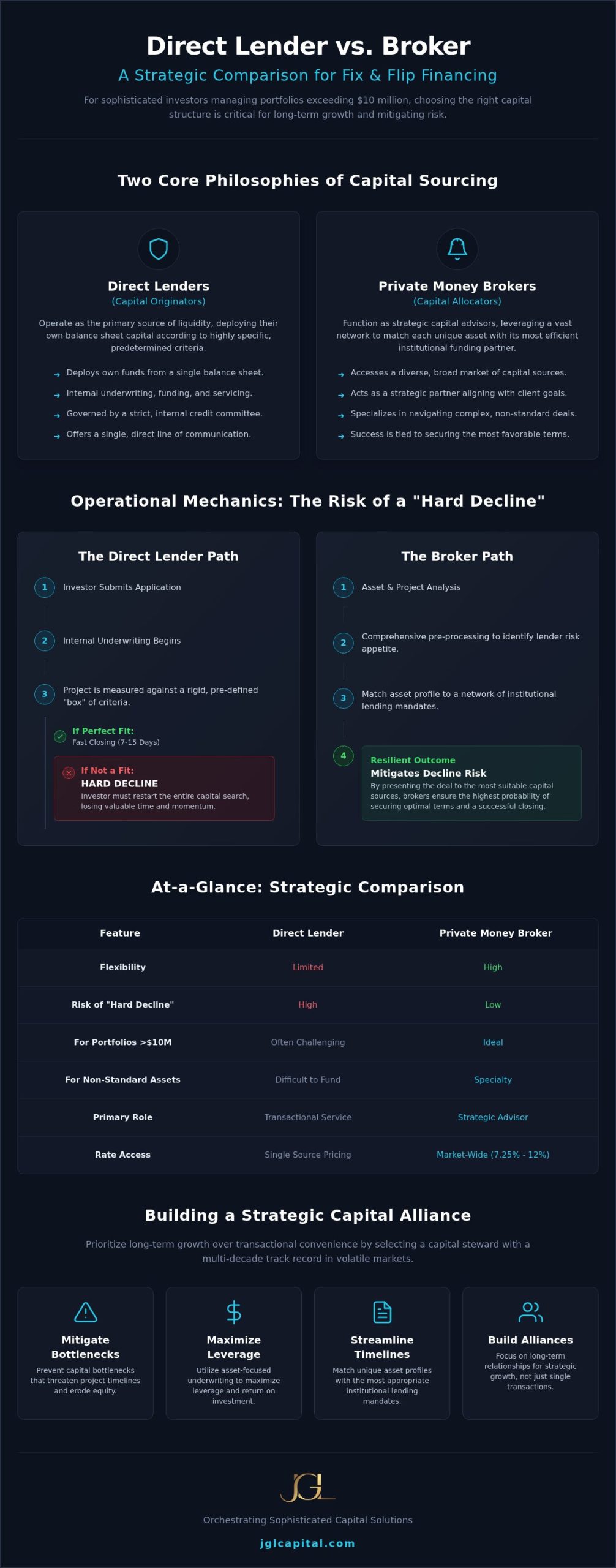
The architectural framework of real estate financing in 2026 is defined by two distinct philosophies: capital origination and capital allocation. For the sophisticated investor, the choice between a direct lender vs broker for fix and flip loans is not merely a choice of service provider, but a decision on how to structure the capital stack for maximum efficiency. Capital originators, known as direct lenders, operate as the primary sources of liquidity, deploying their own balance sheet capital according to highly specific, predetermined criteria. Conversely, private money brokers serve as sophisticated capital allocators, leveraging a vast network of institutional and private sources to ensure that each asset finds its most efficient funding partner.
The common “middleman” label often applied to brokers is a reductive oversimplification that ignores the analytical rigor required to navigate the current lending environment. In a market where interest rates for fix and flip projects fluctuate between 7.25% and 12%, the value of a partner who can orchestrate complex capital solutions becomes evident. Rather than acting as a simple pass-through, a professional broker functions as a strategic ally, mitigating the risk of capital bottlenecks that can delay project starts and erode potential ROI.
This strategic alliance is a cornerstone of successful property investment worldwide; for instance, those looking for specialized guidance in the Auckland market can check out Hewett Mortgages to see how a dedicated brokerage provides expert financial advice for property acquisition.
Defining the Direct Lending Model
In the direct lending model, the entire lifecycle of the loan is contained within a single institution. Underwriting, funding, and servicing are managed internally, governed by a credit committee that enforces strict adherence to the firm’s specific fund mandates. This internal structure provides a sense of stability, yet it’s inherently limited by the firm’s balance sheet constraints and risk appetite. If a project doesn’t fit into the lender’s “pre-defined box,” the investor faces a hard decline, which can be catastrophic for time-sensitive acquisitions. While a single-source capital relationship offers a clear line of communication, it lacks the flexibility required to adapt to non-standard assets or projects requiring capital in excess of ten million dollars.
Defining the Private Money Brokerage Model
The private money brokerage model operates as a conduit to the broader, more diverse capital markets. A broker doesn’t merely facilitate a transaction; they act as a strategic advisor who evaluates the asset’s intrinsic value against a wide spectrum of available liquidity. For a foundational Mortgage Broker Overview, it’s clear that these entities bridge the gap between borrowers and various lending sources, including private equity funds and institutional investors. This model is built on the alignment of objectives, where the broker’s success is tied to securing the most favorable terms for the client. By leveraging established relationships, a broker can often secure non-standard terms that a direct lender’s rigid mandate would simply not allow. This shift from transactional service to strategic capital advisory is what distinguishes a seasoned steward from a mere intermediary.
Operational Mechanics: How Capital Sourcing Influences Project Timelines
Efficiency in capital deployment is frequently misconstrued as a simple metric of days-to-close, yet for the sophisticated investor, speed is a variable contingent upon underwriting depth. While institutional direct lenders often market closing windows of 7 to 15 days, these timelines are strictly dependent on the project adhering to a rigid internal mandate. When a deal deviates from these parameters, the perceived speed of a direct lender often evaporates, replaced by a “hard decline” that forces the investor to restart the capital search from a position of weakness. A disciplined partner recognizes that the debate between a direct lender vs broker for fix and flip loans is actually a question of operational resilience.
Professional brokers mitigate these timing risks by conducting comprehensive pre-processing before a file ever reaches an institutional credit committee. By identifying the specific risk appetite of various capital sources, a broker ensures that the asset is presented to the fund most likely to provide a favorable term sheet. This strategic alignment prevents the “underwriting bottleneck” where projects sit in limbo while internal committees debate non-standard features. In a competitive 2026 market, where Florida’s HB 267 now requires local governments to process residential permits within 30 business days, the ability to align financing with accelerated development timelines is a critical competitive advantage.
The Underwriting Bottleneck: Rigid vs. Flexible
Direct lenders operate within a specific “box” defined by their fund’s investors. If your project features unique storm-resistant “hardened assets” or complex renovation budgets that exceed standard LTC caps, a direct lender may lack the authority to deviate from their established norms. Conversely, a broker’s versatility allows them to pivot capital sources without requiring the investor to submit a new application package. This flexibility is essential when navigating the Truth in Lending Act and other regulatory frameworks that govern commercial asset-backed lending. By maintaining multiple institutional relationships, a broker ensures that project momentum is never sacrificed to a single lender’s internal policy shifts.
Managing Complexity in $10M+ New Construction
Large-scale projects, particularly those exceeding the ten million dollar threshold, rarely benefit from a one-size-fits-all lending approach. These high-stakes developments often require multi-layered capital structures, including bridge financing for land acquisition followed by a transition into construction draws. A broker acts as a capital steward, coordinating these moving parts to ensure that funding remains reliable throughout the project lifecycle. This level of coordination is vital in volatile markets where carrying costs, driven by insurance premiums and interest rates, can quickly erode margins. Investors seeking to optimize their portfolios often find that asset-focused capital strategies provide the necessary stability to scale without the constraints of traditional institutional rigidities.
Analyzing the Value Proposition: Cost, Versatility, and Strategic Leverage
The evaluation of capital sources often descends into a narrow comparison of interest rates and origination points, a methodology that fails to account for the true cost of liquidity. While direct lenders may appear to offer a lower nominal cost by removing the intermediary fee, this perspective ignores the substantial opportunity cost associated with rigid lending mandates. For the professional investor, the strategic decision between a direct lender vs broker for fix and flip loans is ultimately a calculation of total capital worth. A broker’s fee, which typically ranges from 1% to 2% of the loan amount, should be viewed as an allocation toward market intelligence and the mitigation of execution risk. This investment ensures that capital remains available even when primary funds reach their concentration limits or internal credit committees tighten their standards.
The fallacy of the “cheapest” loan is most evident when analyzing the relationship between interest rates and leverage. A direct lender might offer a highly competitive rate but cap their Loan-to-Cost (LTC) at 80%, forcing the investor to deploy more of their own equity. Conversely, a broker’s ability to negotiate a 90% LTC structure, even at a slightly higher rate, significantly enhances the investor’s cash-on-cash return. Compliance with established Consumer Financial Protection Bureau regulations, specifically Regulation X, ensures a baseline of transparency in these fee structures, allowing sophisticated partners to conduct a disciplined analysis of the value provided by their capital steward.
Direct Costs vs. Opportunity Costs
Quantifying value requires a shift from examining line-item expenses to analyzing the impact of loan structures on portfolio scalability. Specialized New Construction Loans require expert placement because the risk profile of a ground-up development is fundamentally different from a standard renovation. A broker who understands these nuances can secure higher leverage that offsets their origination fee many times over. By maximizing the loan-to-value ratio, the broker preserves the investor’s liquidity, enabling the acquisition of additional assets that would otherwise remain out of reach due to capital constraints.
Market Versatility and Program Access
A single point of contact that provides access to bridge loans, DSCR programs, and multi-family financing offers a level of operational efficiency that direct lenders cannot replicate. This versatility is particularly critical during periods of market volatility. When institutional funds pause their lending activities to re-evaluate their portfolios, a broker can pivot to alternative capital sources without disrupting the investor’s project timeline. By comparing the depth of Hard Money Lenders in Florida and national private equity providers, a broker identifies the most resilient capital partner for the specific asset class. This disciplined approach ensures that the investor’s long-term objectives are never compromised by the temporary liquidity issues of a single lending institution.
Selection Criteria for High-Stakes Real Estate Portfolios
Selecting a capital partner for a high-stakes portfolio requires a level of scrutiny that transcends simple rate shopping. While new market entrants often prioritize aggressive marketing and speculative trends, a veteran steward with 30+ years of industry expertise offers a stability that’s indispensable during periods of market correction. The primary distinction in the direct lender vs broker for fix and flip loans debate often lies in the focus of the underwriting itself. Disciplined brokers prioritize the intrinsic value of the asset and the viability of the exit strategy over the personal credit history of the stakeholder, recognizing that for ten million dollar plus projects, the property’s performance is the ultimate security.
This asset-focused evaluation is particularly critical when navigating time-sensitive acquisitions where traditional credit committee delays could result in a lost opportunity. A seasoned broker functions as a quiet expert, relying on intellectual capital rather than aggressive self-promotion to secure terms that align with the investor’s strategic objectives. By framing the relationship as a high-level strategic alliance rather than a simple service provision, the broker ensures that the capital structure supports the long-term preservation of value.
Assessing the Complexity of the Deal
The nature of the asset dictates the necessary capital structure. Standard residential flips may fit within the rigid boxes of traditional direct funds, but multi-family redevelopments or ground-up commercial projects require a more nuanced approach. If a project requires Bridge Loans to secure a distressed asset before permanent financing is arranged, the broker’s role becomes one of a strategic architect. Specialized knowledge in land development and commercial zoning isn’t a luxury; it’s a prerequisite for the preservation of equity in high-value transactions where time-sensitive acquisitions are the norm.
Long-Term Scalability and Partnership
Institutional flippers rarely rely on a single lender’s balance sheet because it creates a single point of failure. By utilizing a broker’s diverse network, investors build a capital pipeline that scales in tandem with their acquisition volume. This approach ensures that funding remains available for large-scale projects, even when specific sectors of the credit market experience contraction. For high-net-worth stakeholders, the discreet nature of private money brokerage provides a layer of confidentiality that traditional institutional channels often lack. Building a lasting real estate legacy requires more than just capital; it demands a strategic ally who values long-term growth and integrity above all else. For investors seeking to secure ten million dollar plus projects, establishing a strategic alliance with an expert capital broker ensures that your portfolio remains insulated from the limitations of rigid lending mandates.
JGL Capital: Orchestrating Sophisticated Capital Solutions
JGL Capital LLC serves as a disciplined steward for the modern real estate investor, providing the analytical rigor necessary to navigate the complex choice between a direct lender vs broker for fix and flip loans. With over three decades of established history, the firm leverages deep-seated market relationships to ensure that capital allocation remains consistent with the strategic objectives of high-net-worth stakeholders. By prioritizing property value over personal credit history, JGL Capital facilitates the generation of worth in a manner that traditional institutional funds, often hampered by rigid mandates and balance sheet constraints, fail to replicate. Our role as a quiet expert allows us to focus on the creation of lasting legacies through careful, deliberate action in the private money markets.
By orchestrating sophisticated capital solutions for projects that frequently exceed the ten million dollar threshold, JGL Capital demonstrates a commitment to building long-term growth and integrity. We understand that in the 2026 landscape, characterized by volatile interest rates and shifting regulatory frameworks, the ability to secure reliable funding is a prerequisite for success. Our specialization in asset-backed commercial loans ensures that project starts are never delayed by capital bottlenecks, as we prioritize the intrinsic value of the real estate over the transactional convenience of standard lending models.
The JGL Capital Methodology
The JGL Capital methodology is rooted in timeless principles of integrity and professional excellence, focusing specifically on the delivery of highly customized solutions for Fix and Flip Loans in Florida and other high-growth national markets. Our approach deliberately transcends the limitations of traditional “box” lending, offering the stability and expertise required for the management of high-stakes portfolios that demand more than superficial analysis. We recognize that the creation and preservation of value in projects exceeding the ten million dollar threshold require more than simple liquidity provision; they demand a sophisticated alignment of capital structure with long-term strategic goals, a process we facilitate through our extensive history of intellectual capital and disciplined underwriting.
Initiating a Strategic Alliance
Initiating a strategic alliance with our firm involves a measured and steady flow of information, mirroring our patient approach to long-term objectives. Our preliminary review process is characterized by a meticulous focus on property potential and project viability, ensuring that every strategic objective is clearly defined before capital is deployed. This disciplined approach allows for the streamlined processing of complex acquisitions and new construction developments, reinforcing our position as a seasoned leader in the private money brokerage sector. By framing our activities as a form of high-level strategic alliance, we provide investors with the security of a partner who is deeply invested in the generation of worth and the successful execution of their real estate vision. Consult with JGL Capital for Institutional-Grade Capital Allocation to ensure your next project is supported by over 30 years of market expertise.
Aligning Capital with Long-Term Strategic Objectives
The decision regarding a direct lender vs broker for fix and flip loans defines the resilience of your real estate portfolio. While direct funds offer a singular point of entry, the strategic versatility of a private money broker ensures that capital remains available as market conditions fluctuate. By prioritizing asset value and project viability over rigid institutional mandates, sophisticated investors maintain the momentum necessary for high-stakes developments. A disciplined capital structure is the foundation of any lasting real estate legacy. It’s the difference between a project that stalls due to capital bottlenecks and one that scales through a strategic alliance.
With over 30 years of industry leadership and a specialization in asset-backed transactions exceeding 10 million dollars, JGL Capital provides the stability and national coverage required by the modern developer. We invite you to Secure Your Next Project with JGL Capital’s Strategic Sourcing and experience the benefits of institutional-grade capital allocation. We look forward to supporting your vision with the precision and expertise your portfolio deserves.
Professional Perspectives: Frequently Asked Questions
What is the primary difference between a direct lender and a broker for fix and flip loans?
The primary distinction lies in the source and management of liquidity. Direct lenders act as capital originators, deploying their own balance sheet funds according to rigid internal mandates. Brokers function as strategic capital allocators, leveraging an expansive network of institutional partners to identify the most efficient funding source for a specific asset profile. This distinction is critical when evaluating a direct lender vs broker for fix and flip loans, as it determines the level of flexibility available to the investor.
Are fix and flip loan brokers more expensive than direct lenders?
While brokers charge an origination fee, they aren’t inherently more expensive when considering the total capital worth. A broker often secures higher loan-to-cost (LTC) ratios or more favorable interest rate structures that a single direct lender’s mandate might prohibit. These enhanced terms frequently offset the nominal brokerage fee by preserving the investor’s liquidity and maximizing the cash-on-cash return across the entire real estate portfolio.
Why would a professional investor choose a broker over a direct lender?
Professional investors prioritize certainty of execution and strategic leverage over nominal interest rate variances. A broker provides a shield against the hard declines common with direct lenders whose risk appetites may shift unexpectedly. By maintaining a diverse capital pipeline, a broker ensures that funding remains reliable even for non-standard assets or complex redevelopments that fall outside the narrow criteria of traditional institutional funds.
How quickly can a broker fund a fix and flip project compared to a direct lender?
Funding timelines are comparable, but brokers offer superior speed for complex or unique assets. While direct lenders can close box deals in 7 to 15 days, any deviation from their criteria causes significant delays. Brokers accelerate the process by conducting preliminary underwriting and placing the deal with a lender whose mandate already aligns with the project’s specific risk profile, thereby bypassing unnecessary administrative hurdles in the direct lender vs broker for fix and flip loans selection process.
Does a broker’s fee come out of the loan proceeds?
Brokerage fees are typically settled as part of the closing costs and are often deducted from the loan proceeds. This structure ensures that the interests of the capital steward and the investor remain perfectly aligned throughout the transaction lifecycle. It eliminates the need for upfront capital outlays, allowing the developer to maintain liquidity for operational expenses and renovation budgets while securing institutional-grade financing.
This focus on liquidity often extends to personal financial planning; for UK-based professionals, ineedcash.co.uk provides clarity on maximizing family-related financial benefits, such as qualifying for free childcare.
Can a broker help with 10 MIL+ new construction or commercial projects?
Specialized brokers are uniquely positioned to orchestrate the multi-layered capital structures required for projects exceeding the ten million dollar threshold. JGL Capital specializes in these high-stakes transactions, coordinating bridge financing and construction draws for large-scale new construction and multi-family assets. This level of expertise is essential for navigating the complexities of high-value commercial developments where traditional lending sources often reach their concentration limits.
Is it better to use a direct lender if I have a high credit score?
Asset performance and property value remain the primary underwriting criteria in private money lending regardless of credit history. While a high credit score is a positive indicator of responsibility, it doesn’t guarantee the most efficient capital structure. A broker prioritizes the intrinsic worth of the real estate, ensuring that even high-credit borrowers secure the maximum leverage and most flexible terms available in the broader private capital market.
What documents are required when working with a private money broker like JGL Capital?
Documentation focuses primarily on the asset’s viability and the investor’s track record rather than extensive personal financial histories. Required items generally include a detailed renovation budget, a signed purchase contract, and a comprehensive breakdown of the projected after-repair value (ARV). Entity documents, such as operating agreements and articles of incorporation, are also necessary to establish the legal framework for the high-level strategic alliance between the borrower and the capital provider.