

In a high-velocity market, the primary obstacle to institutional-grade growth isn’t a lack of capital, but rather the prohibitive latency of traditional depository institutions. Utilizing a sophisticated bridge loan for investment property allows the disciplined investor to decouple the urgency of acquisition from the protracted timelines of permanent financing. You likely recognize that the most lucrative opportunities often vanish while conventional lenders deliberate over personal credit scores rather than the inherent value of the underlying asset. This reality creates unnecessary cash flow gaps during property stabilization or construction phases that can stall a meticulously planned expansion.
This guide provides the analytical framework necessary to master the strategic deployment of bridge financing, ensuring you can secure high-value assets and optimize your portfolio’s expansion in a competitive national landscape. We’ll examine the current 2026 interest rate benchmarks, including the market’s full transition to the Secured Overnight Financing Rate (SOFR), and detail how asset-based underwriting facilitates closings in under three weeks. By aligning your acquisition strategy with a reliable bridge to long-term DSCR or permanent financing, you’ll establish a foundation for the preservation and generation of worth.
Key Takeaways
- Distinguish between consumer-grade financing and professional transitional capital to ensure that your funding structures reflect the sophisticated requirements of institutional investment.
- Leverage the analytical rigor of asset-based underwriting by prioritizing After-Repair Value (ARV) and Loan-to-Cost (LTC) metrics over traditional credit-based constraints.
- Execute a calculated trade-off between capital costs and operational agility to secure high-potential distressed assets that require immediate execution.
- Identify high-value deployment opportunities, such as multi-family acquisitions and new construction, where the flexibility of a bridge loan for investment property serves as a catalyst for growth.
- Accelerate the path to closing by standardizing entity documentation and asset evaluations, facilitating a seamless transition to long-term permanent financing.
The Strategic Function of a Bridge Loan for Investment Property
Professional bridge financing represents a sophisticated allocation of capital designed to facilitate the transition between asset acquisition and the realization of a stabilized state. Unlike consumer-oriented “swing loans” which primarily serve homeowners moving between primary residences, a bridge loan for investment property is an institutional-grade instrument deployed by entities to capitalize on market inefficiencies. Sophisticated investors understand that the true cost of capital isn’t merely the interest rate; it’s the opportunity cost of lost acquisitions. When a high-potential asset enters the market, the primary objective is the speed of execution, as the ability to close with certainty often outweighs the premium associated with short-term financing.
This capital is particularly vital in the context of the “Buy, Rehab, Rent, Refinance” (BRRRR) strategy. By providing the initial liquidity required to purchase and improve a distressed property, bridge financing acts as the catalyst that allows an investor to eventually transition into long-term DSCR or permanent financing once the asset is stabilized. To understand the foundational mechanics of these instruments, one might ask, What is a bridge loan? and how does its structure support professional real estate ventures? By bridging the gap between the immediate need for capital and the eventual eligibility for conventional debt, these loans allow for the preservation and generation of worth in a competitive environment.
The Core Philosophy of Transitional Capital
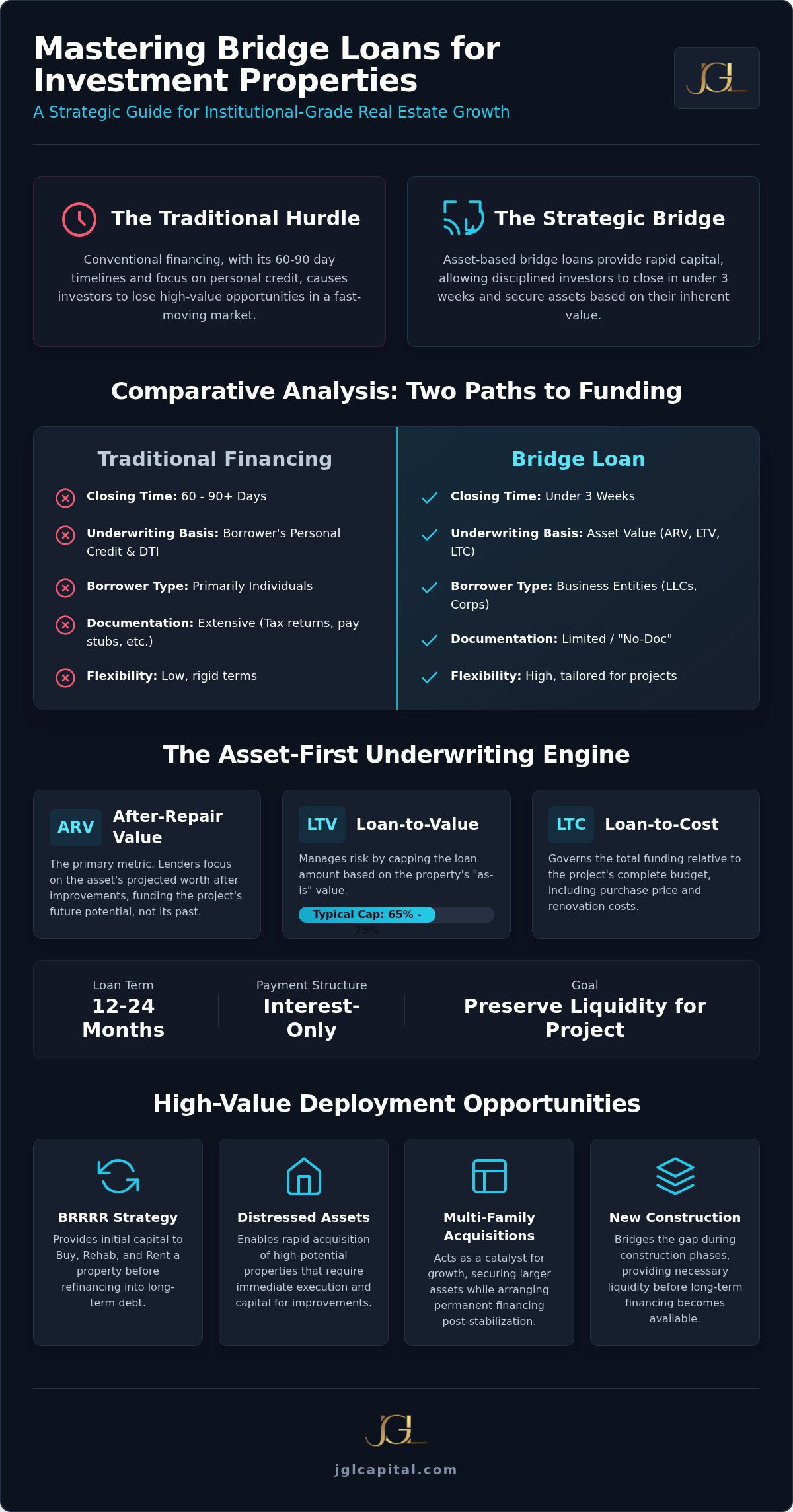
Liquidity management within a volatile real estate environment requires a specific type of transitional capital. It preserves the opportunity value of a deal by bypassing the 60-90 day timelines typically required by traditional depository institutions. If a bank delay causes a contract to fall through, the loss of potential equity gain far exceeds the expense of a bridge facility. Transitional capital is defined as a strategic bridge to a stabilized asset state.
Asset-Backed vs. Credit-Based Lending Models
The institutional approach to lending prioritizes the intrinsic value of the property and its projected performance over the personal debt-to-income ratios of the borrower. This asset-backed model allows for capital deployment to entities like LLCs or corporations, ensuring that the transaction remains a professional business arrangement rather than a personal liability assessment. Limited documentation, often referred to as “No-Doc” lending, accelerates the underwriting process by focusing on the purchase contract and the asset’s quality. This shift in focus from personal credit to property potential is what distinguishes a professional bridge loan for investment property from generic mortgage products.
The Mechanics of Professional Bridge Loan Underwriting
Professional underwriting for a bridge loan for investment property hinges on an analytical rigor that far exceeds the standard credit checks of retail banking. The primary focus is the After-Repair Value (ARV), a metric that demands a sophisticated understanding of market dynamics and the specific capital improvements proposed by the developer. By prioritizing the asset’s future worth, lenders can structure facilities that support the entire lifecycle of the project. This process involves a meticulous evaluation of the Loan-to-Value (LTV) and Loan-to-Cost (LTC) ratios, which serve as the fundamental guardrails for risk management. In 2026, most commercial bridge lenders cap the LTV at 65% to 75% of the “as-is” value, ensuring a conservative entry point while allowing the borrower to leverage the property’s inherent potential.
The temporal nature of these loans, typically ranging from 12 to 24 months, aligns with the period required for property stabilization or renovation. Interest-only payment structures are utilized strategically to preserve liquidity, allowing the investor to redirect cash flow toward the physical enhancement of the asset. Within this ecosystem, the private money broker serves as an essential conduit, sourcing institutional-grade capital that traditional banks simply cannot provide. This role is critical for developers who require a steady influx of capital to maintain momentum on large-scale projects, ensuring that they aren’t limited by the liquidity constraints of local depository institutions.
Evaluating the Collateral: Beyond the Appraisal
Lenders evaluate market demand and property potential through a lens that extends beyond a simple appraisal report. A robust exit strategy, whether through a sale or a refinance into a permanent DSCR loan, is the cornerstone of the underwriting decision. Commercial bridge lending requires technical precision, often involving detailed property inspections and Phase I environmental reviews for larger commercial assets. This disciplined approach ensures that every risk is quantified before capital is deployed into a national market, providing a sense of security for all stakeholders involved.
The Role of Speed in High-Stakes Management
Efficiency in capital deployment is often the deciding factor in securing a high-value asset. A professional bridge loan for investment property can typically close within a 10 to 21 day window, a timeline that is made possible by streamlining the processing and underwriting phases. By removing the bureaucratic layers found in traditional institutions, the focus remains on the asset’s viability and the borrower’s execution capability. As a disciplined steward of investor goals, JGL Capital specializes in managing these high-value transactions with the analytical rigor required to eliminate traditional delays. If your portfolio requires a partner who values precision and speed, aligning with an organization that respects the gravity of your objectives is a logical next step.
Comparative Analysis: Bridge Loans vs. Traditional Investment Financing
The primary distinction between institutional bridge financing and traditional depository lending lies in the prioritization of asset potential over borrower profile. While conventional mortgages offer lower interest rates, they demand stabilized assets and pristine personal credit, often resulting in a rigid underwriting process that cannot accommodate the nuances of transitional properties. For a professional investor, a bridge loan for investment property is an instrument of agility. National averages for bridge rates in June 2026 hover around 10.07%, yet this capital premium is offset by the ability to secure distressed or high-potential assets that traditional banks would reflexively decline. The strategic trade-off is clear: the cost of capital is secondary to the cost of a missed opportunity in a competitive market.
Flexibility in draw schedules represents another critical advantage for developers. Conventional bank disbursements are frequently hampered by bureaucratic layers and inflexible milestones that can stall a project’s momentum. In contrast, bridge financing allows for customized draw schedules tailored to the specific phases of construction or renovation. This is especially relevant for commercial real estate loans, where a property often requires a bridge phase to reach the occupancy or income levels necessary to qualify for permanent financing. By utilizing transitional capital, investors can stabilize the asset before transitioning to a lower-cost, long-term debt structure.
Understanding the Total Cost of Capital
Analyzing the investment basis requires a comprehensive view of the fee structure beyond the headline interest rate. Origination points, which typically range from 1 to 2 points in the current 2026 market, must be integrated into the project’s total ROI calculation. A bridge-funded acquisition that closes in under three weeks often yields a superior net return compared to a deal lost during a 60-day bank delay. The stabilization period is a phase of active value creation, and a flexible partner ensures that liquidity is available exactly when the project’s execution demands it. This disciplined approach to capital management allows for the preservation of equity throughout the asset’s transitional lifecycle.
Flexibility and Customization in Loan Terms
Conventional mortgages are essentially one-size-fits-all products that lack the nuance required for sophisticated portfolio management. Institutional bridge solutions provide a highly customized framework that aligns with the investor’s specific exit strategy, whether that involves a rapid sale or a refinance into a permanent DSCR facility. This alignment of objectives fosters a collaborative relationship between the broker and the investor, moving beyond simple service provision to a strategic alliance. In the pursuit of long-term wealth preservation, the ability to tailor loan terms to the unique requirements of a bridge loan for investment property ensures that the financing structure supports, rather than restricts, the investor’s vision.
Strategic Applications: When to Deploy Bridge Capital
The deployment of institutional capital requires a precise understanding of the asset’s lifecycle and the specific market conditions that necessitate transitional funding. While some view a bridge loan for investment property as a reactive measure, the disciplined investor utilizes it as a proactive tool for high-stakes acquisition. This is particularly evident in fix-and-flip ventures and “heavy lift” renovations where the property’s current state precludes traditional financing. In scenarios involving foreclosure rescue or distressed assets, the ability to inject liquidity rapidly ensures that the investor can stabilize the property before seeking long-term debt.
For those focused on scaling residential portfolios, the “Bridge-to-Perm” strategy provides a seamless transition from acquisition to a stabilized DSCR loan. This method is essential for multi-family complexes where immediate capital is required to improve occupancy rates and enhance Net Operating Income (NOI). By utilizing bridge funds to execute a value-add program, the investor increases the asset’s valuation, thereby optimizing the terms of the eventual permanent financing. This strategic alignment of capital and execution is what distinguishes a professional developer from a casual market participant.
New Construction and Development Scenarios
Large-scale residential developments often face a capital gap between land acquisition and the completion of the vertical build. Asset-backed new construction loans provide the necessary liquidity for developers who possess high-value projects but may have their capital tied up in other ongoing ventures. A seasoned private money broker plays a pivotal role here, specifically in securing $10M+ loans for complex projects that require a deep understanding of construction milestones. This level of funding allows developers to maintain momentum without the restrictive covenants typically imposed by regional banks.
Multi-Family and Commercial Stabilization
The acquisition of undervalued apartment complexes often necessitates a rapid close to outperform competing bids. Bridge financing allows for “tactical hunts” of undervalued commercial assets that require immediate stabilization before they are attractive to institutional lenders. By improving the property’s performance through capital improvements and professional management, the investor bridges the gap to more favorable long-term rates. This disciplined approach to asset management ensures that capital is deployed where it generates the most significant impact on the portfolio’s overall worth. If your strategy involves scaling through high-value acquisitions, you can apply for professional bridge financing to secure your next asset.
Navigating the Bridge Loan Origination Process
The transition from strategic intent to operational execution requires a methodical approach that prioritizes the integrity of the capital stack. Securing a bridge loan for investment property is a process characterized by analytical rigor and the systematic validation of the underlying asset. Unlike the automated, impersonal applications found in retail banking, professional origination begins with a comprehensive evaluation of the collateral and the borrower’s specific exit strategy. This phase demands the aggregation of critical documentation, including detailed property specifications, the executed purchase contract, and entity-specific documents such as operating agreements or articles of incorporation. By standardizing these requirements early in the process, the path to funding is cleared of the bureaucratic friction that typically characterizes traditional lending institutions.
As a seasoned partner in high-stakes management, JGL Capital serves as a disciplined steward throughout this lifecycle. The firm manages the complexities of the transitional phase, ensuring that every strategic objective is articulated and every operational milestone is met. This commitment to precision allows the investor to maintain focus on property stabilization while the administrative burdens of underwriting are handled by experts who respect the gravity of the transaction. The result is a seamless transition from acquisition to a stabilized asset state, providing a reliable foundation for long-term growth.
The Discovery and Analysis Phase
The initial consultation serves as the intellectual foundation for the entire transaction. During this phase, the focus remains on the alignment of objectives, ensuring that the proposed financing structure supports the investor’s broader portfolio strategy. JGL Capital leverages 30 years of industry expertise to conduct a rigorous analysis of the project, identifying the optimal funding source within an extensive national network. This disciplined approach to the creation and preservation of value ensures that the capital deployed is not merely a loan, but a strategic tool for wealth generation. It’s a phase where intellectual capital is utilized to mitigate risk and define a clear path to stabilization.
Securing the Commitment and Closing
Once the analysis is complete, the move from the letter of intent (LOI) to the final funding of the asset is executed with steady precision. The broker assumes the responsibility for managing the administrative tasks of underwriting and document preparation, moving the transaction through the final stages without the delays common in depository institutions. For those seeking a sophisticated and knowledgeable partner, engaging a seasoned private money broker offers a sense of security and exclusivity that is unavailable in the mass market. This professional service concludes with a discreet closing, providing the necessary liquidity to secure high-value assets and initiate the next phase of your investment legacy. To begin this process for your next high-value project, initiating a formal consultation is the logical first step toward securing institutional-grade capital.
Optimizing Capital Allocation for Future Portfolio Resilience
The strategic deployment of a bridge loan for investment property represents a fundamental shift from reactive acquisition to disciplined, institutional-grade portfolio growth. By decoupling the urgency of a high-value transaction from the inherent latency of conventional debt, you ensure that market opportunities are captured rather than conceded to more agile competitors. This analytical approach prioritizes the intrinsic value of the asset and its stabilization potential, establishing a clear path toward the generation of lasting worth. As the 2026 market continues to reward speed and precision, the ability to bridge the gap to permanent financing remains a hallmark of the sophisticated investor.
Navigating the complexities of current capital markets requires a partner who understands the gravity of high-stakes management and the necessity of precision. With over 30 years of industry expertise and a specialization in $10M+ institutional-grade loans, JGL Capital provides nationwide asset-backed lending solutions tailored to your unique strategic objectives. You are invited to Secure Your Transitional Capital with JGL Capital Today to ensure your next development or acquisition is supported by seasoned intellectual capital. Your commitment to excellence deserves a financing structure that’s equally disciplined, steady, and focused on building a lasting legacy.
Frequently Asked Questions
What is the typical interest rate for a bridge loan on an investment property in 2026?
The national average interest rate for a bridge loan for investment property in June 2026 is 10.07%, reflecting a period of relative stabilization within the private lending sector. While the broader market range typically fluctuates between 10% and 12%, highly qualified borrowers with substantial equity may secure rates starting as low as 7.75%. These rates are primarily indexed to the Secured Overnight Financing Rate (SOFR), which serves as the institutional benchmark for pricing transitional capital.
How fast can a bridge loan for an investment property close compared to a bank?
Professional bridge financing facilitates a closing timeline that typically ranges from 10 to 21 days, providing a decisive advantage in competitive acquisition scenarios. In contrast, traditional depository institutions often require 60 to 90 days to navigate bureaucratic underwriting layers and committee approvals. By prioritizing asset value over protracted personal background checks, bridge lenders allow investors to secure high-value properties with a speed that traditional banks cannot replicate.
Can I get a bridge loan for an investment property with a low credit score?
Institutional bridge lenders utilize asset-backed underwriting models that prioritize the property’s intrinsic value and the borrower’s exit strategy over personal credit scores. Because the loan is secured by the collateral itself, investors with lower FICO scores can often obtain funding if the underlying asset demonstrates significant potential for stabilization or value appreciation. This disciplined focus on the property allows sophisticated entities to access capital that would be unavailable through conventional credit-based channels.
What are the typical repayment terms and exit strategies for a bridge loan?
Typical repayment terms for a bridge loan for investment property span 6 to 24 months, with a 12-month duration being the most common standard for residential and multi-family projects. These facilities generally utilize interest-only payment structures to maximize cash flow during the renovation or stabilization phase. The primary exit strategies involve either the sale of the improved asset or a refinance into a permanent debt structure, such as a long-term DSCR loan, once the property meets occupancy requirements.
Are there prepayment penalties on investment property bridge loans?
Prepayment structures vary significantly between lenders, though many professional bridge facilities are designed with flexibility to accommodate rapid project execution. Some agreements may include a minimum interest period, often three to six months, to ensure a baseline return for the lender, while others offer no-penalty exits to support high-velocity fix-and-flip strategies. It’s essential to evaluate these terms during the discovery phase to ensure the capital structure aligns with your projected stabilization timeline.
What property types are eligible for bridge financing through JGL Capital?
Eligibility extends to a diverse range of institutional-grade assets, including multi-family complexes, new construction developments, commercial real estate, and land acquisitions. JGL Capital specializes in high-value transactions exceeding $10 million, providing customized funding solutions for complex projects that require a sophisticated understanding of asset-backed lending. This includes transitional properties requiring significant capital improvements and distressed assets that necessitate a rapid, discreet closing process.
How much of a down payment is required for an asset-backed bridge loan?
Most commercial bridge lenders in 2026 require a capital contribution that results in a Loan-to-Value (LTV) ratio between 65% and 75% of the property’s “as-is” value. This typically translates to a down payment of 25% to 35%, ensuring that the investor maintains a meaningful equity stake in the project’s success. In certain development scenarios, underwriting may also consider the Loan-to-Cost (LTC) ratio, which accounts for both the acquisition price and the projected renovation budget.
What is the difference between a hard money loan and a bridge loan for investors?
While both instruments utilize asset-backed underwriting, a bridge loan is specifically structured as transitional capital intended to “bridge” the gap until a permanent financing solution is secured. Hard money is often associated with shorter-term, higher-cost funding for distressed assets or foreclosure rescues where the primary focus is immediate liquidity. Bridge financing typically implies a more strategic alliance, often serving as a precursor to a long-term DSCR or commercial mortgage once the asset has reached a stabilized state.