

What if the primary constraint on your portfolio growth isn’t a lack of high-value opportunity, but rather the institutional friction inherent in traditional lending? For many sophisticated investors, the pursuit of hard money lenders Orlando represents a deliberate transition toward a more agile and asset-centric model of capital allocation rather than a reaction to credit deficiency. You likely understand that the rigid documentation requirements and protracted underwriting cycles of conventional banks are fundamentally misaligned with the pace of the Florida real estate market, where securing a competitive advantage often requires closing within seven to fourteen days. This systemic friction frequently results in lost opportunities and the unnecessary dilution of potential investment returns.
This article provides the framework to discover how sophisticated investors leverage asset-backed private capital to secure high-value real estate opportunities with institutional precision. We will examine the strategic transition from transactional borrowing to a disciplined alliance with a knowledgeable steward of capital, focusing on the mechanics of rapid deployment and underwriting based on property potential. By prioritizing the intrinsic value of the asset over personal debt-to-income ratios, you can establish a robust foundation for the preservation and generation of wealth within your portfolio.
Key Takeaways
- Understand how hard money lenders Orlando provide the agility you’ll need for rapid-market maneuvers, serving as a strategic form of transitional capital for high-value opportunities.
- Learn the core philosophies of asset-backed underwriting and how it’s used to prioritize property viability over personal credit scores or rigid debt-to-income ratios.
- Analyze the regulatory hurdles that limit traditional institutional lending so you can leverage private capital as a more efficient alternative for complex acquisitions.
- Master the methodical process of securing institutional-grade funding through transparent documentation and a professional approach to capital allocation.
- Identify the characteristics of a disciplined capital steward to ensure your real estate ventures are supported by a partner with a thirty-year legacy in navigating complex markets.
The Evolution of Hard Money Lenders in Orlando: Strategic Capital for Real Estate Investors
The concept of a Hard money loan has evolved from a secondary financing option into a primary vehicle for strategic capital allocation within the Florida market. In the 2026 fiscal environment, these instruments serve as essential transitional capital, allowing for the rapid execution of acquisitions that traditional depository institutions are structurally unable to facilitate. While conventional banks remain tethered to the inertia of rigid regulatory frameworks and protracted committee approvals, the leading hard money lenders Orlando offers provide the agility necessary for sophisticated investors to secure high-value assets before market conditions shift. This specialized form of private capital is defined by its responsiveness and its focus on the underlying value of the real estate asset rather than the personal financial history of the borrower.
The current economic cycle demands a level of precision that traditional lending models simply cannot match. Private capital fills the void left by institutional hesitation, providing a streamlined alternative that prioritizes the viability of the project. It’s a shift from defensive borrowing to offensive capital deployment. By utilizing asset-backed structures, investors can move with institutional precision, securing properties based on their intrinsic worth and future potential.
The Shift Toward Asset-Based Financing
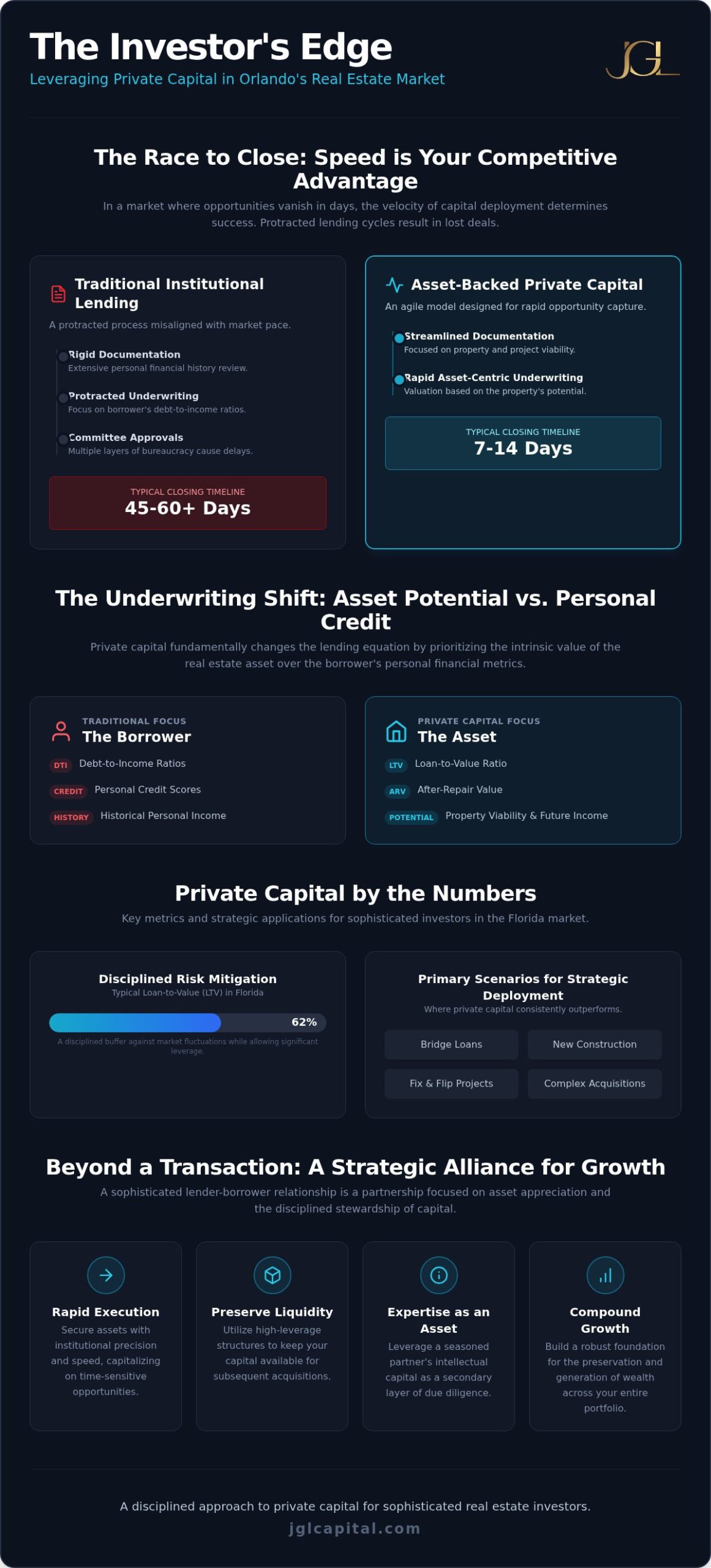
Modern investors increasingly prioritize property-level performance over personal credit metrics. This transition is driven by the need for certainty of execution in competitive environments where a delay of even a few days can result in a lost contract. In Orlando, where closing timelines often compress to a seven to fourteen day window, the ability of private lenders to underwrite based on the After-Repair Value (ARV) or current Loan-to-Value (LTV) ratios is paramount. Typical LTV ratios in Florida currently hover around 62%, reflecting a disciplined approach to risk that still allows for significant leverage. Private capital consistently outperforms conventional financing in scenarios involving bridge loans, new construction, and complex multi-family acquisitions where traditional debt coverage ratios might initially appear insufficient.
Hard Money as a Strategic Alliance
A sophisticated lender-borrower relationship is a collaborative partnership focused on asset appreciation. It’s not merely a transaction; it’s a strategic alliance where the lender’s industry expertise serves as a secondary layer of due diligence. Seasoned partners bring decades of intellectual capital to the table, helping to evaluate the nuances of commercial deals and new construction projects. This disciplined stewardship ensures that capital is allocated to projects with the highest probability of success. High-leverage debt structures, such as those used in fix and flip or rental property loans, allow investors to preserve their liquidity. This liquidity is then available for additional acquisitions, effectively compounding the generation of worth across a diversified portfolio. By framing these activities as strategic alliances, investors can build lasting legacies through careful, deliberate action.
The Underwriting Framework: Assessing Asset Viability and Risk Mitigation
The core of private capital allocation lies in the transition from personal solvency metrics to asset-centric analysis. While traditional banks prioritize Debt-to-Income (DTI) ratios, sophisticated hard money lenders Orlando focus on the structural and economic integrity of the collateral. This underwriting philosophy assumes that the property itself must serve as the primary guarantor of the loan. Risk assessment is conducted through the meticulous calculation of Loan-to-Value (LTV) and Loan-to-Cost (LTC) ratios. In the Florida market, an average LTV of 62% reflects a disciplined buffer against market fluctuations; this ensures that both the steward of capital and the investor are protected against unforeseen volatility. By prioritizing the asset’s intrinsic worth, lenders can offer a streamlined alternative to the rigid underwriting found in conventional depository institutions.
Prioritizing Collateral Integrity Over Credit Metrics
Effective underwriting requires an exhaustive evaluation of the property’s “as-is” value versus its “after-repair” value (ARV). This distinction is critical for bridge loans and fix and flip projects where value creation is realized through physical or operational improvements. For multi-family and commercial assets, the analysis extends to net operating income (NOI) and debt service coverage ratios (DSCR). A borrower’s track record acts as a secondary layer of risk mitigation, signaling the operational capacity to execute the proposed business plan. While the Consumer Financial Protection Bureau (CFPB) provides a regulatory framework for the broader lending industry, private capital practitioners apply a more granular, asset-specific lens to ensure the viability of the exit strategy. It’s this focus on the exit that defines the success of the capital deployment.
Risk Mitigation and Strategic Safeguards
Disciplined lending involves the use of protective covenants and subordinate clauses that align the interests of all stakeholders. These safeguards aren’t merely bureaucratic hurdles. They are strategic instruments designed to manage market-specific volatility and ensure project completion. By conducting rigorous property analysis, lenders verify that capital is deployed into environments where risk is clearly defined and the reward is commensurate with the investment. This level of analytical rigor is what distinguishes a transactional lender from a strategic partner. If you require a partner who values property potential over rigid credit scores, you may find that aligning with a seasoned steward of capital provides the necessary precision for your next acquisition. The focus remains on the preservation of value through every phase of the asset lifecycle.
Comparative Analysis: Private Capital vs. Traditional Institutional Lending
The structural divergence between private capital and traditional depository institutions is rooted in the regulatory frameworks that govern their operations. While conventional banks are subject to the stringent capital reserve requirements of Basel III and the compliance mandates of the Dodd-Frank Act, private hard money lenders Orlando operate with a level of autonomy that allows for rapid capital deployment. These regulatory hurdles often impose a systemic inertia on banks, forcing them into protracted underwriting cycles that prioritize risk avoidance over market opportunity. For the sophisticated investor, the decision to utilize private capital is a calculated trade-off. It’s an exchange of higher nominal interest rates for the agility required to secure high-value assets that would otherwise be lost to more responsive competitors.
The opportunity cost of waiting for a traditional mortgage approval can be staggering in a volatile market. When a bank requires sixty days to process a loan, the lost potential of that capital, combined with the risk of a deal falling through, often exceeds the cost of private debt. Understanding Hard Money in Real Estate Investing reveals that these funds aren’t a last resort. Instead, they are a strategic tool for the preservation and generation of value. By aligning with a partner who prioritizes asset viability, investors can circumvent the rigid credit-score-based underwriting that defines the traditional banking sector.
Speed of Execution and Market Agility
Execution speed serves as a primary differentiator in the Florida real estate landscape. Private capital typically closes within a seven to fourteen day window, a stark contrast to the forty-five to sixty day cycle common in institutional banking. This responsiveness allows investors to offer cash-like terms, a significant competitive advantage when bidding on distressed assets or time-sensitive opportunities. This agility is a cornerstone of modern Real Estate Investing: Strategies and Insights for 2026, where the ability to move with institutional precision defines portfolio growth. When speed is the primary variable, private capital is the only logical choice for high-stakes management.
Flexibility in Complex Asset Classes
Banks frequently struggle with non-stabilized assets, new construction projects, or properties requiring significant repositioning. Their underwriting models are designed for stabilized, cash-flowing assets with long histories. In contrast, private bridge loans offer the customization necessary for transitional properties that don’t yet meet conventional lending criteria. This flexibility is particularly vital for Commercial Real Estate Loans, where the complexity of the deal requires a disciplined steward of capital rather than a rigid bureaucratic process. By focusing on the intrinsic worth and future potential of the property, private lenders facilitate the creation of value in asset classes that traditional institutions simply ignore.
Strategic Deployment: Navigating the Lifecycle of an Asset-Backed Loan
The acquisition of institutional-grade private funding is a methodical process that demands analytical rigor from both the borrower and the steward of capital. Unlike the simplified narratives often found in the retail market, professional hard money lenders Orlando utilize a structured lifecycle to ensure the security and performance of every allocation. This lifecycle begins with the precise alignment of capital and opportunity, a phase where a seasoned broker facilitates the translation of an investor’s vision into a viable credit profile. Transparent documentation serves as the foundation of this relationship. It ensures that every stakeholder understands the strategic objectives and the underlying risk-mitigation protocols from the very first interaction.
Post-closing management is equally critical to the success of the investment. For projects involving renovation or development, the disciplined oversight of construction draws and interest reserves ensures that capital is deployed in lockstep with physical progress. This ongoing stewardship protects the principal while providing the investor with the liquidity necessary to maintain project momentum. It’s a collaborative effort that extends far beyond the initial funding date.
Phase I: Initial Evaluation and Term Sheet Issuance
Initial engagement centers on the submission of a comprehensive executive summary and detailed property specifications. This documentation allows for a preliminary assessment of the asset’s intrinsic worth and its potential for value generation. Once the preliminary analysis is complete, a formal term sheet is issued. This document serves as the strategic blueprint for the deal, outlining the parameters of the loan, including interest rates, points, and specific fees. Early-stage transparency is essential; it prevents the operational friction that can occur when expectations aren’t clearly defined from the outset.
Phase II: Rigorous Due Diligence and Underwriting
Following the acceptance of the term sheet, the project enters a period of intensive due diligence. This stage involves a technical review of appraisals, title reports, and environmental assessments to verify the integrity of the collateral. For investors utilizing Fix and Flip Loans in Florida, this phase includes a rigorous verification of the scope of work to ensure that the proposed renovations are feasible and value-additive. The focus remains on identifying potential risks before capital is committed. If you’re ready to move forward with a partner who values this level of analytical precision, you can initiate your capital allocation strategy today to secure your next high-value opportunity.
JGL Capital: A Disciplined Approach to Private Capital Brokerage
JGL Capital LLC serves as a seasoned, strategic partner for sophisticated investors seeking to navigate the complexities of the private debt market with institutional precision. With a legacy spanning over thirty years, the firm’s established itself as a disciplined steward of capital, prioritizing the preservation and generation of worth through analytical rigor rather than speculative trends. While many hard money lenders Orlando offers operate through purely transactional frameworks, JGL Capital emphasizes a collaborative relationship that aligns institutional resources with high-value real estate opportunities. This approach ensures that every capital allocation is grounded in the intrinsic value of the asset, providing a stable foundation for long-term portfolio growth.
The firm’s expertise is particularly vital when structuring sophisticated instruments. These range from short-term bridge financing to comprehensive New Construction Loans. The focus remains steadfastly on asset-backed stability. It ensures that each project is evaluated with the same level of scrutiny applied to institutional-grade investments. We don’t just provide capital; we provide a strategic framework for success.
A Legacy of Analytical Rigor and Expertise
The firm’s commitment to the creation of value is reflected in its broker-led model. This structure provides investors with access to a diverse array of capital sources that might otherwise remain inaccessible. By leveraging three decades of intellectual capital, JGL Capital navigates complex markets with a precision that traditional institutions often lack. This expertise allows for the articulation of core philosophies that favor long-term growth and integrity. The preference is for declarative, authoritative strategies that leave little room for ambiguity, reinforcing our position as a leader in private capital allocation. It’s a rejection of fleeting industry buzzwords in favor of timeless principles.
Facilitating National Growth Through Local Intelligence
Although rooted in deep industry expertise, JGL Capital facilitates growth on a national scale, serving high-net-worth stakeholders across various jurisdictions from its strategic headquarters. The firm manages a broad spectrum of property types, including multi-family complexes, commercial land, and rental portfolios. We apply local intelligence to national strategic objectives. This breadth of experience allows us to provide highly customized solutions that reflect the unique requirements of each asset class. By framing our role as a strategic ally rather than a simple service provider, we continue to build lasting legacies through careful, deliberate action. Contact JGL Capital for a strategic capital consultation to align your next acquisition with the institutional precision it deserves.
Aligning Capital with Visionary Real Estate Objectives
The transition from conventional debt to sophisticated private capital represents a fundamental shift toward institutional agility. By prioritizing asset viability over personal credit metrics, investors can circumvent the systemic inertia that often characterizes traditional depository institutions. This strategic guide has detailed how asset-focused underwriting and a disciplined approach to risk mitigation serve as the foundation for the preservation and generation of worth in a volatile market. The ability to move with precision remains the primary differentiator for those seeking to expand their portfolios in 2026.
When you partner with JGL Capital, you gain access to over 30 years of strategic industry expertise and a streamlined underwriting process that values the intrinsic worth of your property. Our firm specializes in multi-family and new construction financing, serving as a collaborative ally rather than a transactional provider. This disciplined stewardship is what distinguishes the most professional hard money lenders Orlando offers from more conventional sources. We invite you to Secure Strategic Capital for Your Next Asset Acquisition and begin building a lasting legacy through deliberate, high-stakes management. Your vision deserves a capital partner that matches your analytical rigor and commitment to excellence.
Frequently Asked Questions
What distinguishes hard money from traditional institutional financing?
Hard money is distinguished by its primary reliance on the intrinsic value of the real estate asset rather than the personal creditworthiness of the borrower. While traditional institutions prioritize debt-to-income ratios and extensive historical documentation, private capital providers focus on collateral integrity. This fundamental difference allows for a streamlined underwriting process that facilitates rapid deployment, often closing within a seven to fourteen day window that conventional banks can’t match.
How is the interest rate determined for a private asset-backed loan?
Interest rates for asset-backed loans are determined through a comprehensive analysis of risk, including the Loan-to-Value (LTV) ratio and the quality of the collateral. Market conditions in Florida during the first quarter of 2026 show average rates reflecting the specialized nature of transitional capital. Factors such as the borrower’s experience and the complexity of the project also influence the final rate, ensuring the cost of capital aligns with the strategic objectives of the partnership.
Can hard money be utilized for the acquisition of new construction projects?
Yes, private capital is an essential tool for the acquisition and development of new construction projects, particularly when traditional lenders exhibit hesitation toward non-stabilized assets. JGL Capital maintains a specific focus on new construction and multi-family developments, providing the high-leverage debt structures necessary to maintain project momentum. This funding allows developers to secure land and initiate vertical construction without the protracted delays inherent in institutional committee approvals.
What is the typical duration of a bridge loan in the current market?
The typical duration of a bridge loan in the current market ranges from six to twenty-four months, serving as a form of transitional capital. This short-term structure is designed to facilitate the acquisition, renovation, or repositioning of an asset before it’s refinanced into long-term debt. Such timelines provide the necessary window for investors to execute their business plans while preserving liquidity for additional opportunities within their portfolios.
Does JGL Capital require a minimum credit score for asset-based lending?
JGL Capital prioritizes the underlying property value over rigid personal credit scores, emphasizing the strength of the asset in its underwriting framework. While a borrower’s track record is considered as a secondary layer of risk mitigation, the primary driver for approval is the collateral’s intrinsic worth and the viability of the exit strategy. This approach allows sophisticated investors to bypass the credit-centric hurdles that often stall progress at traditional depository institutions.
What documentation is required to initiate the due diligence process?
Initiating the due diligence process requires a comprehensive executive summary, detailed property specifications, and a clearly articulated exit strategy. For projects involving renovation or development, a verified scope of work and a budget are also essential components of the submission. Providing transparent documentation from the outset ensures that hard money lenders Orlando can conduct an efficient analysis and issue a formal term sheet that aligns with the project’s strategic parameters.
How does the debt-service coverage ratio (DSCR) impact loan approval?
The debt-service coverage ratio (DSCR) serves as a critical metric for evaluating the cash flow viability of rental and commercial properties. A robust DSCR indicates that the asset generates sufficient income to cover its debt obligations, which significantly strengthens the underwriting narrative for long-term hold strategies. While asset value remains the primary focus, a strong ratio provides an additional layer of security that can influence the overall leverage and terms of the loan.
Are there prepayment penalties associated with private hard money loans?
Prepayment penalties vary based on the specific terms of the loan agreement and the strategic objectives of the capital allocation. Some private loans include a minimum interest requirement or a yield maintenance clause to ensure a baseline return for the steward of capital. However, many bridge and fix-and-flip structures are designed for maximum flexibility, allowing investors to exit the loan once the value-add phase is complete without incurring excessive fees.