

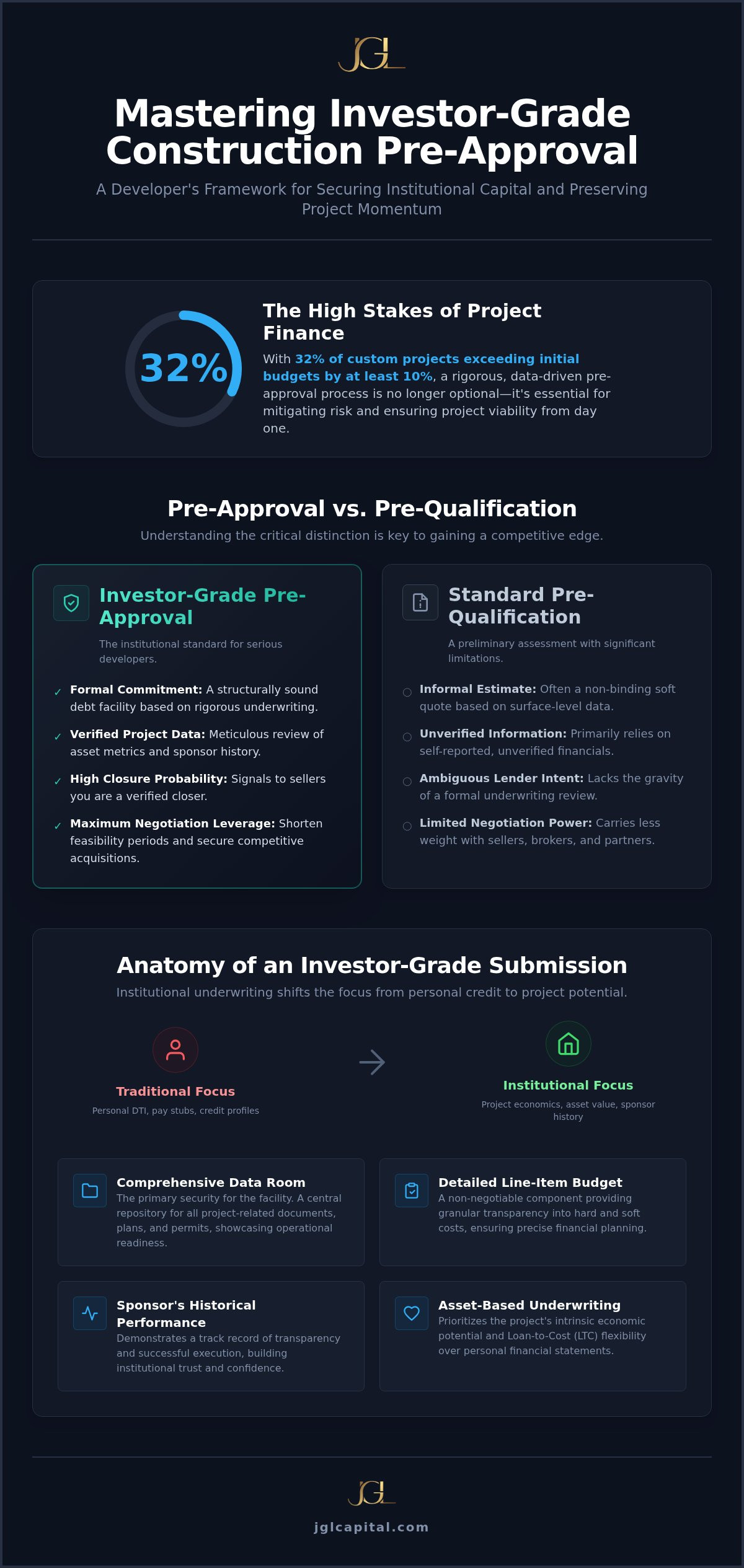
For the sophisticated developer, a pre-approval letter is far more than a routine administrative requirement; it represents a formal validation of a project’s underlying economic viability and the sponsor’s operational discipline. You’ve likely navigated the complexities of institutional underwriting where traditional banks often impose restrictive personal credit requirements on business entities or provide inflexible draw schedules that fail to align with the actualities of site progress. It’s common to find that meeting the precise construction loan requirements for investors in 2026 requires a level of analytical rigor that surpasses the capabilities of regional community lenders, especially when 32% of custom projects exceed initial budgets by at least 10%.
This guide provides the strategic framework necessary to master these institutional protocols, ensuring you can secure the capital necessary to preserve project momentum. We’ll analyze the critical role of Loan-to-Cost (LTC) ratios, the essential components of a robust data room, and the specific documentation required to transition seamlessly from land acquisition to the initial construction draw. By aligning your project with these high-register standards, you’ll establish a foundation for long-term value creation and institutional trust.
Key Takeaways
- Recognize how investor-grade pre-approval serves as a formal commitment that validates project economics and facilitates the acquisition of critical development rights.
- Navigate the rigorous construction loan requirements for investors by transitioning from personal financial statements to comprehensive, project-centric data rooms and detailed line-item budgets.
- Contrast the efficiency of asset-based underwriting with traditional banking limitations, prioritizing Loan-to-Cost (LTC) flexibility to optimize capital leverage.
- Implement a methodical submission protocol that aligns preliminary project information with institutional standards to ensure a streamlined path to the initial construction draw.
- Utilize seasoned industry expertise to manage national development pipelines through a strategic alliance focused on capital preservation and long-term value creation.
The Strategic Significance of Pre-Approval in New Construction
Within the disciplined framework of institutional finance, a pre-approval letter functions as a structural pillar of capital assurance. It’s not merely a cursory assessment of liquidity, but rather a formal commitment that reflects a preliminary level of underwriting rigor. Unlike the informal estimates often provided by retail institutions, an investor-grade pre-approval represents a formal commitment that’s predicated on a thorough evaluation of the project’s fundamentals. This document serves to validate the economic viability of a project while simultaneously signaling the sponsor’s operational readiness to move through the complex Real estate development process. For those managing high-value projects, mastering the specific construction loan requirements for investors is essential to distinguish between a non-binding soft quote and a reliable institutional commitment.
Such clarity mitigates execution risk for every participant within the capital stack, from equity partners to secondary lien holders, by ensuring the primary debt facility is structurally sound from the outset. By establishing this baseline of financial certainty, a developer can navigate the early stages of a project with a level of confidence that’s grounded in analytical reality rather than speculative hope. This rigorous approach to pre-approval ensures that all stakeholders are aligned, reducing the likelihood of mid-cycle capital shortfalls that can derail even the most meticulously planned developments.
Pre-Approval vs. Pre-Qualification: A Critical Distinction
The distinction between these two stages is primarily defined by the depth of verification and the gravity of the lender’s intent. A pre-qualification is frequently based on unverified, self-reported data, whereas a strategic pre-approval requires a meticulous review of asset-based metrics and sponsor history. Professional land sellers and institutional brokers prioritize fully underwritten pre-approvals because they signify a high probability of closure. Possessing this level of institutional backing provides substantial negotiation leverage, as it removes the ambiguity that often plagues early-stage development deals. It transforms the sponsor from a mere interested party into a verified closer in the eyes of the seller.
The Developer’s Edge in Competitive Land Acquisitions
A comprehensive pre-approval allows developers to aggressively shorten feasibility periods within purchase contracts, which is a decisive advantage in competitive markets where speed of execution is a primary value driver. When presenting a project to municipalities or planning boards, the ability to demonstrate capital readiness through a formal letter of intent reinforces the developer’s credibility and financial discipline. By satisfying the stringent construction loan requirements for investors early, a sponsor establishes a track record of transparency that’s highly valued by private capital partners and institutional stewards alike. This proactive positioning ensures that the project remains attractive to the highest caliber of vendors and subcontractors who seek the security of a well-funded project.
Essential Documentation for Investor-Grade Construction Pre-Approval
Institutional underwriting for development projects diverges sharply from the standard practices found in retail mortgage lending. While traditional banks might prioritize debt-to-income ratios or personal pay stubs, the construction loan requirements for investors center on the project’s intrinsic economic potential and the sponsor’s historical performance. Successful pre-approval necessitates a transition from personal financial statements to a comprehensive project data room. This shift ensures that the asset, rather than the individual, serves as the primary security for the facility. It’s a disciplined approach that prioritizes analytical rigor over personal credit profiles, allowing for a more precise articulation of project value.
A meticulously detailed line-item budget remains a non-negotiable component of the submission package. Lenders require granular transparency into both hard and soft costs to ensure the project remains adequately capitalized through to the final certificate of occupancy. This level of detail aligns with broader Federal Construction Loan Requirements, which emphasize the necessity of verified builder experience and contractual integrity. Beyond the numbers, the sponsor’s track record serves as a primary underwriting asset. In the current lending environment, institutional partners scrutinize previous project completions, specifically looking for scale and complexity that match the proposed development’s scope.
The Executive Summary and Project Pro-Forma
The executive summary must articulate a clear investment thesis, supported by a project pro-forma that details the projected After-Repair Value (ARV). For multi-family developments, this pro-forma should accurately project the Net Operating Income (NOI) based on current market cap rates and stabilized occupancy. Providing architectural specifications and a defined scope of work allows the lender to verify that the proposed build aligns with the valuation assumptions. It’s often beneficial to consult with a strategic ally early in this phase to ensure your pro-forma meets institutional standards and reflects current market realities.
Vetting the General Contractor and Development Team
Lenders view the general contractor (GC) as a critical risk factor within the capital stack. Consequently, they require comprehensive GC resumes, proof of licensing, and a history of similar successful builds. The pre-approval process also involves verifying insurance and bonding capacities to protect the project against unforeseen defaults or site incidents. Ensuring that your build team’s credentials are well-documented facilitates a smoother underwriting process and reinforces the project’s overall stability. This alignment between the build team and the capital provider is essential for maintaining a steady rhythm of progress once the first draw is initiated.
Private Capital vs. Institutional Lending: Evaluating Your Pre-Approval Options
Professional developers must navigate the distinct underwriting philosophies that separate traditional depository institutions from private institutional lenders. While traditional banks offer a lower cost of capital, their processes are often encumbered by bureaucratic layers that can extend underwriting timelines by several months. This delay represents a significant opportunity cost in a volatile market where land acquisition windows are narrow. Private capital providers prioritize speed and strategic alignment, offering a streamlined path to pre-approval by focusing on project-specific metrics rather than the rigid debt-to-income constraints that define consumer-facing finance.
A critical component of this evaluation involves the application of Loan-to-Cost (LTC) versus Loan-to-Value (LTV) metrics. Institutional banks often cap their exposure at 50 to 60 percent of cost, which necessitates a higher equity contribution from the sponsor. Conversely, private debt funds may extend leverage up to 75 or 80 percent of cost for developers with a proven history. This increased flexibility allows investors to preserve liquidity for other pipeline projects. When analyzing construction loan requirements for investors, it’s clear that the choice of lender dictates the capital efficiency of the entire development life cycle.
The cost of capital is naturally higher in the private sector, with rates for investor-grade construction loans frequently ranging between 9.75 and 11.25 percent. However, this premium is often offset by the ability to secure land deals that would otherwise be lost to more agile competitors. In a high-stakes environment, the certainty of execution provided by a private institutional partner serves as a form of insurance against market fluctuations and financing contingencies. It’s a strategic trade-off where the speed of funding becomes a primary driver of project profitability.
Asset-Based Underwriting: Prioritizing Project Viability
Private institutional lenders utilize asset-based underwriting to evaluate the underlying real estate collateral as the primary source of repayment. This methodology allows sponsors to bypass the restrictive personal credit requirements that often hinder business entities at traditional banks. By leveraging the 30-year expertise of JGL Capital, developers can navigate complex deals that require a deep understanding of property value over simple credit scores. This approach ensures that the project’s intrinsic worth remains the central focus of the pre-approval decision.
Flexibility in Loan Structure and Draw Schedules
The structural flexibility of private capital extends to the customization of draw schedules, which can be meticulously aligned with specific construction milestones. Unlike the rigid monthly cash flow summaries required by regional banks, private lenders allow for negotiation on inspection triggers and approval protocols. Incorporating interest-only payment structures during the build phase further preserves development liquidity. These terms are designed to reflect the unique risks and rhythms of new builds, providing a collaborative framework that supports the project’s momentum from the initial ground-breaking to the final stabilization.
A Step-by-Step Protocol for Securing Construction Financing Pre-Approval
The protocol for securing institutional funding is a methodical progression that demands absolute transparency and precision. Precision is paramount. It begins with an initial consultation to ensure the alignment of strategic objectives between the developer and the capital provider. This phase is followed by the submission of Preliminary Project Information (PPI), which provides the lender with the foundational metrics required for an asset-based evaluation. Meeting the construction loan requirements for investors at this stage necessitates a high degree of organizational discipline to ensure that the data room is both complete and accurate. A well-organized submission reduces the friction inherent in the underwriting process and accelerates the timeline to a formal commitment.
Underwriters subsequently conduct a rigorous review of the construction budget and feasibility study, evaluating hard costs against current market benchmarks to identify potential capitalization shortfalls. They scrutinize every line item to ensure that the project remains viable under various stressed scenarios. Once the project’s fundamentals are validated, the process moves into formal underwriting, culminating in the issuance of an investor-grade pre-approval letter. This document serves as a definitive signal of capital readiness to all external partners, including land sellers and municipal planning boards. It’s the final validation of a project’s structural integrity before capital is deployed.
Preparing the Loan Request Package
Organizing a professional loan request package requires more than just a collection of documents; it necessitates a cohesive narrative that justifies the project’s market demand. Developers must include detailed architectural plans and site surveys that provide a clear visualization of the intended build. By utilizing sophisticated Real Estate Investing strategies, sponsors can better articulate the projected project value and exit strategy. This level of preparation demonstrates a serious commitment to the project’s success and simplifies the lender’s risk assessment. It transforms raw data into a compelling investment thesis that institutional partners can confidently back.
Navigating the Underwriting Review
During the underwriting review, lenders often issue specific inquiries regarding environmental risks or zoning complexities that could impact the development timeline. It’s essential to have a clearly defined capital stack and a verified source for the down payment to avoid delays in the approval cycle. Finalizing the draw schedule protocol is equally critical, as it establishes the inspection and approval triggers for post-closing efficiency. To ensure your submission meets these institutional standards, you should initiate your project consultation with a seasoned strategic partner. This proactive approach ensures that the construction loan requirements for investors are fully satisfied before the project breaks ground, allowing you to maintain momentum in a competitive market.
Optimizing Your Development Pipeline with JGL Capital
The optimization of a development pipeline is a continuous exercise in strategic foresight and disciplined capital management. It requires a partner that possesses a profound understanding of the cyclical nature of the industry and the specific operational pressures faced by professional developers. JGL Capital operates at this intersection, utilizing over thirty years of institutional history to provide a sense of security and stability that transactional brokers simply cannot replicate. Our commitment to high-stakes management ensures that every project is underwritten with a focus on long-term growth and integrity, reinforcing our position as a quiet expert in the field of asset-backed finance. By maintaining a national footprint, we offer multi-state developers the ability to scale their operations without the need to navigate a fragmented environment of regional lending requirements.
Successful developers recognize that the transition from land acquisition to vertical construction is a critical phase where capital readiness determines the project’s ultimate velocity. Aligning with an institutional partner that understands the construction loan requirements for investors allows for a more fluid movement of resources through each development milestone. This stability is fundamental for sponsors who prioritize the preservation of value and the generation of worth over speculative short-term gains. By framing our activities as a high-level strategic alliance, we ensure that your project’s financial structure is as robust as its physical foundation.
A Disciplined Approach to Value Creation
Asset-backed lending represents the preferred methodology for sophisticated investors who recognize that project viability is the most reliable indicator of success. This disciplined approach to value creation prioritizes the underlying real estate collateral, allowing sponsors to bypass the bureaucratic hurdles that frequently characterize traditional banking relationships. When the construction loan requirements for investors are viewed through the lens of analytical rigor, the path to the first construction draw becomes significantly more predictable. This predictability is essential for maintaining the momentum of a development project, as it ensures that capital is available precisely when it’s required to achieve critical milestones. By eliminating the friction of traditional underwriting, we allow our partners to focus on the execution of their vision and the preservation of project worth.
Next Steps: Securing Your Capital Allocation
Securing a formal capital allocation for an upcoming project necessitates a proactive engagement with industry experts who understand the nuances of resource management. Initiating an inquiry with our team allows for a deep-seated alignment of objectives, ensuring that the proposed debt structure supports the project’s specific exit strategy and cash flow requirements. Consulting with our seasoned professionals regarding Commercial Real Estate Loans provides a foundation for sophisticated decision-making in a complex economic environment. Finalizing your pre-approval serves as a definitive step toward capitalizing on market opportunities with confidence and speed. We remain committed to fostering collaborative relationships that generate lasting worth, serving as a deeply invested ally for those who seek to build enduring legacies through disciplined, deliberate action.
Establishing Your Foundation for Strategic Development
The transition from a speculative project concept to a fully capitalized development requires a disciplined adherence to institutional standards. Mastering the specific construction loan requirements for investors is the primary differentiator between an enthusiast and a professional developer who consistently delivers on their project’s economic promise. By shifting your focus from personal credit metrics to project-centric documentation, such as meticulously detailed line-item budgets and comprehensive pro-formas, you establish a baseline of trust with your capital partners. This analytical rigor not only secures your funding but also serves to mitigate execution risk for every stakeholder involved in the build.
JGL Capital serves as a seasoned strategic ally, leveraging over 30 years of industry expertise to streamline your path to vertical construction. As a national professional brokerage with a steadfast asset-backed lending focus, we prioritize the underlying value of your real estate collateral over traditional banking constraints. This approach ensures that your development pipeline remains fluid and responsive to market opportunities as they arise. Secure Your Strategic Pre-Approval with JGL Capital Today to align your objectives with a partner committed to your long-term growth and professional legacy. It’s time to build with confidence.
Frequently Asked Questions
How long does a pre-approval for a new construction loan typically remain valid?
An institutional pre-approval letter for a new construction facility typically remains valid for a period of 60 to 90 days. This duration allows the sponsor sufficient time to finalize land negotiations while ensuring the lender’s initial risk assessment remains aligned with current market interest rates and economic conditions. If the project timeline exceeds this window, a cursory update of the project’s pro-forma and the sponsor’s liquidity position is generally required to extend the commitment’s validity.
Can I obtain pre-approval before I have a signed contract on a parcel of land?
You can absolutely secure a preliminary pre-approval before executing a formal purchase agreement for a parcel of land. In competitive markets, possessing an institutional letter of intent demonstrates capital readiness to sellers, which often shortens the feasibility period required in the contract. This proactive approach ensures that the project meets the primary construction loan requirements for investors before significant earnest money is deployed, thereby preserving the developer’s capital and negotiation leverage.
What is the minimum credit score required for an asset-based construction pre-approval?
While asset-based underwriting prioritizes the property’s intrinsic value over personal metrics, institutional lenders typically seek a minimum credit score of 680 for the project’s primary sponsors. This threshold serves as a secondary indicator of financial discipline; however, the loan’s structural integrity is fundamentally grounded in the project’s Loan-to-Cost (LTC) and After-Repair Value (ARV) metrics. For professional developers, this balance between sponsor stability and asset quality ensures a more robust and reliable capital structure.
Does the pre-approval cover the cost of the land purchase or just the vertical build?
A comprehensive pre-approval can be structured to facilitate both the land acquisition and the subsequent vertical build phases of a project. Institutional facilities often utilize a Loan-to-Cost (LTC) metric, which accounts for the total project capitalization, including the site purchase and all hard construction costs. Developers must ensure that their equity contribution satisfies the lender’s specific liquidity requirements, as institutional debt funds may cap their total exposure at 75 to 80 percent of the total project cost.
What is the difference between a soft quote and a formal pre-approval letter?
A soft quote is a non-binding estimate based on preliminary, unverified data, whereas a formal pre-approval letter is the culmination of rigorous institutional underwriting. The formal letter represents a credible commitment that land sellers and municipal boards recognize as a definitive validation of the project’s economic viability. Relying on a soft quote during high-stakes negotiations introduces unnecessary execution risk, as it lacks the verified analytical rigor required for a definitive capital allocation.
Will I need to provide personal tax returns for an investor-grade construction loan?
Investor-grade construction loans frequently bypass the requirement for personal tax returns, focusing instead on the project’s projected cash flow and the sponsor’s current liquidity. This asset-based approach allows developers to maintain privacy while streamlining the underwriting process for complex business entities. By prioritizing the project’s pro-forma and the underlying real estate collateral, lenders provide a more efficient path to funding that isn’t hindered by the complex personal financial structures of high-net-worth individuals.
How does the experience of the general contractor affect the pre-approval decision?
The experience of the general contractor is a decisive factor in the lender’s final pre-approval decision and overall risk assessment. Institutional partners conduct a thorough review of the contractor’s resume and recent project history to ensure their expertise matches the proposed development’s scale and complexity. A contractor with a proven track record of on-time completions and budget adherence significantly reduces the project’s operational risk, which often leads to more favorable loan terms and streamlined draw approvals.
Can a pre-approval be issued for a multi-family project under a newly formed LLC?
Pre-approval can certainly be issued for a project held within a newly formed LLC, provided the underlying sponsors possess the necessary development experience. Institutional lenders recognize that special purpose entities are a standard requirement in commercial real estate to isolate project-specific liabilities and align with the construction loan requirements for investors. In these scenarios, the underwriting focus shifts toward the collective track record of the management team and the project’s adherence to disciplined economic fundamentals.