

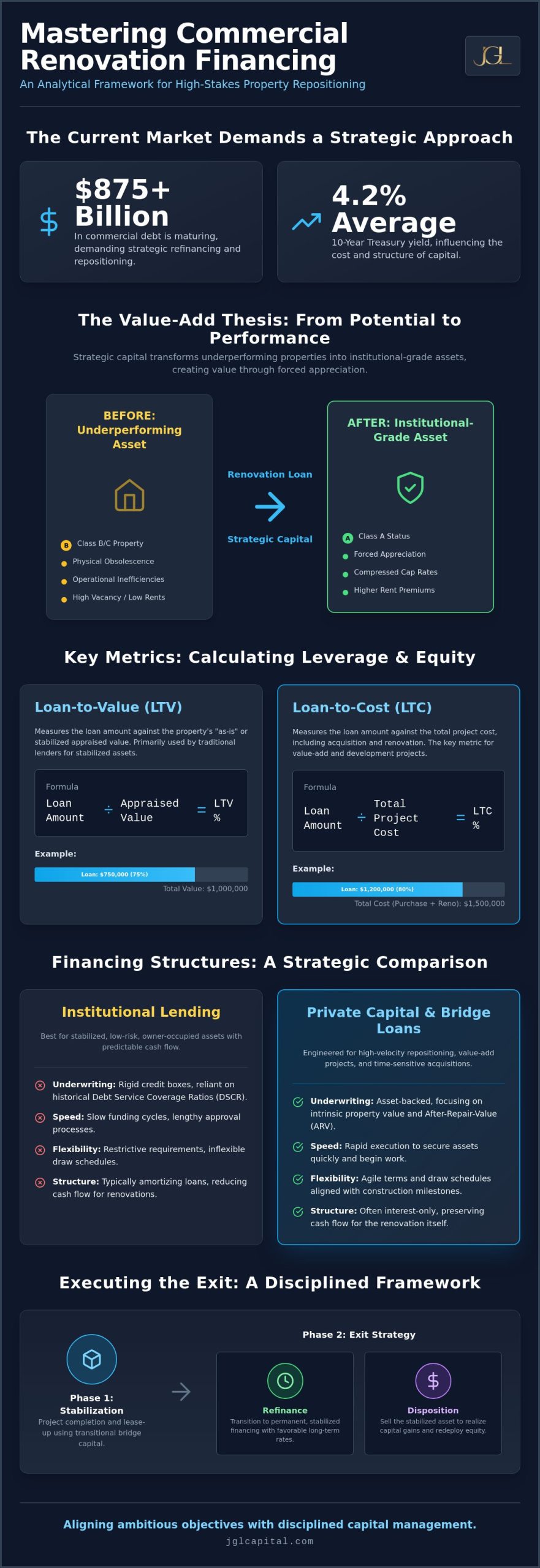
In the high-stakes arena of property repositioning, the nominal interest rate is often the least significant metric of a successful capital stack. While traditional institutions focus on rigid credit boxes, sophisticated investors recognize that commercial renovation loans serve as a vital instrument for unlocking latent asset value. You likely understand that the current market, characterized by a 10-year Treasury yield averaging 4.2 percent and over $875 billion in maturing debt, demands more than just a standard mortgage. You’ve experienced the frustration of slow funding cycles and restrictive bank requirements that threaten to derail time-sensitive value-add strategies.
This guide provides the analytical framework necessary to master the complexities of renovation financing; it ensures you secure the agile, asset-based capital required for high-stakes development. We’ll examine the nuances of LTV versus LTC ratios, the strategic advantages of bridge structures, and the methodology for identifying a capital partner capable of supporting recurring, large-scale projects. By aligning your objectives with disciplined capital management, you can transform a simple renovation into a legacy-defining asset.
Key Takeaways
- Understand how strategic capital facilitates the transition of underperforming Class B and C properties into institutional-grade assets.
- Evaluate the technical differences between various commercial renovation loans to identify the financing structure that provides the necessary agility for high-stakes development.
- Learn to utilize asset-backed underwriting to bypass restrictive institutional credit requirements, focusing instead on the property’s intrinsic value and after-repair potential.
- Master the analytical application of Loan-to-Value and Loan-to-Cost ratios to precisely calculate equity requirements and maximize project leverage.
- Establish a rigorous framework for your exit strategy to ensure a seamless transition from transitional capital to permanent stabilized financing or asset disposition.
The Strategic Role of Commercial Renovation Loans in Asset Repositioning
Commercial renovation loans represent a specialized class of financing designed to facilitate the acquisition and subsequent rehabilitation of underperforming commercial real estate. Unlike a standard commercial mortgage, which typically assumes a stabilized cash flow and a low-risk profile, these instruments are engineered for volatility and growth. They provide the necessary liquidity to execute a turnaround, allowing investors to bridge the gap between an asset’s current state and its highest potential use. In a market where over $875 billion in commercial debt is maturing in 2026, the ability to reposition assets through strategic capital is a critical component of value preservation.
The “Value-Add” investment thesis hinges on the developer’s capacity to identify Class B or C properties that possess institutional-grade potential but suffer from physical obsolescence or operational inefficiencies. By deploying strategic capital, an investor can compress cap rates and elevate the asset to Class A status. This process creates significant equity through forced appreciation rather than relying on broader market trends. Conventional amortizing loans are fundamentally ill-suited for this intensive phase. Banks often require debt service coverage ratios that a vacant or partially occupied building simply cannot meet. Additionally, the rigid structure of traditional bank debt doesn’t allow for the flexible draw schedules required to fund construction milestones.
Defining the Scope of Commercial Rehabilitation
Sophisticated investors distinguish between cosmetic “refresh” projects and structural “gut” rehabilitations. While paint and flooring might improve aesthetic appeal, structural upgrades to HVAC systems or floorplan reconfigurations provide the most significant impact on Net Operating Income. These intensive improvements lead to higher rent premiums and lower long-term operating expenses, which directly influences the property’s terminal value. Commercial renovation loans act as a strategic catalyst for capital appreciation by providing the liquidity necessary to convert architectural potential into quantifiable market value.
Capital Allocation: When to Seek Specialized Renovation Funding
Successful capital allocation requires identifying whether an asset is “distressed” due to physical decay or “under-managed” due to poor leasing strategies. Specialized renovation funding is essential for both scenarios, as it provides the agility to address immediate capital expenditure needs. These loans serve as transitional capital, bridging the gap between the initial purchase and the eventual permanent refinancing once the asset is stabilized. Aligning loan terms with the anticipated project timeline is a hallmark of a disciplined steward. A 12-to-24-month term with interest-only payments often represents the most prudent approach, as it preserves cash flow for the renovation itself rather than diverting it toward principal reduction during the construction phase.
Primary Structures for Financing Commercial Property Renovations
Selecting the optimal capital structure is a decision that carries as much weight as the architectural blueprints themselves. For developers navigating the 2026 market, where the 10-year Treasury yield averages 4.2 percent, the choice between debt instruments determines the project’s ultimate internal rate of return. While institutional options like the SBA 504 loan program provide stability for stabilized, owner-occupied assets, they lack the flexibility required for high-velocity repositioning. Sophisticated investors instead pivot toward bespoke commercial renovation loans that accommodate the inherent risks of the construction phase.
Asset-Backed Bridge Financing for Rapid Execution
Bridge capital facilitates the acquisition of properties that don’t yet meet the stringent debt service coverage ratios required by traditional lenders. These real estate bridge loans are typically structured as interest-only facilities, a feature that preserves vital cash flow during the non-income-producing stages of a renovation. By integrating these instruments into a broader portfolio strategy, developers can secure assets quickly, execute their value-add thesis, and position the property for permanent refinancing at a significantly higher valuation.
Commercial Hard Money: Speed as a Competitive Advantage
In scenarios where a competitive bidding process demands an accelerated closing, hard money serves as a tactical tool. Commercial hard money functions as a specialized form of commercial renovation loans where speed is the primary objective. The underwriting process for these loans prioritizes the property’s intrinsic value and after-repair potential over the borrower’s personal credit history. This asset-based approach allows for funding to occur in a fraction of the time required by traditional institutions. While interest rates are higher, the certainty of execution often outweighs the cost of capital, particularly when a missed opportunity represents a greater loss of potential equity.
Construction-to-permanent financing offers a dual-phase solution for projects intended for long-term hold, automatically converting into a stabilized mortgage once the project reaches a pre-defined occupancy threshold. For large-scale redevelopments, mezzanine debt and preferred equity fill the capital stack, providing the additional leverage necessary to execute complex projects without diluting ownership excessively. This tiered structure allows developers to maximize their return on equity while maintaining a disciplined approach to risk management. Identifying the correct balance between these layers is essential for maintaining project viability. Engaging a partner who understands these nuances is the first step toward a successful strategic alliance in property development.
Private Capital vs. Institutional Lending: A Strategic Comparison
While traditional depository institutions offer lower nominal interest rates, the true cost of capital must be measured through the lens of execution velocity and structural flexibility. Sophisticated developers recognize that the “interest rate” is only one component of a project’s financial efficiency. In a market where an estimated $875 billion of commercial real estate loans are scheduled to mature in 2026, the competition for institutional capital is intense. Private capital sources typically facilitate underwriting in 10 to 14 days, a stark contrast to the 60 to 90 days required by most banks. In the context of commercial renovation loans, this velocity gap represents a critical competitive advantage, allowing investors to secure distressed assets before competitors can navigate institutional committees.
A comprehensive understanding of Commercial real estate financing reveals that private capital offers superior structural customization. Unlike rigid institutional frameworks, private debt allows for the precise tailoring of draw schedules and interest reserves to match specific renovation milestones. This alignment ensures that capital is deployed only when necessary, optimizing the project’s internal rate of return. Furthermore, the distinction between recourse and non-recourse debt is paramount. Private capital often provides non-recourse options for high-stakes renovations, shielding the borrower’s personal assets from project-specific volatility, a protection rarely afforded by traditional bank covenants.
Navigating the Institutional ‘Red Tape’
Traditional banks often maintain a conservative stance toward “heavy-lift” commercial renovations due to the inherent lack of immediate cash flow. This institutional hesitation stems from a reliance on established debt service coverage ratios that a property in transition cannot satisfy. Accessing commercial real estate loans through private channels allows developers to bypass these bureaucratic hurdles. Private underwriting prioritizes the asset’s intrinsic worth and the developer’s specific experience, rather than focusing solely on personal financial covenants that can restrict a borrower’s liquidity and future borrowing capacity.
The Agility of Private Money Brokerage
Engaging a seasoned broker provides access to discretionary capital that remains resilient even in volatile market conditions. With over 30 years of industry expertise, a disciplined steward of capital can navigate complex capital stacks to source bespoke solutions that institutional lenders cannot replicate. This strategic alliance transforms the lending process from a simple transaction into a collaborative partnership. By leveraging established relationships with private funding sources, developers can secure commercial renovation loans that provide the agility needed to capitalize on emerging opportunities as the market stabilizes following the rate cuts of late 2025.
Underwriting and Qualification: The Analytical Framework
Underwriting commercial renovation loans requires an analytical rigor that transcends simple credit scores, focusing instead on the property’s future economic viability and the developer’s capacity to execute a complex value-add strategy. Loan-to-Cost (LTC) ratios serve as the primary metric for capital deployment, as they represent the total capital stack relative to the combined cost of acquisition and construction, whereas Loan-to-Value (LTV) measures the leverage against the asset’s current state. A meticulous After-Repair Value (ARV) assessment acts as the cornerstone of this framework, providing the terminal valuation that justifies the initial capital outlay. Lenders typically expect a post-renovation Debt Service Coverage Ratio (DSCR) of 1.20x to 1.25x, ensuring the asset can support permanent take-out financing once stabilized. A transparent and detailed Scope of Work (SOW) is essential, as it allows the lender to verify that the proposed improvements will actually generate the anticipated rent premiums.
Calculating the Pro Forma Net Operating Income
Projecting rental increases and occupancy improvements post-renovation requires a disciplined approach to market analysis. Validating market comps is critical to justifying the anticipated ARV, ensuring that the projected rental increases are grounded in historical data rather than speculative optimism. This process involves a granular review of competing assets to ensure the subject property will remain competitive within its specific submarket. The pro forma Net Operating Income serves as the ultimate determinant for the feasibility of the exit strategy, whether through refinancing or asset disposition. To begin an analytical review of your next project, you may contact JGL Capital for a strategic evaluation.
The Borrower’s Track Record and Experience
Previous project success serves as a vital trust-builder for asset-based lenders, signaling that the developer possesses the operational discipline to manage construction timelines and budget contingencies. While the property value is the primary security, the borrower’s history of managing similar redevelopments provides the intellectual capital necessary to navigate unforeseen structural or market challenges. Preparing a comprehensive Investor Bio and portfolio summary is a prerequisite for underwriting review, as it establishes the credibility of the management team. Essential documentation for this process includes environmental reports, detailed construction contracts, and a clear breakdown of soft costs, all of which contribute to a holistic view of the project’s risk profile. By presenting a well-documented history of performance, developers can align their objectives with a capital partner who values long-term growth and integrity.
Executing the Exit Strategy: Refinance or Disposition
The successful execution of commercial renovation loans concludes not with the completion of construction, but with the realization of a pre-defined exit strategy. A disciplined investor identifies the path to liquidity before the first draw is requested, ensuring that every renovation milestone aligns with terminal value objectives. Whether the goal is a long-term hold or a strategic disposition, the transition from transitional capital to permanent financing requires methodical planning. In an environment where the Federal Reserve has held the federal funds rate between 3.75 percent and 4.00 percent, the timing of this transition is critical to preserving equity and maximizing the project’s internal rate of return.
Refinancing into a permanent mortgage, often termed “take-out” financing, remains the most common path for those seeking to build a lasting legacy. It’s a process that involves replacing high-velocity bridge debt with a long-term, low-interest facility once the asset reaches a stabilized state. Alternatively, disposition strategies allow developers to capture the value created through repositioning, often utilizing commercial renovation loans as the initial catalyst for this forced appreciation. By selling a stabilized Class A asset, investors can realize significant gains and redeploy capital into new value-add opportunities. JGL Capital serves as a strategic ally throughout this lifecycle, facilitating the seamless migration from transitional bridge structures to permanent debt.
Stabilization and the Path to Permanent Debt
Stabilization occurs when a property reaches its target occupancy and generates a steady, predictable Net Operating Income. This phase is essential for meeting the rigorous standards of institutional-grade real estate investing. Lenders scrutinize the Debt Service Coverage Ratio during this period, typically requiring a minimum of 1.20x to 1.25x to approve permanent financing. Achieving these benchmarks confirms that the renovation has successfully converted architectural potential into a stable financial instrument. It’s the point where the risk profile of the asset shifts from speculative development to stabilized income generation.
Partnering for Long-Term Value Creation
Building a recurring relationship with a strategic capital partner provides a level of stability that transactional lenders cannot offer. JGL Capital’s 30-year history as a disciplined steward of capital ensures that partners have access to intellectual capital across multiple market cycles. This legacy of expertise allows for the creation of highly customized solutions that align with your long-term objectives. By framing financing as a form of high-level strategic alliance rather than a simple service, you ensure the generation of worth remains the primary focus. To discuss the specific nuances of your portfolio repositioning, Consult with JGL Capital for your next commercial renovation project.
Advancing Your Portfolio Through Strategic Capital Alliances
The successful repositioning of a commercial asset requires more than just architectural vision; it demands a capital structure that mirrors the project’s complexity and speed. By transitioning from rigid institutional frameworks to agile, asset-based solutions, developers can effectively navigate the volatility of the current market. You’ve seen how commercial renovation loans serve as a vital instrument for unlocking latent worth, provided that the underwriting remains focused on After-Repair Value and technical project viability rather than restrictive personal credit metrics. A disciplined approach to the capital stack ensures that your exit strategy, whether through stabilization or disposition, remains achievable and profitable.
JGL Capital brings over 30 years of industry expertise to every strategic alliance, offering national funding capabilities that prioritize the intrinsic value of your real estate. By focusing on asset-based underwriting, we provide the stability and discretion required for high-stakes management. You’re invited to Secure Agile Capital for Your Next Commercial Project with JGL Capital and leverage our intellectual capital to build a lasting legacy. We’re ready to support your vision with the precision and reliability your portfolio deserves.
Frequently Asked Questions
What is the typical interest rate for a commercial renovation loan in 2026?
As of July 2026, interest rates for commercial renovation loans generally range from 5.15% to 12.75% for conventional products, while bridge facilities often average around 9.00%. These figures are influenced by the Federal Reserve’s target funds rate of 3.75% to 4.00% and vary based on the specific asset class and project risk profile. Lenders also factor in the 10-year Treasury yield, which is forecasted to average 4.2% throughout the year, as a primary benchmark for long-term pricing.
How much down payment is required for a commercial renovation project?
Equity requirements typically range from 25% to 35% of the total project cost for conventional financing, which corresponds to Loan-to-Value ratios between 65% and 75%. While some specialized programs allow for leverage as high as 90%, most asset-based lenders expect the developer to maintain a disciplined equity position. This ensures a proper alignment of interests between the capital partner and the borrower throughout the construction phase.
Can I get a renovation loan for a property with low occupancy?
Properties with low occupancy or significant vacancy are ideal candidates for asset-based capital, provided the borrower presents a rigorous repositioning plan. Private lenders prioritize the property’s intrinsic value and its After-Repair Value rather than current debt service coverage. This flexibility allows investors to secure and rehabilitate assets that traditional banks would reject due to a lack of immediate cash flow.
What is the difference between LTC and LTV in commercial lending?
Loan-to-Cost (LTC) measures the loan amount against the total project budget, including both the acquisition price and all renovation expenses; conversely, Loan-to-Value (LTV) measures the debt against the property’s current or future appraised value. Lenders utilize LTC to determine the developer’s “skin in the game” during construction. They use LTV to ensure the asset provides sufficient collateral security relative to its market worth at various stages of the project.
How long does it take to fund a private commercial renovation loan?
Private capital sources typically facilitate funding within 10 to 14 days, providing a vital speed advantage over the 60 to 90 days required by institutional banks. This accelerated underwriting process is achieved through a focus on asset value rather than exhaustive personal financial audits. Such velocity is essential for developers who need to close quickly on distressed assets or maintain a steady construction rhythm without funding interruptions.
Do commercial renovation loans require personal guarantees?
Many private commercial renovation loans offer non-recourse structures that limit the borrower’s personal liability to specific “bad boy” carve-outs, such as fraud or gross negligence. This is a significant departure from traditional bank debt, which almost universally requires a full personal guarantee. By utilizing non-recourse debt, sophisticated investors can shield their broader portfolios from the specific risks associated with a single development project.
What documents do I need to provide for a commercial bridge loan?
Lenders require a comprehensive documentation package that includes a detailed Scope of Work, a line-item construction budget, and a clearly articulated exit strategy. You’ll also need to provide environmental reports, an Investor Bio detailing your track record, and specific market comps that justify your projected pro forma income. These documents allow the underwriter to conduct a disciplined analysis of the project’s technical and financial feasibility.
Is hard money a viable option for large-scale multi-family renovations?
Hard money represents a highly viable tactical tool for multi-family renovations where speed and high leverage are necessary to execute a value-add thesis. It allows developers to quickly acquire underperforming Class B or C assets and fund the improvements required to reach institutional standards. Once the property is stabilized and occupancy increases, the hard money debt is typically replaced with permanent, low-interest financing.