

In the rigorous discipline of commercial real estate management, the period of transition is not a state of limbo but a strategic phase of value creation that requires precise capital alignment. You’ve likely experienced the institutional resistance that occurs when traditional banks decline financing due to temporary occupancy fluctuations or the immediate necessity for significant capital improvements. It’s natural to feel a measured degree of anxiety regarding the elevated interest rates typical of transitional capital, especially when the preservation of your projected return on investment is paramount. However, utilizing a bridge loan to stabilize a commercial property is often the most disciplined path toward achieving long-term asset viability.
This guide illustrates how sophisticated investors utilize bridge financing as a catalyst to transform underperforming assets into institutional-grade, bankable holdings. By reading further, you’ll gain a comprehensive understanding of the precise metrics that private debt funds prioritize when evaluating your business plan. We’ll provide a methodical roadmap for property stabilization and discuss the essential criteria for identifying a partner who values the alignment of objectives and the generation of lasting worth. This analysis moves from high-level strategic philosophies to the specific operational strengths required to navigate the $936 billion in commercial debt maturing in 2026.
Key Takeaways
- Learn how to define stabilization through the lens of Net Operating Income and why a bridge loan to stabilize a commercial property is the preferred vehicle for assets that traditional banks deem unseasoned.
- Understand the strategic deployment of capital for physical improvements and tenant enhancements to drive rental premiums and secure institutional-grade value.
- Evaluate the cost of transitional capital using a sophisticated framework that weighs interest expenses against the significant opportunity cost of stagnant asset performance.
- Identify the three primary exit paths—refinancing, divestment, or principal paydown—to ensure your transitional financing serves as a disciplined bridge rather than an open-ended liability.
- Discover the benefits of a strategic alliance with a partner who prioritizes asset potential and the generation of long-term worth over rigid, traditional underwriting metrics.
Defining Stabilization and the Utility of Bridge Capital
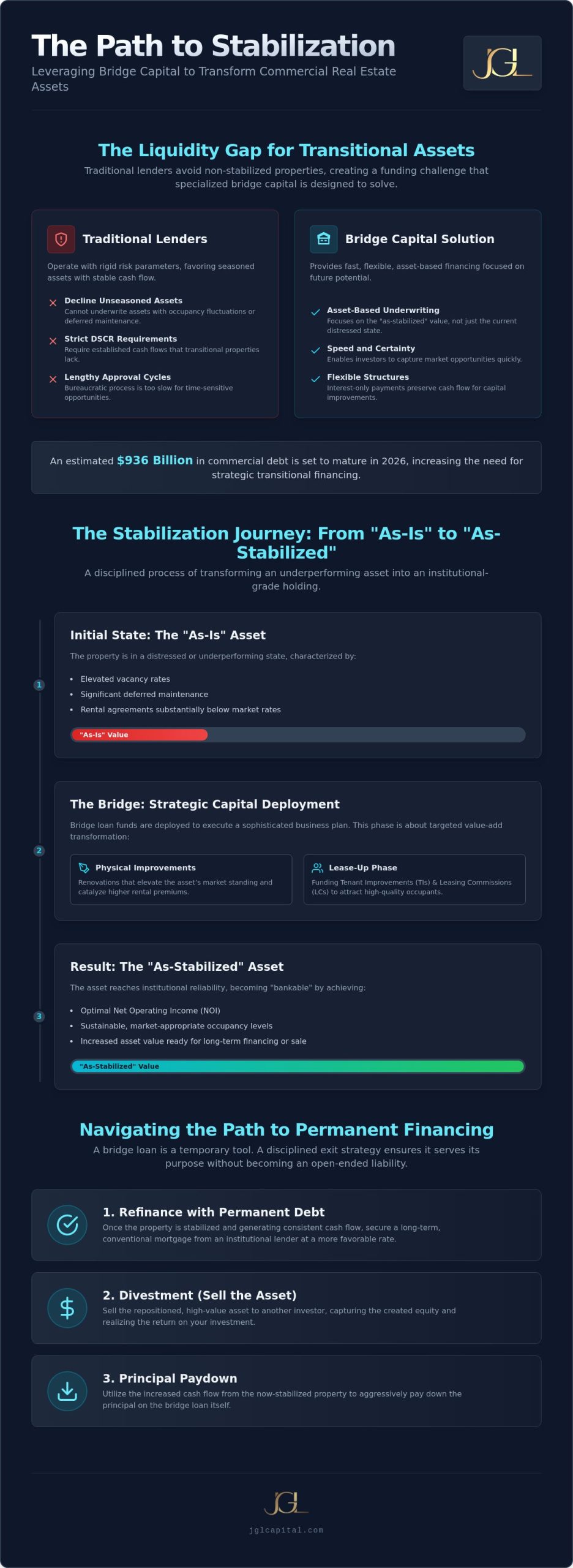
Stabilization represents the strategic inflection point where a commercial asset moves from a state of volatility to one of institutional reliability. In the context of professional underwriting, stabilization is defined by the achievement of a property’s optimal Net Operating Income (NOI) and a sustainable, market-appropriate occupancy level. Traditional institutional lenders typically operate within rigid risk parameters that favor seasoned assets with established cash flows; consequently, they often avoid non-stabilized properties because the inherent unpredictability of transitional periods doesn’t align with their conservative debt-service coverage ratio (DSCR) requirements. This creates a liquidity gap that only specialized capital can bridge.
A bridge loan serves as the essential mechanism for crossing this gap, providing the transitional capital necessary to move an underperforming asset into a bankable state. When time-sensitive projects require a disciplined approach to physical or operational improvements, the speed and certainty of execution offered by private capital become the primary drivers of success. Utilizing a bridge loan to stabilize a commercial property allows the investor to execute a sophisticated business plan without the restrictive oversight or the lengthy approval cycles of a conventional mortgage.
The Mechanics of Non-Stabilized Assets
Non-stabilization is frequently triggered by factors such as elevated vacancy rates, significant deferred maintenance, or rental agreements that sit substantially below current market rates. Underwriting these assets requires a nuanced understanding of the “as-is” value, which reflects the current distressed state, versus the “as-stabilized” value, which projects the asset’s worth once the strategic vision is realized. Asset-based lending prioritizes this inherent potential, allowing the property’s future performance to drive the financing structure. This focus on the asset itself allows sophisticated investors to bypass the personal credit hurdles that often stall progress at traditional institutions, centering the conversation on the property’s eventual worth.
Why Commercial Bridge Loans are the Preferred Instrument
Commercial bridge loans are specifically engineered to support this transformative phase by offering the flexibility of interest-only payment structures, which preserves precious cash flow for capital expenditures. Unlike the bureaucratic delays and exhaustive documentation requirements characteristic of regional banks, private capital provides the agility required to capture market opportunities before they dissipate. These instruments are designed specifically for this transformative phase, offering a tailored solution where traditional products fail. Securing a bridge loan to stabilize a commercial property ensures that the investor maintains control over the timeline of the asset’s lifecycle, moving with a precision that aligns with their long-term strategic objectives.
Strategic Applications: Repositioning Assets for Long-Term Value
Strategic repositioning requires a meticulous orchestration of capital and operational strategy. When an investor utilizes a bridge loan to stabilize a commercial property, the primary objective is often a Value-Add transformation where physical enhancements directly catalyze higher rental premiums. This phase is characterized by a disciplined deployment of capital into renovations that elevate the asset’s market standing. Beyond physical aesthetics, the Lease-Up phase utilizes bridge funds to cover Tenant Improvements (TIs) and Leasing Commissions (LCs), ensuring that the property attracts high-quality, stable occupants. These Strategic Applications of capital are designed to move the asset toward a higher demographic tier, effectively repositioning it to capture increased Net Operating Income (NOI).
Physical Rehabilitation and Capital Expenditures
Targeted renovations are the engine that drives a property’s As-Stabilized value, creating the necessary equity for a future institutional exit. Managing the construction timeline is paramount. Delays in renovation schedules can lead to excessive interest carry-over, which erodes the project’s overall profitability. It’s essential to distinguish this process from new construction loans, which fund ground-up development rather than the rehabilitation of existing structures. A disciplined CapEx budget acts as the safeguard for your ROI, ensuring that every dollar spent on the facade or interior systems translates into a measurable increase in the asset’s valuation.
Operational Stabilization and Income Optimization
Operational stabilization focuses on the internal efficiency of the asset. By reducing bloated operating expenses, investors can maximize their Debt Service Coverage Ratio (DSCR), a critical metric for future permanent lenders. Bridge capital provides the financial runway required to replace underperforming tenants with those who align with the property’s new market position. Aligning your property management objectives with the terms of your bridge loan to stabilize a commercial property ensures a cohesive approach to value preservation. For those seeking a sophisticated partner to navigate these operational complexities, a strategic alliance with JGL Capital LLC offers the expertise needed to secure a lasting legacy.
Financial Metrics: Analyzing the Cost of Transition Capital
Sophisticated investors recognize that the pricing of transitional capital is a direct reflection of the risk profile inherent in non-stabilized assets. While the interest rates for these instruments, currently ranging from 9.00% to 14.00% as of July 2026, are higher than those of permanent debt, they must be evaluated within a “Cost of Capital” versus “Opportunity Cost” framework. A higher interest rate is often a strategic trade-off for the leverage and speed required to execute a value-add plan. The Stabilization Premium is the net value created through the repositioning process after subtracting the total cost of the bridge financing.
When structured correctly, a bridge loan to stabilize a commercial property focuses on Loan-to-Cost (LTC) during the capital expenditure phase, transitioning to a Loan-to-Value (LTV) focus as the asset approaches its terminal state. Many institutional partners utilize a bridge loan to secure commercial real estate because it allows them to preserve their own liquidity for other high-yield opportunities. This disciplined approach to leverage ensures that the equity remains focused on growth rather than being locked in a stagnant, underperforming asset.
Understanding the Bridge Loan Comparison
The following table illustrates the fundamental differences between transitional capital and permanent institutional financing. These metrics highlight why bridge financing is the superior choice for assets in flux.
| Metric | Bridge Loan | Permanent Financing |
|---|---|---|
| Term Length | 12 to 36 Months | 5 to 10+ Years |
| Interest Rate | 9.00% – 14.00% (SOFR based) | 6.00% – 8.00% (Fixed/Treasury) |
| Standard LTV | 60% – 70% | 50% – 60% |
| Execution Speed | 10 to 21 Days | 45 to 90 Days |
A 9% bridge loan can often be more profitable than a 6% bank loan if the latter requires 50% equity. By minimizing the initial equity requirement, the investor maximizes their internal rate of return (IRR). Additionally, the interest-only payment structures common in bridge deals preserve short-term cash flow, ensuring that capital remains available for critical renovations and tenant improvements.
Underwriting the Exit: DSCR and NOI Targets
Lenders evaluate the viability of a bridge deal by pre-underwriting the exit strategy. A target Debt Service Coverage Ratio (DSCR) of 1.25x or higher is typically required for a property to qualify for permanent take-out financing. During the bridge period, underwriters focus heavily on “Pro-Forma” income, which projects the property’s performance after stabilization. Most institutional lenders also require a period of “seasoning,” often six to twelve months of stabilized rental income, before they’ll approve a refinance. Understanding these metrics is essential when using a bridge loan to stabilize a commercial property, as it ensures the transition leads to a predictable and bankable conclusion.
Navigating the Path to Permanent Financing: The Exit Strategy
A bridge loan to stabilize a commercial property is a sophisticated tactical maneuver that remains incomplete without a pre-underwritten terminal solution. Professional investors recognize that entering a short-term debt obligation without a clearly defined exit strategy creates a “bridge to nowhere,” potentially leading to maturity defaults or forced liquidations under unfavorable market conditions. The duration of these instruments, typically spanning 12 to 36 months, is meticulously calibrated to the property’s projected stabilization timeline. This window allows for the execution of capital improvements and lease-up initiatives before transitioning into permanent commercial real estate loans. Identifying whether the final objective is a long-term hold through refinancing, a strategic sale, or a principal paydown is the first step in a disciplined investment lifecycle.
The Refinance Path: Agency and CMBS Options
Refinancing into permanent debt is the most common exit for investors who intend to build lasting legacies through asset retention. For multifamily assets, moving into agency financing through Fannie Mae, Freddie Mac, or HUD requires the property to meet specific occupancy and debt-service coverage thresholds that were unattainable at the time of acquisition. For other sectors such as retail, office, or industrial, CMBS conduit loans offer competitive fixed rates once the asset is stabilized. Maintaining meticulous financial records during the bridge period is vital; take-out lenders will conduct an exhaustive analysis of the property’s performance to verify that the projected Net Operating Income (NOI) has been realized. Proper seasoning of rental income, often requiring six to twelve months of consistent collections, remains a non-negotiable requirement for most institutional refinance platforms.
Strategic Disposition: Selling the Stabilized Asset
Stabilization fundamentally alters the liquidity profile of an asset by making it “bankable” for a wider pool of potential buyers. When you utilize a bridge loan to stabilize a commercial property, you aren’t just improving the physical structure; you’re reducing the risk premium that a future buyer’s lender will apply to the deal. This reduction in perceived risk often leads to “Cap Rate Compression,” where the asset’s value increases exponentially as the market accepts a lower yield in exchange for stability. Investors must remain cognizant of the terms within their bridge agreement, specifically managing any prepayment penalties or yield maintenance requirements if a sale occurs before the loan’s maturity. Achieving this level of operational excellence requires a partner who views financing as a strategic alliance. Explore our capital solutions to ensure your asset reaches its full institutional potential.
Aligning Objectives: The JGL Capital LLC Strategic Alliance
Success in complex real estate transitions requires more than a mere provider of capital; it demands a disciplined steward of private resources who understands the gravity of high-stakes management. JGL Capital LLC brings over 30 years of industry expertise to every engagement, positioning itself as a seasoned partner for those seeking a bridge loan to stabilize a commercial property. Unlike traditional institutions that remain tethered to rigid personal credit metrics, our underwriting philosophy prioritizes the intrinsic value of the property and its documented potential for growth. This analytical rigor allows us to provide highly customized solutions that align perfectly with an investor’s strategic objectives, ensuring that every mid-market transaction is treated with institutional-level precision regardless of its location across our national network.
The JGL Capital LLC Advantage in Asset-Based Lending
Our firm operates on the principle that speed and certainty of execution are non-negotiable for time-sensitive stabilization projects. By utilizing a streamlined underwriting process, we provide the agility required to capture emerging opportunities that traditional banks often overlook. This specialized knowledge is particularly beneficial when navigating the landscape of hard money lenders and private capital markets, where the distinction between a transactional service and a strategic alliance is most pronounced. We maintain an unwavering commitment to transparency, providing clear articulation of points, fees, and closing timelines to instill a sense of security and trust in our sophisticated partners.
Securing Your Transitional Capital
We invite sophisticated investors to present their stabilization plans for a professional, analytical review. As a quiet expert in the field, JGL Capital LLC relies on intellectual capital and a history of successful outcomes rather than aggressive self-promotion to demonstrate our competence. We value long-term integrity and the creation of lasting worth above all else, focusing on building legacies through careful and deliberate action. Ultimately, the right bridge loan to stabilize a commercial property acts as the final catalyst in transforming underperforming liabilities into robust, stabilized assets that serve as the foundation for your portfolio’s future growth. Contact us today to begin a collaborative relationship grounded in stability and expertise.
Securing the Future of Your Commercial Asset
The transition from an underperforming state to institutional bankability requires a meticulous alignment of capital and operational strategy. We’ve explored how a disciplined approach to physical improvements and tenant enhancements directly influences Net Operating Income, creating the necessary equity for a successful exit. By prioritizing asset potential over rigid personal credit metrics, a bridge loan to stabilize a commercial property serves as the essential catalyst for professional value creation. JGL Capital acts as a seasoned steward in this process. We offer over 30 years of industry-leading expertise and a national reach grounded in institutional-grade underwriting.
Secure your strategic bridge financing with JGL Capital today.
Your vision for property stabilization deserves a partner committed to excellence and the generation of lasting worth.
Frequently Asked Questions
What exactly does it mean to “stabilize” a commercial property?
Stabilization is the realization of an asset’s full income potential through the achievement of market-standard occupancy and optimal Net Operating Income (NOI). It involves a disciplined transition from a distressed or underperforming state to one that meets institutional underwriting criteria. This phase often requires physical renovations and the replacement of underperforming tenants with those who can support long-term value preservation and asset bankability.
How much does a commercial bridge loan typically cost in terms of interest and fees?
As of July 2026, interest rates for these transitional instruments typically range from 9.00% to 14.00%, often structured as a spread over the Secured Overnight Financing Rate (SOFR). Borrowers should also anticipate origination fees between 1% and 3% of the total loan amount. These costs reflect the risk premium associated with non-stabilized assets and the specialized nature of the capital provided for high-stakes management.
Can I get a bridge loan if my commercial property has a high vacancy rate?
High vacancy is a primary trigger for utilizing a bridge loan to stabilize a commercial property. While traditional institutional lenders prioritize existing cash flow, private debt funds focus on the asset’s “as-stabilized” value and the viability of your lease-up strategy. This allows sophisticated investors to secure the capital needed to transform vacant space into a productive, income-generating asset that eventually qualifies for permanent debt.
What is the typical duration of a bridge loan for property stabilization?
The typical duration for these loans ranges from 12 to 36 months, providing a measured runway for the execution of a strategic business plan. This timeframe is specifically calibrated to allow for the completion of capital expenditures and the subsequent seasoning of rental income. Most agreements include interest-only payment structures to maximize the capital available for property improvements during this critical window of value creation.
What happens if the property is not stabilized by the time the bridge loan expires?
Failure to achieve stabilization by the maturity date can lead to a maturity default, which may necessitate a forced sale or the pursuit of rescue capital. Some lenders offer extension options, but these are usually contingent on reaching specific performance milestones. It’s imperative to maintain a steady communication rhythm with your partner to address any unforeseen delays in the construction or leasing timeline before the term expires.
Do bridge lenders require a personal guarantee for commercial stabilization loans?
Recourse is a standard requirement for most bridge loans in the current 2026 lending environment. While the underwriting focus remains on the property’s potential, lenders typically require a personal guarantee from the principals to ensure alignment of interests. This accountability serves as a linguistic signature of a serious and disciplined approach to the creation of worth and the preservation of capital throughout the project.
What documents are required to apply for a commercial bridge loan?
Underwriters require a comprehensive package including a detailed business plan, pro-forma projections, and a meticulous schedule of capital expenditures. You’ll also need to provide current rent rolls, property tax records, and evidence of your track record with similar assets. This documentation allows the lender to conduct the analytical rigor necessary to approve a bridge loan to stabilize a commercial property with confidence.
How does the LTV (Loan-to-Value) differ for a bridge loan compared to a bank loan?
Bridge lenders generally offer more flexible leverage than traditional banks, with standard LTV ratios currently between 60% and 70%. Unlike conventional mortgages that focus on the “as-is” value, bridge financing often incorporates a Loan-to-Cost (LTC) framework. This structure allows for the financing of a significant portion of the renovation costs, which is rarely possible through institutional bank products that favor seasoned, low-risk assets.