

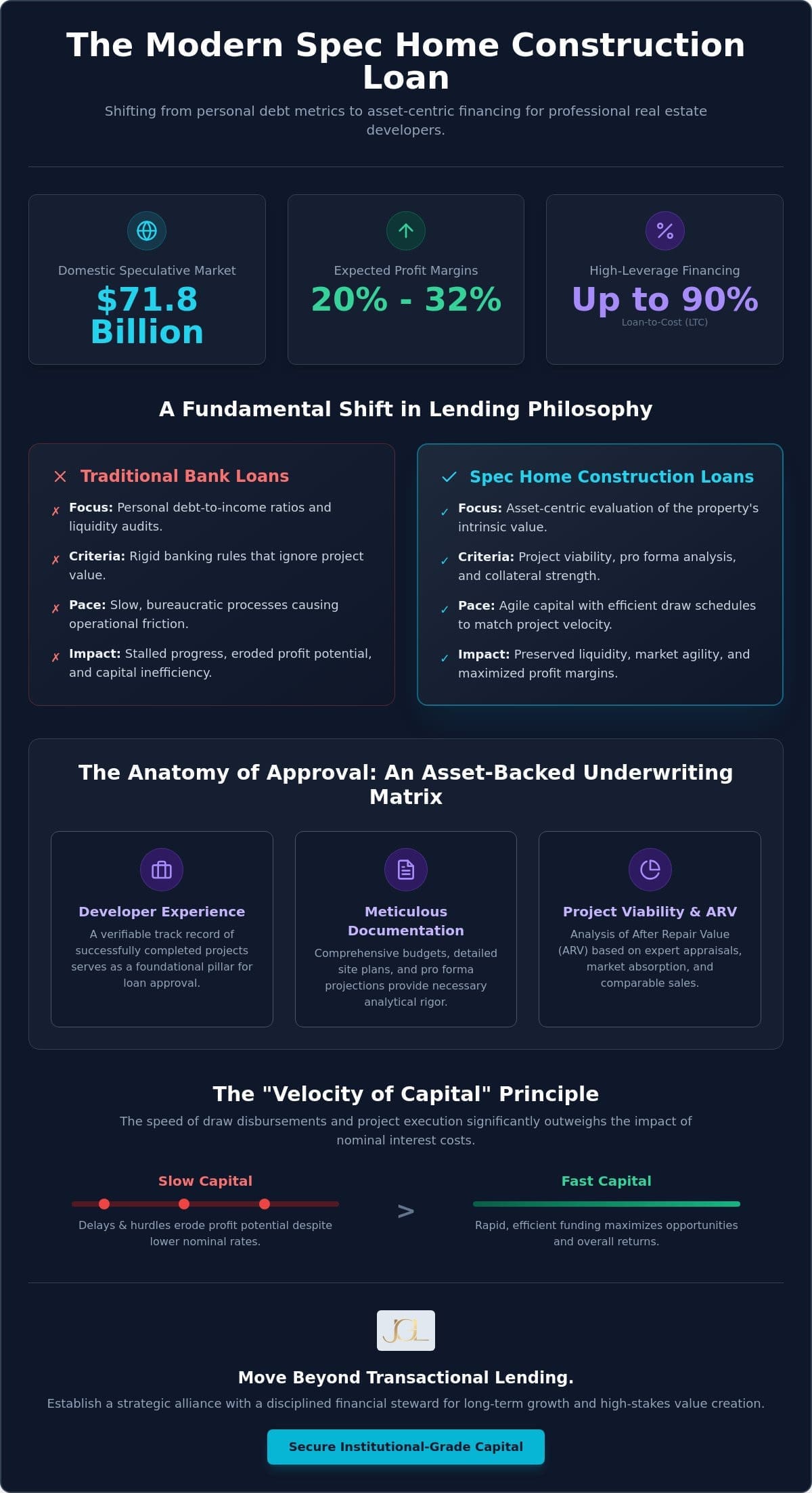
In the contemporary real estate environment, where the domestic speculative housing market is valued at approximately $71.8 billion, the traditional reliance on personal debt-to-income metrics has become a significant impediment to institutional growth. Sophisticated developers recognize that securing a spec home construction loan should be an exercise in asset-centric evaluation rather than an exhaustive audit of personal liquidity. You’ve likely experienced the operational friction caused by inefficient draw schedules or rigid banking criteria that fail to account for the intrinsic value of a well-conceived residential project. These delays don’t just stall progress; they erode the potential for the 20% to 32% profit margins that characterize successful speculative ventures.
This article provides a rigorous analysis of high-leverage financing structures designed to optimize capital flow and preserve your liquidity throughout the development lifecycle. We’ll examine the mechanics of asset-backed underwriting, the strategic advantages of securing up to 90% Loan-to-Cost ratios, and the necessity of aligning with a partner that prioritizes the specialized requirements of professional builders. By moving beyond transactional lending toward a model of strategic alliance, you can ensure that your capital remains as agile as the markets in which you operate.
Key Takeaways
- Distinguish speculative market entries from traditional custom builds to more effectively align your project with institutional-grade financing objectives.
- Leverage a spec home construction loan to access asset-backed structures that prioritize property-level collateral and project viability over rigid personal income metrics.
- Navigate the underwriting matrix by understanding how developer experience and meticulous documentation serve as the foundational pillars of professional loan approval.
- Analyze the “Velocity of Capital” to recognize how the speed of draw disbursements and project execution significantly outweighs the impact of nominal interest costs.
- Establish the parameters for a strategic alliance with a disciplined financial steward capable of supporting long-term growth and high-stakes value creation.
The Strategic Role of Spec Home Construction Loans in Real Estate Development
Speculative development represents a sophisticated intersection of market timing and capital deployment. Unlike custom residential projects, which are initiated with a specific end-user and a secured purchase agreement, speculative entries require a developer to anticipate market needs before they are explicitly voiced. This approach transforms a property into a high-stakes vehicle for value creation. To succeed, one must master the Real estate development process, ensuring that every phase of construction aligns with anticipated demand and institutional exit strategies. It’s a discipline that rewards precision and penalizes hesitation.
Traditional mortgage products are fundamentally ill-suited for this level of professional activity. Retail banks often prioritize personal income verification and debt-to-income ratios, metrics that ignore the underlying viability of the project itself. For the developer, the primary requirement is agility. A spec home construction loan from a private capital source provides this necessary flexibility, focusing on asset-backed structures rather than the personal financial minutiae of the borrower. This evolution in private lending has become the primary engine for modern development. It allows builders to bypass the bureaucratic delays that often derail time-sensitive acquisitions.
Market Dynamics and the Necessity for Specialized Capital
Risk Mitigation through Strategic Financing Structures
Professional development is not merely about construction; it’s about the disciplined management of risk. Strategic financing allows a developer to balance debt service obligations against projected exit values. This ensures that the project remains solvent even if market conditions fluctuate. Private money serves as a protective layer, insulating personal assets from project-specific liabilities. Within this framework, the lender functions as a strategic evaluator of project feasibility. A disciplined steward of capital does not merely provide funds; they provide a rigorous second look at the project’s pro forma. They ensure that the underwriting reflects the realities of the local market and the development cycle.
Decoding the Asset-Backed Lending Framework for Speculative Projects
The institutional logic governing a spec home construction loan prioritizes property-level collateral over the personal financial history of the developer. This shift in focus is essential for scaling a development business. While traditional lenders scrutinize debt-to-income ratios, private capital providers evaluate the intrinsic worth and projected performance of the real estate itself. This methodology allows for higher leverage and more responsive funding cycles. It’s a disciplined approach that treats the project as a standalone business entity. A professional loan package must therefore include comprehensive budgets, detailed site plans, and a verifiable track record of completed projects. These elements provide the analytical rigor necessary for institutional underwriting and risk assessment.
Private lenders place significant weight on the After Repair Value (ARV) when evaluating speculative entries. This metric is determined through a combination of expert appraisals, local market absorption rates, and recent comparable sales. Because speculative builds are completed without a pre-existing buyer, the accuracy of the ARV is the cornerstone of the exit strategy. Aligning with a partner like JGL Capital ensures that these technical underwriting metrics are applied with the nuance required for complex residential developments. This level of expertise distinguishes institutional capital from more transactional retail options.
Understanding LTC vs. LTV in Construction Underwriting
LTC is the ratio of the loan amount to the total cost of construction. In high-stakes development, this metric serves as the primary gauge for initial project funding. Many private structures offer up to 90% LTC, which allows developers to preserve liquidity for concurrent opportunities. Conversely, the Loan-to-Value (LTV) ratio, often expressed as a percentage of the projected ARV, is typically capped at 75%. This cap provides a critical safety margin for both the lender and the developer. While specific government programs like USDA new construction loans exist for targeted residential sectors, they often lack the leverage and speed required for speculative market entries.
The Mechanics of Efficient Draw Schedules
Efficient draw schedules are the lifeblood of construction momentum. A well-designed schedule mirrors the project timeline, ensuring that capital is available exactly when milestones are reached. Inspection-based disbursements provide a layer of security, verifying that work is completed to professional standards before funds are released. This systematic flow of capital prevents the delays that often plague projects with rigid banking partners. It also facilitates better subcontractor management; timely payments are essential for maintaining a high-quality labor force. Predictable capital flow is the foundation of project velocity, ensuring that construction stays on schedule and within the projected interest carry budget.
Navigating the Qualification and Underwriting Matrix
Securing capital for speculative development is not a matter of simple application; it’s a rigorous presentation of project viability and operational competence. The underwriting process for a spec home construction loan requires a methodical assembly of data that transcends simple credit analysis. While retail lenders often oversimplify the requirements, institutional partners utilize a complex matrix to evaluate risk. This matrix prioritizes the developer’s ability to execute the project within the projected timeline and budget. Precision is mandatory. Every document, from site surveys to environmental reports, must withstand a high level of scrutiny to ensure the alignment of interests between the developer and the capital provider.
A detailed Scope of Work (SOW) serves as the technical blueprint for capital approval, providing lenders with the granular detail necessary to validate cost assumptions. This document must be supported by localized market data that proves the project’s relevance to current buyer demand. Understanding construction loan fundamentals is a prerequisite, but speculative projects demand even more rigorous documentation. Lenders look for evidence that the developer has accounted for the specific nuances of the local municipality, including zoning restrictions and utility connections. Persuasive build plans are those that demonstrate a clear path to a profitable exit through empirical evidence rather than optimistic projections.
Establishing Professional Credibility and Track Record
Experience is the primary currency in speculative development. Lenders typically require a track record of at least five completed residential projects within the last three years to offer the most favorable leverage and terms. This history provides an analytical basis for predicting future performance. Furthermore, the credibility of the project is bolstered by a vetted general contractor and a comprehensive sub-tier list. Presenting a portfolio that demonstrates consistent execution capability signals to the lender that the developer is a disciplined steward of capital. It proves that the team can manage the complexities of a 5.4-month average construction timeline without compromising on quality or structural integrity.
The Technical Feasibility Study and Pro Forma Analysis
Rigorous line-item budgeting is a non-negotiable requirement for capital allocation. Given that 32% of custom home projects exceed their initial budgets by at least 10%, institutional lenders look for significant contingency reserves. Your pro forma must account for inflationary pressures on material costs and potential labor shortages that could extend the interest carry period. Aligning project timelines with realistic market absorption rates ensures that the capital remains productive throughout the build cycle. This level of analytical rigor protects the developer’s liquidity and ensures the project remains a viable vehicle for value creation even if market conditions shift during construction.
Financial Optimization: Balancing Capital Costs with Project Velocity
Institutional capital management requires a fundamental paradigm shift from the mere minimization of interest expenses to the maximization of the velocity of capital. While retail discussions often fixate on nominal rates, professional developers understand that the actual cost of a spec home construction loan is secondary to the project’s completion speed. A stalled project or a delayed closing doesn’t just incur additional interest carry; it freezes equity that could be deployed into the next high-yield opportunity. By utilizing agile structures, such as those offered by hard money lenders florida, developers can secure site control and initiate construction long before traditional banking institutions would even complete their initial committee review. This rapid execution serves as the foundation for institutional growth and portfolio scaling.
Comparing the total cost of capital against the profit loss of a stalled project reveals the true value of private financing. When a build sits idle due to administrative friction, the developer loses twice: once in the mounting interest and again in the delayed realization of the 20% to 32% profit margins discussed previously. Disciplined developers treat capital as a tool for momentum. They recognize that a certain closing in a competitive market is often more valuable than a marginal reduction in points. This approach ensures that the project remains a liquid asset rather than a liability tied up in bureaucratic red tape.
Analyzing the Opportunity Cost of Traditional Financing
The opportunity cost of traditional financing is often obscured by the lure of lower rates. A 60 to 90-day bank closing cycle can effectively eliminate an entire quarter of the development year. These delays create friction with subcontractors, who prioritize developers capable of maintaining consistent project momentum through predictable capital flow. When draw disbursements are efficient, project quality remains high and labor costs are more easily controlled. Quantifying the value of speed reveals that the certainty of a private capital partner is a strategic asset that directly influences the project’s internal rate of return.
Strategic Exit Planning and Refinancing Options
A disciplined exit strategy is as critical as the initial acquisition. Transitioning from short-term construction financing into long-term commercial real estate loans provides a stable pathway for those choosing to hold assets within a rental portfolio. Bridge financing serves as a vital tool during the post-construction sales phase, offering the flexibility to wait for an optimal market exit rather than being forced into a fire sale. If market absorption rates slow, a “Build-to-Rent” fallback allows the developer to preserve the project’s value through consistent cash flow. This multi-layered approach ensures that capital remains productive regardless of short-term market volatility.
To optimize your project’s capital velocity and ensure institutional-grade execution, consult with a strategic capital advisor to review your current pipeline.
Securing Institutional-Grade Capital with JGL Capital
JGL Capital operates on a fundamental philosophy of strategic alliance rather than simple service provision, positioning itself as a disciplined partner for high-stakes residential development. For three decades, our firm has served as a sophisticated steward for developers seeking a spec home construction loan that accurately reflects the intrinsic value of their speculative projects. This approach rejects the marketing hyperbole often found in the retail sector; instead, it’s grounded in analytical rigor and a history of successful resource management. We understand that institutional-grade financing requires a partner who values long-term growth and integrity above all else, ensuring that every capital allocation is a deliberate step toward value preservation.
Our role as a national private money broker allows us to provide a level of exclusivity and expertise that transactional competitors cannot match. By leveraging our established history and intellectual capital, we offer highly customized solutions that align with your project’s specific objectives. We recognize that the success of a speculative venture depends on more than just the availability of funds; it requires a capital structure that is as agile and disciplined as the developer executing the build. This commitment to excellence ensures that your project remains a viable vehicle for wealth creation throughout the development cycle.
For developers looking to differentiate their projects through superior design and craftsmanship, you can learn more about Marbella Floating Stairs to explore how high-end staircase solutions can elevate a property’s aesthetic and value.
A Disciplined Approach to Value Creation
We prioritize project merit over the bureaucratic red tape that frequently characterizes traditional banking environments. This focus allows us to evaluate the technical nuances of new construction loans with an analytical rigor that generic lenders cannot replicate. Our commitment to transparency ensures that every fee and closing process is clearly defined, leaving no room for ambiguity or unexpected friction. By aligning our objectives with yours, we ensure that the capital structure supports your specific operational strengths and mitigates the risks inherent in speculative entries. It’s a relationship defined by mutual responsibility and the generation of worth.
Initiating a Collaborative Relationship
The path to a funded draw begins with a comprehensive consultation designed to identify your precise capital needs and project scope. Our internal review and underwriting process is engineered for maximum efficiency, moving from application to funding without the administrative delays that erode project velocity. We don’t just provide a spec home construction loan; we establish a foundation for repeated development success and the creation of lasting legacies. This collaborative model is designed for the quiet expert, the developer who values precision over speed and seeks a partner capable of supporting high-stakes management with steady, measured capital flow.
Optimizing the Development Lifecycle through Strategic Alliance
The successful execution of speculative residential projects relies on the transition from transactional debt to a model of strategic capital stewardship. By prioritizing property-level collateral and maintaining a rigorous focus on the velocity of capital, developers can preserve the liquidity necessary to scale their portfolios in a competitive market. Securing a spec home construction loan that aligns with these institutional principles ensures that your project remains a vehicle for value creation rather than a victim of bureaucratic friction. Meticulous documentation and a proven track record serve as the final components in unlocking high-leverage financing structures.
JGL Capital provides the analytical rigor and disciplined approach required to navigate the complexities of modern development. With over 30 years of industry expertise and a national reach, we offer institutional-grade capital through an asset-backed focus that prioritizes your project’s intrinsic worth. We invite you to Secure Your Strategic Capital Allocation with JGL Capital and establish a partnership grounded in stability and shared objectives. Your commitment to excellence deserves a financial foundation that is equally disciplined. We look forward to supporting the continued growth of your development legacy.
Frequently Asked Questions
What is the typical interest rate for a spec home construction loan in 2026?
Interest rates for professional speculative development typically range from 9.25% to 11.75% depending on the developer’s track record and project complexity. Private capital structures often settle between 10% and 11.25% for seasoned builders. These rates reflect a rebalancing market following the Federal Reserve’s decision to adjust the federal funds rate to a range of 4.00% to 4.25% in late 2025.
How much of a down payment is required for a speculative build?
A down payment of at least 20% of the total project cost is standard for most institutional lenders. While some highly leveraged structures allow for up to 90% Loan-to-Cost (LTC), maintaining a 20% equity stake is often required to ensure a disciplined alignment of interests. This capital requirement protects the project’s solvency and ensures the developer remains a committed steward of the asset throughout the construction lifecycle.
Can I get a spec home loan with no previous development experience?
Securing a spec home construction loan without a documented track record is exceedingly difficult in the current credit environment. Institutional lenders generally require a portfolio demonstrating at least five completed residential projects within the preceding three years to qualify for competitive terms. Individuals lacking this experience often find it necessary to form a strategic alliance with a vetted general contractor who possesses the required institutional credibility.
What is the difference between a custom home loan and a spec home loan?
Speculative loans are asset-backed instruments underwritten based on the project’s profit potential and market absorption rates rather than personal debt-to-income metrics. Conversely, custom home loans are consumer products designed for owner-occupants, often converting to permanent mortgages upon completion. The speculative model prioritizes capital velocity and the generation of worth through the eventual sale of the property to an unidentified buyer.
How do draw inspections work for new construction projects?
Draw inspections involve a systematic verification of construction milestones by a third-party professional before capital is disbursed. This process ensures that the flow of funds mirrors the actual progress on-site, protecting the lender’s collateral while providing the developer with predictable liquidity. Most institutional partners charge a nominal fee, often around $150 per draw, to facilitate these essential site evaluations and maintain project momentum.
Is personal credit a factor in private money construction loans?
Personal credit remains a relevant underwriting pillar, with most private lenders requiring a minimum FICO score between 650 and 680. While the primary focus of a spec home construction loan is property-level collateral, the borrower’s credit history serves as an indicator of financial responsibility. However, the project’s intrinsic value and the developer’s execution history carry significantly more weight than they would in a traditional retail banking environment.
What happens if the project takes longer than the loan term?
Most speculative financing carries a term of 12 to 18 months, though extension options are frequently available for a predetermined fee. If a project exceeds its projected timeline, the developer must negotiate an extension or transition into bridge financing to avoid technical default. Disciplined developers maintain proactive communication with their capital partners to ensure that interest carry doesn’t erode the project’s 20% to 32% profit margins.
Are land costs included in the construction loan financing?
Land costs can be integrated into the total financing package, particularly when the developer already holds significant equity in the site. Some institutional structures even allow for 100% of construction costs to be financed through land subordination. This approach maximizes leverage and preserves the developer’s liquidity for concurrent opportunities, provided the project’s Loan-to-After-Repair-Value (LTARV) remains within the typical 75% cap required for disciplined risk management.