

In a marketplace where transaction volume has surged by 27 percent year over year, the primary constraint on portfolio expansion is rarely a lack of viable assets, but rather the inherent inertia of traditional institutional lending. You likely recognize that the rigid credit requirements and prolonged underwriting cycles of conventional banks often result in missed opportunities, particularly when an asset requires immediate liquidity to secure its position. This guide explores the strategic advantages of using a bridge loan to acquire rental property, framing it not as a mere stopgap, but as a sophisticated instrument for rapid capital deployment and asset stabilization.
By prioritizing the intrinsic value of the real estate over the narrow constraints of personal income metrics, this approach allows for the swift acquisition of high-yield assets that would otherwise remain out of reach. You’ll discover how to manage the transition from short-term bridge financing to permanent debt structures, such as DSCR loans, while remaining compliant with the latest regulatory frameworks like the 2026 FinCEN reporting rules. We will provide a methodical analysis of leverage ratios, exit strategies, and the disciplined execution required to build a lasting legacy in the current rental market.
Key Takeaways
- Distinguish between institutional bridge capital and consumer swing loans to better navigate complex transitional financing requirements.
- Analyze the shift toward asset-backed underwriting where the property’s intrinsic value and potential take precedence over traditional borrower credit constraints.
- Evaluate the tactical advantages of using a bridge loan to acquire rental property to secure non-warrantable or distressed assets that traditional lenders typically decline.
- Establish a robust pipeline for portfolio scaling by executing a clear transition from bridge-funded acquisition to stabilized DSCR refinancing.
- Leverage customized capital solutions and disciplined stewardship to ensure the preservation and long-term growth of high-stakes real estate investments.
The Strategic Role of Bridge Financing in Rental Property Acquisition
In the sophisticated landscape of real estate investment, bridge financing represents a critical instrument for the tactical deployment of capital during transitional phases of asset acquisition. Unlike conventional long-term debt, which remains tethered to rigid amortization schedules and exhaustive personal financial disclosures, a bridge loan operates as a short-term, asset-backed vehicle designed to facilitate immediate control over a property. To understand the foundational mechanics of this instrument, one might ask What is a Bridge Loan? at its core; it’s a financing solution that bridges the gap between the initial purchase and the eventual procurement of permanent debt. For the disciplined investor, using a bridge loan to acquire rental property is a method of securing high-potential assets before they’re absorbed by the broader market. This is especially true when traditional banking timelines would otherwise preclude a successful close.
Liquidity as a Competitive Advantage
In highly competitive markets, the ability to close a transaction with speed and certainty often dictates the final purchase price. Sellers frequently favor offers that bypass the 45-60 day window required by traditional mortgage underwriters. Speed creates leverage. By utilizing bridge capital, investors position themselves as cash-equivalent buyers. This agility doesn’t just secure the asset; it provides a psychological advantage in negotiations. It allows the steward of capital to demand more favorable terms in exchange for the certainty of a rapid exit for the seller. Such a strategy is indispensable when competing against institutional buyers who rely on immediate liquidity to dominate the rental sector.
Institutional vs. Retail Perspectives on Transitional Debt
The shift from retail to institutional perspectives involves a fundamental change in underwriting philosophy. Rather than focusing solely on a borrower’s personal debt-to-income ratios, sophisticated lenders prioritize asset-centric evaluation. This approach analyzes the intrinsic value and the projected net operating income of the property once it’s stabilized. Interest-only structures are frequently utilized within these bridge facilities to maximize short-term cash flow during the renovation phase. By aligning the loan’s duration with the anticipated stabilization period, investors ensure their capital allocation remains efficient. Their debt service remains manageable until the property’s ready for permanent financing. It’s a disciplined approach to value preservation.
The Mechanics of Asset-Backed Underwriting for Rental Assets
Institutional bridge lending is characterized by a rigorous focus on the collateralized asset, a methodology that stands in stark contrast to the standardized, credit-heavy underwriting of retail banks. While traditional financial institutions remain preoccupied with exhaustive debt-to-income (DTI) metrics, the underwriting philosophy for transitional capital prioritizes the intrinsic worth and income-generating potential of the real estate. The strategic use of bridge loans allows for a more nuanced assessment of a property’s future viability rather than its current, perhaps distressed, state. This shift is essential for the professional investor, as it replaces the rigid constraints of personal financial history with a forward-looking analysis of the property’s performance. By using a bridge loan to acquire rental property, investors can leverage the asset’s after-repair value (ARV) to secure funding that reflects the project’s ultimate worth.
Underwriting teams utilize two primary benchmarks to determine capital allocation: Loan-to-Value (LTV) and Loan-to-Cost (LTC) ratios. Standard protocols in 2026 often cap the LTV at 65 to 75 percent of the “as-is” market price, though experienced operators may see LTC extensions reaching 80 percent for comprehensive value-add initiatives. These metrics ensure that the lender’s position is insulated against market volatility while providing the borrower with sufficient liquidity to execute their stabilization plan. Unlike conventional loans that may stall due to a borrower’s complex tax returns or non-traditional income streams, bridge underwriting moves with a precision that honors the timeline of a high-stakes transaction.
Prioritizing Property Value over Personal Financials
For high-net-worth stakeholders, the asset-centric model provides a discreet and efficient path to acquisition. Lenders rely on independent appraisals and sophisticated market analysis to determine the collateral’s ability to secure the debt. This approach is particularly advantageous for investors whose financial profiles are characterized by heavy depreciation or significant reinvestment, which often triggers red flags in retail mortgage systems. By focusing on the “as-is” and “after-repair” values, the lender acts as a strategic ally, ensuring the loan structure aligns with the physical and financial evolution of the property.
Navigating Interest Rates and Fee Structures
Transitional capital is structured using a “points and interest” model, reflecting the specialized nature of short-term, high-speed funding. While rates for these facilities are naturally higher than long-term debt, the cost is justified by the speed of execution and the mitigation of opportunity risk. Investors must evaluate the total cost of capital, including origination fees and underwriting costs, against the projected long-term yield of the rental asset. Securing a bridge loan through a disciplined partner ensures that these costs are balanced against the project’s viability, allowing for a seamless transition to permanent financing once the asset is stabilized. It’s a calculated trade-off where capital agility serves as the primary driver of value preservation.
Bridge Loans vs. Conventional Financing: A Tactical Comparison
The decision to utilize transitional capital over conventional financing is a matter of strategic alignment rather than a simple comparison of interest rates. While traditional bank mortgages offer lower long-term costs, their utility is often compromised by structural rigidity and extensive processing durations. For the institutional-grade investor, using a bridge loan to acquire rental property represents a calculated choice to prioritize acquisition speed and asset control over immediate debt pricing. This maneuver is particularly critical when the opportunity cost of a lost acquisition outweighs the temporary premium associated with bridge financing. In a market where high-yield assets are claimed within days, the deliberate pace of a traditional bank becomes a liability rather than a benefit.
Strategic scenarios exist where bridge financing is not just the preferred path, but the only viable one. Distressed properties or non-warrantable assets, which fail to meet the stringent “rent-ready” standards of conventional underwriters, require a more flexible capital partner. By securing the asset with transitional debt, the investor gains the time necessary to execute a stabilization plan, thereby transforming a non-conforming property into a stabilized asset that qualifies for long-term institutional debt. This tactical pivot ensures that portfolio growth isn’t stunted by the narrow parameters of retail lending.
The Limitations of Traditional Rental Mortgages
Traditional lending frameworks, specifically those governed by government-sponsored enterprises, impose strict condition requirements that frequently disqualify high-potential rental acquisitions. Properties requiring even minor structural remediation or those lacking established utility services are often deemed ineligible by retail banks. Additionally, conventional lenders impose aggregate loan limits and portfolio caps that can stifle the growth of a scaling investment business. These institutions are fundamentally unequipped to handle the transitional nature of value-add projects, as their underwriting models are designed for stabilized, low-risk collateral rather than dynamic transformation. Using a bridge loan to acquire rental property allows the investor to bypass these bureaucratic hurdles entirely.
Bridge Financing vs. Hard Money: Subtle Distinctions
While often conflated in casual discourse, a vital distinction exists between high-interest hard money and institutional bridge lending. Hard money is typically a blunt instrument used for distressed properties requiring total reconstruction. In contrast, bridge loans provide a more sophisticated structure for assets that are closer to “rent-ready” status or require only moderate stabilization. Consider the following distinctions:
- Hard Money: Best suited for deep-value, heavy-rehabilitation projects where the risk profile is significantly higher.
- Bridge Financing: Ideal for properties requiring tenant placement, minor cosmetic updates, or simple seasoning before a long-term refinance.
- Capital Efficiency: Bridge capital often features lower origination fees and more favorable terms than hard money, provided the asset demonstrates a clearer path to stabilization.
Choosing the correct vehicle involves a disciplined assessment of the property’s current state and the intended timeline for a permanent refinance. This ensures that the cost of capital remains aligned with the project’s projected worth.
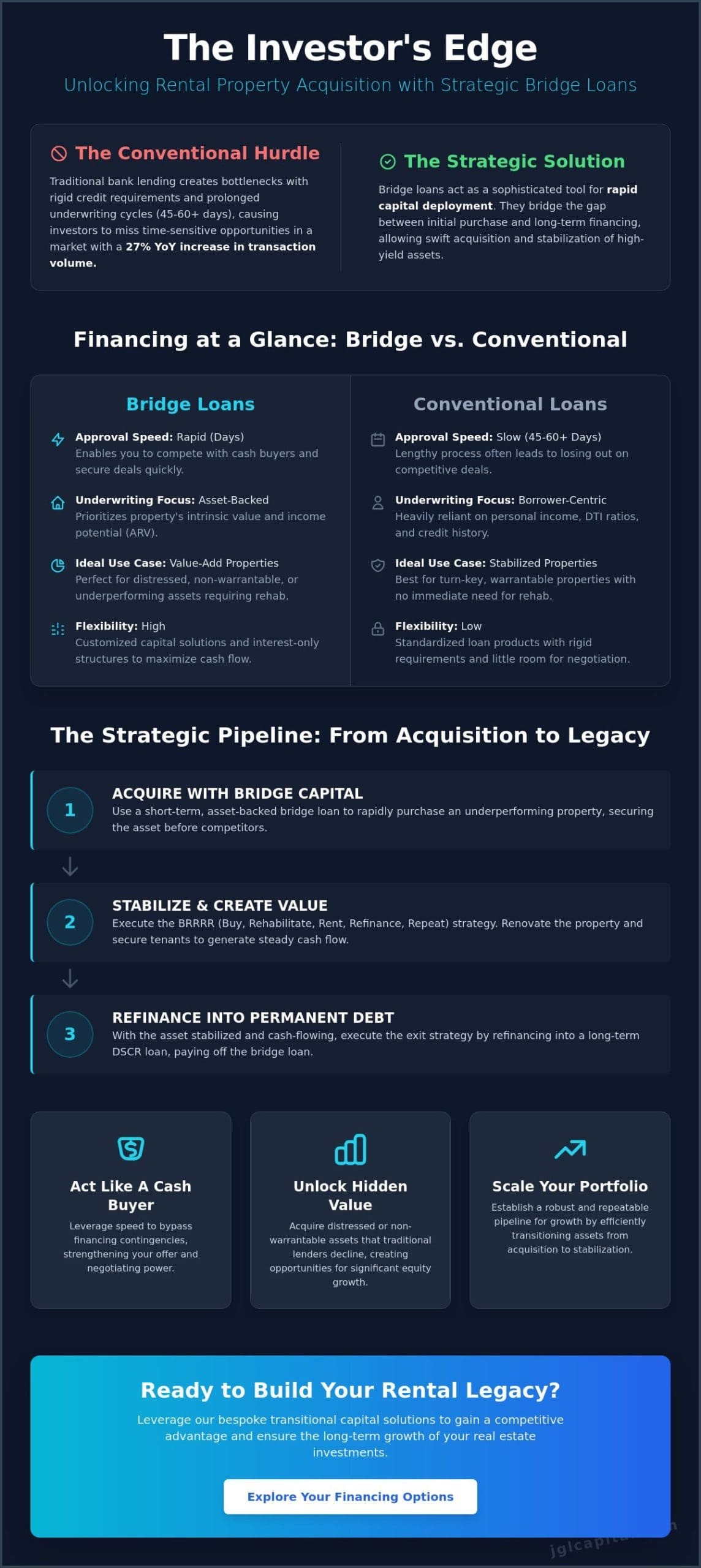
The Strategic Pipeline: From Bridge Acquisition to DSCR Refinance
The progression from transitional capital to permanent debt is a calculated sequence that defines the lifecycle of a high-yield rental portfolio. This institutional pipeline begins with the tactical decision of using a bridge loan to acquire rental property, a move that prioritizes acquisition speed and asset control over immediate long-term debt placement. By securing the asset with bridge financing, an investor effectively isolates the property from market competition, ensuring a swift closing that traditional banking cycles cannot match. This initial phase isn’t merely about debt; it’s about establishing a position of strength from which the subsequent phases of stabilization and refinancing can be executed with precision.
The professional real estate cycle moves through four distinct phases of capital management:
- Phase 1: Acquisition. Utilizing bridge liquidity to secure the property and eliminate closing contingencies.
- Phase 2: Stabilization. Executing the business plan through renovations, operational improvements, and strategic tenant placement.
- Phase 3: Refinance. Transitioning from short-term bridge debt to permanent institutional financing once the asset demonstrates consistent performance.
- Phase 4: Recycling. Extracting equity through the refinance process to redeploy capital into the next acquisition, thereby increasing capital velocity.
Stabilizing the Asset for Long-Term Debt
During the bridge period, which typically spans 6 to 24 months, the primary objective is the systematic increase of the property’s Net Operating Income (NOI). Professional property management plays a critical role here, as optimized lease structures and efficient expense management directly influence the asset’s final valuation and cap rate compression. This period also allows the investor to satisfy the seasoning requirements often mandated by permanent lenders, which usually range from six to twelve months of ownership. By the time the bridge term concludes, the property has been transformed from a transitional asset into a stabilized, income-producing entity that is highly attractive to institutional underwriters.
The DSCR Loan as the Logical Exit Strategy
The Debt Service Coverage Ratio (DSCR) loan represents the most sophisticated exit strategy for the professional rental owner. Unlike conventional mortgages that remain tethered to personal income, DSCR underwriting focuses on whether the property’s cash flow can support the debt. In the current 2026 market, well-qualified borrowers often aim for a coverage ratio above 1.25 to secure the most favorable institutional terms. Transitioning from bridge rates to a 30-year fixed rental property loan provides the stability necessary for long-term wealth preservation and protects the portfolio against interest rate volatility. Investors ready to execute this transition should ensure their strategy for using a bridge loan to acquire rental property is supported by the disciplined capital stewardship of a partner like JGL Capital LLC.
This methodical approach to capital recycling ensures that equity doesn’t remain stagnant. By refinancing out of the bridge loan, you reclaim the initial capital used for the down payment and renovations, allowing for the immediate pursuit of the next high-stakes acquisition. It’s a persuasive rhythm of growth that builds a case for long-term competence through the methodical presentation of stabilized, performing assets. This strategic alliance between short-term agility and long-term stability is what distinguishes a professional portfolio from a collection of individual properties.
JGL Capital LLC: Bespoke Transitional Capital Solutions for Investors
JGL Capital LLC operates on a foundation of disciplined stewardship and strategic capital allocation, principles that have guided the firm through three decades of market evolution. We understand that institutional-grade investors require more than a simple source of debt; they require a partner capable of providing highly customized bridge financing solutions that align with the preservation of wealth. Using a bridge loan to acquire rental property requires a partner who understands the gravity of the transaction and the necessity of analytical rigor. By leveraging thirty years of expertise, we offer a level of stability that is grounded in experience rather than speculative trends. JGL Capital LLC prioritizes a serious and disciplined approach to the creation of value, ensuring that every capital deployment is supported by thorough, institutional-grade analysis.
Our commitment to speed and transparency defines our underwriting of asset-backed loans. We recognize that in competitive acquisition environments, the window for capital allocation is often narrow. Our national reach empowers investors to scale rental portfolios across diverse markets, providing the liquidity necessary to secure high-yield assets without the delays inherent in traditional banking. When using a bridge loan to acquire rental property, the focus must remain on the strategic expansion of the portfolio; for insights into how these acquisitions perform in premier locations, you can learn more about NC High Country Real Estate. By focusing on the intrinsic worth of the collateral, JGL Capital LLC provides a streamlined path to acquisition that honors the complexity of your strategic objectives and the timeline of your project.
A Collaborative Approach to Private Lending
We move beyond the constraints of transactional lending to build long-term strategic alliances with our clients. Working with a seasoned broker allows you to navigate complex capital requirements with a level of precision that is rarely found in the retail sector. Our financing objectives are meticulously aligned with the long-term wealth preservation goals of our partners, ensuring a collaborative relationship that extends beyond a single closing. JGL Capital LLC maintains an alliance-based model that serves as a linguistic signature of our firm, distinguishing us from competitors who prioritize volume over the generation of worth. It’s a partnership defined by integrity and a shared commitment to excellence.
Initiating Your Strategic Acquisition
The process for evaluating your next rental property acquisition is designed to be both methodical and efficient. During the JGL Capital LLC underwriting and funding cycle, you can expect a steady flow of logical, cumulative information that mirrors our patient approach to long-term objectives. We take the time to conduct the thorough analysis required for precision, ensuring that your transitional capital needs are met with a solution tailored to your individual requirements. We don’t rush the process, yet we never sacrifice the speed required for a successful close. To begin this collaborative process, Contact JGL Capital LLC to discuss your transitional capital needs and experience a disciplined approach to asset-based financing.
Strategic Portfolio Expansion through Disciplined Capital
The successful navigation of the rental market requires a sophisticated understanding of capital velocity and asset stabilization. We have explored how bridge financing serves as a catalyst for growth, enabling investors to bypass the inherent inertia of traditional banking. By prioritizing the intrinsic value of real estate over personal credit constraints, you ensure that high-potential assets are secured before they are absorbed by the broader market. Using a bridge loan to acquire rental property is not merely a short-term solution but a deliberate step toward building a stabilized, income-producing portfolio that qualifies for permanent, long-term debt.
JGL Capital LLC stands as a seasoned ally in this process, offering over thirty years of institutional expertise and a national reach that empowers your strategic objectives. Our focus on asset-backed lending and analytical rigor ensures that every transaction is treated with the gravity it deserves. We invite you to align your vision with a partner who values integrity and the preservation of long-term worth. Your pursuit of a lasting legacy in the real estate sector is a journey we are prepared to support with precision and discipline.
Secure Your Next Rental Asset with JGL Capital LLC Bridge Financing
Strategic Inquiries Regarding Transitional Capital
What is the typical duration of a bridge loan for a rental property?
The typical duration for an institutional bridge facility ranges from 6 to 24 months, with a 12 month term representing the standard for residential investment assets. This timeframe provides the necessary latitude for investors to execute stabilization plans, such as renovations or tenant placement, before securing permanent debt. The duration is meticulously calibrated to align with the anticipated lifecycle of the transitional phase.
Can I use a bridge loan if I have a low credit score?
Bridge financing is primarily underwritten based on the intrinsic value of the collateral, making it a viable option for investors who don’t meet the rigid personal credit requirements of traditional banks. While a borrower’s financial history is reviewed as part of a holistic assessment, the asset backed nature of the loan prioritizes property potential and the viability of the exit strategy over personal credit metrics. This approach ensures that sophisticated partners can still deploy capital effectively despite historical credit fluctuations.
How do bridge loan interest rates compare to traditional rental property loans?
Interest rates for bridge loans typically range from 8.0 percent to 14.5 percent, reflecting the increased risk and speed of capital deployment. In contrast, long-term DSCR products in the current market range from approximately 6.12 percent to 8.75 percent. The premium paid for bridge capital is justified by the agility it provides when using a bridge loan to acquire rental property in competitive environments where traditional financing would be too slow to execute.
What are the common exit strategies for a bridge loan on a rental property?
The most prevalent exit strategy involves refinancing the bridge debt into a long-term DSCR loan once the property reaches stabilization and generates consistent income. Other sophisticated options include the strategic sale of the asset to realize capital gains or transitioning into permanent commercial real estate debt for larger multi-family holdings. Each strategy requires a disciplined approach to timing and market analysis to ensure the preservation of value.
Is a down payment required for a bridge loan when acquiring a rental?
A significant equity contribution is required, as most institutional lenders cap the loan to value ratio between 65 percent and 75 percent of the property’s as-is value. This requirement ensures that the borrower’s interests are aligned with the preservation of the asset’s worth throughout the transitional period. For experienced operators, some lenders may extend this leverage to 80 percent on a loan to cost basis for projects involving substantial improvements.
How fast can a bridge loan close compared to a conventional mortgage?
Bridge loans offer a significant temporal advantage, often closing within a fraction of the 45 to 60 day window required by conventional underwriters. This speed to close is a primary driver for using a bridge loan to acquire rental property, as it allows investors to present cash equivalent offers to sellers who prioritize certainty and rapid execution. Our streamlined underwriting process is designed to match the pace of high stakes real estate transactions.
What types of properties are eligible for bridge financing through JGL Capital?
Eligible collateral includes a diverse range of investment assets such as multi-family units, single-family rental properties, and various commercial real estate sectors. We also provide capital for new construction, land acquisitions, and fix and flip projects, provided the asset demonstrates a clear path to stabilization or value creation. Our national reach allows us to support investors across diverse markets with highly customized capital solutions.
Are there prepayment penalties associated with bridge loans?
Prepayment structures vary depending on the specific terms of the capital agreement, with some facilities including minimum interest requirements or yield maintenance clauses. It is essential for investors to conduct a thorough analysis of the loan documents to ensure the exit timeline aligns with the financial structure of the bridge debt. We prioritize transparency in our fee structures to ensure our partners can make informed decisions regarding their capital allocation.